Governance in Public Administration: Meaning, Definitions, Evolution, Principles, Types, Models, Good Governance, E-Governance, Challenges, and Nepal Context
Introduction
Modern governments are expected to do much more than merely make laws or maintain public order. Citizens today expect governments to deliver quality public services, ensure transparency, uphold accountability, protect human rights, encourage public participation, promote sustainable development, and respond effectively to emerging challenges such as digital transformation, climate change, and globalization. Meeting these expectations requires more than a traditional administrative system—it requires good governance.
If you have already explored our in-depth guides on What Is Public Administration, Organization Theory in Public Administration, Decision Making in Public Administration, Leadership in Public Administration, Administrative Ethics, Public Accountability, Management Functions (POSDCORB), Administrative Law in Nepal, Public Policy in Nepal, Human Resource Management, and Bureaucracy in Public Administration, you have already built a strong foundation. Governance is the concept that connects all of these areas and explains how governments, public institutions, civil society, the private sector, and citizens work together to achieve public goals. Understanding governance provides a broader perspective on how modern public administration functions in practice.
In the twenty-first century, governance has become one of the most influential concepts in Public Administration, Political Science, Development Studies, Public Policy, and International Relations. International organizations such as the United Nations (UN), World Bank, OECD, Asian Development Bank (ADB), and UNDP consistently emphasize governance as a key factor in economic development, democratic consolidation, institutional effectiveness, social justice, and sustainable development.
For countries like Nepal, governance has become even more significant after the adoption of the Constitution of Nepal, 2015, which introduced a federal democratic republican system. Effective governance is essential for coordinating the functions of the federal, provincial, and local governments, strengthening public institutions, improving service delivery, ensuring accountability, and building citizens’ trust in government.
This comprehensive guide explores governance from every important perspective. It examines its meaning, scholarly definitions, evolution, characteristics, principles, dimensions, models, types, relationship with public administration, role in democratic governance, emerging trends such as digital governance, major contemporary challenges, and the Nepalese context. Throughout the article, theoretical concepts are connected with practical examples to make the subject easy to understand while maintaining academic depth.
Whether you are preparing for Loksewa (PSC) examinations, studying Public Administration at the university level, conducting research, or simply seeking a deeper understanding of modern governance, this article is designed to serve as a complete, reliable, and long-term reference.
Table of Contents
- What is Governance?
- Definitions of Governance
- Origin and Evolution of Governance
- Governance vs Government vs Public Administration
- Why Governance Matters in the Modern World
- Characteristics of Governance
- Objectives of Governance
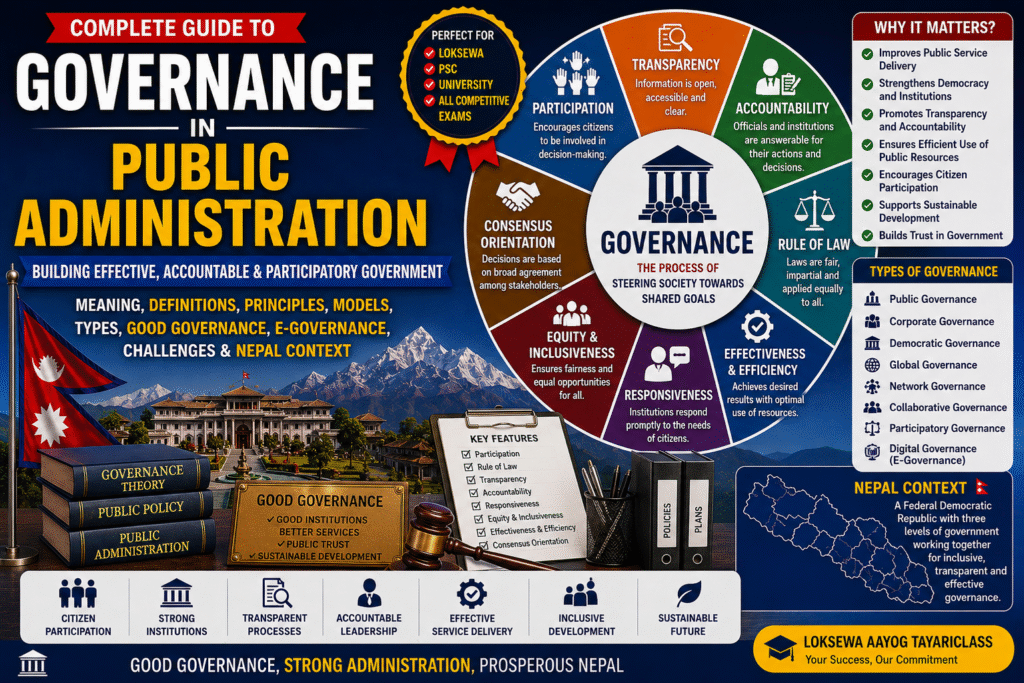
- Principles of Governance
- Pillars of Governance
- Dimensions of Governance
- Types of Governance
- Models of Governance
- Good Governance
- Corporate Governance
- Democratic Governance
- Global Governance
- Network Governance
- Collaborative Governance
- Participatory Governance
- Digital Governance (E-Governance)
- Smart Governance
- Open Government
- Governance and Public Administration
- Governance and Public Policy
- Governance and Sustainable Development Goals (SDGs)
- Role of Government in Governance
- Role of Civil Service
- Role of Citizens
- Role of Civil Society
- Role of the Private Sector
- Role of Media
- Governance in Nepal
- Constitutional Framework of Governance in Nepal
- Governance under Federalism
- Challenges of Governance in Nepal
- Administrative Reforms for Better Governance
- Future of Governance
- Frequently Asked Questions (FAQs)
- Scholar’s Corner
- Key Takeaways
- Conclusion
- References
- Related Articles
- About the Author
What is Governance?
Governance is one of the most important yet frequently misunderstood concepts in Public Administration. Many people use the terms government and governance interchangeably, but they are not the same. Government refers to the formal institutions that exercise political and legal authority, whereas governance refers to the broader process through which public decisions are made, implemented, monitored, and evaluated by involving multiple actors.
In simple terms, governance is the process of steering society toward shared goals through cooperation, coordination, accountability, transparency, participation, and effective decision-making.
Unlike traditional public administration, where the government is viewed as the primary actor, governance recognizes that public affairs are influenced by a wide range of stakeholders, including:
- Government institutions
- Civil servants
- Constitutional bodies
- Local governments
- Private sector organizations
- Civil society organizations (CSOs)
- Non-governmental organizations (NGOs)
- Community groups
- Academic institutions
- International organizations
- Media
- Citizens
Thus, governance is not merely about who governs, but also about how governing takes place, who participates, how decisions are made, how power is exercised, and how public institutions remain accountable to society.
Modern governance is therefore based on the idea that sustainable development and effective public service delivery require collaboration rather than isolated action by government alone.
Simple Definition
Governance is the process through which public authority is exercised, decisions are made, resources are managed, and institutions work together with citizens and other stakeholders to achieve public goals in a transparent, accountable, effective, and participatory manner.
This definition highlights four essential elements:
- Decision-making
- Implementation
- Accountability
- Public participation
These elements distinguish governance from the narrower concept of government.
Governance as a Process Rather Than an Institution
One of the defining characteristics of governance is that it is a process, not a single institution.
Government offices, ministries, departments, and local governments are institutions. Governance, however, is the ongoing process that determines how these institutions interact with one another and with society to solve public problems.
For example, addressing environmental pollution requires cooperation among government ministries, local governments, private industries, environmental organizations, researchers, media, and citizens. The effectiveness of this collective effort depends on the quality of governance rather than the actions of any one institution alone.
Governance in Public Administration
Within Public Administration, governance serves as the bridge between public policy formulation and public service delivery.
A government may design excellent public policies, but without effective governance those policies may never achieve their intended outcomes.
Good governance ensures that:
- Policies are implemented efficiently.
- Public resources are managed responsibly.
- Public officials remain accountable.
- Citizens have opportunities to participate.
- Services reach intended beneficiaries.
- Institutions operate transparently.
- Public trust is strengthened.
For this reason, governance has become one of the central concepts of contemporary Public Administration.
Definitions of Governance
One of the reasons governance has become a central concept in Public Administration is that there is no single universally accepted definition. Different scholars and international organizations define governance from slightly different perspectives depending on whether they emphasize public administration, development, democracy, economics, institutional management, or public participation.
Despite these differences, all definitions share a common idea:
Governance is concerned with how power is exercised, how public decisions are made, how institutions function, and how society collectively pursues public goals.
Understanding these scholarly definitions is particularly important for Loksewa examinations, university studies, and research because they reveal the evolution of governance from a narrow governmental function to a broader system involving multiple actors.
Definitions by Major Scholars
James N. Rosenau
James Rosenau viewed governance as a system of order that can exist even without a central government.
According to Rosenau,
“Governance is a system of rule that depends on interdependent relationships rather than solely on governmental authority.”
Interpretation
Rosenau emphasized that governance is not confined to governments alone. Modern societies increasingly rely on cooperation among governments, private organizations, international institutions, and citizens to solve complex public problems.
R. A. W. Rhodes
British political scientist R. A. W. Rhodes is one of the most influential scholars in governance studies.
He defined governance as:
“Self-organizing, inter-organizational networks characterized by interdependence, resource exchange, rules of the game, and significant autonomy from the state.”
Interpretation
Rhodes argued that governance today is based on networks rather than strict hierarchical control.
Government no longer governs alone.
Instead, ministries, local governments, NGOs, private organizations, universities, community organizations, and citizens cooperate through networks to achieve public objectives.
Gerry Stoker
Gerry Stoker defined governance as
“The development of governing styles in which boundaries between public and private sectors become blurred.”
Interpretation
According to Stoker, governance reflects a shift from traditional government toward collaborative management.
Public problems increasingly require cooperation among multiple sectors rather than exclusive governmental action.
Jan Kooiman
Jan Kooiman regarded governance as
“The totality of interactions through which public and private actors seek to solve societal problems and create societal opportunities.”
Interpretation
Kooiman emphasized interaction, cooperation, and shared responsibility.
His definition highlights that governance is a continuous process involving negotiation, coordination, and collective action.
Definitions by International Organizations
International organizations have played a major role in popularizing governance, especially in relation to development, democracy, institutional reform, and sustainable development.
World Bank Definition
The World Bank (1992) defines governance as:
“The manner in which power is exercised in the management of a country’s economic and social resources for development.”
Key Focus
- Public sector management
- Institutional effectiveness
- Economic development
- Efficient resource utilization
- Accountability
The World Bank considers governance essential for reducing poverty, attracting investment, strengthening institutions, and promoting sustainable economic growth.
United Nations Development Programme (UNDP)
UNDP defines governance as
“The exercise of economic, political and administrative authority to manage a country’s affairs at all levels.”
According to UNDP, governance includes the:
- Mechanisms
- Processes
- Institutions
through which citizens:
- Express their interests.
- Exercise their legal rights.
- Meet their obligations.
- Resolve differences.
Key Message
Governance is fundamentally about empowering people while ensuring effective public administration.
Organisation for Economic Co-operation and Development (OECD)
The OECD views governance as:
“The use of political authority and the exercise of control in a society in relation to the management of its resources for social and economic development.”
The OECD particularly emphasizes:
- Transparency
- Regulatory quality
- Public integrity
- Institutional effectiveness
- Evidence-based policymaking
Asian Development Bank (ADB)
According to the Asian Development Bank,
Good governance requires:
- Accountability
- Participation
- Predictability
- Transparency
These four pillars have become highly influential in governance reforms across Asia, including Nepal.
Comparative Overview of Major Definitions
| Scholar / Organization | Core Idea |
|---|---|
| James Rosenau | Governance extends beyond government through interdependent relationships. |
| R. A. W. Rhodes | Governance operates through self-organizing networks. |
| Gerry Stoker | Governance blurs the boundaries between public and private sectors. |
| Jan Kooiman | Governance is a system of interaction among public and private actors. |
| World Bank | Governance concerns the management of national resources for development. |
| UNDP | Governance is the exercise of political, economic, and administrative authority. |
| OECD | Governance emphasizes effective resource management, integrity, and institutional quality. |
| Asian Development Bank | Governance rests on accountability, participation, transparency, and predictability. |
Common Elements Found in Most Definitions
Although the wording differs, almost every definition contains several common themes.
Governance involves:
- Decision-making.
- Implementation of decisions.
- Accountability.
- Transparency.
- Participation.
- Rule of Law.
- Institutional effectiveness.
- Responsiveness.
- Collaboration.
- Efficient use of public resources.
These common elements collectively form the foundation of modern governance.
Origin and Evolution of Governance
The word “governance” originates from the Greek word kybernan, meaning “to steer,” “to guide,” or “to direct.” It later evolved into the Latin term gubernare and subsequently the Old French word governance, eventually entering the English language.
Historically, governance was associated primarily with the act of governing by kings, rulers, and state authorities. Over time, however, the concept expanded significantly.
Today, governance no longer refers merely to the exercise of governmental authority. It encompasses the broader processes through which governments, markets, civil society, communities, and international organizations collectively shape public decisions and deliver outcomes.
Evolution of Governance: A Historical Perspective
1. Classical Period
In ancient civilizations, governance was closely linked to monarchy, empire, and centralized authority.
Thinkers such as Plato, Aristotle, and Kautilya (Chanakya) explored questions related to justice, administration, public leadership, and the duties of rulers. Their ideas laid the philosophical foundation for later governance theories.
2. Traditional Public Administration (Late 19th–Mid 20th Century)
With the emergence of the modern nation-state, governance became strongly associated with government administration.
Scholars such as Woodrow Wilson and Max Weber emphasized:
- Professional civil service.
- Hierarchical administration.
- Rule-based governance.
- Merit-based recruitment.
- Administrative efficiency.
During this period, governance was largely viewed as a function performed by government institutions.
3. New Public Management Era (1980s–1990s)
Economic reforms and globalization led many governments to adopt managerial approaches inspired by the private sector.
The focus shifted toward:
- Efficiency.
- Performance.
- Customer-oriented services.
- Competition.
- Decentralization.
- Results-based management.
Governance began moving beyond rigid bureaucratic structures toward more flexible management systems.
4. Contemporary Governance (1990s–Present)
Since the 1990s, governance has entered a new phase shaped by globalization, rapid technological advancement, decentralization, democratization, sustainable development, and increasing citizen expectations.
Governments around the world gradually recognized that complex public challenges—such as climate change, public health emergencies, cyber security, poverty reduction, migration, and disaster management—cannot be solved by government institutions acting alone.
As a result, governance evolved into a collaborative, participatory, and network-based system in which multiple actors share responsibility for achieving public goals.
Modern governance now emphasizes:
- Citizen participation.
- Transparency.
- Accountability.
- Collaboration.
- Digital transformation.
- Sustainable development.
- Inclusive decision-making.
- Evidence-based policymaking.
Today, governance has become one of the most influential concepts in Public Administration because it explains how governments, institutions, communities, and citizens collectively create public value.
Evolution of Governance at a Glance
| Period | Main Focus | Characteristics |
|---|---|---|
| Classical Era | Rule by Kings and States | Authority, administration, political order |
| Traditional Public Administration | Government Administration | Hierarchy, bureaucracy, legality |
| New Public Management | Efficiency | Performance, competition, managerial reforms |
| Contemporary Governance | Collaboration | Networks, participation, accountability, digital governance |
Governance vs Government vs Public Administration
One of the most common areas of confusion among students is the difference between Government, Governance, and Public Administration.
Although closely related, these concepts have distinct meanings and should not be used interchangeably.
Understanding their relationship is essential for both academic study and competitive examinations.
What is Government?
Government is the formal political institution that possesses constitutional authority to govern a country.
It consists of elected representatives and public institutions that make laws, formulate policies, maintain public order, protect national sovereignty, and provide public services.
Government derives its authority from the Constitution and the legal system.
Examples
- Federal Government of Nepal
- Provincial Governments
- Local Governments
- Parliament
- Council of Ministers
- Constitutional Bodies
Government answers the question:
“Who governs?”
What is Public Administration?
Public Administration refers to the organization, management, and implementation of public policies and government programmes.
It focuses on how government decisions are translated into practical actions through ministries, departments, civil servants, and public institutions.
Public Administration emphasizes:
- Planning.
- Organizing.
- Staffing.
- Directing.
- Coordinating.
- Budgeting.
- Service delivery.
- Administrative management.
Public Administration answers the question:
“How does the government implement its decisions?”
What is Governance?
Governance is much broader than both government and public administration.
It focuses on how decisions are made, how different actors cooperate, how public resources are managed, and how institutions remain accountable while pursuing public goals.
Governance includes:
- Government.
- Public Administration.
- Civil Society.
- Private Sector.
- Citizens.
- International Organizations.
- Community Institutions.
- Media.
Governance answers the question:
“How should society collectively govern itself?”
Comparative Table: Government vs Governance vs Public Administration
| Basis | Government | Governance | Public Administration |
|---|---|---|---|
| Meaning | Political institution | Decision-making process | Administrative system |
| Main Focus | Exercising political authority | Managing public affairs collaboratively | Implementing public policies |
| Main Actors | Politicians and constitutional institutions | Government, citizens, civil society, private sector, media | Civil servants and administrative agencies |
| Nature | Institution | Process | Management function |
| Primary Objective | Governing the state | Achieving public goals collectively | Delivering public services efficiently |
| Scope | Relatively narrow | Broadest | Intermediate |
| Key Question | Who governs? | How should society be governed? | How are government decisions implemented? |
Relationship among Government, Governance, and Public Administration
These three concepts are complementary rather than competing.
A government formulates public policies.
Public administration implements those policies.
Governance ensures that implementation is transparent, participatory, accountable, lawful, efficient, and responsive to citizens.
In other words:
- Government provides political leadership.
- Public Administration provides administrative capacity.
- Governance provides the framework that guides both toward achieving public value.
None of these concepts can function effectively in isolation.
Why Governance Matters in the 21st Century
Governance has become increasingly important because the nature of public problems has fundamentally changed.
Earlier governments primarily focused on:
- Maintaining law and order.
- Collecting taxes.
- Defending national borders.
Today, governments are expected to address far more complex issues, including:
- Climate change.
- Artificial Intelligence.
- Digital transformation.
- Cybersecurity.
- Global pandemics.
- Sustainable development.
- Urbanization.
- Social inclusion.
- Economic inequality.
- Environmental protection.
These issues require collaboration among multiple institutions and stakeholders.
Consequently, governance has become indispensable for modern public administration.
Importance of Governance
1. Improves Public Service Delivery
Good governance ensures that public services are delivered:
- Efficiently.
- Equitably.
- Responsively.
- Transparently.
Citizens receive better education, healthcare, transportation, social protection, and administrative services.
2. Strengthens Democracy
Governance promotes democratic values through:
- Citizen participation.
- Free flow of information.
- Transparency.
- Accountability.
- Rule of Law.
Democracy becomes stronger when citizens actively participate in public decision-making.
3. Promotes Sustainable Development
Effective governance supports the achievement of:
- Sustainable Development Goals (SDGs).
- Environmental protection.
- Social justice.
- Inclusive economic growth.
- Poverty reduction.
Without good governance, sustainable development becomes difficult to achieve.
4. Increases Public Trust
Transparent decision-making and accountable institutions enhance citizens’ confidence in government.
Higher public trust encourages:
- Civic participation.
- Voluntary compliance with laws.
- Greater institutional legitimacy.
5. Encourages Efficient Resource Management
Public resources—including finances, human resources, natural resources, and public assets—must be managed responsibly.
Governance promotes:
- Financial accountability.
- Efficient budgeting.
- Evidence-based planning.
- Responsible use of public funds.
6. Supports Innovation
Modern governance encourages institutions to:
- Adopt digital technologies.
- Improve administrative processes.
- Experiment with innovative service delivery models.
- Continuously learn and improve.
Innovation enhances government effectiveness while reducing unnecessary administrative burdens.
Nepal Perspective
For Nepal, governance is particularly significant because the country’s federal democratic republican system requires close coordination among federal, provincial, and local governments.
Effective governance is essential to:
- Ensure cooperative federalism.
- Improve public service delivery.
- Strengthen local democracy.
- Enhance transparency and accountability.
- Build citizens’ trust in public institutions.
- Achieve the constitutional vision of social justice, inclusion, and sustainable development.
Governance therefore serves as the foundation upon which Nepal’s democratic institutions and development aspirations can successfully operate.
Characteristics of Governance
Governance is more than the exercise of governmental authority. It is a dynamic process through which governments, public institutions, civil society, the private sector, and citizens collectively work toward achieving public goals. Because governance is process-oriented, it possesses several distinctive characteristics that differentiate it from traditional government administration.
Understanding these characteristics helps explain why governance has become the cornerstone of modern Public Administration.
1. Participation
Participation is one of the most fundamental characteristics of governance.
Modern governance recognizes that public decisions should not be made exclusively by political leaders or bureaucrats. Citizens and other stakeholders should have meaningful opportunities to influence public policies and administrative decisions.
Participation may occur through:
- Elections.
- Public consultations.
- Public hearings.
- Community meetings.
- Civil society organizations.
- Digital participation platforms.
- Social dialogue.
- Local governance mechanisms.
Importance
Participation strengthens democracy because people become active partners rather than passive recipients of government services.
2. Rule of Law
Governance must always operate within the framework of law.
The Rule of Law means that:
- Every individual is equal before the law.
- Government officials are accountable to law.
- Decisions are based on legal procedures rather than personal preferences.
- Human rights are protected.
- Independent courts ensure justice.
Without the Rule of Law, governance cannot remain democratic or accountable.
3. Transparency
Transparency means that government decisions, policies, procedures, and public expenditures are open, accessible, and understandable.
Citizens should be able to know:
- How decisions are made.
- How public money is spent.
- Why policies are adopted.
- How officials perform their responsibilities.
Transparency reduces secrecy and strengthens public confidence.
4. Accountability
Accountability ensures that individuals and institutions are answerable for their actions and decisions.
In governance, accountability applies to:
- Politicians.
- Civil servants.
- Public agencies.
- Constitutional bodies.
- Local governments.
- Public enterprises.
Public officials must explain their decisions and accept responsibility for their performance.
Accountability is one of the strongest safeguards against corruption and abuse of authority.
5. Responsiveness
Governance should respond promptly and appropriately to the needs of society.
Responsive institutions:
- Listen to citizens.
- Address grievances.
- Deliver services efficiently.
- Adapt to changing circumstances.
- Solve public problems without unnecessary delay.
Citizens judge governments largely on how effectively they respond to public needs.
6. Consensus-Oriented Decision-Making
Modern societies consist of diverse groups with different interests.
Governance therefore seeks to build consensus by encouraging dialogue among stakeholders before making important public decisions.
Consensus does not necessarily mean complete agreement.
Rather, it involves finding solutions that broadly serve the public interest while respecting diversity.
7. Equity and Inclusiveness
Good governance ensures that every individual has an opportunity to improve their quality of life regardless of:
- Gender.
- Ethnicity.
- Religion.
- Language.
- Disability.
- Economic status.
- Geographic location.
Inclusive governance promotes social justice and equal access to public services.
8. Effectiveness and Efficiency
Governance aims to achieve desired outcomes while making the best possible use of available resources.
Effective governance means achieving intended objectives.
Efficient governance means achieving those objectives with minimum waste of time, money, and public resources.
Both effectiveness and efficiency are essential for sustainable development.
9. Strategic Vision
Governance requires long-term thinking.
Leaders and public institutions must anticipate future challenges rather than focusing only on immediate political concerns.
Strategic governance involves:
- Long-term planning.
- Sustainable development.
- Institutional strengthening.
- Innovation.
- Capacity building.
Countries with strong governance prepare for future generations rather than merely addressing present demands.
10. Collaboration
Unlike traditional administration, governance emphasizes collaboration among multiple actors.
These include:
- Government.
- Civil society.
- Private sector.
- Academic institutions.
- International organizations.
- Community groups.
- Media.
Collaboration enables societies to address complex problems that cannot be solved by government alone.
Summary of the Characteristics of Governance
| Characteristic | Core Meaning |
|---|---|
| Participation | Citizens actively engage in decision-making |
| Rule of Law | Laws govern everyone equally |
| Transparency | Open and accessible decision-making |
| Accountability | Officials are answerable for their actions |
| Responsiveness | Institutions respond to public needs promptly |
| Consensus Orientation | Decisions seek broad public agreement |
| Equity & Inclusiveness | Equal opportunities for all citizens |
| Effectiveness & Efficiency | Achieving results with optimal use of resources |
| Strategic Vision | Long-term development planning |
| Collaboration | Shared responsibility among stakeholders |
Objectives of Governance
Governance exists to improve the relationship between the state and society while ensuring that public institutions effectively serve the public interest.
Its major objectives include the following.
1. To Promote Public Welfare
The primary objective of governance is to improve the well-being of citizens.
Governments exist not merely to exercise authority but to promote:
- Health.
- Education.
- Security.
- Employment.
- Social justice.
- Economic opportunities.
Public welfare remains the ultimate goal of governance.
2. To Ensure Efficient Public Service Delivery
Governance seeks to provide public services that are:
- Timely.
- Accessible.
- Affordable.
- Reliable.
- Citizen-centred.
Efficient service delivery increases public satisfaction and strengthens trust in government.
3. To Strengthen Democratic Values
Governance supports democracy by encouraging:
- Participation.
- Transparency.
- Accountability.
- Human rights.
- Constitutionalism.
Democratic governance ensures that power is exercised in the public interest.
4. To Promote Sustainable Development
Modern governance seeks balanced progress in:
- Economic development.
- Social inclusion.
- Environmental protection.
This objective aligns closely with the United Nations Sustainable Development Goals (SDGs).
5. To Build Strong Public Institutions
Governance emphasizes:
- Professional civil service.
- Independent judiciary.
- Effective legislature.
- Accountable executive.
- Capable local governments.
Strong institutions create stable and resilient societies.
6. To Protect Public Resources
Governance ensures responsible management of:
- Public finances.
- Natural resources.
- Infrastructure.
- Public property.
- Human resources.
Responsible resource management supports long-term national development.
Principles of Governance
Principles provide the normative foundation upon which governance operates. Although different organizations use slightly different frameworks, most governance systems are built upon the following universally accepted principles.
- Rule of Law.
- Transparency.
- Accountability.
- Participation.
- Responsiveness.
- Equity and Inclusiveness.
- Effectiveness and Efficiency.
- Integrity and Ethical Conduct.
- Consensus Orientation.
- Strategic Vision.
- Sustainability.
- Respect for Human Rights.
These principles guide governments in designing institutions, implementing policies, and delivering public services in a manner that promotes public trust and democratic legitimacy.
Pillars of Governance
Governance rests on several interdependent pillars that support effective administration and democratic development.
The major pillars include:
Political Pillar
Ensures democratic institutions, political stability, electoral integrity, and constitutional government.
Administrative Pillar
Focuses on professional public administration, competent civil service, organizational efficiency, and effective implementation of public policies.
Legal Pillar
Emphasizes the Rule of Law, judicial independence, legal certainty, and protection of constitutional rights.
Economic Pillar
Promotes sound public financial management, economic stability, responsible budgeting, and sustainable development.
Social Pillar
Encourages inclusion, equality, social justice, public participation, and protection of vulnerable groups.
Technological Pillar
Supports digital governance, innovation, cybersecurity, open data, and technology-enabled public services.
Together, these pillars create a governance system capable of responding to both present and future societal needs.
Dimensions of Governance
Governance is multidimensional. It extends beyond government administration and encompasses various interconnected dimensions.
The principal dimensions are:
- Political Governance – Democratic institutions, elections, political accountability, and constitutional order.
- Administrative Governance – Public administration, civil service, organizational management, and service delivery.
- Economic Governance – Fiscal policy, public finance, regulatory systems, and economic management.
- Social Governance – Human rights, inclusion, social justice, education, health, and community participation.
- Environmental Governance – Sustainable resource management, climate action, biodiversity conservation, and environmental regulation.
- Digital Governance – Digital transformation, e-government, AI, cybersecurity, digital identity, and online public services.
These dimensions operate together. Weakness in one dimension often affects the overall quality of governance.
Types of Governance
Governance has evolved into a broad and multidisciplinary concept. As governments, societies, and economies have become increasingly interconnected, different forms of governance have emerged to address specific administrative, political, economic, social, and global challenges.
Each type of governance has a distinct purpose, institutional arrangement, and decision-making process. Together, they form the foundation of modern governance systems.
Understanding these types is essential because competitive examinations, universities, and international organizations frequently distinguish among them.
1. Public Governance
Meaning
Public Governance refers to the process through which government institutions, public administrators, citizens, and other stakeholders collectively manage public affairs to achieve the public interest.
Unlike traditional public administration, which primarily emphasizes government bureaucracy, public governance encourages cooperation among multiple actors.
Public governance focuses on:
- Public value creation.
- Better service delivery.
- Accountability.
- Transparency.
- Citizen participation.
- Efficient use of public resources.
Major Characteristics
- Citizen-centred administration.
- Democratic accountability.
- Institutional cooperation.
- Transparency.
- Performance orientation.
- Ethical public management.
Example
When a municipality consults local communities before preparing its annual development plan and later publishes expenditure reports online, it is practising public governance.
2. Corporate Governance
Meaning
Corporate Governance refers to the system by which companies and organizations are directed, controlled, and held accountable.
Although originally developed for the private sector, corporate governance has become increasingly relevant in public enterprises and state-owned corporations.
Corporate governance seeks to balance the interests of:
- Shareholders.
- Board of Directors.
- Employees.
- Customers.
- Government.
- Investors.
- Society.
Core Principles
- Accountability.
- Transparency.
- Responsibility.
- Fairness.
- Ethical leadership.
- Risk management.
Importance
Strong corporate governance:
- Increases investor confidence.
- Prevents financial misconduct.
- Promotes ethical decision-making.
- Strengthens institutional sustainability.
Scholar’s Insight
The OECD Principles of Corporate Governance are internationally recognized standards guiding responsible corporate management and accountability.
3. Democratic Governance
Meaning
Democratic Governance refers to a governance system where public authority is exercised according to democratic values, constitutional principles, and the will of the people.
It ensures that government remains accountable to citizens while protecting fundamental rights and freedoms.
Key Features
- Free and fair elections.
- Rule of Law.
- Human rights protection.
- Independent judiciary.
- Freedom of expression.
- Citizen participation.
- Political accountability.
Importance
Democratic governance strengthens:
- Public trust.
- Political legitimacy.
- Institutional stability.
- Inclusive development.
Nepal Perspective
Nepal’s Constitution (2015) embraces democratic governance by guaranteeing:
- Multi-party democracy.
- Federal democratic republican governance.
- Fundamental rights.
- Independent constitutional bodies.
- Decentralized governance.
4. Global Governance
Meaning
Global Governance refers to the collective management of international issues through cooperation among states, international organizations, regional institutions, multinational corporations, and civil society.
Since many modern challenges transcend national borders, no single government can solve them independently.
Examples include:
- Climate change.
- International trade.
- Pandemics.
- Cybersecurity.
- Human trafficking.
- Terrorism.
- International migration.
Major Global Institutions
- United Nations (UN).
- World Bank.
- International Monetary Fund (IMF).
- World Trade Organization (WTO).
- World Health Organization (WHO).
- International Labour Organization (ILO).
Importance
Global governance promotes:
- International peace.
- Sustainable development.
- Human rights.
- Global cooperation.
- Collective security.
5. Network Governance
Meaning
Network Governance is a system in which multiple autonomous organizations cooperate through networks rather than strict hierarchical authority.
Instead of commanding others, governments coordinate partnerships.
Participants may include:
- Government agencies.
- NGOs.
- Universities.
- Businesses.
- Community organizations.
- International partners.
Characteristics
- Shared responsibility.
- Cooperation.
- Resource sharing.
- Flexible coordination.
- Mutual trust.
Example
A disaster management programme involving the federal government, provincial authorities, local governments, NGOs, security forces, universities, and international agencies illustrates network governance.
6. Collaborative Governance
Meaning
Collaborative Governance is a process in which government agencies and non-government stakeholders jointly make decisions and implement public policies through consensus and partnership.
Unlike consultation alone, collaboration involves shared decision-making.
Main Principles
- Joint problem-solving.
- Mutual trust.
- Shared responsibility.
- Consensus building.
- Long-term partnerships.
Importance
Collaborative governance improves:
- Policy acceptance.
- Public trust.
- Service quality.
- Conflict resolution.
- Institutional legitimacy.
Scholar’s Corner
Chris Ansell and Alison Gash (2008) defined collaborative governance as a governing arrangement where one or more public agencies directly engage non-state stakeholders in a formal, consensus-oriented, and deliberative decision-making process aimed at making or implementing public policy.
Their framework is among the most influential in contemporary governance literature.
7. Participatory Governance
Meaning
Participatory Governance ensures that citizens actively participate in public decision-making rather than merely voting during elections.
Citizens contribute to:
- Policy formulation.
- Local planning.
- Budget discussions.
- Public consultations.
- Monitoring government programmes.
Methods
- Public hearings.
- Citizen forums.
- Community consultations.
- Participatory budgeting.
- Social audits.
- Digital consultation platforms.
Benefits
- Greater transparency.
- Better policy quality.
- Higher public ownership.
- Stronger democratic legitimacy.
- Increased trust.
Nepal Example
Many local governments in Nepal conduct public hearings, social audits, ward-level consultations, and participatory planning meetings, reflecting the principles of participatory governance.
8. Digital Governance (E-Governance)
Meaning
Digital Governance, often referred to as E-Governance, is the use of information and communication technologies (ICTs) to improve governance, public administration, and service delivery.
It transforms traditional government processes into faster, more accessible, and citizen-friendly digital services.
Major Components
- Online public services.
- Digital identity.
- Electronic procurement.
- Online tax systems.
- Digital land records.
- Mobile government applications.
- Open government data.
- AI-assisted administration.
- Electronic document management.
Objectives
Digital governance seeks to:
- Improve efficiency.
- Reduce corruption.
- Increase transparency.
- Save time and costs.
- Enhance accessibility.
- Strengthen accountability.
- Improve citizen satisfaction.
Advantages
- Faster public services.
- Better information management.
- Reduced paperwork.
- Improved coordination.
- Greater transparency.
- Increased public participation.
- Data-driven decision-making.
Challenges
Despite its advantages, digital governance faces several challenges:
- Digital divide.
- Cybersecurity threats.
- Privacy concerns.
- Limited digital literacy.
- Infrastructure gaps.
- Resistance to organizational change.
Nepal Perspective
Nepal has made notable progress in digital governance through initiatives such as:
- Nagarik App.
- National Identity Card Programme.
- Online company registration.
- Electronic tax filing.
- Online passport services.
- Digital procurement systems.
- Integrated public service portals.
Although significant progress has been made, continued investment in digital infrastructure, cybersecurity, and digital literacy remains essential for expanding digital governance across all levels of government.
Comparative Table: Types of Governance
| Type | Primary Focus | Major Actors |
|---|---|---|
| Public Governance | Public value and service delivery | Government, citizens, civil society |
| Corporate Governance | Organizational management | Board, shareholders, management |
| Democratic Governance | Democracy and constitutional government | Citizens, elected representatives |
| Global Governance | International cooperation | UN, IMF, World Bank, states |
| Network Governance | Institutional collaboration | Multiple organizations |
| Collaborative Governance | Joint decision-making | Government and stakeholders |
| Participatory Governance | Citizen involvement | Citizens and public institutions |
| Digital Governance | Technology-enabled governance | Government, ICT institutions, citizens |
Key Insight
Although these forms of governance differ in their focus, they are not mutually exclusive. Modern governments often combine several approaches simultaneously. For example, Nepal’s federal system incorporates democratic governance through elections, participatory governance through local consultations, digital governance through online public services, and collaborative governance through partnerships with civil society and development organizations.
Together, these approaches contribute to a governance system that is more responsive, transparent, inclusive, and effective.
Models of Governance
While the types of governance explain where governance operates, models of governance explain how governance is organized, how decisions are made, and how different actors interact to achieve public objectives.
Over time, governance has evolved from highly centralized state control to more participatory, collaborative, and technology-driven systems. Understanding these models helps students appreciate the transformation of Public Administration in the twenty-first century.
1. Hierarchical Governance Model
Meaning
The Hierarchical Governance Model is the traditional model of governance in which authority flows from the top to the bottom through a clearly defined chain of command.
It closely resembles Max Weber’s bureaucratic model, where decisions are made by higher authorities and implemented by subordinate officials according to formal rules and procedures.
Characteristics
- Centralized authority.
- Clear hierarchy.
- Formal rules and regulations.
- Chain of command.
- Administrative discipline.
- Standard operating procedures.
- High predictability.
Advantages
- Clear accountability.
- Uniform implementation.
- Administrative stability.
- Legal certainty.
- Easier supervision.
Limitations
- Slow decision-making.
- Excessive bureaucracy.
- Limited citizen participation.
- Poor adaptability.
- Risk of red tape.
Nepal Example
The traditional administrative structure of Nepal before federalism largely reflected the hierarchical governance model, with decision-making concentrated at the central government level.
2. Market Governance Model
Meaning
The Market Governance Model applies market-based principles to improve public sector performance.
Instead of relying solely on government agencies, certain services may be delivered through:
- Competition.
- Public-private partnerships (PPPs).
- Outsourcing.
- Privatization.
- Performance contracts.
This model became popular during the New Public Management (NPM) movement.
Characteristics
- Competition.
- Efficiency.
- Customer orientation.
- Performance measurement.
- Cost-effectiveness.
- Innovation.
Advantages
- Improves efficiency.
- Reduces administrative costs.
- Encourages innovation.
- Increases service quality.
- Enhances organizational flexibility.
Limitations
- Public interest may receive less attention than profitability.
- Unequal access to essential services.
- Accountability challenges.
- Risk of excessive commercialization.
3. Network Governance Model
Meaning
Network Governance emphasizes cooperation among multiple autonomous organizations rather than centralized governmental control.
Instead of commanding others, government acts as a coordinator and facilitator.
Participants
- Government agencies.
- NGOs.
- Civil society.
- Universities.
- Private sector.
- International organizations.
- Community groups.
Characteristics
- Cooperation.
- Shared leadership.
- Information sharing.
- Flexible coordination.
- Mutual trust.
- Joint problem-solving.
Importance
This model is particularly useful for addressing complex issues such as:
- Climate change.
- Disaster management.
- Public health.
- Poverty reduction.
- Urban development.
4. Collaborative Governance Model
Although closely related to network governance, collaborative governance places greater emphasis on joint decision-making rather than simply cooperation.
Government agencies and non-government actors work together from policy formulation to implementation and evaluation.
Key Features
- Consensus building.
- Stakeholder participation.
- Shared responsibility.
- Long-term partnerships.
- Mutual accountability.
Benefits
- Better policy quality.
- Greater public trust.
- Higher implementation success.
- Stronger democratic legitimacy.
5. Adaptive Governance Model
Modern societies constantly face uncertainty.
Adaptive Governance enables governments to respond effectively to changing circumstances through:
- Continuous learning.
- Innovation.
- Flexible decision-making.
- Experimentation.
- Knowledge sharing.
Adaptive governance is particularly valuable for addressing:
- Climate change.
- Pandemics.
- Natural disasters.
- Technological disruption.
- Economic crises.
6. Digital Governance Model
Digital Governance integrates technology into governance processes.
Rather than replacing traditional institutions, technology enhances their effectiveness.
Major technologies include:
- Artificial Intelligence (AI).
- Big Data.
- Cloud Computing.
- Blockchain.
- Internet of Things (IoT).
- Geographic Information Systems (GIS).
- Digital Identity.
- Online Service Portals.
Digital governance enables governments to provide faster, more transparent, and more accessible services.
Comparative Overview of Governance Models
| Model | Primary Focus | Decision-Making Style |
|---|---|---|
| Hierarchical Governance | Authority and control | Top-down |
| Market Governance | Competition and efficiency | Market-oriented |
| Network Governance | Cooperation | Shared coordination |
| Collaborative Governance | Consensus | Joint decision-making |
| Adaptive Governance | Flexibility | Continuous learning |
| Digital Governance | Technology | Data-driven |
Good Governance
Introduction
Among all governance concepts, Good Governance is undoubtedly the most influential in contemporary Public Administration.
Although governments have existed for centuries, merely having governmental institutions does not guarantee development, justice, or effective public service delivery.
The real question is not simply whether a country has a government, but how well that government governs.
This idea gave rise to the concept of Good Governance.
Good Governance refers to a governance system in which public authority is exercised in a manner that is transparent, accountable, participatory, effective, equitable, lawful, ethical, and responsive to the needs of society.
Today, Good Governance serves as the foundation for administrative reforms, democratic governance, sustainable development, anti-corruption initiatives, and public sector modernization across the world.
International organizations such as the United Nations Development Programme (UNDP), World Bank, OECD, Asian Development Bank (ADB), and the United Nations consistently recognize Good Governance as a prerequisite for achieving sustainable and inclusive development.
Definitions of Good Governance
United Nations Development Programme (UNDP)
According to the UNDP,
Good Governance is the exercise of political, economic, and administrative authority in managing a country’s affairs in a manner that promotes participation, transparency, accountability, effectiveness, equity, and the Rule of Law.
World Bank
The World Bank views Good Governance as:
The effective management of a country’s resources and institutions in a manner that promotes development, accountability, and institutional quality.
The World Bank considers governance a key determinant of economic development and poverty reduction.
Simple Definition
Good Governance is a system of governance that promotes transparency, accountability, participation, Rule of Law, efficiency, equity, responsiveness, and integrity while ensuring that public institutions effectively serve the public interest.
Why Good Governance Matters
Good Governance is essential because it:
- Improves public service delivery.
- Reduces corruption.
- Strengthens democracy.
- Protects human rights.
- Promotes sustainable development.
- Builds public trust.
- Encourages responsible use of public resources.
- Attracts investment.
- Improves institutional effectiveness.
- Enhances national competitiveness.
Countries with stronger governance generally experience higher institutional stability, greater citizen confidence, and more sustainable development outcomes.
Good Governance and Public Administration
Good Governance is not separate from Public Administration—it is one of its most important objectives.
Public Administration provides the institutional machinery.
Governance provides the decision-making framework.
Good Governance ensures that this machinery operates ethically, transparently, efficiently, and in the best interests of citizens.
Thus, Good Governance transforms public administration from a rule-based administrative system into a citizen-centred system of public value creation.
UNDP’s Eight Characteristics of Good Governance
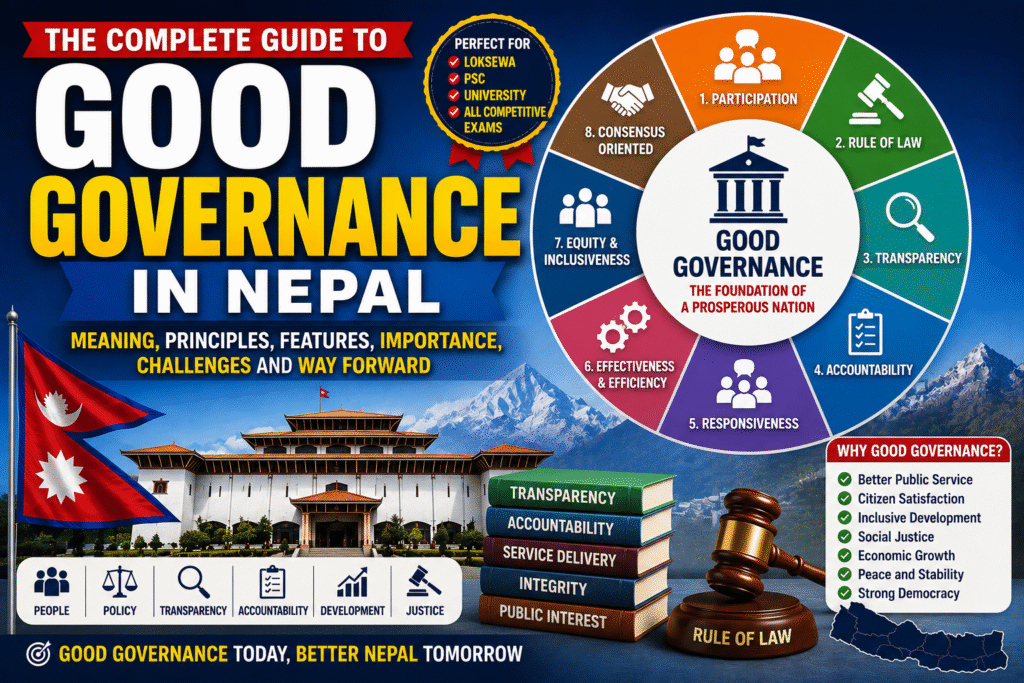
Among the various frameworks developed by international organizations, the United Nations Development Programme (UNDP) has proposed one of the most widely accepted models of Good Governance. According to the UNDP, a governance system can be considered “good” only when it incorporates eight interrelated characteristics. These principles have become global benchmarks for evaluating governments, public institutions, and administrative systems.
Each characteristic complements the others, and together they form the foundation of democratic, effective, and citizen-centred governance.
1. Participation
Meaning
Participation means that all citizens should have the opportunity to influence public decision-making, either directly or through legitimate representatives.
Good governance recognizes that citizens are not merely recipients of government services; they are active partners in governance.
Participation may occur through:
- Elections.
- Public consultations.
- Community meetings.
- Social audits.
- Public hearings.
- Digital consultation platforms.
- Civil society organizations.
- Local government forums.
Importance
Citizen participation:
- Strengthens democracy.
- Improves policy quality.
- Increases public ownership.
- Enhances government legitimacy.
- Builds trust between citizens and government.
Nepal Perspective
Nepal promotes participation through:
- Local government planning processes.
- Ward-level consultations.
- Public hearings.
- Social audits.
- Community forestry groups.
- School Management Committees.
- User Committees for local development projects.
These mechanisms encourage citizens to participate actively in local governance.
2. Rule of Law
Meaning
The Rule of Law means that everyone—including political leaders, civil servants, institutions, and ordinary citizens—is equally subject to the law.
Government decisions must be based on legal authority rather than personal discretion.
Rule of Law requires:
- Independent judiciary.
- Fair legal procedures.
- Equal justice.
- Protection of fundamental rights.
- Constitutional supremacy.
- Legal certainty.
Importance
Without the Rule of Law:
- Corruption increases.
- Human rights are threatened.
- Public trust declines.
- Investment decreases.
- Democracy weakens.
The Rule of Law therefore serves as the backbone of democratic governance.
Nepal Perspective
The Constitution of Nepal, 2015 recognizes the Rule of Law as one of the fundamental principles guiding the democratic state. Institutions such as the judiciary, constitutional commissions, and oversight bodies play a critical role in upholding this principle.
3. Transparency
Meaning
Transparency means that government actions, decisions, procedures, policies, and financial activities are open and accessible to the public.
Citizens should have access to accurate and timely information regarding public affairs.
Transparency requires:
- Open information.
- Clear procedures.
- Public disclosure.
- Freedom of information.
- Accessible records.
- Open budgeting.
Importance
Transparency:
- Reduces corruption.
- Builds public confidence.
- Improves accountability.
- Encourages informed participation.
- Enhances administrative credibility.
Nepal Perspective
Transparency is promoted through:
- Right to Information Act.
- Public procurement transparency.
- Annual public audits.
- Digital government portals.
- Citizen Charters.
- Public disclosure requirements.
4. Responsiveness
Meaning
Responsiveness means that public institutions should respond promptly, fairly, and effectively to the needs and expectations of citizens.
Governments should provide timely services while addressing public complaints without unnecessary delay.
Characteristics of Responsive Governance
- Timely decision-making.
- Quick grievance handling.
- Citizen-friendly services.
- Adaptive administration.
- Continuous improvement.
Benefits
Responsive governance:
- Improves public satisfaction.
- Strengthens institutional legitimacy.
- Reduces administrative delays.
- Encourages citizen trust.
5. Consensus Orientation
Meaning
Modern societies consist of diverse communities with different interests.
Good governance therefore emphasizes consensus-building rather than unilateral decision-making.
Consensus-oriented governance seeks solutions that broadly reflect the public interest while respecting diversity.
Importance
Consensus helps:
- Reduce conflict.
- Promote social harmony.
- Increase policy acceptance.
- Improve long-term stability.
Nepal Perspective
In Nepal’s federal democratic system, consensus is particularly important for coordinating among:
- Federal Government.
- Provincial Governments.
- Local Governments.
- Political parties.
- Civil society.
- Community organizations.
6. Equity and Inclusiveness
Meaning
Good governance ensures that every individual has equal opportunities to participate in society and benefit from development, regardless of gender, ethnicity, caste, language, disability, religion, economic status, or geographic location.
Inclusive governance seeks to leave no one behind.
Importance
Equity promotes:
- Social justice.
- Inclusive development.
- Equal access to public services.
- Protection of marginalized communities.
- National unity.
Nepal Perspective
The Constitution of Nepal emphasizes:
- Social inclusion.
- Proportional representation.
- Gender equality.
- Inclusion of marginalized communities.
- Equal access to public opportunities.
These constitutional commitments strengthen inclusive governance.
7. Effectiveness and Efficiency
Meaning
Governance should achieve desired objectives while making the best possible use of available public resources.
Effectiveness refers to achieving intended results, whereas efficiency refers to achieving those results with minimum waste of time, money, and resources.
Characteristics
- Performance-oriented management.
- Quality public services.
- Evidence-based policymaking.
- Efficient budgeting.
- Responsible resource utilization.
Importance
Effective governance:
- Improves development outcomes.
- Enhances institutional performance.
- Reduces unnecessary expenditure.
- Strengthens public confidence.
8. Accountability
Meaning
Accountability means that public officials, institutions, and decision-makers must explain and justify their actions and accept responsibility for their performance.
Accountability exists in several forms.
Political Accountability
Elected representatives remain accountable to citizens through elections.
Administrative Accountability
Civil servants remain accountable through administrative rules, performance evaluation, and disciplinary mechanisms.
Legal Accountability
Courts ensure that public officials comply with constitutional and legal requirements.
Financial Accountability
Public funds are subject to auditing, budgeting rules, parliamentary oversight, and financial reporting.
Social Accountability
Citizens, media, civil society organizations, and community groups monitor government performance.
Importance
Accountability:
- Prevents abuse of power.
- Reduces corruption.
- Improves public confidence.
- Encourages ethical leadership.
- Strengthens democratic governance.
Summary of UNDP’s Eight Characteristics of Good Governance
| Characteristic | Primary Objective |
|---|---|
| Participation | Citizen involvement in decision-making |
| Rule of Law | Equal application of law and justice |
| Transparency | Open and accessible governance |
| Responsiveness | Timely and citizen-focused services |
| Consensus Orientation | Broad agreement among stakeholders |
| Equity & Inclusiveness | Equal opportunities for all citizens |
| Effectiveness & Efficiency | Better results through optimal resource use |
| Accountability | Responsibility for decisions and actions |
Scholar’s Insight
The UNDP framework remains one of the most influential governance models because it integrates democratic values with administrative performance. Rather than viewing governance solely as the exercise of political authority, it emphasizes that effective governance depends equally on institutions, citizen participation, ethical conduct, legal accountability, and efficient public administration.
For students of Public Administration, this framework provides a practical lens through which government performance can be analyzed, compared, and improved.
World Bank’s Worldwide Governance Indicators (WGI)
Introduction
While the principles of Good Governance provide a conceptual understanding of what effective governance should look like, policymakers and researchers also need reliable methods to measure governance performance.
To address this need, the World Bank developed the Worldwide Governance Indicators (WGI), one of the most widely recognized international frameworks for assessing governance quality.
The WGI does not measure governance through a single score. Instead, it evaluates governance across six complementary dimensions, enabling governments, researchers, international organizations, and development partners to identify institutional strengths and areas requiring improvement.
These indicators are used extensively in:
- Public Administration research
- Public Policy analysis
- International development
- Government reforms
- Investment risk assessment
- Comparative governance studies
The Six Worldwide Governance Indicators (WGI)
1. Voice and Accountability
Meaning
Voice and Accountability measure the extent to which citizens are able to participate in selecting their government and exercise fundamental democratic freedoms.
This indicator examines whether citizens can:
- Participate in free and fair elections.
- Express opinions without fear.
- Access independent media.
- Form civil society organizations.
- Hold governments accountable.
Importance
Strong Voice and Accountability strengthen:
- Democracy.
- Public trust.
- Political legitimacy.
- Citizen engagement.
2. Political Stability and Absence of Violence
Meaning
This indicator evaluates the likelihood that a government may be destabilized by:
- Political violence.
- Terrorism.
- Armed conflict.
- Internal unrest.
- Constitutional crises.
Political stability creates a favorable environment for development and long-term planning.
Importance
Stable governance encourages:
- Investment.
- Economic growth.
- Institutional continuity.
- Social harmony.
3. Government Effectiveness
Meaning
Government Effectiveness measures the quality of:
- Public services.
- Civil service.
- Policy implementation.
- Administrative capacity.
- Public institutions.
It also considers whether governments can successfully implement their policies.
Importance
Effective governments:
- Deliver better public services.
- Improve citizens’ quality of life.
- Increase administrative efficiency.
- Enhance institutional credibility.
4. Regulatory Quality
Meaning
Regulatory Quality evaluates a government’s ability to formulate and implement sound regulations that encourage:
- Economic development.
- Private sector growth.
- Fair competition.
- Innovation.
- Investment.
Effective regulations protect the public while avoiding unnecessary administrative burdens.
5. Rule of Law
Meaning
This indicator measures confidence in legal institutions, including:
- Courts.
- Police.
- Property rights.
- Contract enforcement.
- Crime prevention.
- Judicial independence.
Importance
Strong Rule of Law:
- Protects rights.
- Promotes justice.
- Attracts investment.
- Reduces corruption.
- Strengthens democracy.
6. Control of Corruption
Meaning
Control of Corruption assesses the extent to which public power is exercised for private gain.
It examines:
- Bribery.
- Abuse of authority.
- Nepotism.
- Embezzlement.
- State capture.
- Misuse of public resources.
Importance
Reducing corruption:
- Improves public trust.
- Enhances administrative integrity.
- Promotes economic development.
- Ensures efficient use of public resources.
Summary of the World Bank’s WGI
| Indicator | Focus Area |
|---|---|
| Voice and Accountability | Democracy and citizen participation |
| Political Stability | Peace and institutional stability |
| Government Effectiveness | Public service quality |
| Regulatory Quality | Sound public regulations |
| Rule of Law | Justice and legal institutions |
| Control of Corruption | Integrity and anti-corruption |
OECD Principles of Good Governance
The Organisation for Economic Co-operation and Development (OECD) has significantly influenced governance reforms worldwide. It emphasizes that effective governance depends not only on democratic institutions but also on capable public administration, ethical leadership, evidence-based policymaking, and public trust.
According to the OECD, good governance is built upon several interconnected principles.
1. Integrity
Public officials should perform their duties honestly, ethically, and in the public interest while avoiding conflicts of interest and corruption.
2. Openness and Transparency
Governments should provide timely access to information, communicate decisions clearly, and encourage public scrutiny.
3. Accountability
Public institutions must explain their decisions, accept responsibility for their actions, and remain subject to oversight.
4. Participation
Citizens and stakeholders should be meaningfully involved in policymaking and public decision-making processes.
5. Effectiveness
Governments should achieve policy objectives through efficient institutions, capable civil servants, and evidence-based decision-making.
6. Regulatory Quality
Regulations should be clear, predictable, proportionate, and supportive of sustainable economic and social development.
7. Strategic Vision
Governments should adopt long-term perspectives, anticipate future challenges, and design policies that promote sustainable development.
Governance Measurement Frameworks
Because governance is multidimensional, no single indicator can fully capture its quality. Consequently, several international organizations have developed complementary measurement frameworks.
Some of the most influential frameworks include:
| Organization | Framework | Primary Focus |
|---|---|---|
| United Nations Development Programme (UNDP) | Eight Characteristics of Good Governance | Democratic governance and institutional quality |
| World Bank | Worldwide Governance Indicators (WGI) | Governance performance across six dimensions |
| OECD | Principles of Good Governance | Institutional effectiveness and public integrity |
| Transparency International | Corruption Perceptions Index (CPI) | Public sector corruption |
| World Justice Project | Rule of Law Index | Legal institutions and justice |
| Freedom House | Freedom in the World | Political rights and civil liberties |
Together, these frameworks help governments compare performance, identify institutional weaknesses, and guide governance reforms.
Good Governance in Nepal
Governance has become a national priority in Nepal, particularly after the promulgation of the Constitution of Nepal, 2015, which established a federal democratic republican system. The Constitution envisions governance that is democratic, inclusive, transparent, accountable, and responsive to the needs of citizens.
Nepal’s governance framework is implemented through three constitutionally recognized levels of government:
- Federal Government
- Provincial Governments
- Local Governments
This federal structure aims to bring public services closer to citizens, strengthen local democracy, and improve participation in decision-making.
Constitutional Vision
The Constitution promotes governance through principles such as:
- Rule of Law.
- Democracy.
- Fundamental Rights.
- Social Justice.
- Inclusion.
- Accountability.
- Transparency.
- Decentralization.
- Cooperative Federalism.
- Good Governance.
Several constitutional bodies—including the Commission for the Investigation of Abuse of Authority (CIAA), the Office of the Auditor General, the Public Service Commission, and the National Human Rights Commission—also contribute to strengthening governance by promoting accountability, oversight, integrity, and protection of constitutional values.
Governance Challenges in Nepal
Despite significant constitutional, legal, and administrative reforms, Nepal continues to face several governance challenges. These challenges influence public service delivery, institutional performance, democratic accountability, and sustainable development. Addressing them requires coordinated efforts from government institutions, civil society, the private sector, development partners, and citizens.
1. Political Instability
Frequent changes in government, coalition politics, policy discontinuity, and political uncertainty often delay long-term planning and weaken administrative efficiency.
Effects
- Delayed policy implementation.
- Frequent changes in priorities.
- Reduced investor confidence.
- Weak institutional continuity.
- Slow development projects.
2. Corruption
Corruption remains one of the most serious governance challenges in many countries, including Nepal.
It may occur through:
- Bribery.
- Abuse of authority.
- Procurement irregularities.
- Nepotism.
- Embezzlement.
- Conflict of interest.
Consequences
- Loss of public resources.
- Declining public trust.
- Poor service delivery.
- Reduced investment.
- Weak democratic legitimacy.
Strengthening transparency, accountability, digital systems, and oversight institutions is essential to reduce corruption.
3. Weak Institutional Capacity
Many public institutions continue to face challenges related to:
- Limited human resources.
- Inadequate technical expertise.
- Insufficient financial resources.
- Weak coordination.
- Outdated administrative procedures.
Building institutional capacity is critical for effective governance.
4. Challenges of Federal Governance
Since adopting federalism, Nepal has made important progress in decentralization. However, several practical challenges remain.
These include:
- Overlapping responsibilities.
- Coordination gaps.
- Resource imbalances.
- Capacity differences among local governments.
- Delays in implementing intergovernmental policies.
Strengthening cooperative, coordinated, and collaborative federalism remains an important priority.
5. Limited Citizen Participation
Although democratic participation has increased, many citizens still have limited opportunities to influence policymaking beyond elections.
Expanding:
- Public consultations.
- Social audits.
- Participatory budgeting.
- Digital engagement.
- Community forums.
can strengthen democratic governance.
6. Digital Divide
Digital governance has expanded rapidly, yet unequal access to technology remains a challenge.
Differences in:
- Internet access.
- Digital literacy.
- Infrastructure.
- Geographic connectivity.
can limit equal access to online public services.
7. Bureaucratic Red Tape
Complex administrative procedures, excessive paperwork, and procedural delays continue to affect public service delivery.
Administrative simplification, process reengineering, and digital transformation can significantly improve efficiency.
8. Climate Change and Disaster Governance
Nepal is highly vulnerable to:
- Earthquakes.
- Floods.
- Landslides.
- Glacial Lake Outburst Floods (GLOFs).
- Climate change.
These challenges require integrated governance involving all levels of government and society.
9. Globalization
Global economic integration creates both opportunities and challenges.
Governments must now address issues such as:
- International trade.
- Migration.
- Cybersecurity.
- Cross-border crime.
- Global health.
- Artificial Intelligence.
Modern governance increasingly requires international cooperation.
Strategies for Strengthening Governance in Nepal
Nepal can further improve governance by focusing on the following strategic reforms:
- Strengthen the Rule of Law.
- Enhance institutional capacity.
- Improve civil service professionalism.
- Promote ethical leadership.
- Expand digital governance.
- Increase transparency and open government.
- Strengthen financial accountability.
- Encourage citizen participation.
- Improve intergovernmental coordination.
- Modernize public administration.
- Invest in evidence-based policymaking.
- Promote inclusive and sustainable development.
Future of Governance
Governance continues to evolve in response to changing societal needs and technological innovation. The future of governance will increasingly emphasize:
Artificial Intelligence (AI)
AI can support:
- Policy analysis.
- Predictive governance.
- Smart public services.
- Automated administrative processes.
- Decision support systems.
However, ethical safeguards, transparency, and human oversight will remain essential.
Data-Driven Governance
Governments increasingly rely on:
- Big Data.
- Real-time analytics.
- Evidence-based policymaking.
- Performance dashboards.
Better data enables more informed and responsive decisions.
Smart Governance
Smart Governance integrates technology, citizen participation, innovation, and sustainable development to improve public service delivery.
Smart cities, digital infrastructure, and intelligent public management are becoming central features of modern governance.
Open Government
Future governance will continue promoting:
- Open data.
- Public participation.
- Collaborative policymaking.
- Transparency.
- Accountability.
Open Government strengthens public trust and democratic legitimacy.
Sustainable Governance
The future of governance is closely linked to achieving the United Nations Sustainable Development Goals (SDGs).
Governments must balance:
- Economic growth.
- Social inclusion.
- Environmental protection.
- Intergenerational equity.
Key Takeaways
- Governance is broader than government and public administration.
- It focuses on how public decisions are made and implemented.
- Modern governance involves governments, civil society, the private sector, citizens, academia, media, and international organizations.
- Good Governance is built on participation, Rule of Law, transparency, accountability, responsiveness, effectiveness, efficiency, equity, and inclusiveness.
- The World Bank’s Worldwide Governance Indicators (WGI) and the UNDP framework are internationally recognized tools for evaluating governance quality.
- Nepal’s Constitution, 2015 provides a strong constitutional foundation for democratic and federal governance.
- Digital governance, AI, evidence-based policymaking, and collaborative governance are shaping the future of Public Administration.
Frequently Asked Questions (FAQs)
1. What is governance in Public Administration?
Governance is the process through which public authority is exercised, decisions are made, resources are managed, and governments collaborate with citizens and other stakeholders to achieve public goals.
2. What is the difference between government and governance?
Government refers to formal political institutions that exercise authority, whereas governance refers to the broader processes and interactions through which public affairs are managed.
3. What are the main principles of Good Governance?
The core principles include participation, Rule of Law, transparency, accountability, responsiveness, effectiveness, efficiency, equity, inclusiveness, consensus orientation, and strategic vision.
4. What are the six Worldwide Governance Indicators?
The World Bank’s WGI consists of:
- Voice and Accountability.
- Political Stability and Absence of Violence.
- Government Effectiveness.
- Regulatory Quality.
- Rule of Law.
- Control of Corruption.
5. Why is governance important in Nepal?
Effective governance helps Nepal strengthen federalism, improve public service delivery, promote accountability, reduce corruption, encourage citizen participation, and achieve sustainable national development.
Scholar’s Corner
Woodrow Wilson emphasized the importance of professional administration in implementing public policies efficiently.
Max Weber highlighted bureaucracy, legal-rational authority, and merit-based administration as foundations of modern governance.
R. A. W. Rhodes argued that governance increasingly operates through networks rather than hierarchical state control.
Jan Kooiman viewed governance as continuous interaction among public, private, and societal actors.
Gerry Stoker explained that governance blurs the traditional boundaries between the public and private sectors.
UNDP considers governance the exercise of political, economic, and administrative authority for managing public affairs effectively.
The World Bank emphasizes governance as the effective management of a nation’s resources and institutions for sustainable development.
Together, these scholars demonstrate that governance has evolved from a state-centred concept into a collaborative framework for creating public value.
Conclusion
Governance has emerged as one of the defining concepts of contemporary Public Administration because it shifts attention from who governs to how governing is carried out. In today’s interconnected world, effective governance depends not only on capable governments but also on strong institutions, active citizens, ethical leadership, transparent decision-making, accountable public administration, and constructive collaboration among all stakeholders.
For Nepal, governance is particularly important in strengthening federalism, improving public service delivery, deepening democracy, promoting inclusion, and achieving sustainable development. The Constitution of Nepal, 2015 provides a robust framework for democratic governance, but translating constitutional ideals into everyday administrative practice requires continuous institutional reform, professional civil service, technological innovation, and active citizen engagement.
As governance continues to evolve through digital transformation, artificial intelligence, open government, and collaborative networks, future public administrators must combine administrative competence with ethical leadership, strategic thinking, and a commitment to public value. Ultimately, the quality of governance will determine not only the effectiveness of government institutions but also the trust, prosperity, and well-being of society as a whole.
References
Use authoritative and recent references such as:
- UNDP. Governance for Sustainable Human Development.
- World Bank. Worldwide Governance Indicators (WGI).
- OECD. Principles of Good Governance.
- Rhodes, R. A. W. Understanding Governance.
- Stoker, G. Governance as Theory: Five Propositions.
- Kooiman, J. Modern Governance.
- Constitution of Nepal, 2015.
- Good Governance (Management and Operation) Act, 2008 (Nepal).
- Ministry of Federal Affairs and General Administration (MoFAGA), Nepal.
- Asian Development Bank (ADB) publications on governance.
Related Articles
Continue building your internal linking with articles such as:
- Good Governance in Nepal
- Public Policy in Nepal
- Administrative Law in Nepal
- Leadership in Public Administration
- Administrative Ethics in Public Administration
- Public Accountability in Public Administration
- Decision Making in Public Administration
- Management Functions in Public Administration (POSDCORB)
- Organization Theory in Public Administration
- Human Resource Management in Public Administration
- Civil Service in Nepal
- Public Financial Administration in Nepal
About the Author
Loksewa Aayog Tayariclass publishes research-based study materials, comprehensive notes, exam-oriented MCQs, and in-depth articles on Public Administration, Governance, Public Policy, Administrative Law, Civil Service, and related subjects for Loksewa (PSC), university students, researchers, and lifelong learners in Nepal. Our mission is to make complex public administration concepts simple, accurate, and accessible while maintaining high academic standards and SEO best practices.