Motivation in Public Administration: Meaning, Definitions, Theories, Types, Importance, Techniques, Challenges, and Nepal Context
The Ultimate Guide for Loksewa, PSC, University Students, Researchers, and Competitive Examination Aspirants
Introduction
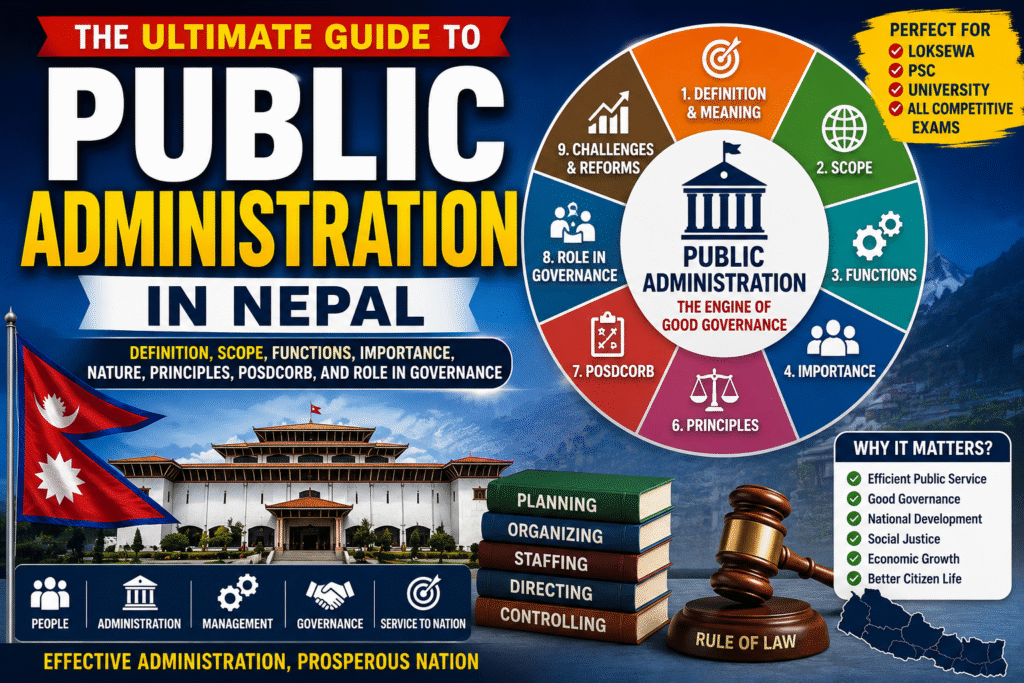
An effective system of Public Administration depends not only on sound laws, well-designed institutions, and efficient organizational structures but also on motivated public employees who are committed to serving society. While Leadership in Public Administration provides vision and direction, Human Resource Management in Public Administration develops and manages employees, Administrative Ethics in Public Administration strengthens integrity and public service values, Management Functions in Public Administration (POSDCORB) coordinates organizational activities, and Public Accountability in Public Administration ensures responsibility for administrative actions, it is Motivation that energizes public officials to perform their duties with commitment, enthusiasm, efficiency, and professionalism. Without motivation, even the most qualified civil servants may struggle to deliver high-quality public services or achieve organizational goals.
Motivation is one of the most influential concepts in organizational behaviour and public management because it explains why people work, what encourages them to perform better, and how organizations can inspire employees to achieve both personal satisfaction and institutional objectives. Governments across the world increasingly recognize that sustainable administrative performance depends not only on recruitment and training but also on creating a work environment where employees feel valued, trusted, respected, and inspired. Motivated employees demonstrate higher productivity, stronger commitment, better teamwork, improved innovation, greater ethical responsibility, and enhanced public service delivery. Conversely, lack of motivation often leads to absenteeism, low productivity, poor service quality, workplace dissatisfaction, corruption risks, and declining public trust.
The study of motivation has evolved significantly over the past century. Early management thinkers primarily emphasized financial incentives as the driving force behind employee performance. However, modern scholars have demonstrated that motivation extends far beyond salary and economic rewards. Psychological needs, opportunities for professional growth, recognition, meaningful work, organizational culture, leadership style, participation in decision-making, and commitment to public service all influence employee motivation. Scholars such as Abraham Maslow, Frederick Herzberg, Douglas McGregor, David McClelland, Victor Vroom, John Stacey Adams, Clayton Alderfer, and Edwin Locke have developed influential theories that continue to shape contemporary public administration and human resource management practices around the world.
In recent decades, researchers have introduced the concept of Public Service Motivation (PSM), particularly through the work of James L. Perry and other scholars. Public Service Motivation emphasizes that many government employees are motivated not only by personal rewards but also by a genuine desire to contribute to society, protect the public interest, promote justice, and improve citizens’ lives. This perspective is especially relevant in democratic governance, where public officials are expected to uphold constitutional values, demonstrate ethical conduct, and deliver citizen-centred services.
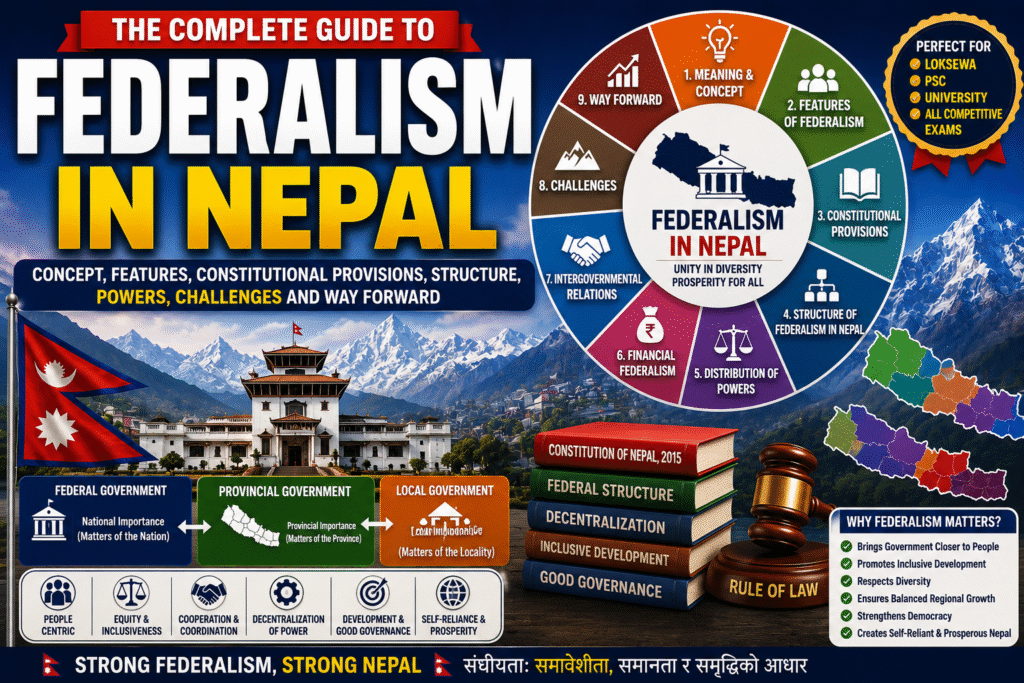
For Nepal, motivation has become increasingly important following the implementation of the Constitution of Nepal, 2015 and the transition to a federal governance system. Public officials working at the Federal, Provincial, and Local levels are expected to deliver efficient, transparent, accountable, and citizen-focused services despite limited resources, increasing public expectations, rapid technological changes, and complex administrative challenges. Strengthening employee motivation through effective leadership, merit-based career development, fair performance evaluation, professional training, ethical organizational culture, and recognition of outstanding service is therefore essential for improving governance and enhancing public confidence in government institutions.
From the perspective of Loksewa (PSC), Judicial Service, University examinations, and other competitive examinations, Motivation in Public Administration is one of the most important and frequently tested topics. Questions commonly focus on the meaning and definitions of motivation, characteristics, objectives, types, motivational theories, motivation techniques, public service motivation, factors affecting employee motivation, relationship with leadership and human resource management, challenges in motivating civil servants, Nepalese administrative practices, and contemporary reforms. A comprehensive understanding of this subject is therefore essential not only for examination success but also for developing the practical knowledge required for effective public service.
This flagship article provides a comprehensive and research-oriented study of Motivation in Public Administration, covering its meaning, scholarly definitions, evolution, nature, characteristics, objectives, importance, major theories, motivation techniques, Public Service Motivation, Nepal context, international best practices, emerging trends, examination-oriented discussions, frequently asked questions, references, and practical insights. Designed as a pillar resource, this guide also establishes meaningful connections with our flagship articles on Public Administration, Leadership in Public Administration, Human Resource Management in Public Administration, Administrative Ethics in Public Administration, Management Functions in Public Administration (POSDCORB), Good Governance in Nepal, Decision Making in Public Administration, Administrative Law in Nepal, and Public Accountability in Public Administration, enabling readers to build a complete and integrated understanding of modern public administration.
Meaning of Motivation
The term Motivation originates from the Latin word movere, meaning “to move” or “to drive.” In the context of public administration, motivation refers to the internal and external forces that stimulate individuals to act, sustain their efforts, and direct their behaviour toward achieving organizational and public objectives.
Motivation is not merely the desire to work. It is the psychological process that influences why employees begin a task, how much effort they invest, how long they continue despite challenges, and how committed they remain to achieving organizational goals. In public organizations, motivation plays a critical role because the quality of public service depends not only on administrative systems but also on the willingness, enthusiasm, and dedication of civil servants.
In simple terms:
Motivation in Public Administration is the process of inspiring, encouraging, and influencing public officials to perform their duties efficiently, ethically, and enthusiastically in order to achieve organizational objectives and serve the public interest.
Motivation differs from coercion or external pressure. A motivated employee performs duties because they understand the importance of their work, feel committed to organizational goals, experience professional satisfaction, and recognize that their contributions create value for society. This distinction is particularly significant in the public sector, where employees are expected to uphold constitutional values, demonstrate integrity, protect public resources, and provide equitable services to citizens.
Modern public administration recognizes that motivation is influenced by a combination of financial rewards, professional development opportunities, recognition, supportive leadership, ethical organizational culture, participation in decision-making, meaningful work, job security, and commitment to public service. Consequently, governments increasingly adopt comprehensive motivational strategies that address both material and psychological needs of public employees.
Definitions of Motivation by Scholars
Motivation has been defined by numerous management and organizational behaviour scholars. Although each scholar emphasizes different aspects of human behaviour, all agree that motivation is the driving force that influences an individual’s willingness, direction, intensity, and persistence in achieving organizational goals.
Understanding these scholarly definitions is essential because they provide the theoretical foundation for modern Human Resource Management, Leadership, Organizational Behaviour, and Public Administration.
Edwin B. Flippo
According to Edwin B. Flippo,
“Motivation is the process of attempting to influence others to do your will through the possibility of gain or reward.”
Flippo highlights that managers motivate employees by creating conditions that encourage them to contribute willingly toward organizational objectives.
Stephen P. Robbins
Stephen P. Robbins defines motivation as:
“The willingness to exert high levels of effort toward organizational goals, conditioned by the effort’s ability to satisfy some individual need.”
Robbins emphasizes that motivated employees work harder when they believe their efforts will satisfy both organizational objectives and personal needs.
Koontz and O’Donnell
According to Koontz and O’Donnell,
“Motivation is a general term applying to the entire class of drives, desires, needs, wishes, and similar forces.”
Their definition explains that motivation originates from human needs and desires, which encourage individuals to take action.
Michael J. Jucius
Michael Jucius states:
“Motivation is the act of stimulating someone or oneself to get a desired course of action.”
This definition stresses that motivation involves encouraging individuals to voluntarily pursue organizational goals.
Dalton E. McFarland
According to McFarland,
“Motivation is the way in which urges, drives, desires, aspirations, striving, or needs direct, control, or explain the behaviour of human beings.”
McFarland’s definition explains the psychological foundation of employee behaviour within organizations.
Fred Luthans
Fred Luthans defines motivation as:
“A process that starts with a physiological or psychological deficiency or need that activates behaviour directed toward a goal or incentive.”
Luthans emphasizes that motivation begins with unmet needs and continues until those needs are fulfilled.
James L. Perry
James L. Perry introduced the influential concept of Public Service Motivation (PSM).
According to Perry,
Public Service Motivation refers to an individual’s predisposition to respond to motives grounded primarily or uniquely in public institutions and organizations.
Unlike private-sector motivation, Public Service Motivation emphasizes commitment to serving society rather than pursuing personal gain.
This concept has become one of the most influential contributions to modern Public Administration.
Comparative Summary of Scholarly Definitions
| Scholar | Main Focus |
|---|---|
| Edwin B. Flippo | Motivation through rewards and incentives |
| Stephen P. Robbins | Effort toward organizational goals |
| Koontz & O’Donnell | Human needs and desires |
| Michael Jucius | Stimulating desired behaviour |
| Dalton E. McFarland | Psychological drives and behaviour |
| Fred Luthans | Need-based motivational process |
| James L. Perry | Public Service Motivation (PSM) |
Although these definitions differ in emphasis, they all recognize that motivation is the force that transforms human potential into productive organizational performance.
Evolution of Motivation Theory
The understanding of employee motivation has evolved significantly over time. As organizations became more complex, scholars recognized that human behaviour could not be explained solely by financial rewards. Modern motivation theory now integrates psychological, social, organizational, and public service dimensions.
Classical Management Era
Early management thinkers, particularly Frederick W. Taylor, viewed employees primarily as economic individuals.
Major assumptions included:
- Employees are mainly motivated by money.
- Higher wages increase productivity.
- Scientific management improves efficiency.
- Financial incentives are the strongest motivators.
Although this approach improved productivity in many industries, it overlooked employees’ psychological and social needs.
Human Relations Movement
The famous Hawthorne Studies conducted by Elton Mayo transformed the understanding of motivation.
Researchers discovered that employees are also motivated by:
- Social relationships.
- Recognition.
- Teamwork.
- Participation.
- Supportive supervision.
This marked a shift from purely economic motivation to human-centred management.
Behavioural Science Approach
During the mid-twentieth century, psychologists developed comprehensive theories explaining human motivation.
Major contributors included:
- Abraham Maslow.
- Frederick Herzberg.
- Douglas McGregor.
- David McClelland.
- Victor Vroom.
- John Stacey Adams.
- Clayton Alderfer.
These theories emphasized that employees possess multiple needs beyond financial rewards.
Contemporary Public Administration
Modern public administration recognizes that employee motivation depends upon a combination of:
- Ethical leadership.
- Organizational culture.
- Professional development.
- Meaningful work.
- Recognition.
- Participation.
- Innovation.
- Public service values.
- Digital work environments.
- Work-life balance.
Today’s governments increasingly focus on employee well-being alongside organizational performance.
Nature of Motivation
Motivation possesses several distinctive characteristics.
Psychological Process
Motivation originates within the human mind and influences behaviour.
Goal-Oriented
Motivation directs employee behaviour toward achieving specific organizational objectives.
Dynamic
Employee motivation changes over time depending upon personal needs, organizational conditions, leadership style, and work environment.
Continuous
Motivation is not a one-time activity.
Managers must continuously motivate employees throughout their careers.
Individualistic
Different employees are motivated by different factors.
Some value salary, while others prioritize recognition, promotion, learning opportunities, flexibility, or meaningful work.
Internal and External
Motivation may arise from:
Internal factors
- Personal satisfaction.
- Achievement.
- Responsibility.
- Commitment.
- Public service values.
External factors
- Salary.
- Promotion.
- Awards.
- Training.
- Job security.
- Recognition.
Characteristics of Motivation
Motivation in public administration possesses the following characteristics:
- It influences employee behaviour.
- It improves work performance.
- It increases organizational commitment.
- It encourages innovation.
- It enhances teamwork.
- It strengthens ethical conduct.
- It promotes job satisfaction.
- It improves service delivery.
- It supports organizational effectiveness.
- It contributes to national development.
Objectives of Motivation
The primary objectives of motivation are:
- Improve employee performance.
- Increase organizational productivity.
- Enhance public service delivery.
- Encourage innovation.
- Improve employee morale.
- Strengthen teamwork.
- Promote ethical behaviour.
- Reduce absenteeism.
- Minimize employee turnover.
- Improve citizen satisfaction.
- Achieve organizational goals efficiently.
Importance of Motivation in Public Administration
Motivation is one of the most critical determinants of administrative success. Effective public institutions depend not only on laws, organizational structures, or financial resources but also on motivated employees who are committed to serving citizens with professionalism, integrity, and dedication.
Improves Employee Performance
Motivated employees work more efficiently, maintain higher productivity, and consistently strive to achieve organizational goals.
Enhances Public Service Delivery
Motivated civil servants provide faster, more responsive, and citizen-centred public services, improving overall governance.
Strengthens Leadership Effectiveness
Effective Leadership in Public Administration relies on understanding what motivates employees and creating an environment where they can perform at their best.
Supports Human Resource Management
Motivation complements Human Resource Management in Public Administration by increasing job satisfaction, encouraging professional development, and improving employee retention.
Promotes Administrative Ethics
Employees who are motivated by public service values are more likely to demonstrate integrity, accountability, fairness, and ethical decision-making, reinforcing the principles discussed in our flagship article on Administrative Ethics in Public Administration.
Builds Good Governance
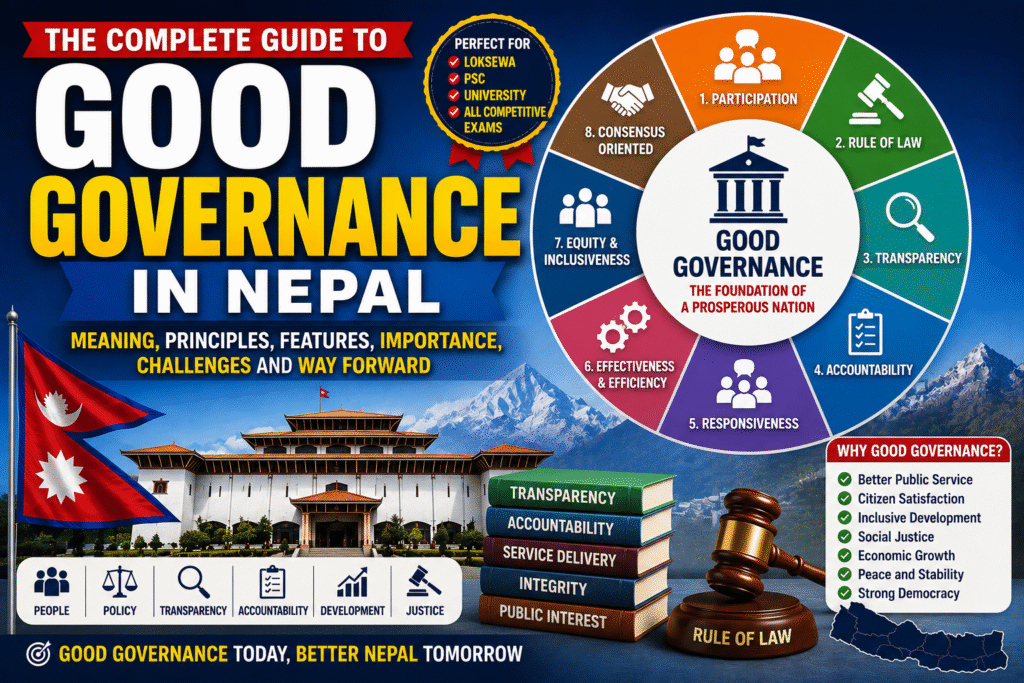
Motivated public officials contribute directly to transparency, accountability, responsiveness, efficiency, and citizen trust—key pillars of Good Governance in Nepal.
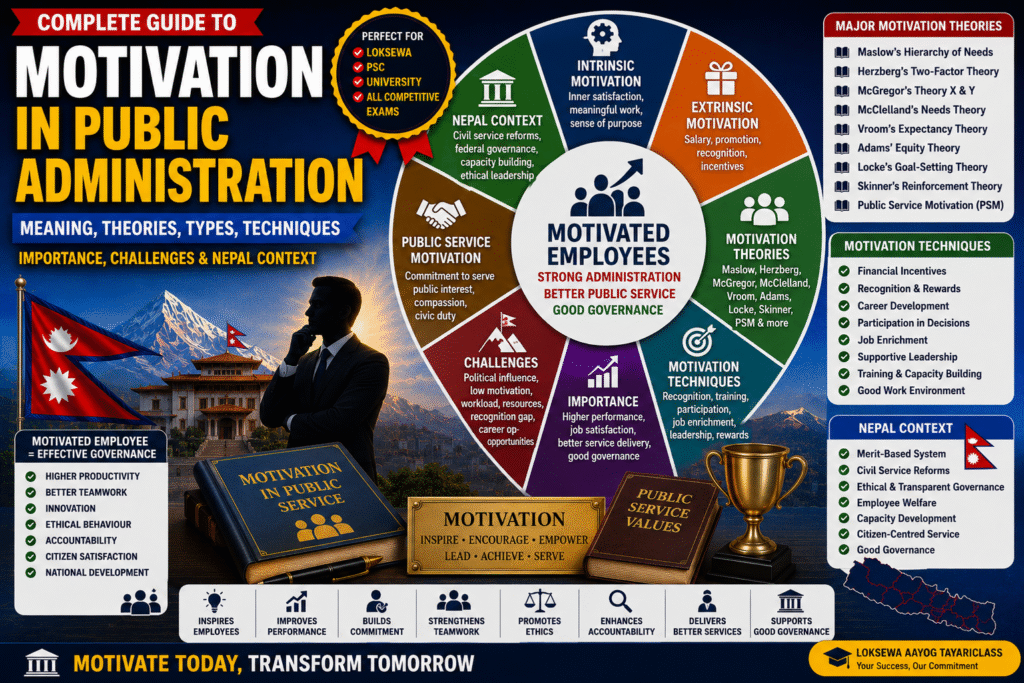
Types of Motivation
Motivation is not a single concept. Employees are inspired by different factors depending on their needs, personality, organizational environment, career stage, and professional aspirations. Understanding the various types of motivation enables public managers to design effective motivational strategies that improve employee performance and organizational effectiveness.
In Public Administration, no single motivational approach is sufficient. Effective civil service management requires a balanced combination of financial rewards, recognition, meaningful work, career development, ethical leadership, and opportunities for professional growth.
1. Intrinsic Motivation
Intrinsic Motivation refers to motivation that originates from within an individual. Employees perform their duties because they genuinely enjoy the work, find it meaningful, or believe it contributes to society.
Characteristics
- Self-driven
- Personal satisfaction
- Commitment to public service
- Internal sense of achievement
- Professional pride
Examples in Public Administration
- A government doctor serving remote communities because helping people provides personal satisfaction.
- A civil servant working beyond office hours during disaster response without expecting additional rewards.
- A teacher employed by the government who is motivated by improving students’ lives.
Intrinsic motivation is considered highly sustainable because it does not depend solely on external rewards.
2. Extrinsic Motivation
Extrinsic Motivation arises from external rewards provided by the organization.
Examples include:
- Salary
- Promotion
- Bonuses
- Awards
- Recognition
- Job security
- Allowances
- Performance incentives
Public Administration Example
A government employee works diligently because outstanding performance increases the likelihood of promotion or recognition.
Extrinsic motivation is effective for encouraging short- and medium-term performance but should be balanced with intrinsic motivation for long-term commitment.
Comparison: Intrinsic vs Extrinsic Motivation
| Basis | Intrinsic Motivation | Extrinsic Motivation |
|---|---|---|
| Source | Internal satisfaction | External rewards |
| Main Driver | Interest and purpose | Salary, promotion, recognition |
| Sustainability | High | Moderate |
| Cost to Organization | Low | Higher |
| Public Administration Example | Serving citizens with dedication | Working for promotion or incentives |
3. Positive Motivation
Positive motivation encourages employees by offering desirable outcomes.
Common methods include:
- Appreciation
- Awards
- Promotion
- Career advancement
- Public recognition
- Additional responsibilities
- Professional development opportunities
Benefits
- Higher morale
- Better teamwork
- Increased creativity
- Strong organizational commitment
Positive motivation is widely regarded as the most effective motivational approach in modern public administration.
4. Negative Motivation
Negative motivation encourages employees by emphasizing undesirable consequences.
Examples include:
- Disciplinary action
- Demotion
- Salary deductions where legally applicable
- Suspension
- Performance warnings
Although negative motivation may improve short-term compliance, excessive reliance on fear can reduce morale, creativity, trust, and organizational commitment.
Modern public administration therefore uses negative motivation cautiously and within legal and ethical boundaries.
5. Financial Motivation
Financial motivation uses monetary benefits to improve employee performance.
Examples include:
- Salary
- Performance-based incentives
- Overtime payments
- Special allowances
- Pension benefits
- Insurance benefits
Financial rewards remain important because they satisfy employees’ economic needs.
However, research consistently shows that money alone cannot sustain long-term motivation.
6. Non-Financial Motivation
Non-financial motivation focuses on psychological, social, and professional needs.
Examples include:
- Respect
- Recognition
- Participation
- Training
- Career development
- Leadership opportunities
- Flexible work arrangements
- Meaningful work
- Supportive organizational culture
Public organizations increasingly emphasize non-financial motivation because it strengthens long-term employee commitment.
Financial vs Non-Financial Motivation
| Financial Motivation | Non-Financial Motivation |
|---|---|
| Salary | Recognition |
| Incentives | Appreciation |
| Bonus | Training |
| Pension | Career Development |
| Allowances | Participation |
| Insurance | Meaningful Work |
The most successful public organizations integrate both approaches.
Major Theories of Motivation
Motivation theories explain why employees behave the way they do and how managers can improve organizational performance.
These theories form one of the most frequently asked areas in Loksewa, PSC, university examinations, and management studies.
1. Maslow’s Hierarchy of Needs Theory
Scholar: Abraham Maslow (1943)
Maslow proposed that human needs are arranged in a hierarchy.
Employees seek to satisfy lower-level needs before higher-level needs become significant.
Five Levels of Needs
Physiological Needs
Basic survival requirements:
- Food
- Water
- Shelter
- Adequate salary
Safety Needs
Employees seek:
- Job security
- Safe working conditions
- Pension
- Health benefits
- Stable employment
Social Needs
Humans desire:
- Friendship
- Teamwork
- Belongingness
- Respect from colleagues
Esteem Needs
Employees seek:
- Recognition
- Promotion
- Responsibility
- Achievement
- Professional reputation
Self-Actualization
The highest level involves:
- Personal growth
- Creativity
- Innovation
- Leadership
- Public contribution
Maslow’s Theory in Public Administration
Government organizations should create an environment where employees can progressively satisfy these needs through fair compensation, secure employment, supportive leadership, recognition, professional development, and meaningful public service.
Advantages
- Easy to understand.
- Widely applicable.
- Encourages holistic employee development.
Limitations
- Human needs do not always follow a fixed order.
- Individual differences influence motivational priorities.
2. Herzberg’s Two-Factor Theory
Scholar: Frederick Herzberg
Herzberg argued that job satisfaction and dissatisfaction are influenced by two different categories of factors.
Hygiene Factors
These prevent dissatisfaction but do not necessarily motivate employees.
Examples:
- Salary
- Working conditions
- Organizational policies
- Supervision
- Job security
Their absence creates dissatisfaction.
Their presence simply creates a neutral working environment.
Motivational Factors
These create genuine satisfaction.
Examples:
- Achievement
- Recognition
- Responsibility
- Advancement
- Challenging work
- Personal growth
Managers should therefore focus not only on salary but also on meaningful work and opportunities for development.
Comparison: Hygiene Factors vs Motivators
| Hygiene Factors | Motivators |
|---|---|
| Salary | Achievement |
| Working Conditions | Recognition |
| Policies | Responsibility |
| Job Security | Promotion |
| Supervision | Growth |
3. McGregor’s Theory X and Theory Y
Scholar: Douglas McGregor
McGregor proposed two contrasting assumptions about employee behaviour.
Theory X
Managers assume employees:
- Dislike work.
- Avoid responsibility.
- Require close supervision.
- Prefer being directed.
Leadership style becomes authoritarian.
Theory Y
Managers assume employees:
- Enjoy meaningful work.
- Accept responsibility.
- Seek creativity.
- Can exercise self-control.
Leadership becomes participative and empowering.
Modern public administration increasingly embraces Theory Y, recognizing that employees perform better when trusted and involved in decision-making.
4. McClelland’s Needs Theory
Scholar: David McClelland
McClelland identified three dominant motivational needs.
Need for Achievement (nAch)
Employees desire success and challenging goals.
Need for Power (nPow)
Employees seek influence and leadership responsibilities.
Need for Affiliation (nAff)
Employees value relationships, cooperation, and teamwork.
Effective public managers recognize that different employees may be motivated by different combinations of these needs.
5. Alderfer’s ERG Theory
Scholar: Clayton Alderfer
Alderfer simplified Maslow’s hierarchy into three categories:
- Existence Needs (material well-being and security)
- Relatedness Needs (relationships and belonging)
- Growth Needs (personal development and achievement)
Unlike Maslow, ERG Theory suggests that multiple needs can influence behaviour simultaneously, making it more flexible for understanding employee motivation.
6. Vroom’s Expectancy Theory
Scholar: Victor H. Vroom (1964)
Victor Vroom proposed that employees become motivated when they believe their efforts will lead to good performance, good performance will result in rewards, and those rewards will satisfy their personal goals.
Unlike earlier theories that focused mainly on human needs, Vroom emphasized the decision-making process behind motivation. Employees consciously evaluate whether it is worthwhile to invest effort in a particular task.
According to Vroom:
Motivation depends on an individual’s expectation that effort will lead to performance and performance will lead to valued rewards.
Three Components of Expectancy Theory
1. Expectancy (Effort → Performance)
Employees ask:
“If I work harder, will my performance improve?”
Expectancy is high when employees:
- Receive proper training.
- Have adequate resources.
- Possess necessary skills.
- Trust organizational support.
2. Instrumentality (Performance → Reward)
Employees ask:
“If I perform well, will I actually receive rewards?”
Instrumentality increases when organizations have:
- Fair promotion systems.
- Transparent performance appraisal.
- Merit-based recognition.
- Consistent administrative decisions.
3. Valence (Value of Reward)
Employees ask:
“Do I actually value the reward being offered?”
Different employees value different rewards.
Some prefer:
- Promotion.
- Recognition.
- Leadership opportunities.
- Flexible working conditions.
- Professional development.
- Increased responsibility.
Application in Public Administration
Government organizations can improve motivation by ensuring:
- Fair promotion systems.
- Transparent performance evaluation.
- Equal opportunities.
- Merit-based recognition.
- Continuous training.
- Supportive leadership.
Advantages
- Highly practical.
- Explains individual differences.
- Encourages meritocracy.
- Supports performance management.
Limitations
- Difficult to measure personal expectations.
- Employees may value rewards differently.
7. Adams’ Equity Theory
Scholar: John Stacey Adams
Adams argued that employees compare their contributions and rewards with those of others.
Employees evaluate:
Inputs
- Education
- Experience
- Skills
- Effort
- Time
- Responsibility
against
Outputs
- Salary
- Promotion
- Recognition
- Respect
- Benefits
If employees perceive fairness, motivation increases.
If they perceive unfairness, motivation declines.
Example
If two civil servants perform similar work but only one receives promotion due to favoritism, the other employee may lose motivation despite working efficiently.
Importance in Public Administration
Equity Theory encourages:
- Fair recruitment.
- Transparent promotion.
- Equal treatment.
- Merit-based administration.
- Administrative justice.
This theory closely relates to our flagship articles on Administrative Ethics, Public Accountability, and Good Governance.
8. Locke’s Goal-Setting Theory
Scholar: Edwin Locke
Locke argued that specific and challenging goals improve employee performance.
Employees become more motivated when goals are:
- Clear.
- Measurable.
- Challenging.
- Achievable.
- Time-bound.
Example
Instead of instructing a department to “improve service delivery,” administrators may establish a measurable objective such as reducing service processing time by 20 percent within one year.
Such clarity improves motivation and accountability.
Benefits
- Improves organizational focus.
- Enhances commitment.
- Encourages performance measurement.
- Supports public sector reforms.
9. Skinner’s Reinforcement Theory
Scholar: B. F. Skinner
Skinner emphasized that behaviour is shaped by its consequences.
Employees repeat behaviours that receive positive consequences and avoid behaviours associated with negative consequences.
Types of Reinforcement
Positive Reinforcement
Rewarding desirable behaviour.
Examples:
- Certificates.
- Promotion.
- Public recognition.
- Appreciation.
- Performance awards.
Negative Reinforcement
Removing undesirable conditions after improved performance.
Punishment
Discouraging unethical or poor behaviour through lawful disciplinary measures.
Extinction
Eliminating undesirable behaviour by withdrawing reinforcement.
Application
Modern public organizations primarily emphasize positive reinforcement because it promotes long-term motivation and employee satisfaction.
10. Public Service Motivation (PSM)
Scholar: James L. Perry
Public Service Motivation is one of the most influential concepts in contemporary Public Administration.
Unlike traditional motivation theories, PSM argues that many public officials are motivated not primarily by money but by a genuine desire to serve society.
According to Perry:
Public Service Motivation is an individual’s inclination to serve the public interest and contribute to society through public institutions.
Dimensions of Public Service Motivation
Commitment to Public Interest
Employees place public welfare above personal gain.
Compassion
Public officials demonstrate empathy toward citizens.
Civic Duty
Employees feel responsible for strengthening democracy and public institutions.
Self-Sacrifice
Public servants willingly make personal sacrifices when serving society.
Importance
Public Service Motivation strengthens:
- Ethical governance.
- Public trust.
- Citizen-centred administration.
- Democratic values.
- Good Governance.
PSM is increasingly recognized as a defining characteristic of high-performing civil services worldwide.
Motivation Techniques in Public Administration
Governments use numerous strategies to motivate employees.
Major techniques include:
Financial Incentives
- Competitive salary.
- Performance-based rewards.
- Allowances.
- Pension benefits.
Recognition
- Employee awards.
- Certificates.
- Public appreciation.
- Merit recognition.
Career Development
- Promotion.
- Training.
- Capacity building.
- Leadership development.
Participation
Employees should be involved in:
- Decision-making.
- Problem-solving.
- Policy discussions.
- Organizational improvement.
Participation increases ownership and commitment.
Job Enrichment
Managers should provide:
- Challenging assignments.
- Greater responsibility.
- Opportunities for creativity.
- Professional autonomy.
Supportive Leadership
Leaders should:
- Encourage teamwork.
- Communicate openly.
- Build trust.
- Mentor employees.
- Recognize achievements.
Healthy Organizational Culture
Organizations should promote:
- Respect.
- Fairness.
- Collaboration.
- Learning.
- Innovation.
- Integrity.
Relationship Between Motivation and Leadership
Leadership and motivation are inseparable.
An effective leader:
- Inspires employees.
- Builds confidence.
- Recognizes achievements.
- Encourages innovation.
- Resolves conflicts.
- Creates a positive work environment.
- Supports professional growth.
Without effective leadership, motivational programs often fail.
Relationship Between Motivation and Human Resource Management
Human Resource Management creates organizational systems that influence employee motivation.
HRM contributes through:
- Recruitment.
- Selection.
- Training.
- Performance appraisal.
- Promotion.
- Career planning.
- Employee welfare.
- Compensation.
Effective HRM ensures employees remain motivated throughout their careers.
Motivation and Organizational Performance
Motivated employees contribute to:
- Higher productivity.
- Better teamwork.
- Improved innovation.
- Faster service delivery.
- Greater accountability.
- Better citizen satisfaction.
- Reduced absenteeism.
- Lower employee turnover.
- Stronger institutional performance.
Organizational success therefore depends significantly on employee motivation.
Motivation and Good Governance
Motivation directly supports the principles of Good Governance.
Motivated public officials are more likely to demonstrate:
- Accountability.
- Transparency.
- Responsiveness.
- Participation.
- Integrity.
- Professionalism.
- Efficiency.
- Citizen-centred service delivery.
Consequently, motivation is not merely an HR concept but a critical component of democratic governance and effective public administration.
Motivation in Nepal’s Public Administration
Motivation has become one of the most important determinants of administrative performance in Nepal, particularly after the adoption of the Constitution of Nepal, 2015 and the implementation of the federal governance system. The Federal, Provincial, and Local Governments are expected to deliver citizen-centred, transparent, accountable, and efficient public services. Achieving these objectives requires not only qualified civil servants but also a highly motivated workforce that is committed to public service and continuous improvement.
Nepal’s public administration has made significant progress in areas such as digital governance, civil service reforms, capacity-building programs, and performance management. However, sustaining employee motivation remains a challenge due to administrative, organizational, and institutional factors.
To strengthen motivation within Nepal’s civil service, public organizations should focus on:
- Merit-based recruitment and promotion.
- Transparent performance evaluation.
- Fair compensation and employee welfare.
- Continuous professional development.
- Ethical leadership.
- Recognition of outstanding performance.
- Employee participation in decision-making.
- Technology-enabled workplaces.
- Strong organizational culture.
- Citizen-centred public service values.
A motivated civil service is essential for strengthening Good Governance, improving Public Accountability, promoting Administrative Ethics, and enhancing citizens’ trust in government institutions.
Challenges in Motivating Public Employees
Despite significant advances in public management, governments around the world continue to face challenges in maintaining employee motivation.
Major challenges include:
Political Interference
Frequent political influence over administrative decisions can reduce employee confidence and weaken merit-based systems.
Limited Career Opportunities
Slow promotion processes may reduce employee enthusiasm and long-term commitment.
Inadequate Recognition
Outstanding employees are not always recognized appropriately, reducing morale.
Resource Constraints
Limited financial and technological resources may restrict motivational programs.
Organizational Resistance to Change
Employees may hesitate to adopt new technologies, innovative practices, or administrative reforms.
Heavy Workload
Excessive responsibilities without adequate support may lead to stress and burnout.
Weak Performance Evaluation
If performance appraisal systems are not transparent and objective, employees may perceive them as unfair.
Communication Gaps
Poor communication between leaders and employees often reduces trust and organizational commitment.
Limited Professional Development
Insufficient training opportunities can reduce employee confidence and career satisfaction.
Work-Life Balance Issues
Maintaining employee well-being has become increasingly important in modern public administration.
International Best Practices
Many countries have developed highly effective motivational strategies that improve administrative performance and employee satisfaction.
Some widely recognized practices include:
- Merit-based civil service systems.
- Transparent recruitment and promotion.
- Continuous professional training.
- Leadership development programs.
- Employee recognition systems.
- Performance-based management.
- Digital human resource management.
- Flexible work arrangements where appropriate.
- Employee wellness initiatives.
- Innovation and suggestion programs.
- Diversity and inclusion policies.
- Lifelong learning opportunities.
Countries such as Singapore, Canada, New Zealand, Australia, Finland, South Korea, and the United Kingdom have adopted many of these practices to build highly professional and motivated public services.
Emerging Trends in Employee Motivation
The concept of motivation continues to evolve as public organizations adapt to technological and societal changes.
Important emerging trends include:
Digital Motivation
Using digital tools and technology to simplify work processes and enhance employee satisfaction.
Artificial Intelligence in Human Resource Management
AI is increasingly being used to support:
- Performance analysis.
- Learning recommendations.
- Workforce planning.
- Administrative efficiency.
Human judgment and ethical oversight, however, remain essential.
Employee Well-Being
Organizations increasingly recognize that physical and mental well-being contributes directly to long-term motivation and performance.
Continuous Learning
Governments encourage lifelong learning through:
- Online training.
- Professional certification.
- Knowledge sharing.
- Capacity development.
Public Service Innovation
Employees are increasingly encouraged to develop innovative solutions for improving public service delivery.
Purpose-Driven Work
Modern employees seek work that creates meaningful social impact rather than focusing solely on financial rewards.
This aligns closely with the concept of Public Service Motivation (PSM).
Key Takeaways
- Motivation is the driving force that encourages employees to achieve organizational goals.
- Public administration depends on motivated civil servants for effective governance.
- Motivation may be intrinsic or extrinsic, financial or non-financial, positive or negative.
- Major motivation theories include Maslow, Herzberg, McGregor, McClelland, Alderfer, Vroom, Adams, Locke, Skinner, and James L. Perry’s Public Service Motivation.
- Effective leadership and human resource management are essential for sustaining employee motivation.
- Motivation contributes directly to organizational performance, ethical behaviour, accountability, transparency, and good governance.
- Nepal’s public administration can strengthen motivation through meritocracy, leadership development, professional training, and employee recognition.
Frequently Asked Questions (FAQs)
What is Motivation in Public Administration?
Motivation in Public Administration refers to the process of encouraging and inspiring public employees to perform their duties efficiently, ethically, and enthusiastically in order to achieve organizational objectives and serve the public interest.
Why is motivation important in public administration?
Motivation improves employee performance, service delivery, organizational commitment, accountability, innovation, and citizen satisfaction while strengthening good governance.
Who introduced Public Service Motivation?
James L. Perry introduced the concept of Public Service Motivation (PSM), emphasizing that many public employees are motivated by a desire to serve society rather than by financial rewards alone.
Which motivation theory is most widely used?
There is no single best theory. Modern organizations often apply a combination of Maslow’s Hierarchy of Needs, Herzberg’s Two-Factor Theory, Vroom’s Expectancy Theory, McGregor’s Theory X and Theory Y, and Public Service Motivation (PSM).
How can public organizations motivate employees?
Public organizations can motivate employees through fair compensation, recognition, training, promotion opportunities, ethical leadership, employee participation, supportive organizational culture, and transparent performance evaluation.
Practice Questions
Short Questions
- Define Motivation in Public Administration.
- Explain any five characteristics of motivation.
- Differentiate between intrinsic and extrinsic motivation.
- State the importance of Public Service Motivation (PSM).
- Explain Herzberg’s Two-Factor Theory.
Long Questions
- Discuss the importance of motivation in improving public administration and good governance.
- Critically evaluate Maslow’s Hierarchy of Needs Theory with examples from public administration.
- Compare and contrast Herzberg’s Two-Factor Theory and Vroom’s Expectancy Theory.
- Explain the major theories of motivation and their relevance to public administration.
- Analyze the challenges of motivating public employees in Nepal and suggest practical measures for improvement.
Conclusion
Motivation is one of the most fundamental pillars of effective public administration because it transforms organizational resources, administrative structures, and public policies into meaningful outcomes through the dedication and commitment of public employees. While laws establish responsibilities and organizational structures define authority, motivation provides the energy that drives civil servants to perform their duties with professionalism, integrity, accountability, and a genuine commitment to public service.
The evolution of motivation theories—from classical economic perspectives to modern concepts such as Public Service Motivation (PSM)—demonstrates that employee performance depends on far more than financial rewards. Recognition, meaningful work, ethical leadership, opportunities for professional development, organizational justice, participation, and a supportive workplace all play vital roles in sustaining motivation.
In Nepal, strengthening employee motivation is essential for building a competent, ethical, and citizen-centred civil service capable of meeting the expectations of federal democratic governance. Merit-based human resource management, transparent performance evaluation, effective leadership, continuous learning, and an ethical organizational culture will remain key drivers of administrative excellence.
Ultimately, motivated public servants are not merely productive employees—they are the foundation of responsive governance, high-quality public service delivery, democratic accountability, and sustainable national development.
References
- Perry, James L., & Hondeghem, Annie. Motivation in Public Management: The Call of Public Service. Oxford University Press.
- Robbins, Stephen P., & Judge, Timothy A. Organizational Behavior. Pearson.
- Koontz, Harold, Weihrich, Heinz, & Cannice, Mark. Management: A Global and Entrepreneurial Perspective. McGraw-Hill.
- Herzberg, Frederick. The Motivation to Work. John Wiley & Sons.
- Maslow, Abraham H. (1943). “A Theory of Human Motivation.” Psychological Review.
- McGregor, Douglas. The Human Side of Enterprise. McGraw-Hill.
- Vroom, Victor H. Work and Motivation. Wiley.
- OECD. Public Governance Directorate. https://www.oecd.org/governance/
- United Nations Department of Economic and Social Affairs (UNDESA). https://publicadministration.desa.un.org/
- World Bank – Governance. https://www.worldbank.org/en/topic/governance
Related Articles
- Public Administration: Definition, Scope, Functions, Importance and Role in Governance
- Organization Theory in Public Administration
- Human Resource Management in Public Administration
- Good Governance in Nepal
- Administrative Law in Nepal
Feel Free To Read Articles From Our Website !
About the Author
Loksewa Aayog Tayariclass Editorial Team publishes research-based study materials, comprehensive notes, MCQs, exam-oriented articles, and evidence-based educational resources for Loksewa (PSC), university students, researchers, and competitive examination aspirants in Nepal. Our mission is to make complex topics in Public Administration, Governance, Administrative Law, Human Resource Management, Public Policy, Leadership, Administrative Ethics, and related disciplines simple, accurate, well-structured, and accessible through high-quality educational content.