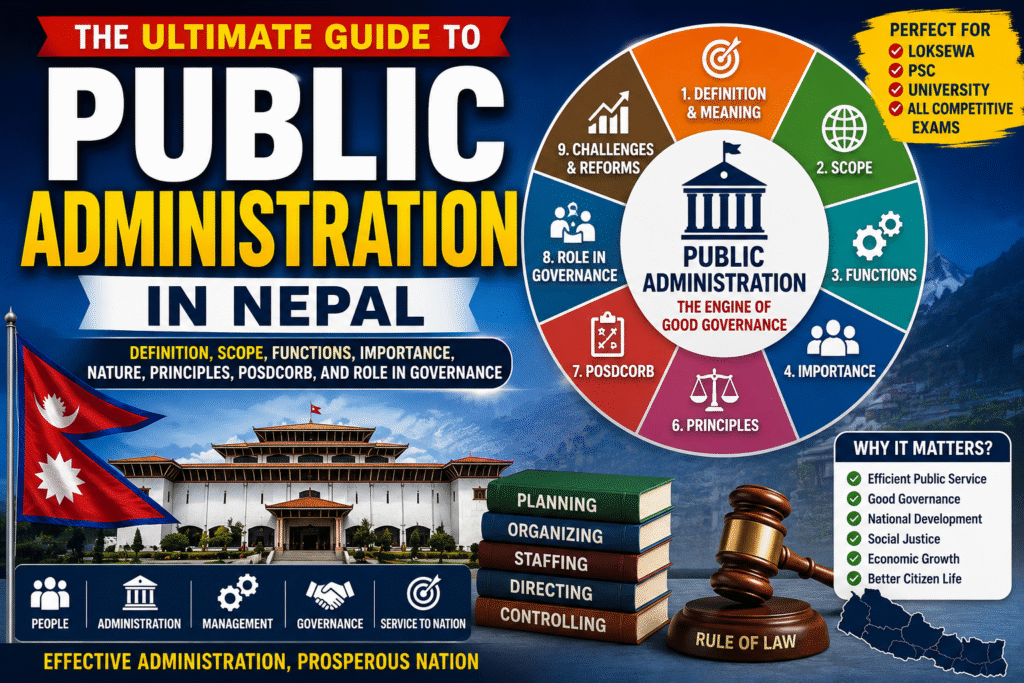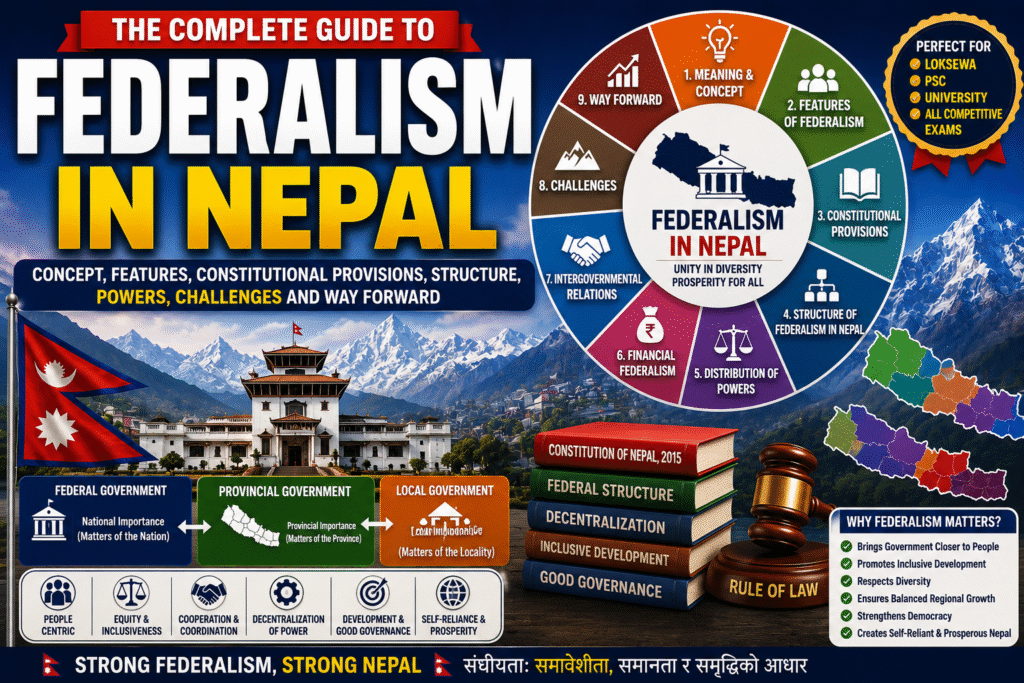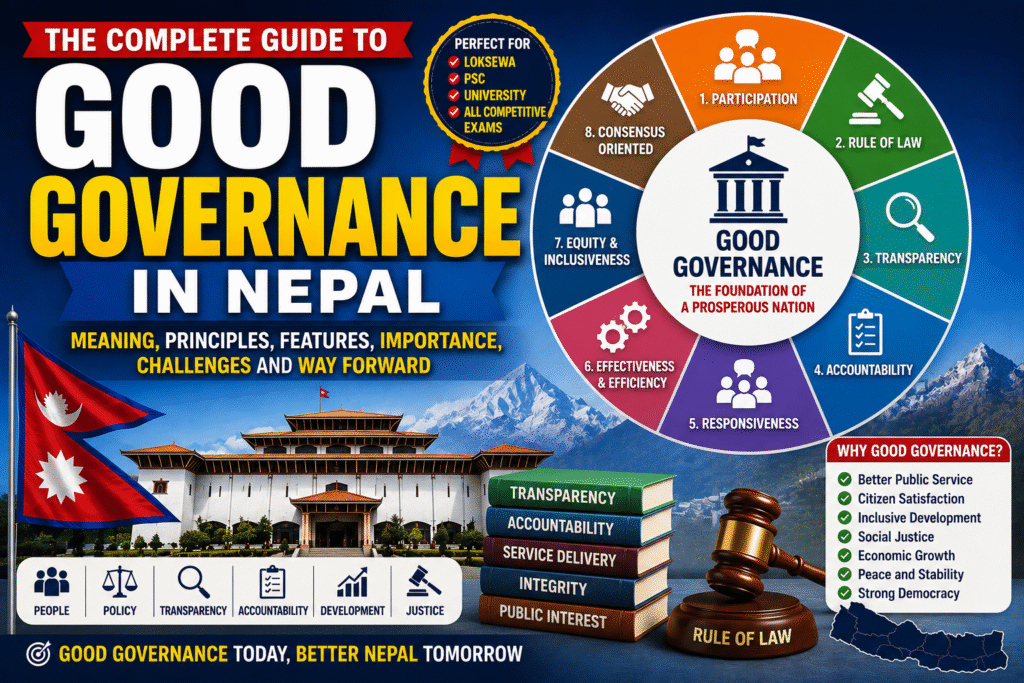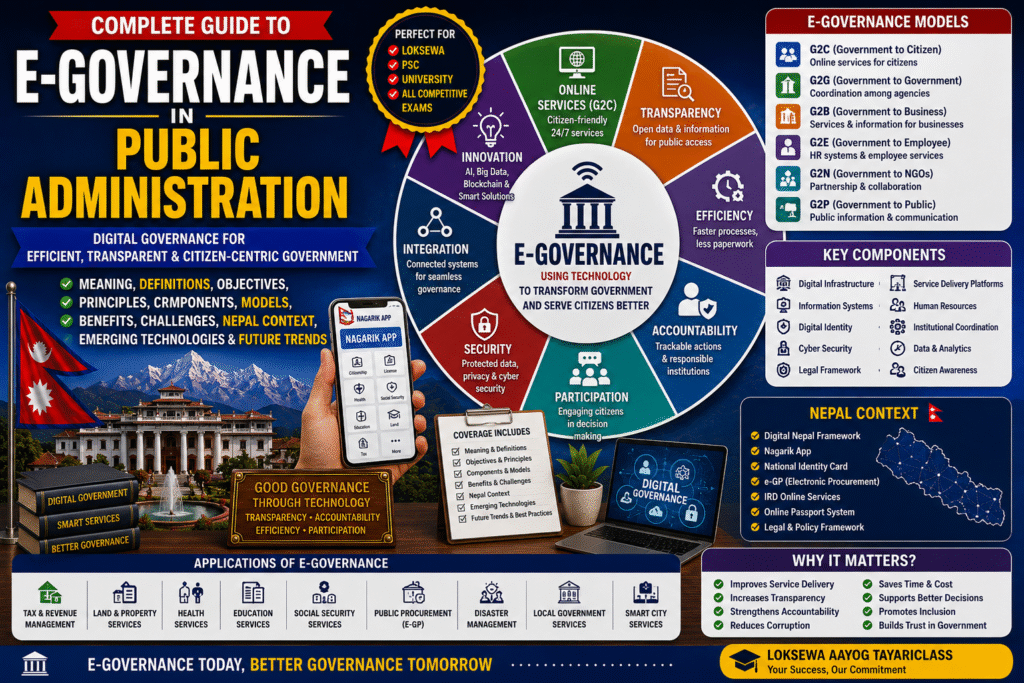
E-Governance in Public Administration: Meaning, Definitions, Objectives, Principles, Components, Models, Benefits, Challenges, Digital Transformation, AI, Nepal Context, and Future Trends
Introduction
The rapid advancement of information and communication technology (ICT) has fundamentally transformed the way governments function and interact with citizens. Around the world, governments are increasingly replacing traditional paper-based administrative systems with digital platforms that deliver public services more efficiently, transparently, and conveniently. This transformation has given rise to the concept of E-Governance, which has become one of the most important developments in modern Public Administration.
Before exploring E-Governance in depth, it is useful to understand the broader concept of Governance in Public Administration, which explains how governments, citizens, the private sector, and civil society work together to make decisions, implement policies, and create public value. E-Governance builds upon these governance principles by leveraging digital technologies to enhance transparency, accountability, participation, efficiency, and responsiveness in public service delivery.
E-Governance is no longer limited to simply computerizing government offices. It represents a comprehensive transformation of administrative processes, institutional culture, policymaking, service delivery, and citizen engagement through the effective use of digital technologies. Governments today utilize online portals, mobile applications, cloud computing, artificial intelligence (AI), blockchain, big data analytics, and digital identity systems to provide faster, more accessible, and citizen-centric public services.
For countries like Nepal, E-Governance has become particularly significant in strengthening federal governance, improving coordination among the federal, provincial, and local governments, reducing bureaucratic delays, increasing transparency, and expanding access to government services even in remote areas. Initiatives such as the Digital Nepal Framework, the Nagarik App, online passport services, electronic tax filing, digital company registration, and electronic procurement systems demonstrate Nepal’s commitment to digital transformation.
As governments continue to embrace emerging technologies, E-Governance is evolving into Digital Governance, where data-driven decision-making, artificial intelligence, smart public services, and integrated digital platforms redefine the relationship between the state and its citizens. Consequently, understanding E-Governance is essential not only for Loksewa (PSC) aspirants and university students but also for policymakers, public administrators, researchers, and anyone interested in the future of public administration.
This comprehensive guide explores the concept of E-Governance from foundational principles to advanced applications, including its meaning, definitions, objectives, characteristics, principles, models, components, stages of evolution, benefits, challenges, legal framework, emerging technologies, Nepal’s digital governance initiatives, global best practices, and future trends, providing readers with a complete and practical understanding of one of the most transformative areas of modern Public Administration.
Meaning of E-Governance
E-Governance, also known as Electronic Governance, refers to the use of Information and Communication Technology (ICT) by governments to improve governance, public administration, public service delivery, transparency, accountability, efficiency, and citizen participation.
Unlike traditional governance, which relies heavily on paper-based procedures, physical offices, and manual administrative processes, E-Governance integrates digital technologies into every stage of government operations. It enables governments to communicate, coordinate, make decisions, manage information, and deliver services more efficiently through electronic platforms.
In today’s digital era, E-Governance is no longer viewed merely as the computerization of government offices. Instead, it represents a comprehensive transformation of governance that places citizens at the centre of public administration while promoting openness, innovation, responsiveness, and evidence-based decision-making.
At its core, E-Governance seeks to answer a simple question:
How can technology help governments serve citizens better?
The answer lies in creating government systems that are faster, more transparent, more accountable, more accessible, and more inclusive.
Definitions of E-Governance
Because E-Governance combines technology, governance, and public administration, different scholars and international organizations define it from slightly different perspectives.
World Bank
According to the World Bank,
E-Governance refers to the use of information technologies by government agencies to transform relations with citizens, businesses, and other branches of government in ways that improve service delivery, strengthen accountability, increase transparency, and enhance administrative efficiency.
This definition emphasizes that technology is not an end in itself; rather, it is a tool for improving governance outcomes.
United Nations (UN)
The United Nations defines E-Governance as:
The application of Information and Communication Technology (ICT) by governments to deliver public services, exchange information, improve administrative efficiency, and promote citizen participation in governance.
The UN highlights the role of E-Governance in supporting democratic governance and sustainable development.
OECD Perspective
The Organisation for Economic Co-operation and Development (OECD) views E-Governance as the strategic use of digital technologies to improve public sector performance, strengthen public trust, and encourage open, transparent, and citizen-centred government.
Simple Definition
In simple terms,
E-Governance is the use of digital technologies by government institutions to provide public services, manage public administration, communicate with citizens, and improve governance through greater efficiency, transparency, accountability, and participation.
Evolution of E-Governance
The development of E-Governance did not occur overnight. It has evolved gradually alongside advances in information technology, internet connectivity, mobile communication, and digital innovation.
Understanding this evolution helps explain why modern governments are moving beyond traditional administration toward fully integrated digital governance.
Phase 1: Traditional Administration
In the early stage, government operations were entirely manual.
Characteristics included:
- Paper-based records.
- Manual file movement.
- Face-to-face service delivery.
- Lengthy administrative procedures.
- Limited access to information.
- Slow communication between offices.
Although this system established administrative order, it often resulted in delays, excessive paperwork, and bureaucratic inefficiency.
Phase 2: Computerization
During the 1980s and 1990s, governments began introducing computers into public administration.
The primary objective was to digitize internal office work.
Examples included:
- Payroll systems.
- Employee databases.
- Financial accounting.
- Record management.
- Statistical databases.
At this stage, technology primarily supported internal administrative efficiency rather than citizen services.
Phase 3: E-Government
With the expansion of the internet, governments started providing services online.
Citizens could access government information and complete certain transactions electronically.
Examples include:
- Online tax filing.
- Passport applications.
- Company registration.
- Utility bill payments.
- License renewals.
- Online procurement systems.
This stage marked the beginning of electronic public service delivery.
Phase 4: E-Governance
Governments gradually realized that technology should not only automate services but also improve governance itself.
Consequently, E-Governance expanded its focus to include:
- Citizen participation.
- Transparency.
- Accountability.
- Open government.
- Digital democracy.
- Collaborative governance.
- Integrated public administration.
Technology became an instrument for improving the quality of governance rather than merely increasing administrative efficiency.
Phase 5: Digital Governance and Smart Government
Today, many governments are entering the era of Digital Governance or Smart Government.
This stage integrates advanced technologies such as:
- Artificial Intelligence (AI).
- Big Data Analytics.
- Cloud Computing.
- Blockchain.
- Internet of Things (IoT).
- Machine Learning.
- Geographic Information Systems (GIS).
- Digital Identity Systems.
Modern digital governance emphasizes proactive, data-driven, personalized, secure, and citizen-centric public services.
From E-Government to E-Governance
Many students mistakenly assume that E-Government and E-Governance are identical. Although closely related, they are not the same.
E-Government mainly focuses on digitizing government operations and delivering services electronically.
E-Governance, however, is broader. It includes not only digital service delivery but also citizen participation, transparency, accountability, collaborative decision-making, institutional reform, and digital democracy.
In other words:
- E-Government = Digital Service Delivery
- E-Governance = Digital Transformation of Governance
Thus, every E-Governance system includes E-Government, but not every E-Government initiative fully achieves the broader goals of E-Governance.
Why E-Governance Has Become Essential
Several global developments have accelerated the adoption of E-Governance:
- Rapid growth of the internet and mobile technology.
- Rising citizen expectations for faster and more convenient public services.
- Increasing demand for transparency and accountability.
- The need to reduce corruption and administrative delays.
- Expansion of digital economies.
- Global commitments to sustainable development.
- Lessons learned during the COVID-19 pandemic, which highlighted the importance of digital public services.
As a result, E-Governance is now recognized as one of the most important reforms in contemporary Public Administration and a key driver of efficient, inclusive, and citizen-centred governance.
Objectives of E-Governance
The primary objective of E-Governance is not simply to digitize government offices, but to transform the entire system of governance into one that is more efficient, transparent, accountable, inclusive, and citizen-centred.
By integrating Information and Communication Technology (ICT) into public administration, governments seek to improve administrative performance while strengthening democratic governance and public trust.
The major objectives of E-Governance are discussed below.
1. To Improve Public Service Delivery
One of the foremost objectives of E-Governance is to provide faster, simpler, and more accessible public services.
Digital platforms allow citizens to obtain government services anytime and from anywhere, reducing the need for repeated visits to government offices.
Examples include:
- Online passport applications.
- Electronic tax filing.
- Digital business registration.
- Online birth and death registration.
- Digital driving licence services.
- Electronic procurement systems.
Importance
- Saves time.
- Reduces administrative burden.
- Improves citizen satisfaction.
- Expands service accessibility.
2. To Promote Transparency
Transparency enables citizens to understand how government decisions are made and how public resources are utilized.
Through digital platforms, governments can publish:
- Budgets.
- Procurement information.
- Development projects.
- Government reports.
- Public expenditure.
- Policy documents.
- Official notices.
Open access to information reduces secrecy and strengthens democratic accountability.
3. To Strengthen Accountability
Digital systems record administrative activities electronically, making it easier to monitor government performance.
Officials become more accountable because:
- Decisions are traceable.
- Transactions are recorded.
- Performance can be measured.
- Audit trails are automatically maintained.
This reduces opportunities for misuse of authority.
4. To Reduce Corruption
One of the most significant advantages of E-Governance is minimizing direct physical interaction between citizens and public officials.
Digital systems reduce opportunities for:
- Bribery.
- Favouritism.
- Unofficial payments.
- Manipulation of records.
- Administrative discretion.
Electronic payment systems and online application tracking further improve transparency.
5. To Increase Administrative Efficiency
Technology enables governments to complete administrative tasks more quickly and accurately.
Efficiency improves through:
- Automation.
- Digital workflows.
- Integrated databases.
- Electronic communication.
- Real-time information sharing.
As a result, governments can provide better services using available public resources more effectively.
6. To Encourage Citizen Participation
Modern governance recognizes citizens as active participants rather than passive service recipients.
E-Governance encourages participation through:
- Online consultations.
- Digital feedback systems.
- Public opinion surveys.
- E-petitions.
- Social media engagement.
- Open government portals.
Citizen participation strengthens democratic governance and improves policy quality.
7. To Improve Decision-Making
Accurate data is essential for effective public administration.
Digital governance provides policymakers with:
- Real-time information.
- Performance indicators.
- Statistical databases.
- Geographic information.
- Predictive analytics.
Evidence-based decisions generally produce better governance outcomes.
8. To Enhance Coordination
Government institutions frequently need to exchange information.
E-Governance improves coordination among:
- Ministries.
- Departments.
- Provincial governments.
- Local governments.
- Constitutional bodies.
- Regulatory agencies.
Integrated digital systems reduce duplication and improve administrative cooperation.
9. To Promote Inclusive Governance
Technology can make public services more accessible to:
- Rural communities.
- Persons with disabilities.
- Senior citizens.
- Women.
- Marginalized groups.
- Remote populations.
When designed inclusively, E-Governance helps reduce inequalities in access to government services.
10. To Support Sustainable Development
Digital governance contributes to sustainable development by:
- Improving public sector efficiency.
- Enhancing environmental sustainability through paperless administration.
- Strengthening institutions.
- Supporting innovation.
- Promoting inclusive growth.
These objectives align closely with the United Nations Sustainable Development Goals (SDGs), particularly SDG 16: Peace, Justice and Strong Institutions.
Characteristics of E-Governance
E-Governance possesses several distinctive characteristics that differentiate it from traditional public administration.
1. Citizen-Centred
Citizens are placed at the centre of governance.
Government services are designed around public needs rather than administrative convenience.
2. Technology-Driven
ICT serves as the primary enabler of governance transformation.
Modern technologies include:
- Internet.
- Mobile applications.
- Cloud computing.
- Artificial Intelligence.
- Big Data.
- Blockchain.
- Digital identity systems.
3. Transparent
Information becomes more accessible through digital platforms, promoting openness in government operations.
4. Accountable
Electronic records make government actions traceable, measurable, and easier to audit.
5. Efficient
Digital automation reduces processing time while improving administrative productivity.
6. Responsive
Governments can respond more quickly to citizen requests, complaints, and emergencies.
7. Integrated
Different government agencies can share information through interconnected digital systems.
This creates seamless public service delivery.
8. Inclusive
E-Governance seeks to provide equal digital access for all citizens regardless of location or social background.
9. Innovative
Continuous technological innovation enables governments to modernize administrative processes.
10. Collaborative
Digital platforms facilitate cooperation among government institutions, businesses, civil society, and citizens.
Principles of E-Governance
Successful E-Governance is guided by several fundamental principles.
Transparency
Government information should be openly available.
Accountability
Public officials should remain answerable for their decisions.
Participation
Citizens should have opportunities to engage in governance.
Efficiency
Public resources should be utilized wisely.
Effectiveness
Government services should achieve intended policy outcomes.
Accessibility
Digital services should be available to all citizens.
Equity
Every citizen should receive equal access to government services.
Security
Government information systems must protect privacy, confidentiality, and sensitive public data.
Privacy Protection
Citizens’ personal information should be handled responsibly and securely.
Interoperability
Government systems should communicate seamlessly across departments and levels of government.
Scope of E-Governance
The scope of E-Governance extends far beyond online public services. It encompasses nearly every aspect of modern governance.
Major areas include:
- Digital public service delivery.
- Public administration.
- Public finance management.
- Human resource management.
- Tax administration.
- Customs administration.
- Judicial administration.
- Health governance.
- Education governance.
- Land administration.
- Election management.
- Disaster management.
- Local government administration.
- Smart city governance.
- Environmental governance.
- Digital identity systems.
- Open government initiatives.
- Regulatory administration.
As technology advances, the scope of E-Governance continues to expand into new areas of public administration and governance.
Core Components of E-Governance
The success of E-Governance depends upon several interconnected components working together as an integrated digital ecosystem. Simply creating government websites or mobile applications is not sufficient. Effective E-Governance requires robust technological infrastructure, sound legal frameworks, skilled human resources, institutional coordination, secure digital systems, and active citizen participation.
Each component plays a distinct role in ensuring that digital governance delivers efficient, transparent, secure, and citizen-centred public services.
1. Digital Infrastructure
Meaning
Digital infrastructure forms the technological foundation of E-Governance. It includes the physical and virtual systems required to support digital government operations.
Major Elements
- High-speed internet connectivity.
- Data centres.
- Cloud computing infrastructure.
- Government networks.
- Optical fibre communication.
- Mobile communication systems.
- Secure government servers.
Without reliable digital infrastructure, electronic governance cannot function effectively.
2. Information Systems
Government agencies generate vast amounts of administrative information every day.
Information systems help governments collect, process, store, retrieve, analyse, and share this information efficiently.
Examples include:
- Population database.
- Tax information systems.
- Land information systems.
- Civil registration systems.
- Public finance management systems.
- Human resource information systems.
- Health information systems.
Integrated databases improve coordination among government institutions.
3. Digital Service Delivery Platforms
Digital platforms enable citizens and businesses to access government services electronically.
Common platforms include:
- Government portals.
- Mobile applications.
- Online registration systems.
- Electronic payment gateways.
- Self-service kiosks.
- Digital complaint management systems.
Modern governments increasingly provide 24/7 online services, reducing dependence on physical government offices.
4. Digital Identity
Digital identity allows governments to verify the identity of citizens securely while providing online services.
Examples include:
- National Digital Identity.
- Electronic Identification Cards.
- Digital signatures.
- Biometric authentication.
- Multi-factor authentication.
Digital identity is essential for secure online governance.
5. Cybersecurity
As governments increasingly depend upon digital technologies, protecting public information becomes critically important.
Cybersecurity includes:
- Data encryption.
- Secure authentication.
- Network protection.
- Malware prevention.
- Incident response systems.
- Digital risk management.
Strong cybersecurity protects citizens, government institutions, and national digital infrastructure.
6. Legal and Regulatory Framework
Technology alone cannot ensure effective governance.
Appropriate laws are required to regulate:
- Electronic transactions.
- Digital signatures.
- Data protection.
- Privacy.
- Cybercrime.
- Information security.
- Digital evidence.
A sound legal framework builds confidence in digital governance.
7. Human Resources and Capacity Building
Successful E-Governance requires competent public officials with digital knowledge and technical skills.
Governments therefore invest in:
- ICT training.
- Digital literacy.
- Leadership development.
- Change management.
- Continuous professional learning.
Technology is only as effective as the people who use it.
8. Institutional Coordination
Digital governance requires close coordination among:
- Ministries.
- Departments.
- Constitutional bodies.
- Provincial governments.
- Local governments.
- Public enterprises.
Integrated governance reduces duplication and improves service delivery.
9. Citizen Awareness and Digital Literacy
Citizens must know how to use digital services.
Governments therefore promote:
- Digital awareness campaigns.
- ICT education.
- Community digital centres.
- Online help services.
- Citizen training programmes.
Digital inclusion remains an essential component of successful E-Governance.
10. Continuous Innovation
Technology evolves rapidly.
Governments must continuously modernize digital systems through:
- Artificial Intelligence.
- Cloud computing.
- Blockchain.
- Big Data.
- Machine Learning.
- Internet of Things.
- Smart public services.
Innovation ensures that governance remains responsive to changing public needs.
Interaction Models of E-Governance
One of the defining features of E-Governance is that it facilitates digital interaction among multiple stakeholders. Depending on the participants involved, these interactions are classified into several models.
Understanding these models is essential because they explain who interacts with whom in a digital governance ecosystem.
1. Government to Citizen (G2C)
Meaning
Government-to-Citizen (G2C) refers to the electronic delivery of public services directly to citizens.
This is the most visible and widely used model of E-Governance because it focuses on improving citizens’ access to government services.
Examples
- Online passport application.
- Digital citizenship services.
- Birth and death registration.
- Online tax payment.
- Utility bill payment.
- Driving licence renewal.
- Social security services.
- Online grievance redressal.
Benefits
- Faster service delivery.
- Reduced waiting time.
- Greater convenience.
- Increased transparency.
- Better citizen satisfaction.
Nepal Examples
- Nagarik App.
- Online Passport System.
- PAN registration.
- National Identity Card services.
- Online company registration.
- Inland Revenue electronic services.
2. Government to Government (G2G)
Meaning
Government-to-Government (G2G) refers to electronic communication and coordination among government institutions.
It enables different agencies to exchange information efficiently and coordinate policy implementation.
Examples
- Electronic file management.
- Integrated financial management.
- Inter-ministerial communication.
- Shared government databases.
- Digital cabinet systems.
Benefits
- Better coordination.
- Reduced duplication.
- Faster decision-making.
- Improved administrative efficiency.
Nepal Context
G2G interactions support coordination among:
- Federal Government.
- Provincial Governments.
- Local Governments.
- Constitutional Bodies.
These systems strengthen cooperative federalism.
3. Government to Business (G2B)
Meaning
Government-to-Business (G2B) refers to digital interactions between government institutions and the private sector.
Governments provide electronic platforms that simplify regulatory compliance and business services.
Examples
- Company registration.
- Tax filing.
- Customs clearance.
- Electronic procurement (e-GP).
- Business licensing.
- Investment approvals.
Benefits
- Easier business operations.
- Reduced compliance costs.
- Greater transparency.
- Improved investment climate.
Nepal Examples
- Office of the Company Registrar online services.
- Inland Revenue electronic filing.
- Public Procurement Monitoring Office (PPMO) e-GP system.
4. Government to Employee (G2E)
Meaning
Government-to-Employee (G2E) refers to digital services provided by governments to their own employees.
These systems improve internal public administration.
Examples
- Electronic payroll.
- Leave management.
- Performance appraisal.
- Employee portals.
- Online training.
- Pension management.
Benefits
- Improved HR management.
- Better employee productivity.
- Reduced paperwork.
- Efficient personnel administration.
5. Government to Non-Governmental Organizations (G2N)
Meaning
Governments increasingly collaborate with NGOs, community organizations, and development partners through digital platforms.
These partnerships support:
- Development programmes.
- Social welfare initiatives.
- Disaster response.
- Community development.
- Public awareness campaigns.
Digital collaboration improves coordination and resource sharing.
6. Government to Public (G2P)
Some scholars also describe Government-to-Public (G2P) as a broader interaction model that focuses on disseminating information to society at large.
Examples include:
- Public awareness campaigns.
- Emergency notifications.
- Weather alerts.
- Election information.
- Health advisories.
- Open data portals.
G2P strengthens transparency and public communication.
Comparative Overview of E-Governance Models
| Model | Primary Stakeholder | Main Purpose |
|---|---|---|
| G2C | Citizens | Public service delivery |
| G2G | Government agencies | Administrative coordination |
| G2B | Businesses | Regulatory and commercial services |
| G2E | Government employees | Human resource management |
| G2N | NGOs & Civil Society | Collaboration and partnerships |
| G2P | General Public | Information sharing and public communication |
Scholar’s Insight
Modern E-Governance is most effective when these interaction models are integrated rather than operating in isolation. For example, a citizen applying for a passport through a G2C portal may trigger G2G coordination between government agencies, involve G2E systems for processing the application, and use secure digital infrastructure governed by national cybersecurity policies. This integrated ecosystem is what distinguishes advanced digital governance from simple online service delivery.
Importance and Advantages of E-Governance
E-Governance has become one of the most significant administrative reforms of the twenty-first century. By integrating Information and Communication Technology (ICT) into public administration, governments can improve the quality of governance while delivering faster, more transparent, and citizen-centred public services.
The importance of E-Governance extends beyond technological modernization. It fundamentally transforms the relationship between government, citizens, businesses, and public institutions by making governance more efficient, accountable, inclusive, and responsive.
1. Improves Public Service Delivery
One of the greatest contributions of E-Governance is the improvement of public service delivery.
Traditional administrative procedures often require citizens to visit multiple government offices, complete lengthy paperwork, and wait several days or even weeks for services.
E-Governance simplifies these processes by allowing citizens to access services online at any time and from any location.
Examples
- Online passport application.
- Electronic tax filing.
- Digital birth registration.
- Online business registration.
- Digital land record services.
- Electronic licence renewal.
Benefits
- Faster processing.
- Reduced paperwork.
- Convenient access.
- Better citizen experience.
2. Enhances Transparency
Transparency is one of the fundamental principles of Good Governance.
Digital platforms allow governments to proactively publish information relating to:
- Budgets.
- Public procurement.
- Government decisions.
- Development projects.
- Laws and regulations.
- Administrative procedures.
When citizens can easily access official information, government becomes more open and trustworthy.
3. Strengthens Accountability
Digital systems automatically record administrative activities.
This creates clear audit trails that enable supervisors, auditors, oversight institutions, and citizens to monitor government performance.
Officials become more accountable because:
- Decisions are traceable.
- Transactions are electronically recorded.
- Performance can be measured objectively.
- Administrative processes become easier to evaluate.
4. Reduces Corruption
Corruption frequently occurs when administrative processes lack transparency and involve excessive personal discretion.
E-Governance minimizes these opportunities by:
- Reducing face-to-face interaction.
- Automating workflows.
- Recording transactions electronically.
- Providing online application tracking.
- Introducing electronic payments.
Digital governance therefore contributes significantly to integrity and public trust.
5. Improves Administrative Efficiency
Automation enables governments to perform administrative tasks more accurately and quickly.
Efficiency improves through:
- Electronic file management.
- Digital approval systems.
- Integrated databases.
- Automated workflows.
- Real-time communication.
As a result, governments can deliver better services while using public resources more effectively.
6. Saves Time and Costs
Both governments and citizens benefit economically from E-Governance.
Citizens save:
- Travel expenses.
- Waiting time.
- Administrative costs.
Governments save:
- Printing costs.
- Storage expenses.
- Office space.
- Manual administrative work.
Paperless administration also contributes to environmental sustainability.
7. Promotes Citizen Participation
Modern governance encourages citizens to participate actively in public decision-making.
Digital platforms facilitate participation through:
- Online consultations.
- Electronic surveys.
- Public feedback portals.
- E-petitions.
- Social media engagement.
- Open government platforms.
Citizen participation improves policy quality and strengthens democratic governance.
8. Improves Coordination
Government institutions often need to exchange information rapidly.
Integrated digital systems facilitate coordination among:
- Ministries.
- Departments.
- Provincial governments.
- Local governments.
- Constitutional bodies.
- Public enterprises.
Improved coordination reduces duplication and accelerates decision-making.
9. Supports Evidence-Based Policymaking
Modern governments increasingly rely on digital data when designing public policies.
Digital governance provides:
- Real-time statistics.
- Administrative databases.
- Geographic information.
- Performance dashboards.
- Predictive analytics.
Better information leads to more informed public decisions.
10. Promotes Inclusive Governance
Well-designed digital systems improve access to public services for:
- Rural populations.
- Persons with disabilities.
- Senior citizens.
- Women.
- Marginalized communities.
- Remote areas.
Inclusive digital governance helps reduce inequalities in public service delivery.
11. Strengthens Disaster and Emergency Management
During emergencies, digital governance enables governments to communicate quickly with citizens.
Examples include:
- Disaster alerts.
- Weather warnings.
- Pandemic information.
- Emergency financial assistance.
- Relief coordination.
The COVID-19 pandemic demonstrated the critical importance of digital public administration.
12. Supports Sustainable Development
E-Governance contributes directly to sustainable development by:
- Reducing paper consumption.
- Improving institutional effectiveness.
- Promoting innovation.
- Strengthening public institutions.
- Supporting environmental sustainability.
It plays an important role in achieving the United Nations Sustainable Development Goals (SDGs), particularly SDG 16: Peace, Justice and Strong Institutions.
Limitations and Challenges of E-Governance
Despite its numerous advantages, E-Governance also faces significant challenges. Successful implementation requires more than technology—it demands institutional readiness, legal safeguards, digital literacy, and continuous investment.
1. Digital Divide
Not all citizens have equal access to:
- Internet connectivity.
- Smartphones.
- Computers.
- Digital skills.
People living in remote or economically disadvantaged areas may find it difficult to benefit from online public services.
2. Cybersecurity Threats
Government information systems are increasingly vulnerable to:
- Cyberattacks.
- Hacking.
- Malware.
- Ransomware.
- Data breaches.
- Identity theft.
Protecting sensitive public information has therefore become a national priority.
3. Privacy Concerns
Governments collect large volumes of personal information.
Without strong privacy safeguards, citizens may lose confidence in digital governance systems.
Protecting personal data requires:
- Secure databases.
- Data protection legislation.
- Responsible data management.
- Ethical use of information.
4. Resistance to Change
Some public officials and citizens may hesitate to adopt new technologies because of:
- Lack of training.
- Fear of technological change.
- Organizational culture.
- Limited digital confidence.
Effective change management is therefore essential.
5. Limited Digital Literacy
Many citizens still require assistance in using:
- Online applications.
- Digital payment systems.
- Government portals.
- Mobile services.
Digital literacy programmes are necessary to ensure inclusive governance.
6. Financial Constraints
Developing secure digital infrastructure requires substantial investment in:
- ICT equipment.
- Software.
- Data centres.
- Network infrastructure.
- Cybersecurity.
- Human resource development.
Developing countries often face resource limitations.
7. Infrastructure Gaps
Reliable E-Governance depends upon:
- Stable electricity.
- High-speed internet.
- Secure communication networks.
- Modern ICT infrastructure.
Infrastructure gaps remain a challenge, particularly in geographically remote regions.
8. Legal and Regulatory Challenges
Rapid technological development often outpaces legislation.
Governments must continuously update legal frameworks relating to:
- Electronic transactions.
- Digital signatures.
- Cybercrime.
- Privacy.
- Artificial Intelligence.
- Data governance.
Critical Success Factors for Effective E-Governance
The long-term success of E-Governance depends on several key factors working together:
- Strong political commitment.
- Clear digital governance policies.
- Reliable ICT infrastructure.
- Adequate financial investment.
- Skilled human resources.
- Robust cybersecurity.
- Effective legal and regulatory frameworks.
- High levels of digital literacy.
- Inter-agency coordination.
- Continuous innovation and evaluation.
- Citizen trust and active participation.
Countries that successfully combine these factors are more likely to achieve efficient, transparent, and citizen-centred digital governance.
Scholar’s Insight
Research consistently shows that technology alone does not create good governance. Successful E-Governance emerges when digital innovation is combined with effective institutions, ethical leadership, legal accountability, organizational capacity, and citizen trust. In other words, computers and software can modernize administration, but only sound governance can transform public value.
E-Governance in Nepal
Introduction
Nepal has made significant progress in adopting Information and Communication Technology (ICT) to modernize public administration and improve public service delivery. Although the journey toward digital governance is still evolving, recent constitutional reforms, digital policies, institutional initiatives, and technological innovations have accelerated the implementation of E-Governance across all three levels of government.
The Constitution of Nepal, 2015, with its federal governance structure, has further emphasized the need for efficient coordination, transparency, accountability, citizen participation, and technology-enabled service delivery. Consequently, digital governance has become an important pillar of Nepal’s administrative reform agenda.
Today, citizens can access numerous government services online, including tax filing, passport applications, company registration, procurement systems, and digital identity services. These initiatives demonstrate Nepal’s commitment to building a more citizen-centric, transparent, and efficient public administration.
Evolution of E-Governance in Nepal
Nepal’s digital governance journey has progressed gradually over the past three decades.
Early Phase
Initially, ICT was introduced mainly for:
- Computerization of government offices.
- Payroll management.
- Financial accounting.
- Record keeping.
- Basic administrative automation.
Internet Era
With increased internet access, government institutions began introducing online information portals and electronic public services.
Examples included:
- Government websites.
- Online notices.
- Electronic forms.
- Digital communication.
- Online information dissemination.
Digital Transformation Phase
In recent years, Nepal has entered a more comprehensive stage of digital governance through integrated digital platforms and mobile applications.
Current initiatives focus on:
- Digital identity.
- Online public services.
- Electronic procurement.
- Mobile governance.
- Integrated government databases.
- Digital payments.
- Citizen-centric service delivery.
Major E-Governance Initiatives in Nepal
1. Digital Nepal Framework
One of Nepal’s most ambitious digital transformation initiatives is the Digital Nepal Framework, introduced by the Government of Nepal.
Vision
To transform Nepal into a digitally empowered nation by integrating technology into governance, economic development, education, agriculture, healthcare, tourism, finance, and public service delivery.
Major Objectives
- Expand digital infrastructure.
- Improve internet connectivity.
- Modernize government services.
- Promote digital innovation.
- Strengthen the digital economy.
- Enhance ICT capacity.
- Improve public administration.
The Digital Nepal Framework serves as the country’s long-term digital transformation roadmap.
2. Nagarik App
The Nagarik App is one of Nepal’s most important digital governance initiatives.
It provides citizens with access to multiple government services through a single mobile application.
Services Available
- Citizenship information.
- PAN details.
- Driving licence information.
- Social security information.
- Health-related services.
- Educational records.
- Public notices.
- Government certificates.
- Various digital public services.
Importance
The Nagarik App represents a major step toward integrated digital government and one-stop public service delivery.
3. National Identity Card (NID)
Nepal is gradually implementing the National Identity Card Programme.
The digital identity system aims to:
- Improve citizen identification.
- Strengthen public administration.
- Reduce duplication.
- Improve service integration.
- Enhance security.
- Facilitate digital authentication.
Digital identity forms the foundation for future digital governance.
4. Electronic Procurement (e-GP)
The Public Procurement Monitoring Office (PPMO) operates Nepal’s Electronic Government Procurement (e-GP) System.
The system enables:
- Online tender publication.
- Electronic bidding.
- Procurement monitoring.
- Transparent procurement.
- Reduced administrative delays.
Electronic procurement improves transparency while reducing opportunities for corruption.
5. Inland Revenue Electronic Services
The Inland Revenue Department (IRD) has introduced several electronic services, including:
- Online PAN registration.
- Electronic tax filing.
- Online tax payment.
- Taxpayer information systems.
These services reduce paperwork and improve tax administration.
6. Online Passport Services
The Department of Passports now provides online appointment and application facilities.
Benefits include:
- Reduced waiting time.
- Better appointment management.
- Improved administrative efficiency.
- Enhanced citizen convenience.
7. Office of the Company Registrar
Businesses can now access several services electronically, including:
- Company registration.
- Annual filings.
- Company information.
- Digital documentation.
These reforms improve Nepal’s business environment.
Legal Framework for E-Governance in Nepal
The implementation of E-Governance is supported by several constitutional and legal instruments.
Major legal frameworks include:
- Constitution of Nepal, 2015.
- Electronic Transactions Act, 2008 (ETA).
- Right to Information Act, 2007.
- Good Governance (Management and Operation) Act, 2008.
- National ICT Policy.
- Digital Nepal Framework.
- Public Procurement Act and related regulations.
Together, these laws provide legal recognition to electronic transactions, digital communication, transparency, and technology-enabled governance.
Emerging Technologies Transforming E-Governance
Digital governance is evolving rapidly with the emergence of advanced technologies.
These technologies are transforming not only public service delivery but also policymaking, administrative decision-making, and citizen engagement.
1. Artificial Intelligence (AI)
Artificial Intelligence enables governments to:
- Automate routine tasks.
- Analyze large datasets.
- Predict policy outcomes.
- Improve public service delivery.
- Detect fraud.
- Support administrative decision-making.
- Provide AI-powered citizen assistance through chatbots.
AI is expected to become one of the most influential technologies in future public administration.
2. Big Data Analytics
Governments generate enormous amounts of administrative data.
Big Data Analytics helps governments:
- Understand citizen needs.
- Improve planning.
- Monitor public programmes.
- Predict future trends.
- Support evidence-based policymaking.
3. Cloud Computing
Cloud technology allows government agencies to:
- Store information securely.
- Share data efficiently.
- Reduce infrastructure costs.
- Improve collaboration.
- Enhance disaster recovery.
Cloud-based government systems are becoming increasingly common worldwide.
4. Blockchain
Blockchain technology offers:
- Secure record management.
- Tamper-resistant databases.
- Transparent transactions.
- Digital identity verification.
- Smart contracts.
Potential applications include:
- Land registration.
- Public procurement.
- Digital certificates.
- Supply chain monitoring.
5. Internet of Things (IoT)
IoT connects physical devices through digital networks.
Applications include:
- Smart cities.
- Traffic management.
- Environmental monitoring.
- Disaster warning systems.
- Public infrastructure management.
6. Geographic Information Systems (GIS)
GIS supports:
- Urban planning.
- Disaster management.
- Land administration.
- Infrastructure development.
- Environmental governance.
Global Best Practices in E-Governance
Several countries are recognized as global leaders in digital governance.
Estonia
Often regarded as one of the world’s most advanced digital governments, Estonia provides secure online voting, digital identity, e-health, e-tax, and integrated public services.
Singapore
Singapore has developed a highly efficient Smart Nation initiative that integrates AI, digital infrastructure, and citizen-centred public services.
South Korea
South Korea consistently ranks among the world’s leading countries in the United Nations E-Government Development Index (EGDI) due to its advanced digital public services and strong ICT infrastructure.
Denmark
Denmark emphasizes digital inclusion, secure electronic communication, and high-quality online public services.
These international experiences demonstrate that successful E-Governance depends on technology, institutional capacity, legal frameworks, public trust, and continuous innovation.
Future of E-Governance
Introduction
E-Governance is continuously evolving alongside technological innovation. While the initial focus was on digitizing government services, the future of governance lies in creating intelligent, predictive, integrated, and citizen-centric digital governments.
Emerging technologies such as Artificial Intelligence (AI), Machine Learning (ML), Blockchain, Big Data Analytics, Cloud Computing, the Internet of Things (IoT), Digital Identity Systems, and Smart Infrastructure are transforming the way governments design policies, deliver services, and interact with citizens.
Future governments will not simply react to citizens’ requests—they will increasingly anticipate public needs, provide proactive services, and make evidence-based decisions using real-time data.
Major Future Trends in E-Governance
1. Artificial Intelligence (AI)-Driven Government
Artificial Intelligence is expected to revolutionize Public Administration by enabling governments to automate routine tasks, analyze complex datasets, and improve policy decisions.
Potential Applications
- AI-powered citizen service chatbots.
- Predictive policy analysis.
- Fraud detection.
- Smart tax administration.
- Healthcare management.
- Disaster prediction.
- Traffic management.
- Intelligent grievance redress systems.
Benefits
- Faster decision-making.
- Better public services.
- Increased efficiency.
- Reduced administrative workload.
- Improved resource allocation.
However, governments must also address ethical issues such as algorithmic bias, transparency, accountability, and data privacy.
2. Smart Government
Smart Government represents the next stage of E-Governance.
Rather than merely providing online services, Smart Government integrates:
- Artificial Intelligence.
- Big Data.
- IoT.
- Cloud Computing.
- Digital Identity.
- GIS.
- Real-time analytics.
The objective is to provide personalized, proactive, and intelligent public services.
3. Data-Driven Governance
Future governments will increasingly rely on data rather than assumptions.
Administrative decisions will be supported by:
- Real-time statistics.
- Predictive analytics.
- Geographic information.
- Citizen feedback.
- Performance dashboards.
- Administrative databases.
Evidence-based policymaking improves both effectiveness and accountability.
4. Open Government and Open Data
Governments around the world are publishing public information through Open Data Portals.
Open government promotes:
- Transparency.
- Public participation.
- Innovation.
- Academic research.
- Private-sector innovation.
- Civic technology development.
Citizens and researchers can use open data to develop innovative public solutions.
5. Integrated Digital Government
Instead of separate departmental systems, future governments will provide one-stop digital platforms where citizens can access multiple public services through a single account.
Examples include:
- Unified citizen portals.
- Integrated digital identity.
- Shared government databases.
- Single sign-on authentication.
This significantly improves user experience.
6. Sustainable Digital Governance
Future E-Governance will contribute directly to sustainable development through:
- Paperless administration.
- Green ICT.
- Smart energy management.
- Environmental monitoring.
- Digital public services.
- Climate governance.
Digital transformation and sustainability will increasingly complement each other.
Key Takeaways
- E-Governance is the application of Information and Communication Technology (ICT) to improve governance and public administration.
- It aims to enhance transparency, accountability, efficiency, responsiveness, participation, and service delivery.
- E-Governance is broader than E-Government because it also includes citizen participation, institutional reform, and democratic governance.
- The major interaction models are G2C, G2G, G2B, G2E, G2N, and G2P.
- Core components include digital infrastructure, information systems, cybersecurity, digital identity, legal frameworks, human resources, institutional coordination, and digital literacy.
- Nepal has made notable progress through initiatives such as the Digital Nepal Framework, Nagarik App, National Identity Card, Electronic Government Procurement (e-GP), and online tax and passport services.
- Emerging technologies—including AI, Blockchain, Big Data, Cloud Computing, and IoT—are shaping the future of digital governance.
- Successful E-Governance requires not only advanced technology but also capable institutions, ethical leadership, strong legal frameworks, and active citizen participation.
Frequently Asked Questions (FAQs)
1. What is E-Governance in Public Administration?
E-Governance is the use of Information and Communication Technology (ICT) by governments to improve public administration, service delivery, transparency, accountability, efficiency, and citizen participation.
2. What is the difference between E-Government and E-Governance?
E-Government focuses primarily on delivering government services electronically.
E-Governance is broader because it includes digital service delivery, citizen participation, institutional reform, transparency, accountability, and collaborative governance.
3. What are the main objectives of E-Governance?
The primary objectives include:
- Improving public service delivery.
- Increasing transparency.
- Strengthening accountability.
- Reducing corruption.
- Enhancing administrative efficiency.
- Encouraging citizen participation.
- Supporting evidence-based policymaking.
- Promoting inclusive governance.
4. What are the major models of E-Governance?
The principal interaction models are:
- Government to Citizen (G2C)
- Government to Government (G2G)
- Government to Business (G2B)
- Government to Employee (G2E)
- Government to Non-Governmental Organizations (G2N)
- Government to Public (G2P)
5. Why is E-Governance important for Nepal?
E-Governance helps Nepal strengthen federal governance, improve public service delivery, increase transparency, reduce corruption, enhance coordination among different levels of government, and expand access to government services through digital platforms.
Scholar’s Corner
Richard Heeks argues that E-Governance is not merely about introducing computers into government offices; it is about transforming governance through the strategic use of information and communication technologies to create greater public value.
The United Nations (UN) emphasizes that digital government should be citizen-centric, inclusive, transparent, and aligned with sustainable development.
The World Bank views E-Governance as a powerful instrument for improving governance by strengthening service delivery, transparency, accountability, and institutional effectiveness.
The OECD highlights that digital transformation should support innovation, public trust, evidence-based policymaking, and better government performance.
These perspectives collectively demonstrate that technology is an enabler—not a substitute—for good governance. Sustainable digital transformation depends on strong institutions, ethical leadership, effective laws, and informed citizen participation.
Conclusion
E-Governance represents one of the most transformative developments in contemporary Public Administration. By integrating Information and Communication Technology (ICT) into governance processes, governments can deliver faster, more transparent, accountable, efficient, and citizen-centred public services. However, the true significance of E-Governance extends beyond technological modernization. It redefines the relationship between governments and citizens by promoting participation, collaboration, evidence-based policymaking, and institutional innovation.
For Nepal, E-Governance offers a significant opportunity to strengthen federal governance, modernize public administration, reduce bureaucratic delays, enhance transparency, and expand public access to essential services. Initiatives such as the Digital Nepal Framework, Nagarik App, National Identity Card Programme, and electronic procurement systems illustrate the country’s growing commitment to digital transformation. Continued investment in digital infrastructure, cybersecurity, legal reforms, institutional capacity, and digital literacy will be essential to maximize these benefits.
As the world moves toward AI-driven governance, smart governments, and integrated digital ecosystems, future public administrators must combine technological competence with ethical leadership, accountability, and a strong commitment to public value. Ultimately, the success of E-Governance will be measured not by the sophistication of technology alone, but by its ability to improve people’s lives, strengthen democratic governance, and build trustworthy, resilient public institutions.
References
Use authoritative and up-to-date references such as:
- United Nations. United Nations E-Government Survey (latest edition).
- World Bank. E-Government and Governance Resources.
- OECD. Digital Government Policy Framework.
- Richard Heeks. Implementing and Managing eGovernment.
- Constitution of Nepal, 2015.
- Electronic Transactions Act, 2008 (Nepal).
- Digital Nepal Framework, Government of Nepal.
- National Information Technology Center (NITC), Nepal.
- Public Procurement Monitoring Office (PPMO), Nepal.
- Ministry of Communication and Information Technology (MoCIT), Nepal.
Suggested Related Articles
To strengthen internal linking and topical authority, link this article with:
- Good Governance in Nepal
- Public Policy in Nepal
- Administrative Law in Nepal
- Leadership in Public Administration
- Administrative Ethics in Public Administration
- Public Accountability in Public Administration
- Decision Making in Public Administration
- Management Functions in Public Administration (POSDCORB)
- Organization Theory in Public Administration
- Human Resource Management in Public Administration
- Civil Service in Nepal
- Public Financial Administration in Nepal
About the Author
Loksewa Aayog Tayariclass publishes research-based study materials, comprehensive notes, exam-focused MCQs, and high-quality educational articles on Public Administration, Governance, Public Policy, Administrative Law, Civil Service, and related subjects for Loksewa (PSC), university students, researchers, and lifelong learners in Nepal. Our mission is to make complex concepts simple, accurate, practical, and accessible while maintaining the highest academic standards and SEO best practices.