Leadership in Public Administration: Meaning, Theories, Styles, Principles, Qualities, Importance, Challenges, and Nepal Context
The Ultimate Guide for Loksewa, PSC, University Students, Researchers, and Competitive Examinations
Introduction
Leadership is one of the most influential and indispensable elements of Public Administration. Governments may possess constitutional authority, well-designed public policies, adequate financial resources, advanced technologies, and highly qualified civil servants, yet without effective leadership, these resources often fail to produce meaningful public outcomes. Leadership provides direction, inspires people, coordinates collective efforts, resolves conflicts, drives innovation, and transforms governmental objectives into practical achievements. It is therefore regarded as one of the fundamental pillars of effective, ethical, and citizen-centred public administration.
Public Administration is not merely about enforcing laws or managing government offices; it is fundamentally about serving people and advancing the public interest. Achieving these goals requires leaders who can formulate a clear vision, motivate employees, make informed decisions, manage change, uphold constitutional values, and maintain public trust. Effective public leaders are expected to balance political priorities with administrative professionalism while ensuring that governance remains transparent, accountable, responsive, efficient, and equitable.
Unlike leadership in the private sector, leadership in public administration operates within a complex democratic environment. Public leaders must work under constitutional limitations, legal frameworks, parliamentary oversight, judicial review, media scrutiny, financial regulations, and citizen expectations. Every significant administrative decision is influenced by political institutions, public accountability, ethical standards, and the rule of law. Consequently, leadership in the public sector requires not only managerial competence but also integrity, emotional intelligence, strategic thinking, collaboration, and a deep commitment to public service.
Throughout the history of public administration, scholars have consistently emphasized the importance of leadership. Chester Barnard viewed executives as essential coordinators who maintain organizational cooperation. Herbert Simon highlighted leadership in relation to rational decision-making and organizational behaviour. Douglas McGregor demonstrated how leadership styles influence employee motivation and organizational performance through Theory X and Theory Y. Warren Bennis argued that leadership is the capacity to transform vision into reality, while John P. Kotter distinguished leadership from management by emphasizing that leaders create direction, inspire change, and motivate people rather than merely maintaining administrative systems.
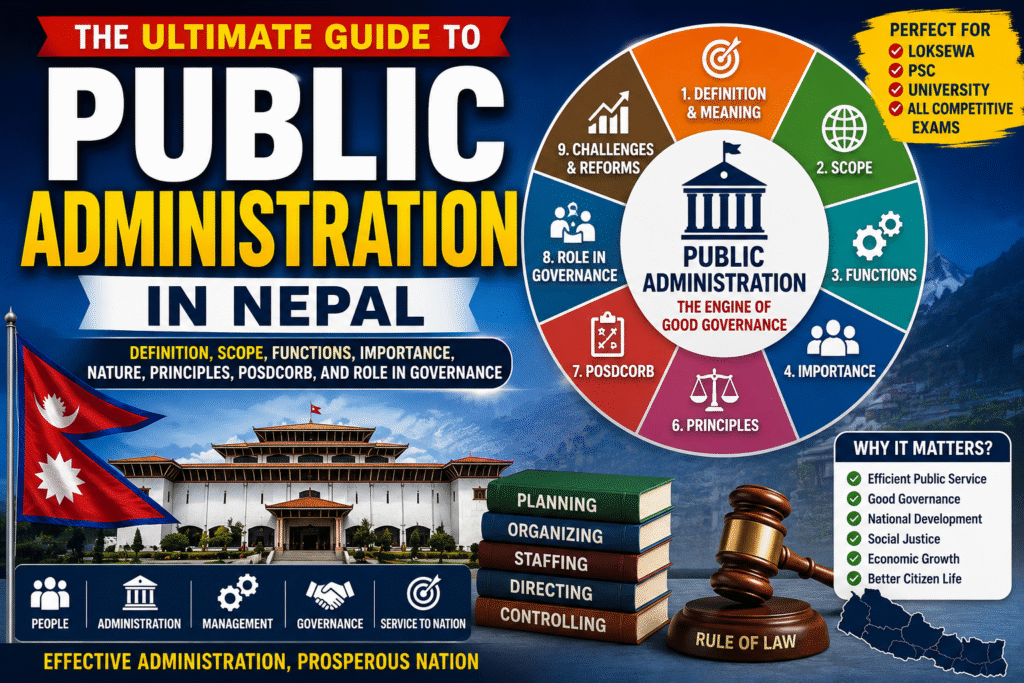
Leadership is closely connected with every major concept of Public Administration. Management Functions (POSDCORB) require leadership for planning, organizing, staffing, directing, coordinating, reporting, and budgeting. Decision Making depends on leaders who can evaluate alternatives and make timely choices. Human Resource Management relies on leadership to develop, motivate, and retain competent public servants. Public Accountability demands leaders who accept responsibility for decisions and organizational outcomes. Good Governance requires leaders who promote transparency, participation, responsiveness, and the rule of law. Likewise, Administrative Law ensures that leadership remains lawful, while Public Policy depends on capable leadership for successful implementation. Within Nepal’s federal governance system, leadership is equally important at the Federal, Provincial, and Local levels, where coordination among multiple institutions is essential for effective service delivery.
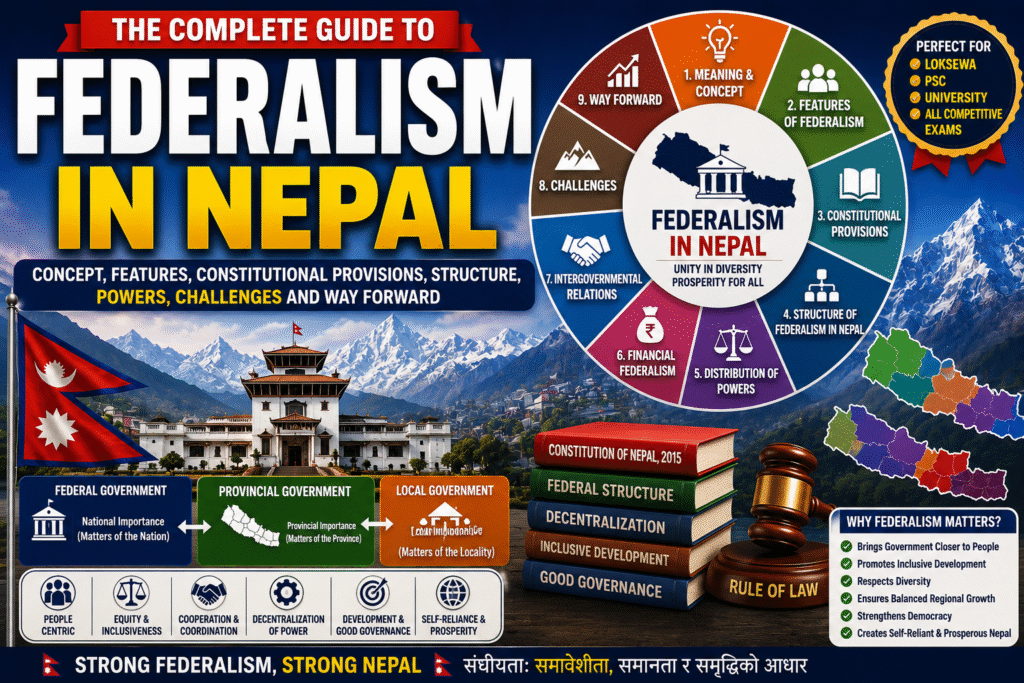
In Nepal, leadership has become increasingly significant following the implementation of the Constitution of Nepal, 2015 and the transition to a federal democratic republic. The federal governance structure requires public leaders who can coordinate among different levels of government, manage limited resources efficiently, encourage citizen participation, embrace digital governance, and ensure accountability in public institutions. Chief Administrative Officers, Secretaries, Department Heads, Provincial Secretaries, Local Government Executives, constitutional office bearers, and political executives all play vital leadership roles in strengthening democratic governance and achieving national development goals.
The rapid advancement of digital technology, artificial intelligence, data-driven governance, climate change, globalization, and increasing public expectations has further transformed the nature of public leadership. Modern public leaders must not only administer government institutions efficiently but also manage organizational change, encourage innovation, collaborate across sectors, communicate effectively with stakeholders, and build resilient institutions capable of addressing complex public challenges.
For Loksewa (PSC), Judicial Service, university examinations, and other competitive examinations, Leadership in Public Administration is one of the most important and frequently tested topics. Questions commonly focus on its meaning, definitions, characteristics, theories, leadership styles, principles, qualities of effective leaders, functions, challenges, ethical dimensions, and practical relevance in Nepal’s administrative system. A comprehensive understanding of this topic is therefore essential for academic excellence, competitive examinations, and future public service careers.
This article provides a complete and research-based exploration of Leadership in Public Administration, covering its meaning, scholarly definitions, evolution, characteristics, principles, leadership theories, leadership styles, essential qualities, functions, ethical leadership, transformational leadership, challenges, Nepalese context, international best practices, future trends, examination-oriented questions, and practical applications. Designed as a flagship pillar resource, this guide integrates academic depth with practical insights to provide readers with a comprehensive understanding comparable to a high-quality textbook while remaining engaging, structured, and easy to understand.
Meaning of Leadership in Public Administration
Leadership in Public Administration refers to the ability of public officials and administrative leaders to influence, inspire, guide, and coordinate individuals and institutions in order to achieve public goals efficiently, ethically, and in accordance with constitutional and legal principles.
Unlike leadership in business organizations, public leadership focuses primarily on serving the public interest rather than maximizing profit. It requires balancing efficiency with accountability, innovation with legality, and administrative effectiveness with democratic values.
In simple terms,
Leadership in Public Administration is the process of influencing, motivating, and guiding public officials and government institutions to achieve organizational objectives while promoting good governance, accountability, transparency, and public welfare.
Effective public leadership transforms governmental policies into meaningful public outcomes and ensures that administrative systems remain responsive to the needs of citizens.
Definitions by Scholars
Scholars from Public Administration, Management, and Organizational Behaviour have defined leadership from different perspectives. Together, these definitions explain why leadership is considered one of the most important functions of administration.
Chester I. Barnard
Barnard viewed leadership as an essential executive function.
According to Barnard,
Leadership is the ability of an executive to secure cooperation and maintain an effective system of coordinated efforts within an organization.
His definition emphasizes cooperation, communication, and organizational effectiveness.
Warren Bennis
Warren Bennis famously defined leadership as:
“Leadership is the capacity to translate vision into reality.”
This definition highlights the importance of vision, inspiration, and organizational transformation.
John P. Kotter
John Kotter distinguished leadership from management by stating that:
Leadership is about establishing direction, aligning people, and motivating them to overcome challenges and achieve organizational goals.
According to Kotter, management maintains stability, whereas leadership drives change.
Peter F. Drucker
Peter Drucker emphasized responsibility in leadership.
According to Drucker,
The ultimate task of leadership is to produce results while developing people and strengthening institutions.
Harold Koontz and Cyril O’Donnell
They defined leadership as:
The process of influencing people so that they willingly strive toward achieving group objectives.
This definition highlights motivation and teamwork.
Keith Davis
Keith Davis defined leadership as:
The ability to persuade others to seek defined objectives enthusiastically.
Enthusiasm and voluntary commitment are central to his definition.
Stephen P. Robbins
According to Robbins,
Leadership is the ability to influence a group toward achieving a vision or a set of goals.
Historical Evolution of Leadership in Public Administration
The understanding of leadership has evolved significantly over time.
Traditional Leadership
Early administrative systems relied on authority derived from monarchy, seniority, military command, or hereditary rule.
Leadership was largely authoritarian and hierarchical.
Classical Administrative Era
Classical scholars emphasized:
- Authority
- Discipline
- Unity of Command
- Hierarchy
- Administrative control
Leadership was viewed primarily as directing and supervising employees.
Human Relations Era
Following Elton Mayo’s Hawthorne Studies, leadership increasingly focused on:
- Employee motivation
- Communication
- Participation
- Human behaviour
- Teamwork
Leadership became more people-oriented.
Behavioural and Contingency Era
Researchers recognized that no single leadership style is universally effective.
Successful leadership depends upon:
- Organizational goals
- Employee characteristics
- Situational factors
- External environment
Contemporary Leadership
Modern public leadership emphasizes:
- Collaboration
- Innovation
- Digital governance
- Citizen participation
- Ethical decision-making
- Emotional intelligence
- Diversity and inclusion
- Sustainable development
Today’s leaders must adapt quickly to changing public expectations and technological advancements.
Nature of Leadership in Public Administration
Leadership in public administration possesses several distinctive characteristics.
Goal-Oriented
Leadership directs organizational efforts toward achieving public objectives.
People-Centred
Effective leadership focuses on motivating, developing, and empowering employees rather than merely exercising authority.
Dynamic
Leadership evolves according to changing political, economic, technological, and social conditions.
Continuous Process
Leadership is not a one-time activity.
It continues throughout:
- Planning
- Decision Making
- Policy Implementation
- Monitoring
- Evaluation
- Organizational Improvement
Ethical
Public leaders must maintain honesty, integrity, impartiality, and accountability.
Democratic
Modern public leadership encourages participation, consultation, collaboration, and shared decision-making.
Service-Oriented
Unlike private organizations that primarily pursue profit, public leaders work to improve public welfare and protect the public interest.
Characteristics of Effective Leadership
Successful public leaders generally possess the following characteristics.
Vision
They establish a clear direction for the organization.
Integrity
They maintain honesty, transparency, and ethical conduct.
Accountability
They accept responsibility for decisions and organizational performance.
Communication Skills
They communicate goals, policies, and expectations clearly.
Decision-Making Ability
They evaluate alternatives objectively and make informed decisions.
Emotional Intelligence
They understand and manage both their own emotions and those of others.
Adaptability
They respond effectively to changing environments and emerging challenges.
Innovation
They encourage creativity and continuous improvement.
Team Building
They promote cooperation and collaboration among employees.
Public Service Commitment
They prioritize the public interest above personal or political interests.
Objectives of Leadership in Public Administration
Effective leadership seeks to achieve multiple organizational and societal objectives.
These include:
- Achieving organizational goals.
- Improving public service delivery.
- Motivating public employees.
- Promoting innovation.
- Ensuring accountability.
- Strengthening institutional capacity.
- Maintaining administrative discipline.
- Building citizen trust.
- Managing organizational change.
- Supporting sustainable national development.
Importance of Leadership in Public Administration
Leadership is indispensable for effective governance.
Its importance can be understood through the following dimensions.
Provides Direction
Leadership establishes organizational vision, priorities, and long-term goals.
Improves Decision-Making
Competent leaders make timely, rational, and evidence-based decisions.
This naturally connects with our previous article on Decision Making in Public Administration.
Enhances Organizational Performance
Leadership aligns human, financial, and technological resources to improve efficiency.
Motivates Employees
Inspired employees demonstrate higher productivity, creativity, and commitment.
This also complements the concepts discussed in Human Resource Management in Public Administration.
Strengthens Good Governance
Leadership promotes transparency, accountability, responsiveness, participation, and the rule of law.
These principles directly support our flagship articles on Good Governance in Nepal and Public Accountability in Public Administration.
Facilitates Policy Implementation
Even the best-designed public policies fail without capable leadership.
Effective leaders coordinate institutions, allocate resources, resolve implementation challenges, and monitor progress.
Builds Public Trust
Ethical and accountable leadership strengthens citizens’ confidence in government institutions.
Promotes Innovation
Modern leaders encourage digital governance, evidence-based policymaking, organizational learning, and continuous improvement.
Core Elements of Effective Public Leadership
Strong public leadership rests on several interconnected elements.
- Vision and strategic thinking.
- Integrity and ethical conduct.
- Accountability and transparency.
- Effective communication.
- Sound decision-making.
- Collaboration and teamwork.
- Emotional intelligence.
- Adaptability and resilience.
- Citizen-centred service.
- Commitment to constitutional values and the rule of law.
Together, these elements enable public leaders to guide institutions effectively while maintaining democratic legitimacy and public confidence.
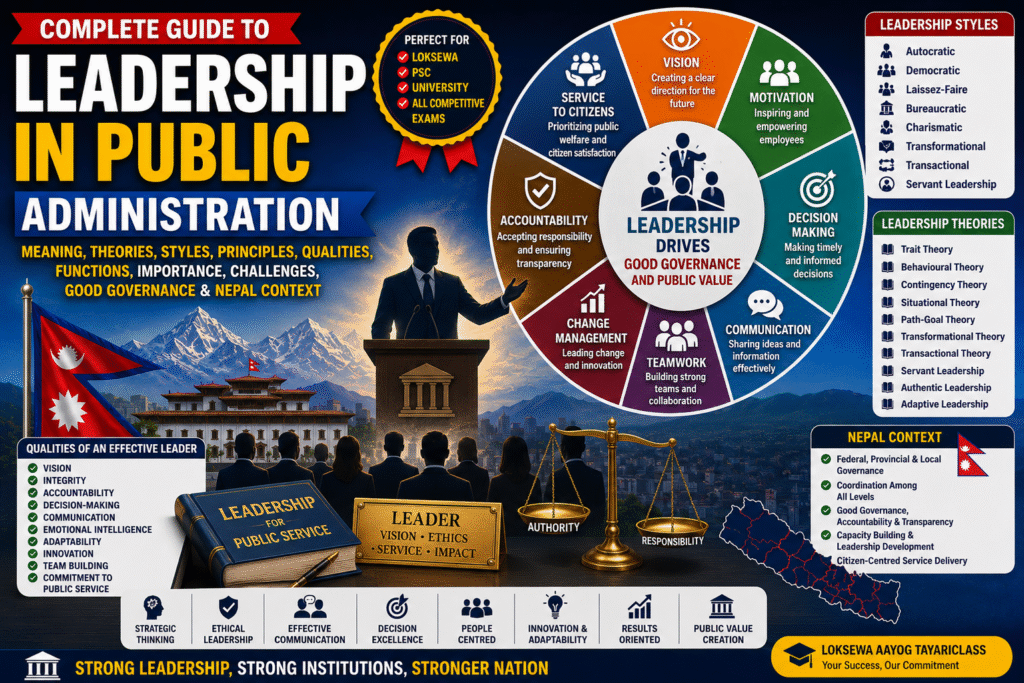
Leadership Theories in Public Administration
Understanding leadership theories helps explain why some leaders successfully motivate employees, manage change, and achieve organizational goals while others struggle. Over time, scholars have developed several theories to explain how leadership develops and how it influences organizational performance.
In Public Administration, these theories provide practical guidance for leading government institutions, implementing public policies, improving service delivery, and strengthening democratic governance.
1. Great Man Theory
The Great Man Theory is one of the earliest leadership theories.
It assumes that:
- Leaders are born, not made.
- Leadership is an inherent quality.
- Only a few exceptional individuals possess leadership abilities.
According to this theory, history is shaped by extraordinary leaders who naturally emerge during crises.
Advantages
- Highlights the importance of vision and courage.
- Explains the influence of exceptional leaders during major historical events.
Criticisms
- Ignores education and training.
- Assumes leadership cannot be developed.
- Does not explain successful modern organizational leadership.
Today, this theory has limited practical application in Public Administration because leadership can be developed through education, experience, and continuous learning.
2. Trait Theory
Trait Theory argues that successful leaders possess certain personal characteristics that distinguish them from others.
Common leadership traits include:
- Intelligence
- Integrity
- Self-confidence
- Emotional stability
- Communication skills
- Initiative
- Responsibility
- Courage
- Adaptability
- Vision
Importance
Trait Theory assists public organizations in:
- Leadership selection.
- Executive development.
- Civil service promotion.
- Succession planning.
Limitation
No single set of traits guarantees effective leadership in every situation.
3. Behavioural Theory
Behavioural Theory shifted attention from who leaders are to what leaders do.
It argues that leadership behaviours can be learned through training and experience.
Major leadership behaviours include:
- Supporting employees.
- Communicating effectively.
- Delegating responsibilities.
- Motivating teams.
- Solving problems.
- Encouraging participation.
Importance in Public Administration
Government training institutions increasingly focus on behavioural competencies because leadership skills can be developed.
4. Contingency Theory
Developed primarily by Fred Fiedler, Contingency Theory states that:
There is no single best leadership style.
Leadership effectiveness depends on:
- Organizational environment.
- Nature of work.
- Employee competence.
- Organizational culture.
- Available resources.
- Political circumstances.
Example
A disaster management agency may require directive leadership during emergencies, while a policy research institution may benefit from participative leadership.
Importance
Contingency Theory is highly relevant to modern public administration because government organizations operate under changing political, economic, and social conditions.
5. Situational Leadership Theory
Developed by Paul Hersey and Ken Blanchard, Situational Leadership argues that leaders should adapt their leadership style according to the maturity and competence of followers.
The four primary leadership styles are:
- Telling
- Selling
- Participating
- Delegating
Importance
This theory encourages flexibility rather than rigid leadership behaviour.
It is widely applicable in civil service organizations where employees possess different experience levels.
6. Path–Goal Theory
Developed by Robert House, the Path–Goal Theory suggests that leaders improve employee performance by helping employees achieve organizational goals.
Leaders should:
- Clarify objectives.
- Remove obstacles.
- Provide support.
- Increase employee motivation.
- Reward performance.
Leadership styles include:
- Directive
- Supportive
- Participative
- Achievement-oriented
Application
This theory is especially useful in public organizations implementing development projects requiring coordination among multiple stakeholders.
7. Transformational Leadership Theory
Transformational Leadership focuses on inspiring employees to achieve extraordinary performance by creating a compelling vision and fostering organizational change.
Transformational leaders:
- Inspire others.
- Encourage innovation.
- Promote organizational learning.
- Develop future leaders.
- Build commitment.
Four Components
- Idealized Influence
- Inspirational Motivation
- Intellectual Stimulation
- Individualized Consideration
Importance
Modern governments increasingly require transformational leaders capable of managing digital transformation, administrative reform, and institutional modernization.
8. Transactional Leadership Theory
Transactional leadership is based on structured relationships between leaders and employees.
It emphasizes:
- Rules.
- Procedures.
- Rewards.
- Performance monitoring.
- Corrective action.
Advantages
- Clear expectations.
- Administrative discipline.
- Organizational stability.
- Efficient routine operations.
Limitation
It may discourage innovation and creativity.
9. Servant Leadership Theory
Popularized by Robert K. Greenleaf, Servant Leadership places service before authority.
Servant leaders focus on:
- Serving employees.
- Empowering citizens.
- Ethical leadership.
- Community development.
- Listening.
- Empathy.
Relevance
This philosophy closely aligns with democratic public administration and citizen-centred governance.
10. Authentic Leadership Theory
Authentic leaders demonstrate:
- Honesty.
- Integrity.
- Transparency.
- Ethical behaviour.
- Self-awareness.
Authentic leadership strengthens public trust and institutional legitimacy.
11. Adaptive Leadership Theory
Adaptive Leadership helps organizations respond to rapidly changing environments.
Adaptive leaders:
- Encourage innovation.
- Learn continuously.
- Solve complex problems.
- Manage uncertainty.
- Promote organizational resilience.
This approach is increasingly important in the era of Artificial Intelligence, digital governance, climate change, and global crises.
Comparison of Major Leadership Theories
| Theory | Main Focus | Key Idea |
|---|---|---|
| Great Man | Natural leaders | Leaders are born |
| Trait | Personal characteristics | Leadership depends on traits |
| Behavioural | Actions | Leadership behaviours can be learned |
| Contingency | Situation | Best style depends on circumstances |
| Situational | Followers | Leadership changes according to employee maturity |
| Path–Goal | Motivation | Leaders remove obstacles to success |
| Transactional | Performance | Rewards and supervision |
| Transformational | Vision | Inspire organizational change |
| Servant | Service | Serve people first |
| Authentic | Integrity | Lead with honesty and ethics |
| Adaptive | Change | Respond effectively to complex challenges |
Leadership Styles in Public Administration
Leadership theories explain why leadership works, while leadership styles describe how leaders behave in practice.
1. Autocratic Leadership
The leader makes decisions independently with minimal employee participation.
Suitable for
- Emergency management.
- National security.
- Crisis response.
- Disaster management.
Advantages
- Fast decision-making.
- Clear authority.
- Immediate action.
Disadvantages
- Reduces employee motivation.
- Limits innovation.
- May create resistance.
2. Democratic (Participative) Leadership
Employees actively participate in decision-making.
Advantages
- Higher motivation.
- Better teamwork.
- Improved decision quality.
- Greater organizational commitment.
This style strongly supports Good Governance and Public Accountability.
3. Laissez-Faire Leadership
Leaders provide broad autonomy while employees make operational decisions.
Suitable mainly for:
- Research institutions.
- Universities.
- Highly professional organizations.
4. Bureaucratic Leadership
Bureaucratic leaders emphasize:
- Rules.
- Procedures.
- Hierarchy.
- Legal compliance.
This style is common in government organizations where legality and consistency are essential.
5. Charismatic Leadership
Charismatic leaders inspire followers through:
- Vision.
- Confidence.
- Excellent communication.
- Personal influence.
While charismatic leadership can drive change, organizations should avoid becoming overly dependent on one individual.
Principles of Effective Leadership in Public Administration
Effective public leadership is guided by several fundamental principles.
- Commitment to the public interest.
- Respect for the Constitution and the Rule of Law.
- Accountability and transparency.
- Ethical decision-making.
- Integrity and honesty.
- Citizen-centred service delivery.
- Inclusiveness and participation.
- Evidence-based decision-making.
- Collaboration across institutions.
- Continuous learning and innovation.
These principles ensure that leadership contributes not only to organizational success but also to democratic governance and sustainable national development.
Qualities and Competencies of an Effective Public Leader
Leadership in Public Administration is not determined solely by authority or position. Effective public leaders distinguish themselves through a combination of knowledge, professional competence, ethical values, emotional intelligence, and a genuine commitment to public service. These qualities enable leaders to guide institutions, motivate employees, respond to changing public needs, and uphold democratic governance.
The following qualities are widely recognized by scholars and international organizations as essential for effective public leadership.
1. Vision
Vision is the ability to see beyond present circumstances and develop a clear picture of the organization’s future.
A visionary public leader:
- Sets long-term goals.
- Aligns institutional objectives with national priorities.
- Inspires employees toward a shared purpose.
- Anticipates future opportunities and challenges.
Without vision, organizations often lose direction and struggle to adapt to change.
2. Integrity
Integrity is one of the most fundamental qualities of public leadership.
A leader with integrity:
- Acts honestly.
- Maintains transparency.
- Avoids corruption.
- Upholds ethical standards.
- Protects public resources.
Integrity builds public trust and institutional credibility.
3. Accountability
An effective public leader accepts responsibility for both successes and failures.
Accountable leaders:
- Explain their decisions.
- Accept constructive criticism.
- Learn from mistakes.
- Ensure transparency in governance.
This directly complements our article on Public Accountability in Public Administration.
4. Professional Competence
Leadership requires more than good intentions.
Public leaders should possess:
- Administrative knowledge.
- Policy understanding.
- Legal awareness.
- Financial management skills.
- Human resource management abilities.
- Strategic planning capability.
Professional competence enables evidence-based decision-making.
5. Communication Skills
Successful leadership depends upon effective communication.
Public leaders should communicate clearly with:
- Employees.
- Citizens.
- Political executives.
- Media.
- Civil society.
- Development partners.
Good communication reduces misunderstanding and strengthens organizational coordination.
6. Decision-Making Ability
Leaders constantly face complex administrative choices.
Effective decision-makers:
- Analyze evidence objectively.
- Consider multiple alternatives.
- Assess risks carefully.
- Choose appropriate solutions.
- Evaluate outcomes continuously.
This naturally reinforces our flagship article on Decision Making in Public Administration.
7. Emotional Intelligence
Modern leadership requires emotional maturity.
Emotionally intelligent leaders:
- Understand their own emotions.
- Respect others’ perspectives.
- Resolve conflicts peacefully.
- Build strong professional relationships.
- Motivate employees effectively.
High emotional intelligence creates healthier organizational cultures.
8. Adaptability
Government organizations operate in rapidly changing environments.
Effective leaders adapt to:
- Political change.
- Technological innovation.
- Economic uncertainty.
- Public expectations.
- Administrative reforms.
- Global challenges.
Adaptability ensures long-term institutional resilience.
9. Innovation
Innovation enables governments to improve public services.
Innovative leaders encourage:
- Creative thinking.
- Digital transformation.
- Process improvement.
- Organizational learning.
- Evidence-based reform.
Innovation is increasingly important in the era of Artificial Intelligence and digital governance.
10. Commitment to Public Service
Public administration exists to serve citizens.
An effective leader always prioritizes:
- Public welfare.
- Constitutional values.
- Social justice.
- Equal service delivery.
- National development.
This commitment distinguishes public leadership from private sector leadership.
Core Competencies of Public Leaders
Modern governments increasingly emphasize leadership competencies rather than authority alone.
Important competencies include:
- Strategic thinking.
- Policy analysis.
- Organizational management.
- Ethical judgment.
- Negotiation skills.
- Conflict resolution.
- Crisis management.
- Digital literacy.
- Financial management.
- Team leadership.
- Public communication.
- Stakeholder engagement.
- Performance management.
- Change management.
Together, these competencies enable leaders to guide organizations effectively in complex governance environments.
Functions of Leadership in Public Administration
Leadership performs numerous managerial and administrative functions that contribute to organizational effectiveness.
1. Establishing Vision and Direction
Leaders define organizational goals and communicate a clear strategic direction.
Every successful government institution requires leaders who can transform constitutional objectives into practical administrative action.
2. Planning
Leadership contributes to planning by:
- Setting priorities.
- Identifying objectives.
- Allocating resources.
- Anticipating future challenges.
This function closely relates to Planning, the first component of POSDCORB.
3. Decision Making
Leadership involves making timely, rational, and legally sound decisions.
Public leaders must balance:
- Public interest.
- Constitutional obligations.
- Administrative efficiency.
- Financial responsibility.
- Political realities.
4. Motivating Employees
Effective leaders encourage employees to perform beyond minimum expectations.
Motivation may include:
- Recognition.
- Professional development.
- Fair evaluation.
- Empowerment.
- Positive organizational culture.
5. Coordination
Government institutions often involve multiple departments and stakeholders.
Leadership promotes coordination among:
- Ministries.
- Departments.
- Constitutional bodies.
- Provincial governments.
- Local governments.
- Development partners.
Coordination directly supports another key element of POSDCORB.
6. Communication
Leadership ensures the effective flow of information throughout an organization.
Good communication promotes:
- Transparency.
- Cooperation.
- Employee engagement.
- Better decision implementation.
7. Conflict Resolution
Conflicts naturally arise within organizations.
Effective leaders resolve disputes through:
- Dialogue.
- Negotiation.
- Mediation.
- Fair decision-making.
Constructive conflict management strengthens organizational harmony.
8. Change Management
Modern public organizations continually experience reform.
Leadership guides employees through:
- Administrative restructuring.
- Digital transformation.
- Policy reforms.
- Organizational modernization.
Successful change depends heavily upon effective leadership.
9. Performance Management
Leaders monitor organizational performance through:
- Goal setting.
- Performance indicators.
- Evaluation.
- Feedback.
- Continuous improvement.
Performance management strengthens accountability and service quality.
10. Ethical Governance
Leadership establishes ethical organizational culture.
Leaders influence ethical behaviour by:
- Demonstrating integrity.
- Preventing corruption.
- Promoting fairness.
- Ensuring transparency.
- Protecting public interest.
Ethical leadership directly strengthens Good Governance.
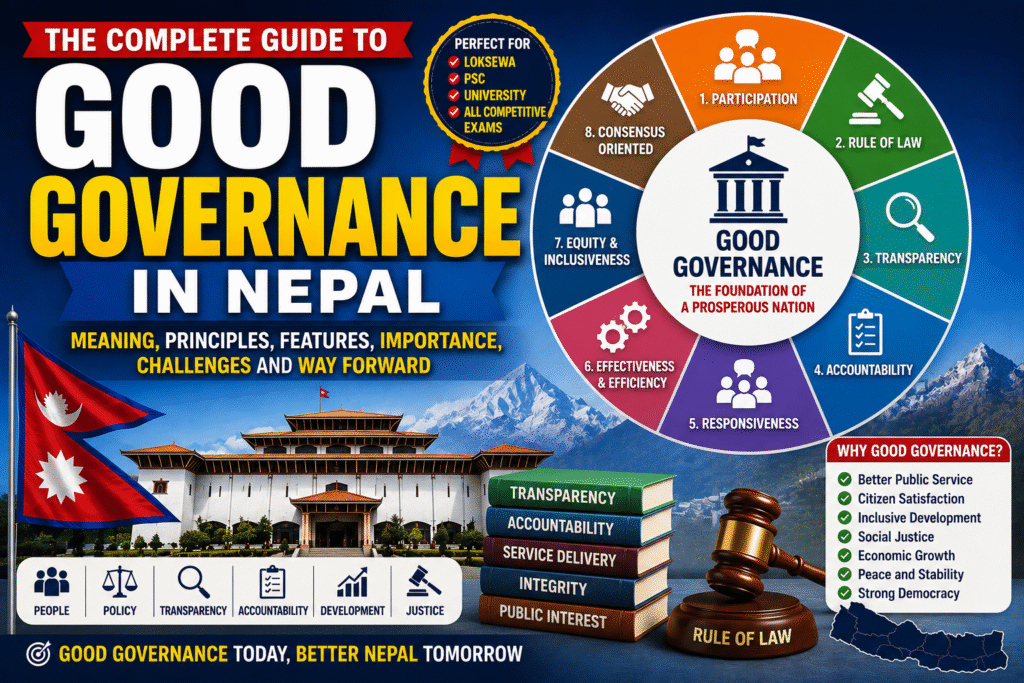
Leadership and Good Governance
Leadership and Good Governance are inseparable.
Strong leadership transforms governance principles into practical administrative outcomes.
Effective leaders promote:
- Transparency.
- Accountability.
- Rule of Law.
- Participation.
- Responsiveness.
- Equity.
- Efficiency.
- Inclusiveness.
Without capable leadership, good governance remains only a theoretical concept.
This section naturally complements our previous flagship article on Good Governance in Nepal.
Leadership in Nepal’s Public Administration
Leadership plays an increasingly important role in Nepal’s federal administrative system.
Following the Constitution of Nepal, 2015, leadership responsibilities have expanded across Federal, Provincial, and Local Governments.
Major public leaders include:
- Prime Minister.
- Ministers.
- Chief Secretary.
- Secretaries.
- Provincial Chief Secretaries.
- Provincial Secretaries.
- Chief Administrative Officers.
- Department Heads.
- Local Government Executives.
- Heads of Constitutional Bodies.
These leaders are responsible for implementing public policies, coordinating institutions, managing public resources, ensuring accountability, and delivering quality public services.
Nepal’s transition to federalism has made collaborative leadership more important than ever, as effective governance now depends on coordination among all three levels of government.
Challenges of Leadership in Public Administration
Despite continuous reforms in governance and public management, leadership in public administration faces numerous challenges. These challenges arise from political, administrative, economic, technological, and social changes. Understanding these challenges helps policymakers and public administrators develop stronger institutions and more effective leadership strategies.
1. Political Interference
One of the most significant challenges is excessive political interference in administrative decision-making.
Political interference may affect:
- Administrative neutrality.
- Merit-based decision-making.
- Civil service professionalism.
- Policy continuity.
- Institutional independence.
Professional public leaders must maintain a balance between democratic accountability and administrative impartiality.
2. Bureaucratic Resistance to Change
Government organizations often possess deeply established procedures and hierarchical structures.
As a result, leaders may encounter resistance when introducing:
- Administrative reforms.
- Digital governance.
- Organizational restructuring.
- Innovation.
- New technologies.
Successful leaders manage resistance through communication, participation, training, and gradual implementation.
3. Limited Resources
Many public organizations operate under financial, human, and technological constraints.
Leaders must therefore:
- Prioritize programs.
- Allocate resources efficiently.
- Improve productivity.
- Encourage innovation despite limited budgets.
4. Corruption and Ethical Challenges
Corruption weakens institutional credibility and public trust.
Public leaders must address:
- Abuse of authority.
- Conflict of interest.
- Nepotism.
- Bribery.
- Financial irregularities.
Ethical leadership is essential for preventing corruption and promoting integrity.
5. Rapid Technological Change
Artificial Intelligence, automation, big data, and digital governance are transforming public administration.
Modern leaders must continuously update their knowledge regarding:
- Digital governance.
- Cybersecurity.
- Data privacy.
- Digital public services.
- Artificial Intelligence governance.
6. Increasing Public Expectations
Citizens increasingly expect governments to provide:
- Faster services.
- Transparent decisions.
- Online services.
- Better communication.
- Greater participation.
- High-quality governance.
Public leaders must continuously improve service delivery to meet these expectations.
7. Crisis and Disaster Management
Public leaders frequently face unexpected crises such as:
- Earthquakes.
- Floods.
- Pandemics.
- Economic crises.
- Cybersecurity threats.
- Climate-related disasters.
Effective crisis leadership requires preparedness, coordination, resilience, and rapid decision-making.
8. Globalization
Globalization has expanded administrative responsibilities beyond national boundaries.
Public leaders now cooperate with:
- International organizations.
- Development partners.
- Regional institutions.
- Foreign governments.
Global cooperation requires diplomatic, strategic, and cross-cultural leadership skills.
Leadership Development Strategies
Strong leadership rarely develops by chance. Governments should establish systematic leadership development programs.
1. Continuous Professional Training
Leaders should receive regular training in:
- Public policy.
- Administrative law.
- Human resource management.
- Digital governance.
- Financial management.
- Leadership development.
2. Merit-Based Promotion
Leadership positions should primarily depend upon:
- Competence.
- Experience.
- Performance.
- Integrity.
- Professional qualifications.
Meritocracy strengthens institutional effectiveness.
3. Ethical Leadership Development
Training should promote:
- Honesty.
- Transparency.
- Accountability.
- Integrity.
- Public service values.
Ethics should remain central to every leadership program.
4. Strengthening Emotional Intelligence
Leadership programs should develop:
- Self-awareness.
- Empathy.
- Communication.
- Conflict management.
- Teamwork.
5. Digital Leadership Capacity
Future public leaders should understand:
- Artificial Intelligence.
- Data analytics.
- Digital transformation.
- E-Governance.
- Cybersecurity.
Digital competence has become a core leadership requirement.
6. International Learning
Governments should encourage:
- International exchange programs.
- Comparative administrative studies.
- Global leadership workshops.
- Best practice sharing.
Learning from successful governance systems accelerates institutional improvement.
International Best Practices
Many countries have strengthened public leadership through innovative reforms.
Common international practices include:
- Competency-based leadership development.
- Performance evaluation systems.
- Open Government initiatives.
- Digital transformation.
- Evidence-based policymaking.
- Citizen-centred service delivery.
- Ethical leadership frameworks.
- Continuous executive education.
- Succession planning.
- Leadership coaching and mentoring.
Organizations such as the United Nations (UN), OECD, World Bank, and Asian Development Bank (ADB) consistently emphasize adaptive, ethical, and collaborative leadership as key drivers of good governance.
Future Trends in Public Leadership
Public leadership continues to evolve alongside technological, institutional, and societal changes.
Important emerging trends include:
Digital Leadership
Leaders increasingly manage digital public services, online platforms, and data-driven governance.
Artificial Intelligence Governance
AI supports:
- Decision support.
- Predictive analysis.
- Service delivery.
- Fraud detection.
- Policy evaluation.
However, leaders must ensure AI is used ethically, transparently, and responsibly.
Collaborative Leadership
Modern governance increasingly depends on collaboration among:
- Government.
- Private sector.
- Civil society.
- International organizations.
- Local communities.
Collaborative leadership improves policy implementation and service delivery.
Adaptive Leadership
Leaders must respond effectively to uncertainty, complexity, and continuous change.
Adaptive leadership promotes:
- Innovation.
- Organizational learning.
- Institutional resilience.
Citizen-Centred Leadership
Governments increasingly design services based on citizens’ needs rather than administrative convenience.
Citizen-centred leadership strengthens democratic governance and public satisfaction.
Leadership in Nepal: Way Forward
To strengthen leadership within Nepal’s public administration, the following measures are particularly important:
- Promote merit-based appointments and promotions.
- Strengthen ethical standards across the civil service.
- Expand digital governance and leadership capacity.
- Encourage evidence-based decision-making.
- Enhance coordination among Federal, Provincial, and Local Governments.
- Invest in continuous professional development.
- Strengthen accountability and transparency mechanisms.
- Foster innovation and organizational learning.
- Increase citizen participation in governance.
- Build resilient institutions capable of responding to future challenges.
Frequently Asked Questions (FAQs)
What is leadership in public administration?
Leadership in public administration is the process of influencing, guiding, and motivating public officials to achieve governmental objectives while serving the public interest and upholding democratic values.
Why is leadership important in public administration?
Leadership improves decision-making, policy implementation, employee motivation, accountability, organizational performance, and public service delivery.
What is the difference between leadership and management?
Management focuses on planning, organizing, and controlling organizational activities, whereas leadership focuses on creating vision, inspiring people, managing change, and motivating employees.
Which leadership style is most suitable for public administration?
There is no universally best leadership style. Effective public leaders adopt different styles depending on the organizational context, legal requirements, employee capabilities, and public needs.
What qualities should an effective public leader possess?
An effective public leader should demonstrate vision, integrity, accountability, communication skills, emotional intelligence, professional competence, adaptability, ethical conduct, and commitment to public service.
Practice Questions
Short Questions
- Define leadership in public administration.
- State any five qualities of an effective public leader.
- Differentiate between leadership and management.
- Explain Transformational Leadership.
- What is Situational Leadership?
Long Questions
- Discuss the major theories of leadership in public administration with suitable examples.
- Explain the importance of leadership in promoting good governance.
- Analyze the challenges of leadership in Nepal’s public administration and suggest appropriate reforms.
- Compare Transformational and Transactional Leadership.
- Discuss the role of leadership in implementing public policies and strengthening accountability.
Conclusion
Leadership is the driving force behind effective public administration. While institutions, laws, and policies provide the formal framework for governance, it is leadership that transforms these frameworks into meaningful public outcomes. Effective public leaders inspire people, guide organizations through change, uphold constitutional values, strengthen accountability, and ensure that public resources are used efficiently and ethically.
In Nepal, the transition to federal governance, growing public expectations, rapid technological advancement, and increasingly complex policy challenges have made effective leadership more important than ever. Public leaders must combine professional competence with integrity, innovation, emotional intelligence, and a strong commitment to democratic principles. By strengthening leadership development, promoting meritocracy, embracing digital transformation, and fostering citizen-centred governance, Nepal can build resilient public institutions capable of delivering high-quality public services and advancing sustainable national development.
Leadership, therefore, is not merely about holding authority—it is about creating public value, building trust, empowering people, and guiding society toward a better future.
About the Author
Loksewa Aayog Tayariclass Editorial Team publishes research-based study materials, comprehensive notes, MCQs, and exam-oriented educational resources for Loksewa (PSC), university students, researchers, and competitive examination aspirants in Nepal. Our mission is to provide accurate, well-structured, easy-to-understand, and SEO-optimized content that supports academic excellence and strengthens knowledge in Public Administration, Governance, Public Policy, Administrative Law, and related disciplines.