Administrative Ethics in Public Administration: Meaning, Principles, Ethical Theories, Code of Conduct, Integrity, Accountability, Corruption, Challenges, and Nepal Context
The Ultimate Guide for Loksewa, PSC, University Students, Researchers, and Competitive Examinations
Introduction
Public administration is ultimately measured not only by the efficiency of its institutions but also by the ethical standards that guide the conduct of public officials. Governments exercise significant authority over public resources, public policies, public finances, and citizens’ rights. When this authority is exercised with honesty, fairness, transparency, and responsibility, it strengthens democratic governance and public trust. Conversely, when ethical standards are ignored, the consequences include corruption, abuse of authority, administrative injustice, declining institutional credibility, and weakened public confidence. For this reason, Administrative Ethics is widely recognized as one of the fundamental pillars of modern Public Administration.
Administrative Ethics refers to the moral values, professional standards, and principles that guide the behaviour and decision-making of public officials while performing their official duties. It requires administrators to act with integrity, impartiality, accountability, transparency, respect for the rule of law, and unwavering commitment to the public interest. Ethics goes beyond legal compliance; an action may be lawful yet still fail to meet the ethical expectations of fairness, honesty, and responsible governance. Therefore, ethical administration requires both adherence to law and commitment to moral responsibility.
The importance of ethics has increased considerably in the twenty-first century due to globalization, rapid technological advancement, digital governance, artificial intelligence, expanding citizen participation, and greater public demand for transparency and accountability. Citizens today expect governments not only to deliver services efficiently but also to ensure that every decision is ethical, impartial, inclusive, and free from corruption. Ethical public administration has therefore become an essential condition for sustainable development, democratic legitimacy, and effective governance.
Numerous scholars have emphasized the central role of ethics in administration. Woodrow Wilson argued that administration should be conducted professionally and responsibly in the public interest. Dwight Waldo highlighted that public administration cannot be separated from democratic values and ethical responsibility. Paul H. Appleby viewed morality as an inseparable component of public service, while John Rohr emphasized constitutional ethics and the responsibility of public administrators to uphold constitutional principles. Contemporary organizations such as the United Nations (UN), OECDhttps://www.oecd.org/governance/, World Bank, and Transparency International similarly identify integrity, accountability, transparency, and ethical leadership as indispensable foundations of good governance.
Administrative Ethics is closely connected with nearly every major concept of Public Administration. Leadership in Public Administration requires ethical leaders who inspire trust through integrity and responsible conduct. Public Accountability depends on administrators who willingly accept responsibility for their decisions and actions. Good Governance is built upon ethical principles such as transparency, participation, responsiveness, equity, and the rule of law. Administrative Law provides the legal framework within which ethical administration operates, while Human Resource Management promotes ethical organizational culture through recruitment, training, performance management, and disciplinary systems. Similarly, Decision Making in Public Administration increasingly emphasizes ethical reasoning, evidence-based choices, and protection of the public interest.
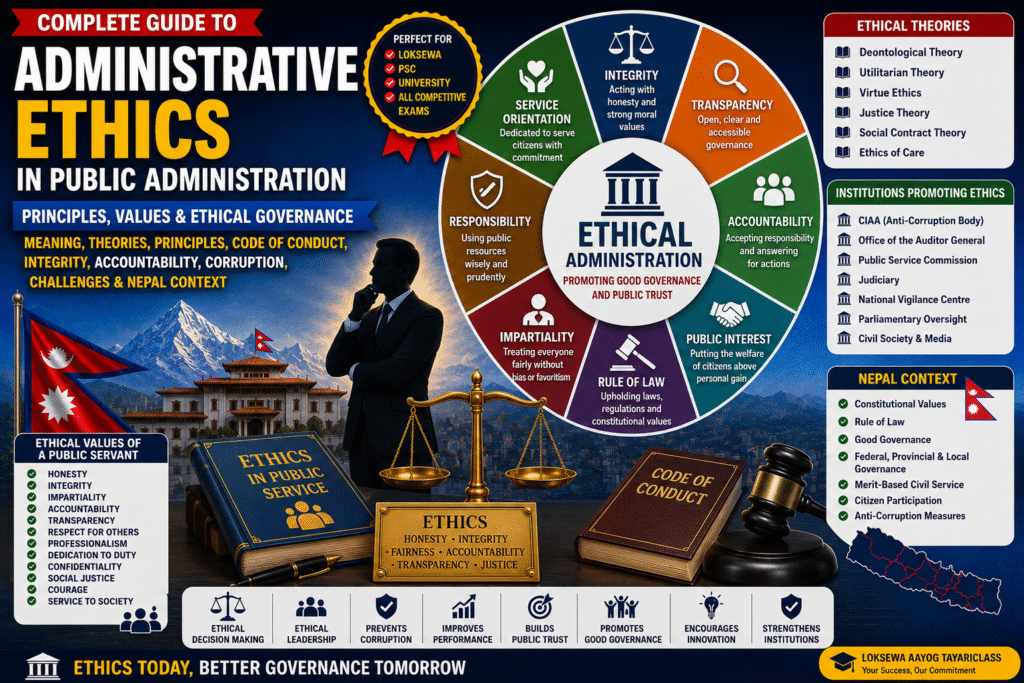
In Nepal, Administrative Ethics has become increasingly important following the adoption of the Constitution of Nepal, 2015, which establishes constitutional values including the rule of law, accountability, transparency, social justice, and good governance. Public officials at the Federal, Provincial, and Local levels are expected to perform their duties with integrity, impartiality, professionalism, and respect for constitutional principles. Institutions such as the Commission for the Investigation of Abuse of Authority (CIAA), the Office of the Auditor General, the Public Service Commission, the National Vigilance Centre, and the Judiciary all contribute to promoting ethical governance and preventing abuse of public authority.
For Loksewa (PSC), Judicial Service, university examinations, and other competitive examinations, Administrative Ethics is one of the most important and frequently examined topics. Questions often focus on its meaning, definitions, ethical theories, principles, code of conduct, integrity, accountability, corruption, ethical dilemmas, constitutional values, institutional mechanisms, Nepalese context, and administrative reforms. A thorough understanding of this subject is therefore essential for academic success, competitive examinations, and future careers in public service.
This flagship article presents a comprehensive and research-oriented study of Administrative Ethics in Public Administration, covering its meaning, scholarly definitions, evolution, ethical theories, principles, code of conduct, integrity, accountability, corruption, ethical leadership, institutional framework, Nepal context, international best practices, emerging challenges, future trends, frequently asked questions, and examination-oriented discussions. Structured as a pillar resource, this guide is designed to serve as a long-term reference for students, researchers, and public administration professionals while naturally connecting with our existing flagship articles on Public Administration, Good Governance, Leadership, Public Accountability, Administrative Law, Human Resource Management, Decision Making, and Civil Service.
Meaning of Administrative Ethics
Administrative Ethics refers to the moral principles, professional values, standards of conduct, and ethical responsibilities that guide the behaviour and decision-making of public officials while performing their official duties. It ensures that administrative authority is exercised not for personal gain but for the welfare of society, the protection of constitutional values, and the promotion of the public interest.
In simple terms,
Administrative Ethics is the application of moral values and ethical principles in public administration to ensure honesty, integrity, accountability, fairness, transparency, and responsible governance.
Unlike private organizations, where decisions are often driven primarily by business objectives and profitability, public administration exists to serve citizens. Therefore, every administrative decision must satisfy not only legal requirements but also ethical expectations. An action may comply with the law yet still be considered unethical if it violates principles of justice, impartiality, or public trust.
Administrative Ethics is not confined to preventing corruption. It encompasses every aspect of responsible public service, including fairness in recruitment, impartial decision-making, transparent financial management, protection of confidential information, respectful treatment of citizens, proper use of public resources, and adherence to constitutional values. Ethical administration therefore strengthens democratic governance and builds confidence between citizens and the state.
Definitions by Scholars
Several distinguished scholars have explained Administrative Ethics from different perspectives. Together, these definitions demonstrate that ethics is an indispensable foundation of effective public administration.
Dwight Waldo
Dwight Waldo emphasized that administration cannot be separated from moral responsibility.
According to Waldo,
Public Administration is inherently value-oriented, and every administrative decision involves ethical considerations.
His work shifted the study of administration beyond efficiency to include democracy, justice, and public values.
Paul H. Appleby
Paul Appleby regarded morality as inseparable from public service.
According to Appleby,
Government administration is fundamentally different from business administration because it exists to serve the public interest and therefore demands a higher ethical standard.
John A. Rohr
John Rohr emphasized constitutional ethics.
According to Rohr,
Public administrators should exercise their authority in accordance with constitutional principles and democratic values.
He argued that ethical public service begins with loyalty to the Constitution rather than to individuals or political interests.
Terry L. Cooper
Terry Cooper defined administrative ethics as:
The study and application of ethical principles in public organizations for guiding responsible administrative behaviour and public decision-making.
His work is widely regarded as one of the most influential contributions to modern administrative ethics.
Dennis F. Thompson
Dennis Thompson argued that:
Public officials are morally responsible not only for their own actions but also for the decisions and outcomes produced by the institutions they lead.
His perspective expands ethics beyond individual conduct to institutional responsibility.
Evolution of Administrative Ethics
The concept of Administrative Ethics has evolved alongside the development of modern public administration.
Classical Administrative Era
Early public administration emphasized:
- Efficiency.
- Hierarchy.
- Discipline.
- Rules.
- Administrative control.
Ethical issues received comparatively little attention.
Human Relations Era
With the emergence of behavioural approaches, greater importance was given to:
- Human dignity.
- Employee welfare.
- Organizational culture.
- Fair treatment.
- Participation.
Ethics became increasingly linked with leadership and organizational behaviour.
New Public Administration (NPA)
The New Public Administration movement of the late twentieth century expanded the scope of ethics by emphasizing:
- Social equity.
- Citizen participation.
- Democratic values.
- Administrative responsiveness.
- Public accountability.
New Public Management (NPM)
New Public Management introduced private-sector management techniques into government while simultaneously raising important ethical concerns regarding accountability, transparency, equity, and protection of the public interest.
Contemporary Governance
Modern governance recognizes ethics as essential for:
- Good Governance.
- Anti-corruption.
- Digital Governance.
- Human Rights.
- Sustainable Development.
- Citizen-centred administration.
Today, Administrative Ethics is considered one of the core pillars of democratic governance.
Nature of Administrative Ethics
Administrative Ethics possesses several distinctive characteristics.
Value-Based
Administrative Ethics is founded upon moral values rather than mere technical procedures.
Public Interest Oriented
Every ethical administrative decision seeks to protect and promote the welfare of society.
Constitutional
Ethical administration respects:
- Constitutional supremacy.
- Rule of Law.
- Fundamental Rights.
- Democratic principles.
Dynamic
Ethical standards continue to evolve with changing technologies, governance models, and public expectations.
Universal
Although administrative systems differ across countries, core ethical values such as honesty, fairness, accountability, and integrity are universally accepted.
Preventive
Administrative Ethics aims to prevent misconduct before it occurs by establishing professional standards, ethical education, institutional safeguards, and accountability mechanisms.
Characteristics of Administrative Ethics
Administrative Ethics is characterized by the following features:
- Integrity.
- Honesty.
- Accountability.
- Transparency.
- Impartiality.
- Fairness.
- Respect for the Rule of Law.
- Responsibility.
- Professionalism.
- Service orientation.
- Respect for human dignity.
- Protection of public resources.
- Commitment to constitutional values.
These characteristics collectively distinguish ethical administration from merely legal or procedural administration.
Scope of Administrative Ethics
The scope of Administrative Ethics extends across every area of public administration.
It includes:
- Public decision-making.
- Public financial management.
- Human Resource Management.
- Public procurement.
- Service delivery.
- Policy implementation.
- Leadership.
- Administrative accountability.
- Conflict of interest management.
- Anti-corruption measures.
- Citizen relations.
- Digital governance.
- Environmental responsibility.
- Artificial Intelligence governance.
- Institutional integrity.
As governments become more technologically advanced and interconnected, the scope of administrative ethics continues to expand.
Objectives of Administrative Ethics
Administrative Ethics seeks to achieve several important objectives.
- Promote integrity in public service.
- Protect the public interest.
- Strengthen public trust.
- Prevent corruption.
- Encourage accountability.
- Improve transparency.
- Ensure fairness in administrative decisions.
- Enhance professionalism.
- Uphold constitutional values.
- Improve the quality of public service delivery.
- Support democratic governance.
- Strengthen institutional credibility.
Importance of Administrative Ethics
Administrative Ethics is indispensable for effective public administration.
Its importance can be understood from several perspectives.
Promotes Good Governance
Ethics strengthens transparency, accountability, participation, responsiveness, equity, and the Rule of Law.
This naturally complements our flagship article on Good Governance in Nepal.
Builds Public Trust
Citizens develop confidence in government institutions when public officials consistently demonstrate honesty, fairness, and integrity.
Prevents Corruption
Ethical standards reduce opportunities for:
- Bribery.
- Abuse of authority.
- Nepotism.
- Fraud.
- Misuse of public resources.
Strengthens Leadership
Ethical leadership inspires employees and creates an organizational culture based on responsibility and public service.
This section directly connects with our flagship article on Leadership in Public Administration.
Improves Decision-Making
Administrative Ethics encourages public officials to evaluate decisions not only on legal or financial grounds but also on fairness, justice, and long-term public benefit.
Protects Human Rights
Ethical administration respects equality, dignity, inclusion, and the constitutional rights of every citizen.
Supports Sustainable Development
Ethical governance ensures that today’s decisions do not undermine the rights and opportunities of future generations.
Relationship with Other Public Administration Concepts
Administrative Ethics is closely interconnected with almost every major concept in Public Administration.
- Leadership in Public Administration provides ethical direction and role modelling.
- Public Accountability ensures officials remain answerable for ethical conduct.
- Good Governance is built upon ethical values such as transparency, integrity, and participation.
- Administrative Law establishes the legal framework within which ethical behaviour must occur.
- Human Resource Management promotes ethics through recruitment, training, appraisal, and discipline.
- Decision Making in Public Administration requires ethical reasoning alongside legal and technical analysis.
- Civil Service in Nepal depends upon neutrality, professionalism, and integrity for effective service delivery.
Together, these relationships demonstrate that Administrative Ethics is not an isolated topic but the moral foundation connecting every major dimension of Public Administration.
Ethical Theories in Administrative Ethics
Ethical theories provide systematic frameworks for determining what is right, fair, and morally acceptable in public administration. They help public officials make responsible decisions, especially when legal requirements, political pressures, and public expectations conflict. A sound understanding of these theories enables administrators to justify their actions not only legally but also ethically.
1. Deontological Theory (Duty-Based Ethics)
Major Philosopher: Immanuel Kant
Deontological ethics argues that the morality of an action depends on whether it fulfills one’s duty, regardless of its consequences.
According to Kant:
People should always do what is morally right because it is their duty, not because it produces favorable outcomes.
Core Principles
- Duty comes before personal interest.
- Rules must be followed consistently.
- Every individual deserves equal respect.
- Ethical actions should never depend solely on results.
Application in Public Administration
A civil servant should refuse a bribe even if accepting it appears beneficial to someone because accepting corruption violates official duty and public trust.
Strengths
- Promotes integrity.
- Protects the Rule of Law.
- Encourages fairness and impartiality.
- Prevents arbitrary decision-making.
Limitations
- May be too rigid in emergency situations.
- Sometimes ignores practical consequences.
2. Utilitarian Theory (Consequentialism)
Major Philosophers: Jeremy Bentham and John Stuart Mill
Utilitarianism evaluates actions according to their consequences.
Its central principle is:
The best decision is the one that produces the greatest good for the greatest number of people.
Application in Public Administration
When allocating limited disaster relief funds, administrators prioritize actions that maximize benefits for the largest number of affected citizens.
Advantages
- Encourages efficient use of public resources.
- Supports evidence-based policymaking.
- Promotes public welfare.
Limitations
- Minority rights may be overlooked.
- Ethical decisions cannot always be measured by numbers alone.
3. Virtue Ethics
Major Philosopher: Aristotle
Virtue Ethics focuses not primarily on rules or consequences but on the moral character of the decision-maker.
According to Aristotle:
Good administration begins with good character.
Important virtues include:
- Honesty.
- Courage.
- Wisdom.
- Justice.
- Compassion.
- Temperance.
- Integrity.
Application
An ethical public leader consistently demonstrates honesty and fairness even when external supervision is absent.
Importance
Virtue ethics emphasizes developing ethical public servants rather than merely enforcing ethical rules.
4. Justice Theory
Major Philosopher: John Rawls
Rawls argued that justice should guide public institutions.
His theory emphasizes:
- Equal rights.
- Equal opportunities.
- Fair distribution of public resources.
- Protection of disadvantaged groups.
Application
Government scholarship programs should be designed fairly, ensuring disadvantaged citizens receive equal opportunities.
Importance
Justice Theory strongly supports:
- Social equity.
- Inclusive governance.
- Democratic administration.
5. Social Contract Theory
Major Thinkers:
- Thomas Hobbes
- John Locke
- Jean-Jacques Rousseau
Social Contract Theory argues that governments derive legitimacy from the consent of the people.
Public officials therefore have an ethical obligation to:
- Protect citizens’ rights.
- Respect constitutional values.
- Serve the public interest.
- Exercise authority responsibly.
Importance
This theory reinforces democratic accountability and constitutional governance.
6. Ethics of Care
Ethics of Care emphasizes:
- Empathy.
- Compassion.
- Human relationships.
- Respect.
- Responsiveness.
Rather than applying rigid rules alone, administrators should consider human circumstances when making decisions.
Example
Providing additional assistance to vulnerable citizens during natural disasters demonstrates ethics of care.
Comparison of Major Ethical Theories
| Theory | Main Focus | Leading Scholar |
|---|---|---|
| Deontology | Duty and rules | Immanuel Kant |
| Utilitarianism | Consequences | Bentham & Mill |
| Virtue Ethics | Moral character | Aristotle |
| Justice Theory | Fairness | John Rawls |
| Social Contract | Public consent | Locke, Hobbes, Rousseau |
| Ethics of Care | Compassion | Carol Gilligan and later scholars |
Principles of Administrative Ethics
Ethical public administration rests upon several universally accepted principles.
1. Integrity
Integrity requires public officials to remain honest, truthful, and consistent in both words and actions.
Integrity forms the foundation of public trust.
2. Accountability
Public officials must explain and justify their decisions and accept responsibility for administrative outcomes.
This naturally reinforces our flagship article on Public Accountability in Public Administration.
3. Transparency
Government decisions should be open, understandable, and accessible whenever legally appropriate.
Transparency reduces corruption and increases public confidence.
4. Impartiality
Public officials should treat every citizen fairly without discrimination based on:
- Political affiliation.
- Religion.
- Ethnicity.
- Gender.
- Economic status.
5. Rule of Law
Administrative authority must always operate within constitutional and legal boundaries.
Ethical administration never permits arbitrary exercise of power.
6. Public Interest
Every administrative decision should prioritize the welfare of society rather than personal or political interests.
7. Professional Competence
Ethical responsibility includes maintaining professional knowledge and continuously improving administrative skills.
8. Respect for Human Dignity
Every citizen deserves respectful treatment regardless of social, economic, or cultural background.
9. Confidentiality
Public officials should protect confidential information while balancing transparency with legal obligations.
10. Service Orientation
Public office is fundamentally a public trust.
Administrative decisions should always aim to improve citizens’ well-being.
Code of Conduct in Public Administration
A Code of Conduct is a formal document that establishes the ethical standards expected of public officials.
Although specific provisions vary across countries, most codes include the following obligations:
- Act honestly and fairly.
- Avoid corruption.
- Maintain political neutrality where required.
- Respect the Constitution and the law.
- Protect confidential information.
- Avoid conflicts of interest.
- Use public resources responsibly.
- Treat citizens respectfully.
- Demonstrate professionalism.
- Promote transparency and accountability.
A well-designed code of conduct strengthens ethical organizational culture and promotes consistency in administrative behaviour.
Integrity in Public Administration
Integrity means maintaining consistency between ethical values and administrative actions.
A public servant with integrity:
- Refuses bribery.
- Uses public resources responsibly.
- Avoids favoritism.
- Respects legal procedures.
- Acts in the public interest.
- Accepts accountability.
Integrity is widely regarded as the cornerstone of ethical governance.
Conflict of Interest
A conflict of interest arises when an official’s personal interests interfere—or appear to interfere—with official responsibilities.
Common Examples
- Awarding government contracts to relatives.
- Participating in decisions involving personal financial interests.
- Accepting gifts that influence official decisions.
- Using confidential information for private benefit.
Managing Conflicts of Interest
Effective measures include:
- Disclosure of personal interests.
- Recusal from affected decisions.
- Transparent procurement processes.
- Independent oversight.
- Clear institutional guidelines.
Proper management of conflicts of interest protects public confidence and institutional legitimacy.
Ethical Decision-Making in Public Administration
Ethical decision-making involves evaluating administrative choices using both legal standards and ethical principles.
A practical model includes these steps:
- Clearly identify the issue.
- Gather relevant facts and legal requirements.
- Identify stakeholders who may be affected.
- Consider ethical principles such as integrity, fairness, accountability, and public interest.
- Evaluate available alternatives.
- Select the most ethical and lawful option.
- Implement the decision transparently.
- Review outcomes and learn for future decisions.
This structured approach helps administrators make decisions that are legally sound, ethically defensible, and publicly accountable.
Ethical Leadership
Ethical leadership is the practical application of administrative ethics through leadership behaviour.
Ethical leaders:
- Lead by example.
- Demonstrate integrity.
- Encourage transparency.
- Promote accountability.
- Prevent corruption.
- Respect the Rule of Law.
- Foster an ethical organizational culture.
- Place the public interest above personal gain.
Ethical leadership directly supports our flagship articles on Leadership in Public Administration, Good Governance in Nepal, and Administrative Law in Nepal, demonstrating how these concepts work together to strengthen democratic governance.
Corruption and Administrative Ethics
Corruption is one of the greatest threats to ethical public administration. It weakens democratic institutions, undermines the rule of law, wastes public resources, discourages investment, reduces administrative efficiency, and erodes citizens’ trust in government. While laws and regulations can punish corrupt behaviour, Administrative Ethics seeks to prevent corruption by cultivating integrity, accountability, and a strong public service culture.
The relationship between corruption and administrative ethics is inverse: the stronger the ethical culture within public institutions, the lower the likelihood of corruption.
Meaning of Corruption
Corruption refers to the misuse of public authority, official position, or entrusted power for private benefit.
Transparency International defines corruption as:
“The abuse of entrusted power for private gain.”
This definition applies not only to financial misconduct but also to any misuse of public office for personal, political, or organizational advantage.
Common Forms of Corruption
Corruption takes many forms in public administration.
The most common include:
Bribery
Accepting or offering money, gifts, or favors to influence official decisions.
Nepotism
Giving unfair preference to family members in recruitment, promotion, procurement, or other official matters.
Favoritism
Providing unjustified benefits to friends, associates, or influential individuals.
Embezzlement
Misappropriating public funds or government property for personal use.
Abuse of Authority
Using official powers beyond legal limits for private or political interests.
Fraud
Intentionally deceiving the government or the public for financial or personal benefit.
Conflict of Interest
Allowing personal interests to influence official responsibilities.
Patronage
Making appointments based on political loyalty rather than merit and competence.
Causes of Unethical Behaviour in Public Administration
Unethical conduct rarely results from a single factor. It often emerges from the interaction of institutional weaknesses, personal motivations, and organizational culture.
Major causes include:
- Weak ethical leadership.
- Lack of accountability.
- Political interference.
- Poor organizational culture.
- Inadequate salaries and incentives.
- Weak internal control systems.
- Lack of transparency.
- Excessive administrative discretion.
- Weak law enforcement.
- Limited public awareness.
- Inadequate ethics education.
- Ineffective disciplinary mechanisms.
These factors highlight why ethics must be integrated into every aspect of public administration rather than treated as a separate subject.
Consequences of Unethical Administration
Failure to uphold ethical standards has far-reaching consequences.
It can lead to:
- Declining public trust.
- Reduced administrative efficiency.
- Poor service delivery.
- Misuse of public resources.
- Increased corruption.
- Weak democratic governance.
- Human rights violations.
- Social inequality.
- Reduced foreign investment.
- Slower economic development.
- Institutional instability.
Ethical governance, therefore, is not merely a moral ideal but also an economic and developmental necessity.
Ethical Dilemmas in Public Administration
An ethical dilemma arises when a public official must choose between competing ethical values, legal obligations, organizational expectations, or public interests.
Unlike routine administrative decisions, ethical dilemmas often involve situations where every available option has both advantages and disadvantages.
Common Ethical Dilemmas
- Confidentiality versus transparency.
- Loyalty to superiors versus loyalty to the Constitution.
- Administrative efficiency versus procedural fairness.
- Political responsiveness versus administrative neutrality.
- Public security versus individual rights.
- Equality versus equity in resource allocation.
Resolving ethical dilemmas requires careful consideration of legal requirements, ethical principles, constitutional values, and long-term public interest.
Institutional Mechanisms for Promoting Administrative Ethics
Ethical governance depends not only on individual morality but also on strong institutions that encourage integrity and prevent misconduct.
1. Commission for the Investigation of Abuse of Authority (CIAA)
The CIAA is Nepal’s constitutional anti-corruption body.
Its major functions include:
- Investigating abuse of authority.
- Preventing corruption.
- Recommending legal action.
- Promoting integrity in public administration.
The CIAA plays a central role in strengthening administrative accountability and ethical governance.
2. Office of the Auditor General (OAG)
The Auditor General promotes ethics through financial accountability.
Its responsibilities include:
- Auditing public expenditure.
- Evaluating financial compliance.
- Detecting irregularities.
- Promoting responsible financial management.
The Auditor General strengthens transparency and protects public resources.
3. Public Service Commission (PSC)
The Public Service Commission contributes to ethical administration by ensuring:
- Merit-based recruitment.
- Fair competition.
- Equal opportunity.
- Professional civil service.
Meritocracy reduces favoritism and strengthens institutional integrity.
4. Judiciary
An independent judiciary protects ethical governance by:
- Interpreting laws.
- Reviewing administrative actions.
- Protecting constitutional rights.
- Ensuring the Rule of Law.
Judicial review discourages arbitrary administrative behaviour.
5. National Vigilance Centre
The National Vigilance Centre supports ethical governance through:
- Monitoring administrative integrity.
- Preventing corruption.
- Promoting transparency.
- Strengthening institutional discipline.
6. Parliament
Parliament exercises oversight through:
- Question sessions.
- Committee investigations.
- Budget scrutiny.
- Legislative review.
Parliamentary oversight reinforces democratic accountability.
7. Civil Society and Media
Independent media and civil society organizations contribute by:
- Investigating corruption.
- Raising public awareness.
- Promoting transparency.
- Monitoring government performance.
An informed society strengthens ethical governance.
Administrative Ethics in Nepal
Administrative Ethics has gained increasing importance following the promulgation of the Constitution of Nepal, 2015 and the adoption of the federal democratic governance system.
Public officials are expected to perform their duties in accordance with:
- Constitutional supremacy.
- Rule of Law.
- Transparency.
- Accountability.
- Professionalism.
- Integrity.
- Impartiality.
- Public service values.
Despite significant progress, Nepal continues to face challenges such as:
- Political interference.
- Delays in public service delivery.
- Corruption risks.
- Weak institutional coordination.
- Limited digital governance capacity.
- Inconsistent enforcement of ethical standards.
Strengthening ethics therefore remains a continuous reform priority.
International Best Practices
Many countries have successfully strengthened administrative ethics through comprehensive governance reforms.
Common international practices include:
- Mandatory Codes of Ethics.
- Independent anti-corruption commissions.
- Whistleblower protection laws.
- Transparent procurement systems.
- Open Government initiatives.
- Digital public services.
- Ethics training for civil servants.
- Asset declaration requirements.
- Strong parliamentary oversight.
- Citizen participation mechanisms.
Organizations such as the United Nations (UN), OECD, World Bank, and Transparency International consistently advocate these practices to improve integrity and public trust.
Emerging Trends in Administrative Ethics
The scope of administrative ethics continues to evolve.
Important emerging trends include:
- Digital Ethics.
- Artificial Intelligence Ethics.
- Data Privacy and Cybersecurity.
- Open Government Data.
- Environmental Ethics.
- Sustainable Governance.
- Inclusive Governance.
- Citizen-Centred Public Services.
- Behavioural Ethics.
- Ethical Leadership Development.
Future public administrators will increasingly require ethical competence alongside legal and technical expertise.
Frequently Asked Questions (FAQs)
What is Administrative Ethics?
Administrative Ethics is the application of moral principles and professional values in public administration to ensure integrity, accountability, transparency, fairness, and service to the public interest.
Why is Administrative Ethics important?
It strengthens public trust, prevents corruption, improves decision-making, promotes accountability, and supports good governance.
What is the relationship between Administrative Ethics and Good Governance?
Administrative Ethics provides the moral foundation for Good Governance by promoting transparency, accountability, participation, integrity, and the Rule of Law.
How does Administrative Ethics reduce corruption?
By encouraging ethical leadership, clear codes of conduct, institutional accountability, transparency, merit-based administration, and effective oversight mechanisms.
Practice Questions
Short Questions
- Define Administrative Ethics.
- Explain any five principles of Administrative Ethics.
- Differentiate between ethics and law.
- What is a conflict of interest?
- State the role of the CIAA in promoting administrative ethics.
Long Questions
- Discuss the importance of Administrative Ethics in promoting Good Governance.
- Explain the major ethical theories with suitable examples.
- Analyze the causes of corruption in public administration and suggest measures for its control.
- Evaluate the institutional mechanisms promoting administrative ethics in Nepal.
- Discuss emerging ethical challenges in the era of digital governance and Artificial Intelligence.
Conclusion
Administrative Ethics is the moral foundation of Public Administration. While laws define what public officials are permitted or prohibited from doing, ethics guides them toward what they ought to do in the public interest. Ethical administration ensures that authority is exercised with integrity, fairness, accountability, transparency, and respect for constitutional values.
In Nepal, strengthening administrative ethics is essential for consolidating federal democratic governance, improving public service delivery, combating corruption, and enhancing citizens’ confidence in public institutions. Ethical leadership, merit-based civil service, effective oversight institutions, continuous ethics education, and responsible use of emerging technologies will be critical in shaping the future of public administration.
Ultimately, administrative ethics is not simply about avoiding misconduct—it is about creating a public service culture where integrity, professionalism, and commitment to the common good become the defining characteristics of governance. This ethical foundation enables governments to deliver equitable, efficient, and citizen-centred services while safeguarding democracy and sustainable national development.
Related Articles
📘 Public Administration: Definition, Scope, Functions, Importance and Role in Governance
📘 Organization Theory in Public Administration
📘 Public Policy: Meaning, Process, Types, Models and Nepal Context
📘 Decision Making in Public Administration
📘 Leadership in Public Administration
📘 Public Accountability in Public Administration
About the Author
Loksewa Aayog Tayariclass Editorial Team publishes research-based study materials, comprehensive notes, MCQs, and exam-oriented educational resources for Loksewa (PSC), university students, researchers, and competitive examination aspirants in Nepal. Our mission is to provide accurate, well-structured, easy-to-understand, and SEO-optimized content that strengthens knowledge in Public Administration, Governance, Administrative Law, Public Policy, Leadership, Administrative Ethics, and related disciplines.