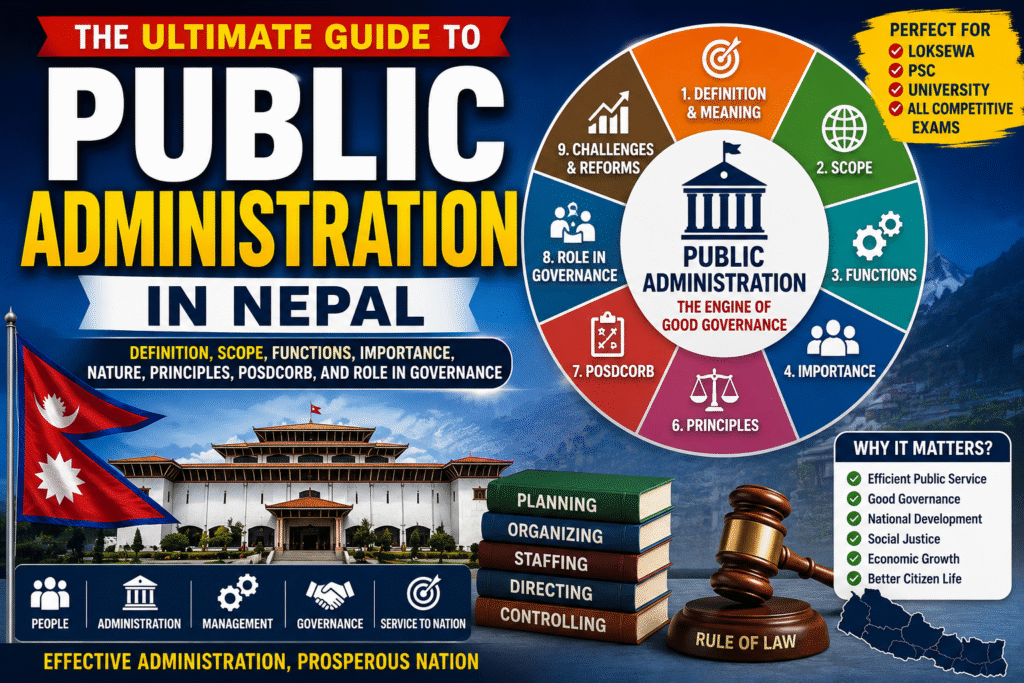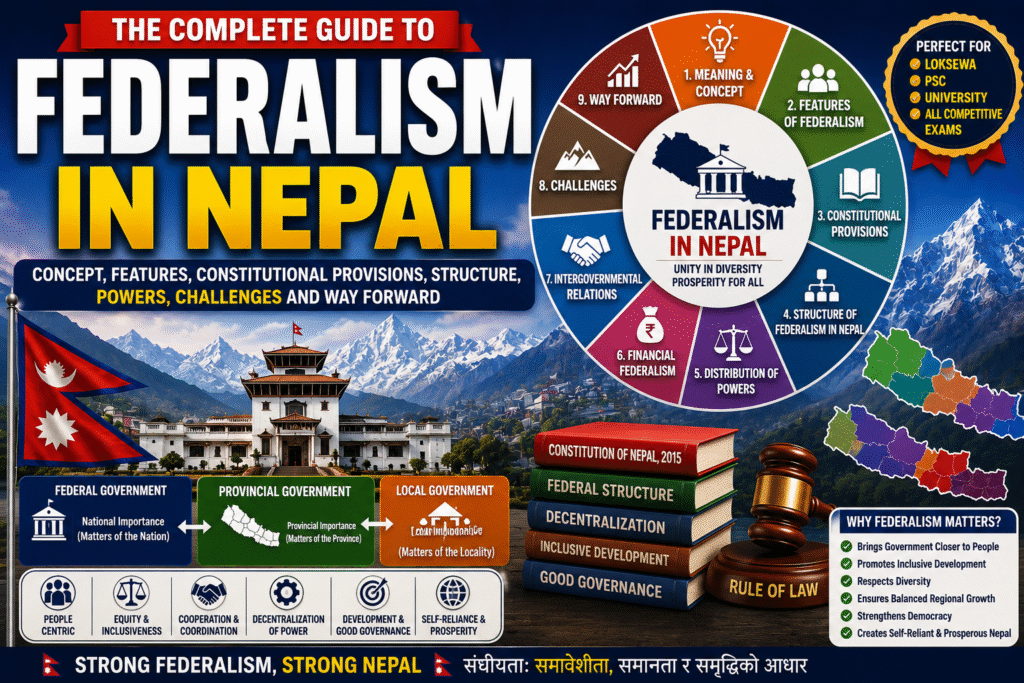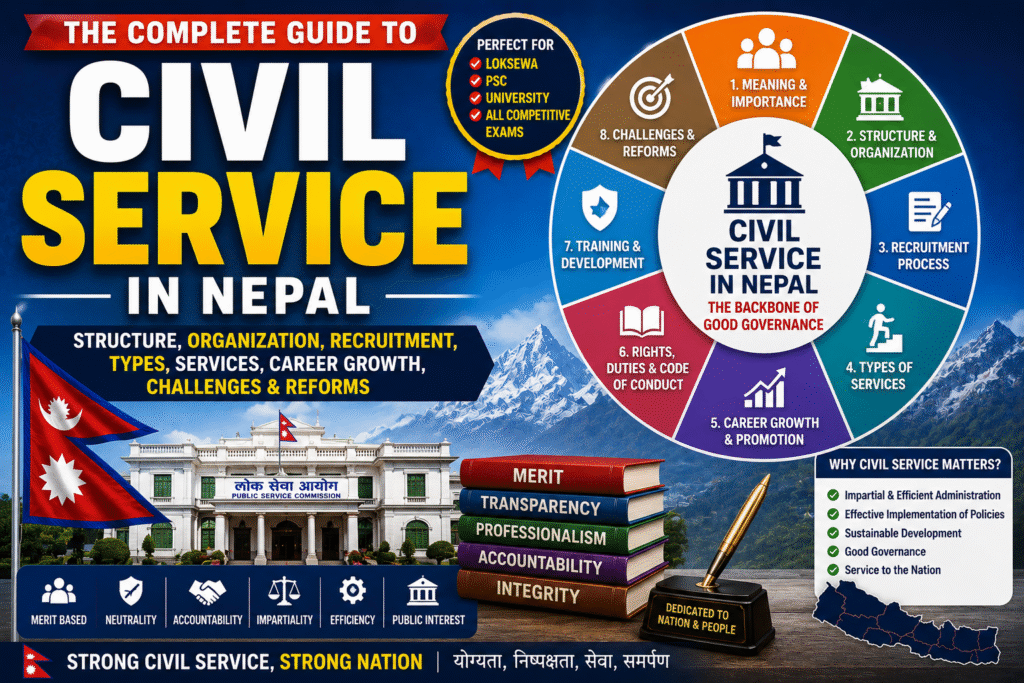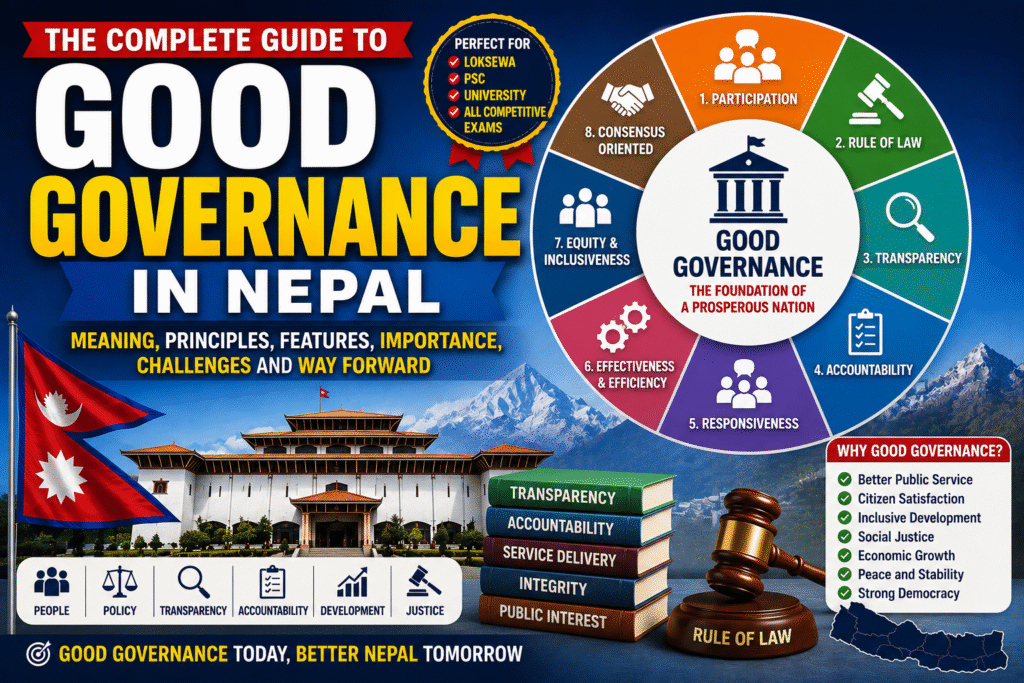
Good Governance in Nepal: Meaning, Principles, Characteristics, Indicators, Challenges, and Importance
The Ultimate Guide for Loksewa, University Students, and Competitive Examinations
Introduction
In today’s world, development is no longer measured solely by economic growth, infrastructure, or technological advancement. Nations are increasingly evaluated by the quality of their governance system and good governance practices—how effectively public institutions function, how transparently decisions are made, how responsibly public resources are managed, and how fairly citizens are treated under the rule of law. The principles of good governance, including transparency, accountability, citizen participation, efficiency, and inclusiveness, have become essential indicators of effective public administration and sustainable development.
A country may possess abundant natural resources, a large economy, or significant political power. However, without good governance, these advantages often fail to translate into sustainable development or improved quality of life. Conversely, many countries with limited natural resources have achieved remarkable progress through accountable institutions, transparent administration, strong legal systems, and effective public service delivery. This demonstrates that good governance is one of the most valuable foundations of national development.
For Nepal, the concept of good governance has become increasingly significant following the restoration of democracy, the restructuring of the state under federalism, and the adoption of the Constitution of Nepal, 2015. Citizens today expect governments not only to formulate policies but also to deliver quality public services efficiently, uphold the rule of law, combat corruption, protect fundamental rights, and ensure inclusive participation in decision-making.
Good governance therefore extends far beyond the routine functioning of government. It emphasizes how power is exercised, how decisions are taken, how institutions remain accountable, and how public resources are utilized for the collective welfare of society. It seeks to establish a governance system where public institutions are transparent, responsive, efficient, equitable, participatory, and accountable to the people they serve.
In the context of Public Administration, good governance serves as both a guiding principle and an ultimate objective. Modern public administration is no longer limited to maintaining law and order or implementing government policies. It now focuses on citizen-centric service delivery, institutional integrity, ethical leadership, digital transformation, social inclusion, environmental sustainability, and evidence-based policymaking—all of which are essential components of good governance.
For Loksewa examinations, good governance is one of the most frequently tested topics because it is closely linked with constitutional law, federalism, public administration, civil service, accountability, transparency, decentralization, public finance, and sustainable development. A clear conceptual understanding enables candidates to answer descriptive, analytical, and objective questions effectively.
This comprehensive guide explores the meaning, evolution, principles, characteristics, indicators, constitutional framework, legal provisions, institutional mechanisms, importance, challenges, and future prospects of good governance in Nepal. It combines theoretical concepts with the Nepalese context to provide students, competitive examination candidates, and general readers with a complete understanding of one of the most important subjects in modern governance.
Understanding Governance Before Good Governance
Before studying Good Governance, it is important to understand the broader concept of Governance itself. Although the terms Government and Governance are often used interchangeably in everyday discussions, they do not have the same meaning. A clear distinction between these concepts forms the foundation for understanding good governance.
Governance refers to the overall process through which public authority is exercised, decisions are made, policies are implemented, resources are managed, and relationships among the government, private sector, and civil society are coordinated to achieve collective goals.
Unlike government, which primarily refers to formal political institutions, governance encompasses a much broader system involving multiple actors, institutions, legal frameworks, and processes that influence public decision-making.
Modern governance recognizes that solving complex social, economic, and environmental problems requires cooperation among governments, citizens, businesses, non-governmental organizations, international institutions, and local communities.
Consequently, governance is best understood not merely as the exercise of governmental power but as the collective process of managing public affairs in a manner that promotes development, justice, accountability, and public welfare.
Governance: Scholarly Perspectives
Various international organizations and scholars have explained governance from different perspectives.
According to the World Bank, governance refers to the manner in which power is exercised in the management of a country’s economic and social resources for development.
The United Nations Development Programme (UNDP) defines governance as the exercise of economic, political, and administrative authority to manage a nation’s affairs at all levels.
Similarly, governance scholars emphasize that governance involves the interaction of institutions, rules, procedures, and stakeholders that collectively influence public policy and administrative outcomes.
Although these definitions differ in wording, they share a common idea: governance is concerned with how authority is exercised rather than merely who exercises it.
Government vs Governance
One of the most common questions in Loksewa and university examinations is the distinction between Government and Governance.
| Basis | Government | Governance |
|---|---|---|
| Meaning | Formal political institution exercising state authority | Process of exercising authority and managing public affairs |
| Nature | Institutional | Process-oriented |
| Main Actors | Government institutions | Government, private sector, civil society, citizens |
| Focus | Administration and policy implementation | Decision-making, accountability, participation, transparency |
| Scope | Comparatively narrow | Broad and multidimensional |
| Objective | Running the state | Achieving effective, accountable and inclusive governance |
Understanding this distinction makes it easier to appreciate why good governance focuses not only on governmental institutions but also on the quality of decision-making, public participation, transparency, accountability, and institutional effectiveness.
Meaning of Good Governance
The concept of Good Governance emerged from the realization that development depends not only on government policies but also on the quality of institutions responsible for implementing those policies. A country may have abundant resources and well-designed development plans, yet without transparency, accountability, participation, and the rule of law, sustainable development remains difficult to achieve.
Good governance therefore focuses on how public authority is exercised, how decisions are made, how public resources are managed, and how governments remain accountable to citizens.
In simple terms, good governance means governing in a manner that is transparent, accountable, participatory, responsive, effective, equitable, lawful, and citizen-oriented.
Rather than concentrating solely on governmental power, good governance emphasizes the quality of governance processes and the relationship between the state and its citizens.
A government is considered successful not merely because it formulates policies, but because it implements them fairly, efficiently, ethically, and in the public interest.
Definitions of Good Governance
Although different international organizations describe good governance in different ways, their definitions emphasize similar principles.
World Bank
The World Bank introduced the concept of good governance prominently in the late 1980s while examining development challenges in many countries.
According to the World Bank:
Good governance is the manner in which power is exercised in managing a country’s economic and social resources for development.
This definition highlights efficient resource management, institutional effectiveness, and responsible exercise of public authority.
United Nations Development Programme (UNDP)
According to the UNDP:
Good governance is the exercise of economic, political, and administrative authority to manage a country’s affairs at all levels in a manner that promotes participation, transparency, accountability, effectiveness, equity, and the rule of law.
This definition emphasizes democratic participation and citizen-centered governance.
Asian Development Bank (ADB)
The Asian Development Bank identifies four core dimensions of good governance:
- Accountability
- Participation
- Predictability (Rule of Law)
- Transparency
These four dimensions have significantly influenced governance reforms in many developing countries, including Nepal.
Simple Definition for Loksewa
For examination purposes, good governance can be defined as:
Good governance is a system of governing in which public authority is exercised transparently, accountably, efficiently, equitably, and according to the rule of law for the welfare of citizens.
This definition is concise, accurate, and suitable for descriptive answers.
Evolution of the Concept of Good Governance
Although the principles of fairness, justice, and responsible administration have existed since ancient civilizations, the modern concept of good governance gained international recognition only in the late twentieth century.
Following the economic crises experienced by many developing countries during the 1980s, international organizations observed that financial assistance alone could not ensure sustainable development. Weak institutions, corruption, political instability, poor public administration, and lack of accountability often prevented development programmes from achieving their intended outcomes.
As a result, organizations such as the World Bank, United Nations, International Monetary Fund (IMF), and Asian Development Bank (ADB) increasingly emphasized governance reforms as an essential requirement for economic and social development.
During the 1990s, good governance became closely associated with:
- Democratic governance
- Public sector reform
- Anti-corruption initiatives
- Decentralization
- Human rights
- Citizen participation
- Sustainable development
Today, good governance is recognized as one of the most important foundations for achieving the United Nations Sustainable Development Goals (SDGs), particularly SDG 16: Peace, Justice and Strong Institutions.
Core Objectives of Good Governance
The primary objective of good governance is to ensure that public institutions serve the interests of citizens efficiently, fairly, and responsibly.
Its major objectives include:
- Promoting transparency in public administration.
- Strengthening accountability of public institutions.
- Ensuring citizen participation in decision-making.
- Protecting the rule of law.
- Improving public service delivery.
- Preventing corruption and misuse of public resources.
- Promoting social justice and inclusion.
- Strengthening democratic institutions.
- Encouraging sustainable development.
- Building public trust in government.
These objectives collectively contribute to creating a governance system that is responsive to the needs and aspirations of citizens.
Why Good Governance Matters
Good governance is not merely an administrative ideal; it has direct implications for the daily lives of citizens.
When governance is effective:
- Public services become more accessible.
- Corruption decreases.
- Investment increases.
- Economic development accelerates.
- Citizens develop greater trust in public institutions.
- Human rights receive stronger protection.
- Social inclusion improves.
- Political stability is strengthened.
Conversely, poor governance often results in corruption, weak institutions, inequality, inefficient service delivery, and declining public confidence.
Thus, good governance is widely regarded as a prerequisite for sustainable national development.
Principles of Good Governance
The concept of good governance is built upon several universally accepted principles. These principles guide governments in exercising public authority responsibly and effectively.
Although different organizations describe these principles in slightly different ways, they generally converge around eight fundamental pillars.
Participation
Participation is one of the cornerstones of democratic governance.
Citizens should have meaningful opportunities to participate in public decision-making either directly or through their elected representatives.
Participation strengthens democracy because it allows governments to understand public needs and encourages citizens to take ownership of development processes.
Inclusive participation also ensures that women, marginalized communities, minorities, persons with disabilities, and disadvantaged groups have equal opportunities to contribute to governance.
Rule of Law
Good governance requires that all individuals and institutions—including the government itself—operate within the framework of law.
The rule of law ensures:
- Equality before the law.
- Protection of fundamental rights.
- Independent judiciary.
- Fair legal procedures.
- Impartial law enforcement.
Without the rule of law, accountability and justice cannot be effectively maintained.
Transparency
Transparency means that governmental decisions, procedures, and information are open and accessible to the public.
Transparent governance allows citizens to understand:
- How decisions are made.
- How budgets are spent.
- How policies are implemented.
- How public institutions function.
Transparency reduces corruption and strengthens public trust.
Accountability
Accountability requires public officials and institutions to answer for their decisions, actions, and performance.
Governments should be accountable to:
- Citizens
- Parliament
- Constitutional bodies
- Judiciary
- Oversight institutions
Accountability promotes responsible administration and discourages misuse of public authority.
Responsiveness
A responsive government addresses public needs promptly and effectively.
Citizens expect public institutions to deliver services within reasonable timeframes and respond fairly to complaints, emergencies, and changing social needs.
Responsiveness improves public satisfaction and strengthens confidence in government.
Consensus Orientation
In a democratic society, different individuals and groups often have diverse interests, opinions, and expectations. Good governance recognizes these differences and seeks to build consensus through dialogue, consultation, negotiation, and mutual understanding rather than imposing unilateral decisions.
Consensus orientation does not necessarily mean that everyone agrees on every issue. Instead, it aims to identify solutions that best serve the long-term interests of society while respecting the legitimate concerns of different stakeholders.
Governments practicing consensus-oriented governance encourage public consultation during policy formulation, legislative processes, and development planning. This approach strengthens social harmony, enhances policy acceptance, and reduces conflict.
Equity and Inclusiveness
One of the fundamental objectives of good governance is to ensure that every individual has an equal opportunity to improve their quality of life.
Equity does not always mean treating everyone identically. Rather, it means providing fair opportunities by recognizing different social, economic, geographical, and cultural circumstances.
Inclusive governance ensures that all sections of society—including women, children, senior citizens, persons with disabilities, indigenous nationalities, Madhesi communities, Dalits, minorities, and economically disadvantaged groups—participate in governance and benefit from public services.
For countries like Nepal, characterized by significant geographical and social diversity, inclusiveness is a constitutional and democratic necessity.
Effectiveness and Efficiency
Good governance requires governments to achieve desired results while making the best possible use of available public resources.
Effectiveness refers to the extent to which public policies and programmes achieve their intended objectives.
Efficiency refers to accomplishing those objectives with minimum waste of time, money, human resources, and administrative effort.
An effective and efficient government:
- Delivers quality public services.
- Reduces unnecessary administrative delays.
- Utilizes public resources responsibly.
- Encourages innovation.
- Continuously improves institutional performance.
Efficient public administration strengthens public confidence and contributes directly to national development.
Strategic Vision
Good governance is not limited to solving immediate problems. It also requires long-term vision and strategic planning.
Governments should anticipate future challenges, identify emerging opportunities, and formulate policies that promote sustainable development for future generations.
Strategic vision involves:
- Long-term national planning.
- Sustainable economic development.
- Environmental protection.
- Human resource development.
- Digital transformation.
- Institutional strengthening.
- Disaster preparedness.
Leaders with strategic vision balance present needs with future national interests.
Summary of the Principles of Good Governance
| Principle | Purpose |
|---|---|
| Participation | Citizen involvement in decision-making |
| Rule of Law | Equality and legal certainty |
| Transparency | Open and accessible governance |
| Accountability | Responsibility for public decisions |
| Responsiveness | Timely public service delivery |
| Consensus Orientation | Broad agreement on public policies |
| Equity & Inclusiveness | Equal opportunities for all citizens |
| Effectiveness & Efficiency | Best use of public resources |
| Strategic Vision | Long-term sustainable development |
Exam Tip
In Loksewa descriptive answers, do not simply list the principles of good governance. Briefly explain each principle and, where appropriate, relate it to Nepal’s governance system. This demonstrates conceptual understanding and generally earns higher marks.
Characteristics of Good Governance
Although the principles of good governance explain the values that guide public administration, its characteristics describe how those values are reflected in the functioning of government institutions.
A government practicing good governance generally demonstrates the following characteristics.
Citizen-Centred Administration
The primary objective of public administration is to serve citizens rather than administrative institutions themselves.
Citizen-centred governance focuses on public needs, improves accessibility to government services, simplifies administrative procedures, and enhances public satisfaction.
Public institutions should treat citizens as partners in governance rather than merely as service recipients.
Transparency in Decision-Making
Governmental decisions should be made openly and based on clear legal procedures.
Citizens should have access to information regarding:
- Government policies.
- Public expenditure.
- Procurement processes.
- Development programmes.
- Administrative decisions.
Transparency strengthens public confidence and reduces opportunities for corruption.
Strong Accountability Mechanisms
Public officials should be answerable for their actions and decisions.
Accountability is strengthened through:
- Parliamentary oversight.
- Independent judiciary.
- Constitutional bodies.
- Financial auditing.
- Public reporting.
- Citizen feedback mechanisms.
These mechanisms encourage responsible governance and improve institutional integrity.
Rule-Based Administration
Good governance emphasizes administration according to constitutional and legal provisions rather than personal discretion.
Rule-based administration promotes:
- Fairness.
- Predictability.
- Equality before the law.
- Protection of citizens’ rights.
This characteristic strengthens democratic governance and institutional stability.
Efficient Public Service Delivery
Public services should be delivered in a timely, accessible, affordable, and reliable manner.
Governments should continuously improve service quality by:
- Simplifying procedures.
- Using digital technologies.
- Reducing bureaucratic delays.
- Strengthening institutional capacity.
Efficient service delivery directly influences citizens’ trust in government.
Ethical Leadership
Good governance requires leaders who demonstrate honesty, integrity, professionalism, impartiality, and commitment to public welfare.
Ethical leadership creates an organizational culture that discourages corruption and encourages accountability.
Inclusive Decision-Making
Public policies should reflect the needs and aspirations of diverse communities.
Inclusive governance encourages consultation with stakeholders before making major decisions, thereby improving both legitimacy and policy effectiveness.
Continuous Institutional Improvement
Good governance is a continuous process rather than a fixed achievement.
Governments should regularly evaluate institutional performance, identify weaknesses, adopt innovations, and reform administrative systems to meet changing public expectations.
Indicators of Good Governance
The quality of governance can be assessed through various measurable indicators. International organizations use these indicators to compare governance performance across countries and identify areas requiring reform.
Some of the most widely recognized indicators include:
- Rule of Law
- Control of Corruption
- Government Effectiveness
- Regulatory Quality
- Political Stability
- Voice and Accountability
- Public Participation
- Transparency
- Access to Justice
- Quality of Public Service Delivery
- Protection of Human Rights
- Institutional Integrity
These indicators help policymakers evaluate governance performance and design appropriate reform strategies.
Remember
Principles explain the values of good governance, while indicators are used to measure whether those values are actually being practiced. They are related but not identical concepts.
Good Governance in Nepal
Good governance has become one of the most important objectives of Nepal’s democratic and administrative reforms. Following the restoration of democracy, the adoption of federalism, and the promulgation of the Constitution of Nepal, 2015, the concept of good governance has gained greater constitutional, legal, and practical significance.
The Constitution envisions a governance system that is democratic, transparent, accountable, inclusive, decentralized, and responsive to the needs of citizens. Consequently, good governance is no longer regarded merely as an administrative ideal but as a constitutional obligation of every public institution.
In Nepal, good governance seeks to transform public administration from a traditional bureaucratic model into a citizen-centred system that prioritizes service delivery, transparency, accountability, participation, and the rule of law.
The ultimate objective is to ensure that public institutions work for the people, with the people, and in the best interest of the people.
Constitutional Foundation of Good Governance in Nepal
The Constitution of Nepal, 2015 provides a strong constitutional foundation for good governance. Although the Constitution does not define the term “good governance” in a single provision, its principles are reflected throughout the constitutional framework.
Several constitutional provisions collectively promote transparency, accountability, inclusion, democratic participation, decentralization, and responsible governance.
Some of the major constitutional foundations include:
- Federal Democratic Republican system.
- Sovereignty vested in the people.
- Rule of Law.
- Fundamental Rights.
- Independent Judiciary.
- Separation of Powers.
- Inclusive Governance.
- Decentralization through Federalism.
- Constitutional Commissions.
- Public Accountability.
- Right to Information.
- Social Justice.
- Independent Constitutional Bodies.
Together, these constitutional arrangements establish the institutional environment necessary for good governance.
Directive Principles, Policies and Obligations of the State
The Constitution also directs the State to establish a governance system based on:
- Social justice.
- Economic prosperity.
- Sustainable development.
- Inclusive democracy.
- Efficient public administration.
- Equal opportunity.
- Equitable distribution of national resources.
- Protection of human rights.
- Accountability of public institutions.
These constitutional directives guide public institutions while formulating laws, policies, and development programmes.
Legal Framework Supporting Good Governance
In addition to constitutional provisions, Nepal has enacted several laws to strengthen good governance and improve public administration.
Some of the most important laws include:
- Good Governance (Management and Operation) Act, 2064 (2008)
- Right to Information Act, 2064
- Prevention of Corruption Act, 2059
- Commission for the Investigation of Abuse of Authority Act
- Public Procurement Act
- Civil Service Act
- Financial Procedure and Fiscal Responsibility laws
- Local Government Operation Act, 2074
Together, these laws create the legal framework for transparent, accountable, and efficient governance.
Good Governance (Management and Operation) Act, 2064
One of Nepal’s most significant governance reforms was the enactment of the Good Governance (Management and Operation) Act, 2064 (2008).
The Act aims to make public administration:
- Transparent.
- Accountable.
- Efficient.
- Effective.
- Citizen-oriented.
- Responsive.
It seeks to improve administrative performance by establishing standards for public institutions and public officials.
The Act encourages governments to simplify administrative procedures, improve service delivery, strengthen accountability mechanisms, and enhance public trust.
Objectives of the Good Governance Act
The Act seeks to:
- Ensure citizen-friendly administration.
- Improve quality of public services.
- Increase transparency.
- Strengthen accountability.
- Reduce unnecessary administrative delays.
- Promote ethical conduct among public officials.
- Encourage efficient use of public resources.
- Enhance public confidence in government institutions.
These objectives align closely with internationally recognized principles of good governance.
Institutional Mechanisms Promoting Good Governance
Nepal has established several constitutional and statutory institutions to promote accountability, transparency, integrity, and democratic governance.
These institutions perform oversight functions and help ensure that public authorities exercise their powers responsibly.
Commission for the Investigation of Abuse of Authority (CIAA)
The CIAA is Nepal’s principal constitutional anti-corruption body.
Its major responsibilities include:
- Investigating abuse of public authority.
- Preventing corruption.
- Investigating complaints against public officials.
- Promoting integrity in public administration.
The CIAA plays a crucial role in strengthening public accountability.
Office of the Auditor General
The Auditor General examines the financial management of government institutions.
Its responsibilities include:
- Conducting financial audits.
- Conducting compliance audits.
- Conducting performance audits.
- Reporting irregularities.
- Promoting financial accountability.
Independent auditing strengthens transparency and responsible use of public resources.
Public Service Commission (PSC)
The Public Service Commission ensures merit-based recruitment into Nepal’s civil service.
Its functions include:
- Conducting competitive examinations.
- Recommending qualified candidates.
- Promoting fairness in recruitment.
- Protecting merit principles.
A professional civil service is one of the essential pillars of good governance.
National Human Rights Commission (NHRC)
The NHRC protects and promotes fundamental human rights.
Its major functions include:
- Monitoring human rights situations.
- Investigating violations.
- Making recommendations.
- Promoting awareness of human rights.
Protection of human rights is an important component of good governance.
National Information Commission
The National Information Commission promotes citizens’ right to access public information.
Its responsibilities include:
- Implementing the Right to Information Act.
- Protecting citizens’ information rights.
- Promoting transparency.
- Increasing public awareness regarding access to information.
Access to information strengthens transparency and democratic accountability.
Judiciary
An independent judiciary safeguards constitutional supremacy and protects citizens’ rights.
The judiciary contributes to good governance by:
- Upholding the Constitution.
- Interpreting laws.
- Protecting fundamental rights.
- Resolving disputes impartially.
- Ensuring the Rule of Law.
Judicial independence remains one of the strongest safeguards against abuse of governmental authority.
Role of Federalism in Promoting Good Governance
Nepal’s transition to federalism has significantly influenced the country’s governance system.
Federalism contributes to good governance by:
- Bringing government closer to citizens.
- Increasing citizen participation.
- Improving local accountability.
- Decentralizing decision-making.
- Strengthening local democracy.
- Improving public service delivery.
- Encouraging locally responsive development.
However, the effectiveness of federalism depends upon strong coordination, institutional capacity, financial sustainability, and responsible leadership at all three levels of government.
Loksewa Insight
In descriptive answers, it is highly effective to connect Good Governance, Federalism, and Public Administration. These three concepts are closely interrelated in Nepal’s governance system. Demonstrating these links reflects a deeper conceptual understanding and generally strengthens high-mark answers.
Importance of Good Governance
Good governance is the foundation of a democratic, prosperous, and inclusive society. It ensures that governmental authority is exercised responsibly, public resources are utilized efficiently, and citizens receive quality public services without discrimination.
For developing countries like Nepal, good governance is not merely an administrative objective but a fundamental requirement for achieving sustainable development, strengthening democracy, and improving the quality of life of citizens.
The importance of good governance can be understood from the following perspectives.
1. Strengthens Democracy
Democracy is meaningful only when governments remain accountable to the people.
Good governance promotes democratic values by encouraging citizen participation, protecting fundamental rights, ensuring free and fair elections, and strengthening representative institutions.
It transforms democracy from a system of elections into a system of responsive and responsible governance.
2. Promotes Rule of Law
A society governed by the rule of law ensures that everyone—including public officials—is subject to the Constitution and laws of the country.
Good governance strengthens:
- Equality before the law.
- Independent judiciary.
- Fair administration of justice.
- Protection of human rights.
- Legal certainty.
This creates public confidence in state institutions.
3. Improves Public Service Delivery
Citizens expect governments to provide essential public services efficiently and fairly.
Good governance improves service delivery by:
- Reducing unnecessary administrative procedures.
- Improving institutional efficiency.
- Expanding digital services.
- Enhancing citizen satisfaction.
- Strengthening service quality.
Efficient service delivery increases public trust in government.
4. Enhances Transparency and Accountability
Transparency allows citizens to know how public decisions are made and how public funds are spent.
Accountability ensures that public officials answer for their actions and performance.
Together, these principles:
- Reduce misuse of authority.
- Strengthen institutional integrity.
- Promote ethical administration.
- Increase public confidence.
5. Controls Corruption
Corruption weakens public institutions, wastes national resources, discourages investment, and reduces citizens’ trust in government.
Good governance helps combat corruption by:
- Promoting transparent procurement systems.
- Strengthening oversight institutions.
- Enforcing anti-corruption laws.
- Improving financial accountability.
- Encouraging ethical leadership.
Reducing corruption contributes directly to national development.
6. Promotes Inclusive Development
Good governance ensures that development benefits all sections of society rather than only a limited group.
Inclusive governance:
- Reduces social inequality.
- Promotes equal opportunities.
- Protects marginalized communities.
- Encourages gender equality.
- Supports social justice.
Inclusive development contributes to long-term social stability.
7. Encourages Economic Growth
Investors prefer countries with transparent institutions, predictable legal systems, efficient administration, and political stability.
Good governance creates an environment that:
- Encourages investment.
- Generates employment.
- Improves productivity.
- Expands business opportunities.
- Supports sustainable economic growth.
8. Strengthens Public Trust
Citizens develop confidence in government when public institutions function fairly, efficiently, and transparently.
Public trust encourages:
- Greater citizen participation.
- Higher tax compliance.
- Better cooperation with public institutions.
- Stronger democratic legitimacy.
Trust is one of the most valuable assets of any government.
9. Supports Sustainable Development
The United Nations Sustainable Development Goals (SDGs) emphasize the importance of strong institutions and effective governance.
Good governance contributes to:
- Poverty reduction.
- Quality education.
- Better healthcare.
- Environmental protection.
- Gender equality.
- Peaceful societies.
- Sustainable economic development.
Without good governance, achieving sustainable development becomes extremely difficult.
10. Strengthens Federalism in Nepal
Nepal’s federal system can succeed only when all three levels of government operate transparently, responsibly, and cooperatively.
Good governance strengthens federalism by:
- Improving coordination.
- Increasing local accountability.
- Enhancing citizen participation.
- Strengthening local democracy.
- Ensuring effective implementation of constitutional powers.
Challenges of Good Governance in Nepal
Although Nepal has made significant constitutional and institutional progress, the effective implementation of good governance continues to face several challenges.
Understanding these challenges is particularly important for Loksewa examinations because analytical questions frequently require both identification of problems and practical recommendations.
Corruption
Corruption remains one of the most significant obstacles to good governance.
It reduces public trust, increases development costs, weakens institutions, discourages investment, and diverts public resources from development activities.
Despite constitutional safeguards and anti-corruption institutions, controlling corruption remains an ongoing challenge.
Political Instability
Frequent changes in government, shifting political priorities, and policy discontinuity often delay development programmes and weaken long-term governance reforms.
Stable political leadership is essential for effective implementation of public policies.
Weak Institutional Capacity
Many public institutions continue to face shortages of skilled human resources, technical expertise, financial resources, and modern administrative systems.
Limited institutional capacity reduces administrative efficiency and affects service delivery.
Bureaucratic Delays
Complex administrative procedures, excessive paperwork, and lengthy decision-making processes continue to create unnecessary delays in public service delivery.
Administrative simplification and digital transformation are essential to address these challenges.
Limited Coordination
Effective governance under federalism requires close coordination among the Federal, Provincial, and Local Governments.
However, overlapping responsibilities, communication gaps, and institutional conflicts sometimes reduce administrative efficiency.
Limited Citizen Participation
Although democratic participation has expanded, many citizens still have limited opportunities to participate meaningfully in policy formulation, budgeting, monitoring, and evaluation.
Greater civic engagement can strengthen accountability and improve governance outcomes.
Inequality and Social Exclusion
Geographical disparities, poverty, gender inequality, and unequal access to education and public services continue to affect inclusive governance.
Addressing these disparities remains essential for achieving equitable national development.
Weak Implementation of Laws
Nepal has enacted many progressive laws and policies.
However, implementation often remains weaker than policy formulation due to limited institutional capacity, inadequate monitoring, and insufficient accountability.
Effective implementation is as important as making good laws.
Measures to Strengthen Good Governance in Nepal
Improving governance requires continuous reforms, strong institutions, ethical leadership, and active citizen participation.
Some important measures include:
- Strengthening the rule of law.
- Enhancing transparency in government.
- Improving accountability mechanisms.
- Promoting merit-based civil service.
- Expanding digital governance and e-governance.
- Strengthening anti-corruption institutions.
- Increasing citizen participation.
- Simplifying administrative procedures.
- Improving intergovernmental coordination.
- Building institutional capacity.
- Promoting ethical leadership.
- Ensuring effective implementation of existing laws.
- Protecting freedom of information.
- Strengthening parliamentary oversight.
- Improving public financial management.
These reforms collectively contribute to stronger democratic governance and improved public trust.
Good Governance and the Sustainable Development Goals (SDGs)
Good governance plays a central role in achieving the 2030 Agenda for Sustainable Development adopted by the United Nations.
Among the 17 Sustainable Development Goals, SDG 16 — Peace, Justice and Strong Institutions directly focuses on governance.
SDG 16 seeks to:
- Promote peaceful and inclusive societies.
- Ensure access to justice for all.
- Build effective, accountable, and inclusive institutions.
- Reduce corruption.
- Strengthen the rule of law.
- Improve transparency.
- Enhance public participation.
Progress toward SDG 16 also supports the achievement of many other SDGs, including poverty reduction, quality education, gender equality, and sustainable economic growth.
Nepal’s Future Roadmap for Good Governance
Achieving good governance is a continuous process rather than a one-time reform. As Nepal advances under its federal democratic system, governance reforms must adapt to changing public expectations, technological innovations, and global development trends.
The future of good governance in Nepal depends on strengthening democratic institutions, improving public administration, promoting ethical leadership, embracing digital transformation, and ensuring meaningful citizen participation at all levels of government.
Some key priorities for the future include:
- Strengthening constitutional institutions.
- Enhancing institutional accountability.
- Expanding digital governance and online public services.
- Improving transparency through open government initiatives.
- Promoting evidence-based policymaking.
- Building a professional and merit-based civil service.
- Increasing citizen participation in governance.
- Strengthening local governments under federalism.
- Improving intergovernmental coordination.
- Enhancing disaster preparedness and climate governance.
- Promoting innovation in public administration.
- Encouraging integrity and ethical leadership.
A governance system that continuously learns, adapts, and reforms itself will be better equipped to address future national challenges.
Good Governance in Nepal: At a Glance
| Aspect | Summary |
|---|---|
| Meaning | Transparent, accountable, participatory, efficient, and lawful governance |
| Objective | Improve public welfare through responsible governance |
| Constitutional Basis | Constitution of Nepal, 2015 |
| Major Law | Good Governance (Management and Operation) Act, 2064 |
| Core Principles | Participation, Rule of Law, Transparency, Accountability, Responsiveness, Consensus Orientation, Equity & Inclusiveness, Effectiveness & Efficiency, Strategic Vision |
| Major Institutions | CIAA, Auditor General, Public Service Commission, National Human Rights Commission, National Information Commission, Judiciary |
| Major Challenges | Corruption, political instability, weak institutional capacity, bureaucratic delays, poor coordination, inequality |
| Major Reforms | Digital governance, institutional strengthening, accountability, citizen participation, anti-corruption measures |
Frequently Asked Questions (FAQs)
What is Good Governance?
Good governance is the process of exercising public authority in a transparent, accountable, participatory, efficient, equitable, and lawful manner to promote public welfare and sustainable development.
Why is Good Governance important?
Good governance strengthens democracy, improves public service delivery, controls corruption, protects human rights, promotes economic development, and increases public trust in government.
What are the main principles of Good Governance?
The major principles are:
- Participation
- Rule of Law
- Transparency
- Accountability
- Responsiveness
- Consensus Orientation
- Equity and Inclusiveness
- Effectiveness and Efficiency
- Strategic Vision
Which law promotes Good Governance in Nepal?
The Good Governance (Management and Operation) Act, 2064 (2008) is the principal legislation promoting good governance in Nepal.
Which constitutional bodies support Good Governance in Nepal?
Important constitutional institutions include:
- Commission for the Investigation of Abuse of Authority (CIAA)
- Office of the Auditor General
- Public Service Commission (PSC)
- National Human Rights Commission (NHRC)
- National Information Commission
- Independent Judiciary
How does federalism support Good Governance?
Federalism promotes good governance by decentralizing authority, bringing government closer to citizens, increasing public participation, strengthening local accountability, and improving service delivery.
Practice Questions for Loksewa & University Examinations
Short Questions
- Define Good Governance.
- Distinguish between Government and Governance.
- State the major principles of Good Governance.
- Explain the importance of transparency in public administration.
- Discuss the role of accountability in democratic governance.
Long Questions
- Explain the concept, principles, and characteristics of Good Governance with reference to Nepal.
- Discuss the constitutional and legal framework of Good Governance in Nepal.
- Analyze the major challenges of Good Governance in Nepal and suggest practical measures for improvement.
- Evaluate the role of constitutional bodies in promoting Good Governance in Nepal.
- Explain the relationship between Federalism, Public Administration, and Good Governance.
Quick Revision Notes
- Good Governance focuses on how power is exercised rather than who exercises it.
- It is built on transparency, accountability, participation, responsiveness, efficiency, equity, and the rule of law.
- Nepal’s constitutional framework strongly supports democratic and accountable governance.
- The Good Governance (Management and Operation) Act, 2064 provides the legal foundation for governance reforms.
- Constitutional institutions such as the CIAA, Auditor General, PSC, NHRC, and Judiciary play a vital role in ensuring accountability and integrity.
- Good governance is essential for strengthening democracy, federalism, sustainable development, and public trust.
- Despite significant progress, Nepal continues to face challenges including corruption, weak institutional capacity, bureaucratic delays, and implementation gaps.
- Continuous institutional reform, digital transformation, ethical leadership, and active citizen participation are crucial for achieving effective and sustainable governance.
Conclusion
Good governance is not merely an administrative concept; it is the foundation of democratic governance, sustainable development, and public trust. It determines how effectively public institutions serve citizens, how responsibly public resources are managed, and how fairly justice and opportunities are distributed across society.
In Nepal, the transition to federalism and the adoption of the Constitution of Nepal, 2015 have created new opportunities to strengthen governance through decentralization, transparency, accountability, citizen participation, and inclusive development. Constitutional provisions, governance-related legislation, and independent oversight institutions collectively provide a strong institutional framework for promoting good governance.
However, the true success of good governance depends not only on constitutional provisions and legal reforms but also on their effective implementation. Persistent challenges such as corruption, political instability, bureaucratic inefficiency, weak institutional capacity, and limited public participation continue to hinder governance outcomes. Addressing these challenges requires committed political leadership, a professional civil service, ethical public officials, active civic engagement, and continuous institutional reform.
Ultimately, good governance is a shared responsibility. Governments, constitutional bodies, civil servants, the private sector, civil society organizations, the media, and citizens must work together to uphold the principles of transparency, accountability, integrity, participation, and the rule of law. Only through such collective efforts can Nepal build a governance system that promotes prosperity, social justice, democratic stability, and sustainable development for present and future generations.
References
- Constitution of Nepal, 2015
- Good Governance (Management and Operation) Act, 2064
- Right to Information Act, 2064
- United Nations Development Programme (UNDP)
- World Bank – Governance and Development
- Asian Development Bank (ADB)
- Sustainable Development Goals (SDGs), United Nations
——————————–
About the Author
Loksewa Aayog Tayariclass publishes research-based study materials, detailed notes, MCQs, and exam-focused resources for Loksewa, PSC, and university students in Nepal.
Our content focuses on providing structured, exam-oriented learning resources based on authentic sources, government publications, and academic references.