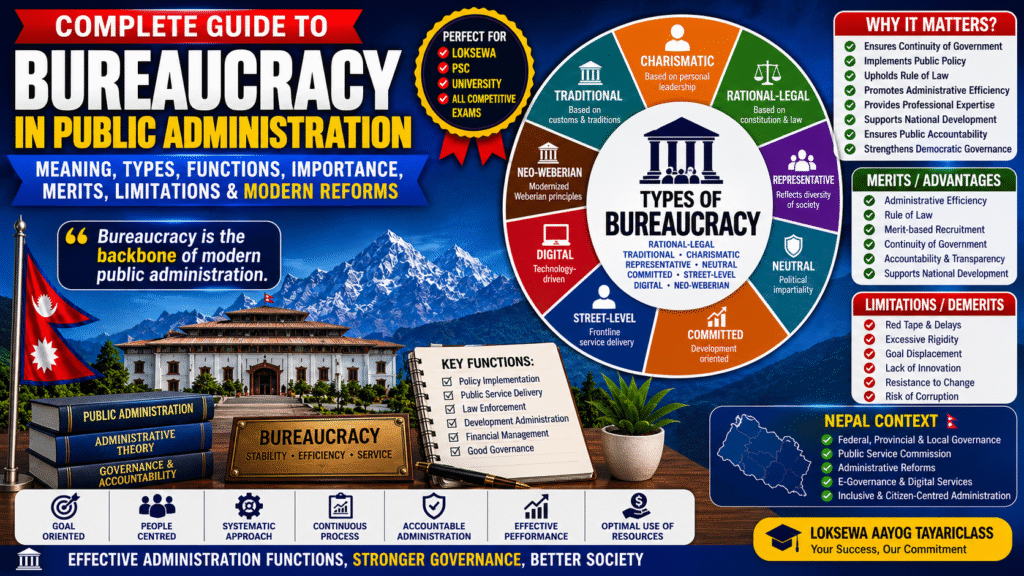
Bureaucracy in Public Administration: Meaning, Definitions, Characteristics, Max Weber’s Theory, Types, Functions, Merits, Demerits, Challenges, Administrative Reforms, and Nepal Context
The Ultimate Guide for Loksewa, PSC, University Students, Researchers, MPA Scholars, and Competitive Examination Aspirants
Introduction
Modern governments are expected to deliver efficient public services, maintain law and order, implement development policies, protect citizens’ rights, regulate economic activities, respond to emergencies, and promote sustainable national development. Behind every successful government is a well-organized administrative system that transforms public policies into practical actions. At the centre of this administrative system stands bureaucracy—a structured, professional, and rule-based institution responsible for ensuring continuity, stability, expertise, and impartiality in public administration. Regardless of changes in political leadership, bureaucratic institutions remain responsible for implementing government decisions and maintaining the day-to-day functioning of the state.
To fully understand bureaucracy, it is helpful to view it alongside other foundational concepts of public administration. Public Administration explains the overall process of managing public affairs, while Organization Theory in Public Administration examines how public organizations are structured and function. Leadership in Public Administration focuses on inspiring and directing public officials, Human Resource Management in Public Administration deals with recruiting, developing, and retaining competent civil servants, and Motivation in Public Administration explains how employees are encouraged to perform effectively. Similarly, Management Functions in Public Administration (POSDCORB) describe the essential managerial activities required to achieve organizational goals, Decision Making in Public Administration provides the framework for administrative choices, Administrative Ethics in Public Administration establishes standards of integrity and professionalism, Public Accountability in Public Administration ensures responsibility for administrative actions, Administrative Law in Nepal provides the legal foundation for administrative authority, Good Governance in Nepal promotes transparency and citizen-centred service delivery, and Public Policy in Nepal explains how government decisions are formulated and implemented. Bureaucracy acts as the institutional mechanism through which all these concepts are translated into practical governance.
The term bureaucracy often evokes mixed reactions. In everyday language, it is frequently associated with excessive paperwork, unnecessary delays, rigid procedures, and administrative red tape. However, in the academic discipline of Public Administration, bureaucracy has a much broader and more balanced meaning. It represents a system of administration based on specialization, hierarchy, merit, legal authority, clearly defined rules, professionalism, and continuity. The classical sociologist Max Weber regarded bureaucracy not as an obstacle but as the most rational and efficient organizational form for managing large and complex institutions. According to Weber, bureaucracy enables organizations to operate predictably, fairly, and consistently by replacing arbitrary personal decisions with impersonal legal rules and professional competence.
Over time, the understanding of bureaucracy has evolved significantly. While Weber’s ideal model remains the intellectual foundation of administrative theory, later scholars demonstrated that bureaucratic organizations may also develop weaknesses such as rigidity, excessive formalism, communication barriers, resistance to innovation, and procedural delays. Researchers including Robert K. Merton, Philip Selznick, Alvin Gouldner, Michel Crozier, Herbert Simon, and Michael Lipsky expanded the study of bureaucracy by examining its practical behaviour, organizational dynamics, decision-making processes, street-level implementation, and relationship with democracy and public accountability. Contemporary public administration therefore views bureaucracy as a dynamic institution that must continuously adapt to changing technologies, citizen expectations, globalization, digital governance, and administrative reforms.
In democratic societies, bureaucracy performs a unique constitutional role. Political leaders formulate public policies based on electoral mandates, while bureaucrats provide professional advice, implement government decisions, manage public resources, deliver services, enforce laws, and ensure administrative continuity. This relationship requires a careful balance between political responsiveness and administrative neutrality. Bureaucrats are expected to remain politically impartial while faithfully implementing the lawful decisions of elected governments. Consequently, debates concerning bureaucratic neutrality, political commitment, administrative accountability, representative bureaucracy, citizen participation, and public sector reforms remain central themes in modern governance.
The relevance of bureaucracy has become even more significant in the twenty-first century. Rapid technological advancement, artificial intelligence, digital governance, open government initiatives, evidence-based policymaking, collaborative governance, environmental challenges, and increasing public expectations require bureaucratic institutions to become more innovative, transparent, responsive, and citizen-oriented than ever before. Modern bureaucracies are no longer expected merely to administer rules; they are expected to solve complex public problems, facilitate economic development, encourage public participation, manage crises, protect democratic values, and deliver high-quality services efficiently. This transformation has led to new concepts such as digital bureaucracy, collaborative governance, network governance, adaptive administration, and the Neo-Weberian State, which seek to modernize traditional bureaucratic systems without abandoning their fundamental principles of legality, professionalism, and merit.
For Nepal, the study of bureaucracy is particularly important because the implementation of the Constitution of Nepal, 2015 and the transition to a federal democratic republic have significantly transformed the country’s administrative landscape. The Federal, Provincial, and Local Governments require a competent, professional, accountable, and citizen-centred bureaucracy capable of coordinating across multiple levels of government while maintaining constitutional values, administrative neutrality, ethical conduct, and efficient service delivery. Nepal’s civil service therefore plays a crucial role in implementing public policies, promoting good governance, supporting socio-economic development, strengthening democratic institutions, and improving citizens’ trust in government. Understanding the structure, evolution, challenges, and future direction of Nepalese bureaucracy is essential for both academic study and practical administrative reform.
From the perspective of Loksewa (PSC), Judicial Service, University examinations, MPA, BPA, BBS, BA Political Science, and other competitive examinations, bureaucracy is one of the most important and frequently examined topics. Questions commonly cover the meaning and definitions of bureaucracy, Weber’s theory, characteristics of ideal bureaucracy, types of bureaucracy, principles, functions, merits, limitations, bureaucratic dysfunctions, neutrality versus commitment, representative bureaucracy, street-level bureaucracy, bureaucracy in Nepal, administrative reforms, and the relationship between bureaucracy, democracy, governance, and public policy. A thorough understanding of these concepts not only helps students succeed in examinations but also develops the analytical skills necessary for understanding how governments actually function.
This flagship article presents a comprehensive, research-based, and examination-oriented study of Bureaucracy in Public Administration. It explores the historical evolution of bureaucracy, scholarly definitions, theoretical foundations, Max Weber’s ideal model, major characteristics and principles, organizational structure, different forms of bureaucracy, key functions, advantages, criticisms, bureaucratic dysfunctions, representative and street-level bureaucracy, bureaucracy in Nepal, administrative reforms, digital transformation, emerging global trends, comparative perspectives, frequently asked questions, practice questions, scholarly references, and practical insights. Designed as a pillar resource, this guide also establishes meaningful connections with our flagship articles on Public Administration, Organization Theory in Public Administration, Leadership in Public Administration, Human Resource Management in Public Administration, Motivation in Public Administration, Management Functions in Public Administration (POSDCORB), Decision Making in Public Administration, Administrative Ethics in Public Administration, Public Accountability in Public Administration, Administrative Law in Nepal, Good Governance in Nepal, and Public Policy in Nepal, enabling readers to develop a complete and integrated understanding of modern public administration.
Meaning of Bureaucracy
The term bureaucracy refers to a formal system of administration in which public organizations operate through clearly defined laws, established procedures, hierarchical authority, specialization of functions, merit-based recruitment, professional expertise, and administrative accountability. It is one of the most important organizational concepts in Public Administration because it explains how governments organize their institutions, distribute authority, coordinate administrative activities, and deliver public services efficiently and consistently.
In academic literature, bureaucracy is not merely a collection of government offices or public officials. Rather, it is a structured administrative system designed to ensure that public decisions are implemented objectively, fairly, and predictably according to legal rules rather than personal preferences. Bureaucracy emphasizes continuity, institutional stability, professionalism, impartiality, and uniform application of laws, making it an essential mechanism for democratic governance and effective public administration.
In its simplest sense:
Bureaucracy is a rule-based, hierarchical, and professional administrative system through which governments and large organizations implement policies, manage public affairs, and deliver services in accordance with established laws and procedures.
The concept is applicable not only to government departments but also to public corporations, universities, international organizations, regulatory authorities, and even many large private institutions. However, within Public Administration, bureaucracy primarily refers to the professional civil service that supports elected governments by implementing policies, administering public programs, maintaining administrative continuity, and serving the public interest.
Modern bureaucracy differs significantly from arbitrary or personalized administration. In bureaucratic systems, authority is attached to offices rather than individuals; responsibilities are clearly defined; recruitment is based on merit and qualifications; decisions are documented; and officials are expected to act impartially within the limits of the law. These characteristics promote fairness, accountability, efficiency, and predictability while reducing favoritism, corruption, and personal discretion.
Although bureaucracy is sometimes criticized for excessive formalism, procedural delays, and rigid rules, it remains indispensable because modern governments cannot function effectively without a professional administrative apparatus capable of managing complex responsibilities across multiple sectors and levels of government.
Etymology and Origin of the Term Bureaucracy
Understanding the origin of the word bureaucracy provides valuable insight into how the concept evolved from a simple administrative arrangement into one of the most influential ideas in Public Administration. Although bureaucracy is now associated with complex governmental organizations and professional civil services, the term itself has a fascinating historical background rooted in eighteenth-century Europe.
The word bureaucracy is derived from two different languages:
- The French word “bureau”, meaning desk, office, or government office.
- The Greek word “kratos” (κράτος), meaning power, authority, or rule.
When these two words are combined, bureaucracy literally means “rule by offices” or “government through administrative offices.” The term symbolizes an administrative system in which authority is exercised through officially established institutions rather than through the personal power of individual rulers.
The expression bureaucratie was first introduced in 1745 by the French economist Jacques Claude Marie Vincent de Gournay. Interestingly, Gournay used the term critically to describe the growing influence of government officials and administrative offices in France. He believed that excessive administrative control and complex regulations could hinder economic freedom and efficient governance.
During the nineteenth century, the meaning of bureaucracy gradually expanded. Rather than referring only to government offices, scholars began using the term to describe an entire administrative system characterized by hierarchy, specialization, legal authority, written rules, and professional officials. As governments became larger and more complex during the Industrial Revolution, bureaucracy emerged as the dominant organizational model for managing public institutions.
The concept reached its highest level of theoretical development through the work of the German sociologist Max Weber (1864–1920). Weber transformed bureaucracy from a political expression into a comprehensive sociological and administrative theory. Instead of viewing bureaucracy merely as an administrative burden, Weber argued that it represented the most rational, efficient, predictable, and technically superior form of organization for governing large institutions. His theory became the intellectual foundation of modern Public Administration and continues to influence administrative systems throughout the world.
Today, the meaning of bureaucracy extends far beyond its literal origin. It refers not only to government offices but also to a professional administrative system based on merit, legal authority, specialization, accountability, continuity, and organizational discipline. Modern bureaucracies are responsible for implementing laws, managing public resources, delivering essential services, supporting democratic governance, and ensuring that government functions continue regardless of political change.
Thus, the historical evolution of the term demonstrates an important transformation: what began as a criticism of administrative expansion eventually became one of the most significant organizational concepts in the study of Public Administration.
Quick Facts
| Aspect | Description |
|---|---|
| French Word | Bureau (Office or Desk) |
| Greek Word | Kratos (Power or Rule) |
| Literal Meaning | Rule by Offices |
| First Used By | Jacques Claude Marie Vincent de Gournay |
| Year | 1745 |
| Modern Theoretical Foundation | Max Weber |
| Central Idea | Professional, rule-based, hierarchical administration |
Evolution and Historical Development of Bureaucracy
Bureaucracy did not emerge overnight. It developed gradually over thousands of years as human societies became more organized, governments expanded their responsibilities, and administrative systems evolved to manage increasingly complex political, economic, and social affairs. The history of bureaucracy reflects the history of civilization itself, demonstrating how societies have continuously searched for more effective ways to govern people, administer justice, collect revenue, maintain security, and deliver public services.
The evolution of bureaucracy can be understood through several important historical stages.
Ancient Civilizations
The earliest forms of bureaucracy appeared in ancient civilizations where rulers required organized administrative systems to govern large territories and populations.
Ancient Egypt established one of the world’s earliest administrative structures. Officials maintained land records, supervised agricultural production, collected taxes, managed irrigation systems, and coordinated large construction projects such as the pyramids.
Similarly, Mesopotamian kingdoms developed administrative offices responsible for maintaining legal records, regulating trade, collecting taxes, and enforcing royal decrees.
In ancient China, particularly during the Qin and Han dynasties, bureaucracy reached an advanced stage of development. Government officials were selected based on their knowledge and administrative competence, laying the foundation for one of the earliest merit-based civil service systems in history. This tradition later evolved into the famous Imperial Examination System, which influenced civil service reforms across many countries.
Ancient India also developed sophisticated administrative systems. Texts such as Kautilya’s Arthashastra describe an organized bureaucracy responsible for taxation, public finance, law enforcement, diplomacy, intelligence, infrastructure, and provincial administration. Kautilya emphasized professional administration, accountability, and ethical conduct—principles that remain relevant in modern public administration.
Medieval Period
During the medieval era, administrative authority was closely linked to monarchies, feudal institutions, and religious organizations.
Most officials were appointed through personal loyalty, noble status, or royal favour rather than merit. Administrative systems were often decentralized, and public offices lacked standardized procedures.
Although bureaucratic structures existed, they were generally less professional and more dependent on personal relationships than modern bureaucracies.
Rise of the Modern State
The emergence of nation-states between the sixteenth and eighteenth centuries significantly transformed public administration.
Governments assumed broader responsibilities, including:
- National defence.
- Tax administration.
- Foreign relations.
- Public finance.
- Judicial administration.
- Infrastructure development.
These expanding responsibilities required permanent administrative institutions staffed by trained officials rather than temporary royal advisers.
As a result, bureaucratic organizations became increasingly structured, specialized, and professional.
Industrial Revolution
The Industrial Revolution accelerated bureaucratic development throughout Europe and North America.
Rapid industrialization, urbanization, economic expansion, and population growth required governments to regulate factories, provide public education, improve transportation, maintain public health, and manage expanding economies.
Large public organizations needed standardized rules, specialized departments, written documentation, and clear chains of authority. Bureaucracy became the most practical organizational model for managing these complex responsibilities efficiently.
Max Weber and Scientific Bureaucracy
The most significant milestone in the evolution of bureaucracy occurred during the late nineteenth and early twentieth centuries through the work of Max Weber.
Weber observed that traditional and charismatic forms of authority were insufficient for governing modern industrial societies. He proposed Rational-Legal Authority, in which authority is derived from laws rather than personal status or individual charisma.
According to Weber, an ideal bureaucracy is characterized by:
- Clearly defined hierarchy.
- Division of labour.
- Merit-based recruitment.
- Written rules and procedures.
- Professional administration.
- Impersonal decision-making.
- Career orientation.
- Legal authority.
Weber’s theory remains one of the foundational pillars of Public Administration and Organization Theory.
Post-Weberian Developments
Following Weber, numerous scholars examined both the strengths and limitations of bureaucracy.
Researchers such as Robert K. Merton, Philip Selznick, Alvin Gouldner, Michel Crozier, Herbert Simon, and Michael Lipsky demonstrated that bureaucratic organizations could also experience rigidity, red tape, communication barriers, excessive formalism, and resistance to change.
These contributions shifted the study of bureaucracy from an ideal organizational model to a more realistic understanding of administrative behaviour.
Contemporary Bureaucracy
Modern bureaucracy has expanded beyond Weber’s classical framework to address contemporary governance challenges.
Today’s bureaucracies increasingly emphasize:
- Citizen-centred service delivery.
- Transparency.
- Accountability.
- Digital governance.
- Artificial Intelligence.
- Evidence-based policymaking.
- Collaborative governance.
- Innovation.
- Sustainable development.
- Ethical administration.
Rather than serving merely as rule-enforcing institutions, modern bureaucracies are expected to become adaptive organizations capable of solving complex public problems while maintaining legality, professionalism, and democratic accountability.
Evolution of Bureaucracy at a Glance
| Historical Period | Major Administrative Development |
|---|---|
| Ancient Civilizations | Early administrative systems for taxation, law, and governance |
| Medieval Period | Feudal and monarchy-based administration |
| Rise of Nation States | Permanent government institutions |
| Industrial Revolution | Expansion of professional administration |
| Max Weber Era | Rational-Legal Bureaucracy and Ideal Type Model |
| Post-Weberian Era | Behavioural and organizational critiques |
| Contemporary Era | Digital, citizen-centred, collaborative, and AI-enabled bureaucracy |
The historical development of bureaucracy illustrates that administrative systems continuously evolve in response to changing political institutions, economic conditions, technological innovations, and societal expectations. Although the forms of bureaucracy have changed over time, its fundamental purpose remains the same: to provide an organized, professional, and lawful system for governing complex societies.
Definitions of Bureaucracy by Major Scholars
Over the years, many scholars from sociology, political science, public administration, and management have attempted to define bureaucracy from different perspectives. Some scholars emphasize bureaucracy as a rational organizational structure, while others focus on its role in administration, legal authority, specialization, and public service delivery.
Although their approaches differ, most definitions agree that bureaucracy is a professional administrative system designed to ensure efficiency, continuity, predictability, impartiality, and effective implementation of public policies.
Understanding these scholarly definitions is essential because they form the theoretical foundation of modern Public Administration and frequently appear in Loksewa, PSC, university, and civil service examinations.
Max Weber
The most influential definition of bureaucracy was provided by the German sociologist Max Weber.
According to Weber,
“Bureaucracy is the ideal type of organization based on rational-legal authority, hierarchy, specialization, written rules, merit, and impersonal relationships.”
Weber did not define bureaucracy as inefficient or rigid. Instead, he viewed it as the most technically efficient organizational structure for administering large and complex institutions.
For Weber, bureaucracy was characterized by:
- Rational decision-making.
- Clearly defined authority.
- Professional officials.
- Merit-based recruitment.
- Written rules.
- Administrative continuity.
- Impersonality.
His theory remains the intellectual foundation of modern bureaucratic administration.
Harold J. Laski
According to Harold J. Laski,
“Bureaucracy is a system of government in which control is completely in the hands of officials so that their power endangers the liberties of ordinary citizens.”
Unlike Weber, Laski viewed bureaucracy more critically. He warned that when administrative officials accumulate excessive power without democratic accountability, bureaucracy may become authoritarian and unresponsive to public needs.
His perspective highlights the importance of balancing bureaucratic efficiency with democratic control.
Peter M. Blau
Peter Blau defined bureaucracy as:
“An organization designed to accomplish large-scale administrative tasks through the systematic coordination of the work of many individuals.”
Blau emphasized coordination and organizational efficiency rather than merely hierarchy.
His definition recognizes bureaucracy as an organizational mechanism for managing complex activities involving numerous employees.
Victor A. Thompson
According to Victor A. Thompson,
“Bureaucracy is an organization characterized by a hierarchy of authority, specialization, and highly formalized rules.”
Thompson focused on three essential characteristics:
- Hierarchy
- Specialization
- Formalization
These features continue to define most modern public organizations.
Carl J. Friedrich
Carl Friedrich described bureaucracy as:
“An organization of persons systematically arranged to perform official duties.”
His definition emphasizes organized administration, official responsibility, and systematic coordination.
Marshall E. Dimock
Marshall Dimock viewed bureaucracy as:
“A professional administrative organization established for the efficient implementation of public policy.”
Dimock highlighted bureaucracy’s implementation role.
According to him, governments formulate policies, but bureaucracies transform those policies into practical administrative action.
Herbert A. Simon
Although Herbert Simon did not provide a single formal definition comparable to Weber’s, his work fundamentally transformed the understanding of bureaucracy.
Simon argued that bureaucracy should be understood through the lens of administrative decision-making rather than merely organizational structure.
His concept of bounded rationality explains that bureaucrats make decisions under conditions of limited information, limited time, and limited human cognitive capacity.
Simon’s work shifted administrative theory from ideal organizational structures toward realistic decision-making behaviour.
Dwight Waldo
Dwight Waldo regarded bureaucracy as an essential institution of democratic governance.
According to Waldo, bureaucracy should not merely pursue efficiency but must also uphold:
- Democratic values.
- Public accountability.
- Ethics.
- Public interest.
- Citizen participation.
His perspective broadened bureaucracy beyond technical administration to include normative responsibilities.
James Q. Wilson
James Q. Wilson viewed bureaucracy as:
“A government organization that performs public tasks through established authority and administrative procedures.”
Wilson emphasized that bureaucracies exist to implement governmental responsibilities in accordance with legal authority and institutional procedures.
Comparative Summary of Scholarly Definitions
| Scholar | Main Emphasis |
|---|---|
| Max Weber | Rational-legal authority and ideal bureaucracy |
| Harold J. Laski | Concentration of official power and democratic concerns |
| Peter M. Blau | Coordination of large organizations |
| Victor A. Thompson | Hierarchy, specialization, and formal rules |
| Carl J. Friedrich | Organized performance of official duties |
| Marshall E. Dimock | Implementation of public policy |
| Herbert A. Simon | Administrative decision-making and bounded rationality |
| Dwight Waldo | Democratic values and public interest |
| James Q. Wilson | Government organizations performing public functions |
Although these definitions differ in focus, they collectively demonstrate that bureaucracy is far more than a collection of government offices. It is a structured administrative system that combines professional expertise, legal authority, organizational coordination, and public accountability to achieve governmental objectives.
Scholar’s Corner
| Scholar | Examination Keyword |
|---|---|
| Max Weber | Ideal Type Bureaucracy |
| Herbert Simon | Bounded Rationality |
| Dwight Waldo | Democratic Administration |
| Peter Blau | Organizational Coordination |
| Marshall Dimock | Policy Implementation |
| Harold Laski | Bureaucratic Power |
| Victor Thompson | Formal Organization |
Exam Tip: In Loksewa and university examinations, if asked to “Define Bureaucracy,” begin with Max Weber’s definition, then enrich your answer by briefly mentioning Laski (critical view) and Simon (decision-making perspective). This demonstrates both classical and contemporary understanding.
Concept of Bureaucracy in Public Administration
Bureaucracy is one of the central concepts of Public Administration because it provides the institutional framework through which governments perform their administrative responsibilities. While elected political leaders formulate public policies and establish national priorities, bureaucratic organizations are responsible for translating those policies into concrete administrative actions. Without bureaucracy, even the most carefully designed laws and policies would remain theoretical rather than producing tangible outcomes for citizens.
In Public Administration, bureaucracy refers to a professional, permanent, hierarchical, merit-based, and rule-governed administrative system responsible for implementing government decisions, managing public resources, enforcing laws, coordinating administrative activities, and delivering public services efficiently and impartially. Unlike political institutions, which may change following elections, bureaucratic institutions provide continuity and stability by ensuring that essential governmental functions continue regardless of political transitions.
The concept of bureaucracy extends beyond the simple existence of government offices. It encompasses the principles, structures, procedures, values, and professional norms that enable public organizations to function effectively. A well-designed bureaucracy promotes consistency in administrative decisions, equal treatment of citizens, accountability, transparency, specialization, and adherence to the rule of law.
Modern public administration views bureaucracy not only as an administrative machinery but also as an essential democratic institution. Bureaucrats advise political executives, implement legislation, coordinate intergovernmental activities, regulate public affairs, manage development programs, respond to emergencies, and ensure that government services reach citizens fairly and efficiently. Consequently, bureaucracy serves as the operational backbone of the state, linking constitutional authority, public policy, administrative law, and service delivery into a coherent system of governance.
However, contemporary public administration also recognizes that bureaucracy must continuously evolve. Modern bureaucracies are expected to become more transparent, citizen-oriented, innovative, digitally enabled, and accountable while preserving the classical strengths identified by Max Weber—professionalism, legality, merit, and organizational discipline. The challenge for today’s governments is therefore not to replace bureaucracy but to reform and modernize it so that it remains responsive to changing societal needs and democratic expectations.
Bureaucracy vs Public Administration
Although the terms Bureaucracy and Public Administration are closely related, they are not synonymous. Many students mistakenly use them interchangeably, but from an academic perspective they represent two distinct concepts with different scopes, purposes, and functions. Understanding this distinction is essential because it frequently appears in Loksewa, PSC, university, and competitive examinations.
Public Administration is a broad discipline concerned with the planning, organization, direction, coordination, implementation, and evaluation of government activities. It includes administrative theories, organizational structures, leadership, human resource management, public finance, policy implementation, ethics, accountability, governance, and citizen participation.
Bureaucracy, on the other hand, is one important component of Public Administration. It refers specifically to the professional administrative machinery through which government decisions are implemented. Bureaucracy provides the institutional structure, personnel, procedures, and legal framework required to transform public policies into practical action.
In simple terms:
Public Administration is the entire system of managing public affairs, whereas Bureaucracy is the professional administrative organization that performs much of that work.
Every bureaucracy forms part of public administration, but public administration encompasses many other dimensions beyond bureaucracy, including political leadership, public policy, governance, budgeting, administrative reforms, public participation, and intergovernmental relations.
Key Differences Between Bureaucracy and Public Administration
| Basis | Bureaucracy | Public Administration |
|---|---|---|
| Meaning | Administrative machinery | Entire field of public management |
| Scope | Narrow | Broad |
| Nature | Organizational structure | Academic discipline and administrative process |
| Focus | Implementation of government decisions | Planning, policy, management, implementation, evaluation |
| Personnel | Civil servants and administrative officials | Politicians, administrators, institutions, citizens, and stakeholders |
| Objective | Efficient execution of administrative work | Effective governance and public service delivery |
| Relationship | Component of Public Administration | Includes Bureaucracy as one of its major components |
Exam Tip
A useful way to remember the distinction is:
Public Administration is the body; Bureaucracy is one of its most important organs.
Bureaucracy vs Civil Service
Another common misconception is that bureaucracy and civil service mean exactly the same thing. Although they are closely connected, they are conceptually different.
The Civil Service refers to the permanent body of government employees appointed through established recruitment procedures to perform public duties. These individuals occupy official positions in ministries, departments, commissions, constitutional bodies, and other public organizations.
Bureaucracy refers not merely to these employees but to the complete administrative system within which they operate. It includes organizational hierarchy, legal authority, procedures, administrative culture, rules, specialization, accountability mechanisms, and institutional arrangements.
Thus, civil servants constitute the human component, while bureaucracy represents the institutional framework.
Example
The officers working in Nepal’s Federal Civil Service are civil servants.
The administrative system consisting of ministries, departments, reporting relationships, legal procedures, hierarchy, and organizational rules collectively constitutes Nepalese bureaucracy.
Comparison
| Basis | Bureaucracy | Civil Service |
|---|---|---|
| Meaning | Administrative system | Government employees |
| Nature | Institutional framework | Human resource |
| Scope | Broad | Comparatively narrow |
| Includes | Structure, rules, hierarchy, officials | Only officials |
| Focus | Administration | Personnel |
Bureaucracy vs Administration
The terms bureaucracy and administration are also related but not identical.
Administration refers to the overall process of planning, organizing, directing, coordinating, supervising, controlling, and evaluating activities for achieving predetermined objectives.
Administration exists in:
- Government
- Private organizations
- Universities
- Hospitals
- NGOs
- International organizations
- Business enterprises
Bureaucracy is only one particular organizational model through which administration is carried out.
Therefore:
Administration is a function, whereas Bureaucracy is a structure designed to perform that function.
Modern organizations may adopt bureaucratic structures, flexible organizational structures, matrix organizations, network governance, or collaborative governance depending on their objectives.
Comparison
| Basis | Bureaucracy | Administration |
|---|---|---|
| Meaning | Organizational system | Managerial process |
| Nature | Structural | Functional |
| Scope | Limited | Very broad |
| Concern | Rules, hierarchy, specialization | Planning, organizing, directing, controlling |
| Applicability | Mainly large organizations | All organizations |
Bureaucracy vs Politics
The relationship between bureaucracy and politics has long been one of the most debated topics in Public Administration.
Both institutions are essential to democratic governance, but they perform fundamentally different roles.
Politics concerns the acquisition and exercise of political authority. Political leaders formulate public policies, establish priorities, represent citizens, and make decisions based on democratic mandates.
Bureaucracy implements those political decisions through professional administration.
The traditional distinction is often summarized as:
Politicians decide what government should do; bureaucrats determine how those decisions are implemented within the law.
Politics
Political leaders generally:
- Formulate public policies.
- Represent public opinion.
- Make political decisions.
- Provide democratic leadership.
- Respond to electoral mandates.
Bureaucracy
Bureaucrats generally:
- Advise political executives.
- Implement public policies.
- Enforce laws.
- Manage government programs.
- Deliver public services.
- Maintain administrative continuity.
Politics–Administration Dichotomy
One of the earliest debates in Public Administration concerns the Politics–Administration Dichotomy, proposed by Woodrow Wilson and further developed by Frank J. Goodnow.
According to this theory:
- Politics should formulate public policy.
- Administration should implement policy professionally and impartially.
- Bureaucrats should remain politically neutral while faithfully executing lawful governmental decisions.
Although modern scholars recognize that politics and administration often interact, the dichotomy remains historically important because it established professionalism and neutrality as core bureaucratic values.
Political Neutrality vs Political Responsiveness
Modern democratic bureaucracies are expected to balance two important principles.
Political Neutrality
Civil servants should:
- Serve any elected government equally.
- Avoid partisan political activities.
- Make objective administrative decisions.
- Uphold the Constitution and the Rule of Law.
Political Responsiveness
At the same time, bureaucrats must:
- Respect democratic decisions.
- Implement lawful government policies.
- Cooperate with elected representatives.
- Respond effectively to changing policy priorities.
An effective bureaucracy therefore combines professional neutrality with constitutional responsiveness.
Concept Map
Government
        │
        ▼
Political Leadership
        │
(Formulates Policies)
        │
        ▼
Bureaucracy
        │
(Implements Policies)
        │
        ▼
Public Administration
        │
(Delivers Public Services)
        │
        ▼
Citizens
Key Terms to Remember
- Bureaucracy
- Public Administration
- Civil Service
- Administrative Organization
- Political Neutrality
- Political Responsiveness
- Politics–Administration Dichotomy
- Merit System
- Administrative Professionalism
- Rule of Law
Scholar’s Corner
Woodrow Wilson
Often regarded as the Father of Public Administration, Wilson argued that politics and administration should be distinguished to improve administrative efficiency and professionalism.
Frank J. Goodnow
Goodnow refined the Politics–Administration Dichotomy by distinguishing the expression of the will of the state (politics) from the execution of that will (administration).
Common Misconception
A common misconception is that bureaucracy simply means “too many rules” or “slow government offices.” While excessive procedures and red tape can occur in poorly managed bureaucracies, the academic concept of bureaucracy is much broader. At its core, bureaucracy is a professional, rule-based administrative system designed to ensure fairness, consistency, accountability, continuity, and efficient governance.
Max Weber’s Theory of Bureaucracy
No discussion of bureaucracy is complete without examining the work of Max Weber (1864–1920), the German sociologist whose theory fundamentally transformed the study of Public Administration, Sociology, Political Science, and Organizational Theory. Although bureaucratic institutions had existed for centuries, Weber was the first scholar to explain bureaucracy systematically as an ideal organizational model based on rationality, legality, professionalism, and administrative efficiency.
Weber observed that the rapid growth of governments, industrial organizations, military institutions, universities, and large corporations required a form of administration that was more stable, predictable, and efficient than traditional systems based on personal loyalty or hereditary authority. He argued that modern societies could no longer rely on rulers’ personal discretion or inherited privilege to administer increasingly complex organizations. Instead, administration needed to be grounded in law, professional competence, and clearly defined organizational structures.
For this reason, Weber developed what is now known as the Ideal Type Theory of Bureaucracy, which remains one of the most influential theories in Public Administration.
Historical Background of Weber’s Theory
To understand Weber’s theory, it is important to understand the historical context in which he wrote.
During the nineteenth century, Europe experienced profound political, economic, and social transformation.
These changes included:
- Rapid industrialization.
- Expansion of nation-states.
- Growth of capitalism.
- Scientific and technological progress.
- Increasing government responsibilities.
- Urbanization.
- Expansion of public education.
- Development of modern legal systems.
Traditional methods of administration, which depended heavily on kings, nobles, family influence, or personal loyalty, became increasingly ineffective for governing large and complex societies.
Weber therefore asked a fundamental question:
“What type of organization can administer modern society most efficiently, fairly, and predictably?”
His answer was bureaucracy based on rational-legal authority.
Unlike many critics who viewed bureaucracy negatively, Weber considered bureaucracy an achievement of modern civilization because it replaced arbitrary personal rule with objective legal authority and professional administration.
Weber’s Three Types of Authority
One of Weber’s greatest contributions was his classification of authority into three ideal types.
Understanding these forms of authority is essential because bureaucracy is directly based on Rational-Legal Authority.
1. Traditional Authority
Traditional authority derives its legitimacy from customs, traditions, culture, and long-established social practices.
People obey leaders because:
- “It has always been this way.”
- Authority is inherited.
- Customs are respected.
Examples
- Kings and Queens.
- Feudal rulers.
- Tribal chiefs.
- Hereditary monarchies.
Characteristics
- Based on tradition.
- Personal loyalty.
- Hereditary succession.
- Limited professional administration.
Traditional authority often lacks standardized administrative procedures and depends heavily on personal relationships.
2. Charismatic Authority
Charismatic authority arises from the exceptional qualities, personality, vision, or leadership abilities of an individual.
People obey because they admire the leader personally.
Examples
- Revolutionary leaders.
- Religious reformers.
- Inspirational political leaders.
- Military heroes.
Characteristics
- Personal influence.
- Emotional attachment.
- Extraordinary leadership.
- Unstable after the leader departs.
Although charismatic leadership can inspire rapid change, Weber argued that it cannot provide long-term administrative stability.
3. Rational-Legal Authority
This is the foundation of Weber’s bureaucracy.
Under Rational-Legal Authority:
- Authority comes from law.
- Officials exercise legal powers.
- Offices—not individuals—possess authority.
- Rules govern decision-making.
- Merit determines recruitment.
- Professional competence guides administration.
Citizens obey government not because they fear an individual ruler but because they recognize the legitimacy of the legal system.
According to Weber, this form of authority is the most appropriate for modern democratic states.
Comparison of Weber’s Three Types of Authority
| Basis | Traditional Authority | Charismatic Authority | Rational-Legal Authority |
|---|---|---|---|
| Source of Authority | Tradition | Personal charisma | Law |
| Leadership | Hereditary | Inspirational | Official position |
| Stability | Moderate | Low | High |
| Rules | Limited | Personal | Formal legal rules |
| Recruitment | Birth | Personal qualities | Merit |
| Modern Government | Limited | Rare | Dominant |
What Is an Ideal Type?
One of the most misunderstood concepts in Weber’s theory is the phrase “Ideal Type.”
The word ideal does not mean perfect or flawless.
Instead, it refers to a theoretical model created to help scholars understand and analyze real organizations.
An ideal type is an analytical framework that highlights the essential characteristics of a phenomenon in their purest form.
Real-world bureaucracies rarely match Weber’s model completely.
Instead, his ideal bureaucracy serves as a benchmark against which actual organizations can be compared.
Example
No government bureaucracy perfectly satisfies every Weberian principle.
However, governments throughout the world attempt to approximate Weber’s model by promoting:
- Merit-based recruitment.
- Professional civil service.
- Written procedures.
- Legal authority.
- Administrative accountability.
- Organizational hierarchy.
Weber’s Assumptions About Bureaucracy
Weber believed that an effective administrative organization should rest upon several fundamental assumptions.
These assumptions explain why bureaucracy can manage large organizations more efficiently than informal systems.
Assumption 1: Organizations Require Clearly Defined Rules
Rules create consistency, fairness, and predictability.
Without rules:
- Decisions become arbitrary.
- Corruption increases.
- Citizens receive unequal treatment.
Assumption 2: Authority Should Be Legal Rather Than Personal
Officials should exercise authority because of the office they occupy—not because of wealth, family background, or personal influence.
This strengthens the Rule of Law.
Assumption 3: Division of Labour Improves Efficiency
Each employee should perform specialized responsibilities according to expertise.
Specialization increases:
- Productivity.
- Accuracy.
- Professional competence.
Assumption 4: Merit Should Determine Recruitment
Government positions should be filled according to:
- Qualifications.
- Competence.
- Competitive examinations.
- Professional ability.
This principle forms the basis of modern civil service systems, including Nepal’s Loksewa recruitment process.
Assumption 5: Hierarchy Improves Coordination
Organizations require clear reporting relationships.
Every official should know:
- Their responsibilities.
- Their supervisor.
- Their authority.
- Their accountability.
Assumption 6: Written Records Ensure Continuity
Administrative decisions should be properly documented.
Written documentation promotes:
- Transparency.
- Accountability.
- Institutional memory.
- Administrative consistency.
Assumption 7: Impersonality Promotes Fairness
Officials should apply laws equally without discrimination based on:
- Personal relationships.
- Political affiliation.
- Religion.
- Social status.
- Wealth.
- Family background.
This principle remains fundamental to democratic public administration.
Why Weber Considered Bureaucracy the Most Rational Form of Organization
Weber regarded bureaucracy as the most rational organizational model because it combines legality, expertise, specialization, hierarchy, professionalism, and predictability within a coherent administrative framework.
According to Weber, bureaucracy offers several important advantages over traditional administrative systems.
It:
- Ensures continuity despite political change.
- Reduces arbitrary decision-making.
- Promotes professional competence.
- Encourages administrative discipline.
- Improves organizational coordination.
- Protects equality before the law.
- Supports merit-based recruitment.
- Enhances efficiency in large organizations.
- Creates stable administrative procedures.
- Strengthens public confidence in government institutions.
For Weber, bureaucracy represented not merely an organizational technique but a defining feature of the modern constitutional state. It allowed governments to administer increasingly complex societies through objective legal authority rather than through personal power or inherited privilege.
Scholar’s Insight: Weber praised bureaucracy as the most technically efficient form of organization, but he also cautioned that excessive dependence on rigid rules could eventually create an “iron cage” of rationality, where procedures overshadow human judgment and flexibility. This idea later inspired many scholars to examine both the strengths and limitations of bureaucratic administration.
Characteristics of Weberian Bureaucracy
The distinguishing features of Weberian bureaucracy explain why Max Weber considered bureaucracy the most rational and technically efficient form of organization. These characteristics are not isolated principles; rather, they operate as an integrated administrative system that promotes professionalism, consistency, accountability, predictability, and organizational effectiveness.
Each characteristic complements the others. For example, specialization increases expertise, hierarchy strengthens coordination, written rules ensure consistency, and merit-based recruitment enhances competence. Together, these elements create an organizational framework capable of administering large and complex institutions efficiently.
Although real-world bureaucracies may not fully satisfy every Weberian principle, these characteristics continue to serve as the benchmark for evaluating administrative organizations across the world.
1. Clearly Defined Division of Labour (Specialization)
One of the most fundamental characteristics of Weberian bureaucracy is the division of labour, also known as specialization.
According to Weber, administrative work should be divided into distinct duties, with each official assigned specific responsibilities based on knowledge, qualifications, and expertise. Rather than expecting every employee to perform every task, bureaucracy distributes work systematically so that each individual becomes highly skilled in a particular area.
Specialization improves both efficiency and quality because employees repeatedly perform similar functions, gain experience, and develop professional competence. It also reduces duplication of work, minimizes confusion, and facilitates accountability by making responsibilities clearly identifiable.
For example, in a ministry, finance officers manage budgeting and expenditure, legal officers provide legal advice, human resource officers handle personnel administration, planning officers prepare development plans, and information technology officers manage digital systems. Each officer performs duties within a clearly defined area of responsibility.
Importance of Division of Labour
- Promotes professional expertise.
- Improves productivity.
- Reduces duplication of work.
- Increases administrative efficiency.
- Clarifies individual responsibilities.
- Strengthens accountability.
2. Hierarchical Structure
Another defining characteristic of Weberian bureaucracy is the establishment of a clear hierarchy of authority.
Hierarchy means that every office occupies a specific position within an organizational chain of command. Lower-level officials remain accountable to higher authorities, while higher authorities supervise, coordinate, and guide the work of subordinate officials.
This vertical structure ensures administrative discipline, effective communication, coordinated decision-making, and proper supervision. It also establishes clear reporting relationships, enabling employees to know from whom they receive instructions and to whom they are accountable.
For example, within a government ministry, a Section Officer reports to an Under Secretary, the Under Secretary reports to a Joint Secretary, the Joint Secretary reports to the Secretary, and the Secretary reports to the concerned Minister.
Such a structured chain of authority reduces confusion and promotes orderly administration.
Benefits of Hierarchy
- Establishes clear authority.
- Facilitates supervision.
- Enhances coordination.
- Improves communication.
- Maintains administrative discipline.
- Ensures accountability.
3. Formal Rules and Written Procedures
Weber argued that bureaucratic organizations should function according to written laws, regulations, policies, and standard operating procedures rather than personal preferences.
Every important administrative activity—including recruitment, promotion, procurement, budgeting, disciplinary action, and service delivery—should follow predetermined legal procedures.
Written rules promote consistency because similar cases are treated similarly regardless of the individuals involved. They also reduce arbitrary decision-making and strengthen transparency.
Furthermore, written procedures create institutional memory, allowing organizations to maintain continuity even when employees retire, transfer, or change positions.
Advantages of Written Rules
- Promotes fairness.
- Ensures consistency.
- Reduces favoritism.
- Protects the Rule of Law.
- Strengthens transparency.
- Facilitates administrative continuity.
4. Merit-Based Recruitment and Promotion
Weber believed that public offices should be filled through merit rather than personal influence, political loyalty, family relationships, or social status.
Appointments should be based on objective criteria such as education, professional qualifications, competitive examinations, experience, and demonstrated competence.
Similarly, promotions should reward performance, integrity, and capability rather than favoritism.
Modern civil service commissions, including Nepal’s Public Service Commission (Loksewa Aayog), are founded upon this Weberian principle.
Merit-based systems improve public confidence while enhancing administrative professionalism.
Importance of Merit System
- Encourages competence.
- Promotes equal opportunity.
- Reduces nepotism.
- Minimizes political interference.
- Builds public trust.
- Improves administrative quality.
5. Impersonality
Perhaps the most distinctive feature of Weberian bureaucracy is the principle of impersonality.
Impersonality does not mean treating people without respect or compassion. Rather, it means that administrative decisions should be based on laws, objective facts, and established procedures instead of personal emotions, friendships, political pressure, or family connections.
Under this principle, all citizens receive equal treatment before the law.
For instance, when issuing a citizenship certificate, passport, business license, or social security benefit, officials should apply the same legal criteria to every applicant, regardless of social status or personal relationships.
Impersonality promotes fairness, equality, and public confidence in government institutions.
Advantages
- Ensures equal treatment.
- Reduces discrimination.
- Prevents corruption.
- Promotes objectivity.
- Protects administrative neutrality.
- Strengthens public confidence.
6. Professional Career Service
Weber viewed bureaucracy as a career-oriented profession rather than temporary employment.
Officials are appointed to permanent positions, receive specialized training, develop professional expertise, gain administrative experience, and advance through clearly established career paths.
Career service contributes to administrative stability because experienced officials retain institutional knowledge despite changes in political leadership.
Professional career systems also encourage long-term commitment, ethical behaviour, and organizational loyalty.
Characteristics
- Permanent employment.
- Career advancement.
- Professional development.
- Specialized training.
- Institutional continuity.
- Long-term organizational commitment.
7. Technical Competence
Weber emphasized that bureaucratic officials should possess the technical knowledge necessary to perform their duties effectively.
Modern governments manage increasingly complex areas such as:
- Public finance.
- Health.
- Education.
- Environmental protection.
- Digital governance.
- Artificial intelligence.
- Infrastructure development.
- Disaster management.
These responsibilities require professionally trained administrators capable of making informed decisions.
Technical competence therefore remains essential for effective public administration.
8. Official Jurisdiction
Each office within a bureaucracy possesses clearly defined legal authority and responsibilities.
Officials cannot exercise unlimited discretion.
Instead, every position specifies:
- Duties.
- Powers.
- Responsibilities.
- Limits of authority.
- Reporting relationships.
This legal clarity prevents overlapping responsibilities and administrative conflict.
It also strengthens accountability because officials can be evaluated according to clearly established responsibilities.
9. Written Records and Documentation
Weber believed that bureaucratic organizations should maintain comprehensive written records of their decisions and activities.
Official documentation serves several important purposes:
- Provides legal evidence.
- Promotes accountability.
- Preserves institutional memory.
- Facilitates audits.
- Supports transparency.
- Enables future reference.
Modern electronic record management systems represent the digital evolution of this Weberian principle.
10. Administrative Discipline
Effective bureaucracy depends upon organizational discipline.
Officials are expected to:
- Follow laws.
- Respect organizational rules.
- Meet professional standards.
- Perform assigned duties responsibly.
- Maintain ethical conduct.
- Respect hierarchical authority.
Administrative discipline ensures organizational stability and reliable service delivery.
Summary Table: Characteristics of Weberian Bureaucracy
| Characteristic | Core Purpose |
|---|---|
| Division of Labour | Specialization and expertise |
| Hierarchy | Clear authority and supervision |
| Written Rules | Consistency and legality |
| Merit-Based Recruitment | Professional competence |
| Impersonality | Fairness and equality |
| Career Service | Stability and continuity |
| Technical Competence | Efficient administration |
| Official Jurisdiction | Clear authority and responsibility |
| Written Documentation | Accountability and institutional memory |
| Administrative Discipline | Organizational effectiveness |
Scholar’s Corner
Max Weber
Weber argued that bureaucracy derives its strength not from the power of individuals but from the legitimacy of legal authority, professional competence, and organizational discipline. According to him, modern organizations function most effectively when authority is attached to offices rather than personalities, ensuring continuity, impartiality, and predictability.
Nepal Insight
Nepal’s civil service reflects many Weberian characteristics through its constitutional framework and administrative practices. Recruitment through the Public Service Commission (Loksewa Aayog), defined organizational hierarchies within ministries, written laws and regulations, official documentation systems, and career-based public service all demonstrate the influence of Weber’s model. At the same time, ongoing administrative reforms seek to complement these traditional strengths with greater innovation, digital governance, citizen-centred service delivery, and performance-oriented management.
Quick Revision Box
Remember the ten core characteristics of Weberian bureaucracy:
- Division of Labour
- Hierarchy
- Written Rules
- Merit-Based Recruitment
- Impersonality
- Career Service
- Technical Competence
- Official Jurisdiction
- Written Documentation
- Administrative Discipline
Exam Tip: In descriptive questions, do not simply list these characteristics. Briefly explain each with a practical example. This demonstrates conceptual understanding and helps distinguish your answer in Loksewa and university examinations.
Principles of Bureaucracy
While the characteristics of bureaucracy describe how a bureaucratic organization is structured, the principles of bureaucracy explain the fundamental rules and values that guide its operation. These principles ensure that public organizations function consistently, lawfully, efficiently, and professionally. In modern Public Administration, they remain the cornerstone of effective governance and continue to influence administrative reforms across democratic nations.
Max Weber did not present these principles as isolated rules. Rather, they form an integrated framework in which each principle reinforces the others, creating a coherent administrative system capable of managing large and complex organizations.
1. Principle of Rational-Legal Authority
The foundation of Weberian bureaucracy is Rational-Legal Authority.
Under this principle, authority belongs to the office, not to the individual occupying it. Public officials exercise power only because the law authorizes them to do so. Consequently, administrative decisions must always remain within constitutional and legal boundaries.
Unlike traditional systems, where authority originates from heredity, or charismatic systems, where authority depends on personality, bureaucratic authority derives from laws enacted through legitimate constitutional processes.
Importance
- Upholds the Rule of Law.
- Prevents arbitrary decision-making.
- Strengthens constitutional governance.
- Ensures equality before the law.
- Promotes administrative legitimacy.
2. Principle of Hierarchy
Hierarchy establishes a clearly defined chain of authority within the organization.
Every official has a designated superior and, where applicable, subordinate officials. Responsibilities, reporting relationships, and supervisory authority are clearly specified.
Hierarchy promotes coordination while ensuring that decisions can be reviewed through successive administrative levels.
However, modern public administration also recognizes that excessive hierarchical rigidity may slow decision-making. Therefore, many governments now combine hierarchical accountability with decentralized operational flexibility.
Importance
- Clarifies authority.
- Facilitates supervision.
- Promotes accountability.
- Improves organizational coordination.
- Reduces administrative confusion.
3. Principle of Division of Labour
Administrative efficiency depends upon specialization.
Rather than assigning every task to every employee, bureaucracy distributes responsibilities according to professional expertise, educational qualifications, and organizational needs.
This principle recognizes that specialization produces higher quality decisions, greater efficiency, and improved service delivery.
Benefits
- Develops expertise.
- Improves productivity.
- Enhances professionalism.
- Reduces duplication.
- Strengthens accountability.
4. Principle of Merit
One of the greatest strengths of bureaucracy is the Merit Principle.
Appointments, promotions, transfers, and career advancement should be determined by objective qualifications instead of political influence, family relationships, wealth, caste, religion, or personal connections.
Modern democratic civil services, including Nepal’s Public Service Commission (Loksewa Aayog), are founded upon this principle.
Merit strengthens public confidence because citizens expect competent individuals to occupy public offices.
Merit-Based Recruitment Promotes
- Competence.
- Fair competition.
- Equal opportunity.
- Professional excellence.
- Administrative neutrality.
5. Principle of Impersonality
Administrative decisions should be based upon objective legal standards rather than personal preferences.
Impersonality means that every citizen receives equal treatment regardless of social status, political affiliation, religion, ethnicity, gender, economic condition, or personal relationships.
This principle protects both citizens and public officials by ensuring consistency and fairness.
It also reduces corruption, favouritism, nepotism, and discrimination.
6. Principle of Written Rules
Bureaucratic organizations rely upon written laws, regulations, manuals, policies, and standard operating procedures.
Written rules create administrative consistency because similar cases are handled according to identical legal standards.
They also make government more transparent by enabling citizens to understand the procedures governing administrative decisions.
Importance
- Consistency.
- Transparency.
- Predictability.
- Legal certainty.
- Administrative continuity.
7. Principle of Accountability
Every bureaucratic official is accountable for the authority entrusted to them.
Accountability exists in several dimensions:
- Legal accountability.
- Administrative accountability.
- Financial accountability.
- Ethical accountability.
- Public accountability.
Officials must explain their decisions, justify the use of public resources, and remain answerable to constitutional institutions and citizens.
Modern public administration increasingly emphasizes accountability as one of bureaucracy’s most important democratic responsibilities.
8. Principle of Professionalism
Bureaucracy is intended to function as a professional career service.
Professional administrators are expected to possess:
- Technical competence.
- Specialized knowledge.
- Ethical conduct.
- Administrative skills.
- Continuous learning.
- Commitment to public service.
Professionalism ensures that administrative decisions are based upon expertise rather than personal opinion.
9. Principle of Continuity
Governments change through elections, but administration continues without interruption.
This continuity enables governments to maintain:
- Public services.
- National security.
- Public finance.
- Development programmes.
- Judicial administration.
- Public health.
- Education.
Without bureaucratic continuity, governmental stability would be impossible.
10. Principle of Administrative Neutrality
One of the defining characteristics of democratic bureaucracy is political neutrality.
Civil servants should faithfully implement the lawful policies of whichever government is elected while remaining non-partisan in their professional conduct.
Administrative neutrality strengthens democracy because it ensures that public administration serves the Constitution rather than any particular political party.
Summary Table: Principles of Bureaucracy
| Principle | Core Objective |
|---|---|
| Rational-Legal Authority | Legality and constitutional governance |
| Hierarchy | Coordination and supervision |
| Division of Labour | Specialization and efficiency |
| Merit | Competence and fairness |
| Impersonality | Equality before the law |
| Written Rules | Consistency and predictability |
| Accountability | Responsibility for administrative actions |
| Professionalism | Technical excellence |
| Continuity | Stability of government |
| Administrative Neutrality | Democratic impartiality |
Ideal Bureaucratic Structure
Max Weber described bureaucracy as an Ideal Type Organization, meaning a conceptual model that represents the essential characteristics of an efficient administrative system.
The ideal bureaucratic structure consists of clearly defined offices connected through legal authority, specialization, hierarchy, and formal communication channels.
Each office possesses:
- Clearly defined responsibilities.
- Legally established authority.
- Professional staff.
- Accountability mechanisms.
- Reporting relationships.
- Written procedures.
Instead of relying upon individual personalities, the organization functions through institutional rules that continue regardless of changes in personnel.
Simplified Organizational Structure of a Bureaucracy
Political Executive (Minister)
            │
            ▼
Secretary
            │
            ▼
Joint Secretary
            │
            ▼
Under Secretary
            │
            ▼
Section Officer
            │
            ▼
Assistant Section Officer
            │
            ▼
Administrative Staff
This structure illustrates the Weberian principle that authority flows downward through legally established offices, while accountability flows upward through the same chain of command.
Elements of an Ideal Bureaucratic Organization
An ideal bureaucratic organization combines several interrelated elements:
- Clearly defined objectives.
- Formal organizational hierarchy.
- Division of labour and specialization.
- Merit-based recruitment.
- Professional career service.
- Written laws and procedures.
- Official documentation and record-keeping.
- Legal authority.
- Administrative discipline.
- Accountability and supervision.
- Impersonality in decision-making.
- Coordination among organizational units.
These elements collectively enable bureaucracy to function as a stable, professional, and predictable administrative system.
Objectives of Bureaucracy
The primary objective of bureaucracy is not merely to enforce rules but to help governments achieve public goals effectively and fairly.
Its major objectives include:
- Implementing public policies.
- Maintaining the Rule of Law.
- Delivering quality public services.
- Promoting administrative efficiency.
- Ensuring impartial decision-making.
- Protecting citizens’ rights.
- Managing public resources responsibly.
- Supporting democratic governance.
- Maintaining institutional continuity.
- Advancing national development.
Why Weber’s Model Became the Foundation of Modern Public Administration
Weber’s bureaucratic model became the foundation of modern Public Administration because it offered a systematic alternative to arbitrary, hereditary, and personalized administration.
His framework introduced principles that remain central to contemporary governance:
- Professional civil service.
- Merit-based recruitment.
- Legal authority.
- Organizational specialization.
- Administrative accountability.
- Rule-based decision-making.
- Institutional continuity.
Even though modern governments have adopted newer approaches—such as New Public Management (NPM), New Public Governance (NPG), digital governance, and collaborative governance—these reforms generally build upon Weber’s foundations rather than replacing them entirely. Merit, legality, professionalism, and accountability continue to underpin effective public administration.
Scholar’s Corner
Max Weber’s enduring contribution was demonstrating that efficient government depends not on the personal qualities of rulers alone, but on strong institutions governed by law, competent professionals, and clear organizational principles. His ideas continue to shape civil service systems, including Nepal’s administrative framework, and remain indispensable for understanding how modern states function.
Types of Bureaucracy
Bureaucracy is not a single, uniform concept. Over time, scholars have identified several forms of bureaucracy based on the source of authority, organizational characteristics, political relationship, representativeness, administrative behaviour, and evolving governance practices. Understanding these different types helps explain why bureaucratic systems vary across countries, historical periods, and institutional settings.
Classical Public Administration focused primarily on Traditional, Charismatic, and Rational-Legal Bureaucracy, while contemporary administrative theory has expanded the discussion to include Representative Bureaucracy, Neutral Bureaucracy, Committed Bureaucracy, Street-Level Bureaucracy, Digital Bureaucracy, and the Neo-Weberian State.
Each type reflects a different philosophy of governance and administrative practice.
1. Traditional Bureaucracy
Traditional Bureaucracy is based on customs, traditions, hereditary authority, and long-established social practices. Officials derive their authority from historical traditions rather than written constitutions or modern legal systems.
Appointments are often influenced by family background, social status, or hereditary succession instead of professional qualifications.
Historically, this form of bureaucracy existed in monarchies, feudal kingdoms, and ancient empires.
Characteristics
- Authority based on tradition.
- Hereditary appointments.
- Strong personal loyalty.
- Limited specialization.
- Informal administrative procedures.
- Resistance to rapid institutional change.
Advantages
- Administrative continuity.
- Strong cultural legitimacy.
- High public acceptance in traditional societies.
- Stable leadership in homogeneous communities.
Limitations
- Lack of merit-based recruitment.
- Nepotism and favouritism.
- Weak accountability.
- Limited innovation.
- Low administrative professionalism.
Example
Historical monarchies of Europe, traditional kingdoms, and many pre-modern administrative systems.
2. Charismatic Bureaucracy
Charismatic Bureaucracy develops around the extraordinary personality, vision, or leadership qualities of an individual rather than formal institutions.
Officials obey because of personal trust and admiration for the leader.
Such systems frequently emerge during revolutions, national crises, independence movements, or periods of major political transformation.
Characteristics
- Personal leadership.
- Emotional loyalty.
- Inspirational authority.
- Flexible administrative behaviour.
- Rapid decision-making.
Advantages
- Quick reforms.
- Strong public motivation.
- High organizational commitment.
- Effective crisis leadership.
Limitations
- Instability after leadership change.
- Weak institutional development.
- Dependence on one individual.
- Limited continuity.
Examples
Administrative systems built around revolutionary or transformational leaders during significant historical transitions.
3. Rational-Legal Bureaucracy
This is the most influential and widely accepted form of bureaucracy in modern Public Administration.
It is based on:
- Constitution.
- Laws.
- Rules.
- Professional competence.
- Merit.
- Hierarchy.
- Accountability.
Authority belongs to public offices rather than individuals.
Officials exercise power only within legally defined responsibilities.
Most democratic governments—including Nepal—primarily follow this bureaucratic model.
Characteristics
- Merit-based recruitment.
- Professional civil service.
- Rule of Law.
- Hierarchical organization.
- Written procedures.
- Administrative neutrality.
- Accountability.
- Specialization.
Advantages
- Administrative efficiency.
- Transparency.
- Predictability.
- Professionalism.
- Equal treatment.
- Institutional continuity.
Limitations
- Excessive paperwork.
- Procedural rigidity.
- Slow decision-making.
- Red tape.
- Limited flexibility.
4. Representative Bureaucracy
The theory of Representative Bureaucracy argues that public administration should reflect the diversity of the society it serves.
A bureaucracy becomes more legitimate when its employees represent different social groups, including gender, ethnicity, language, geography, caste, disability, and other communities.
Representative bureaucracy strengthens public confidence because citizens see themselves reflected within government institutions.
In Nepal, constitutional provisions relating to inclusive representation illustrate the practical importance of this concept.
Characteristics
- Inclusive recruitment.
- Social diversity.
- Equal opportunity.
- Fair representation.
- Democratic legitimacy.
Advantages
- Better public trust.
- Inclusive decision-making.
- Greater social justice.
- Improved policy responsiveness.
Challenges
- Balancing representation with merit.
- Political debates over inclusion.
- Administrative complexity.
5. Neutral Bureaucracy
Neutral Bureaucracy emphasizes political impartiality.
Civil servants remain professionally independent from political parties while faithfully implementing the lawful policies of whichever government is elected.
Neutrality protects democratic governance because administrative decisions are based on law rather than partisan interests.
Characteristics
- Political impartiality.
- Professional conduct.
- Equal service to every government.
- Constitutional loyalty.
- Rule-based decision-making.
Advantages
- Administrative stability.
- Public confidence.
- Professional integrity.
- Reduced political interference.
Challenges
Complete neutrality may sometimes be difficult when governments pursue highly political reforms requiring active administrative commitment.
6. Committed Bureaucracy
Committed Bureaucracy argues that civil servants should actively support the developmental objectives of elected governments instead of remaining completely detached.
Supporters believe that developing countries require administrators who are committed to national development, poverty reduction, economic transformation, and social progress.
However, commitment should always remain within constitutional and legal limits.
Characteristics
- Development orientation.
- Active implementation.
- Goal-focused administration.
- Policy responsiveness.
Advantages
- Faster implementation.
- Developmental focus.
- Strong administrative coordination.
Risks
- Politicization.
- Reduced neutrality.
- Possible misuse of administrative power.
7. Street-Level Bureaucracy
The concept of Street-Level Bureaucracy was developed by Michael Lipsky (1980).
It focuses on public officials who interact directly with citizens and whose day-to-day decisions significantly influence policy implementation.
Examples include:
- Police officers.
- Teachers.
- Health workers.
- Local government officials.
- Social workers.
- Revenue officers.
- Immigration officers.
These officials often exercise administrative discretion because real-life situations cannot always be addressed by rigid rules alone.
Their decisions shape citizens’ actual experience of government.
Characteristics
- Direct citizen interaction.
- Administrative discretion.
- Frontline service delivery.
- Practical policy implementation.
Importance
Street-level bureaucrats are often described as the “face of government” because citizens judge government performance largely through their everyday interactions with these officials.
8. Digital Bureaucracy
Digital Bureaucracy represents the transformation of traditional administrative systems through digital technology.
Governments increasingly use:
- Online services.
- Electronic records.
- Artificial Intelligence.
- Digital identity systems.
- Data analytics.
- E-Governance platforms.
- Cloud computing.
Digital bureaucracy seeks to improve efficiency while reducing administrative delays.
Nepal’s growing adoption of digital government services reflects this global trend.
Characteristics
- Technology-based administration.
- Paperless processes.
- Digital records.
- Online service delivery.
- Faster communication.
- Data-driven decision-making.
Advantages
- Increased transparency.
- Faster service.
- Reduced corruption opportunities.
- Improved accessibility.
- Lower administrative costs.
Challenges
- Cybersecurity.
- Digital divide.
- Privacy concerns.
- Technical infrastructure.
- Capacity building.
9. Neo-Weberian Bureaucracy
The Neo-Weberian State does not reject Weber’s bureaucracy.
Instead, it modernizes it.
This approach combines the strengths of classical bureaucracy with modern governance reforms.
It preserves:
- Rule of Law.
- Merit.
- Professionalism.
- Hierarchy.
- Accountability.
At the same time, it incorporates:
- Citizen-centred service.
- Performance management.
- Digital innovation.
- Transparency.
- Collaboration.
- Results-oriented governance.
Many European countries have adopted Neo-Weberian reforms as an alternative to purely market-oriented administrative models.
Comparative Table: Types of Bureaucracy
| Type | Source of Authority | Main Focus |
|---|---|---|
| Traditional | Customs and traditions | Stability through tradition |
| Charismatic | Personal leadership | Inspirational authority |
| Rational-Legal | Constitution and law | Professional administration |
| Representative | Social inclusion | Diversity and legitimacy |
| Neutral | Political impartiality | Constitutional administration |
| Committed | Development goals | National transformation |
| Street-Level | Administrative discretion | Citizen service delivery |
| Digital | Technology | Efficient and transparent governance |
| Neo-Weberian | Modernized Weberian principles | Professional yet citizen-centred administration |
Scholar’s Corner
Michael Lipsky
Michael Lipsky introduced the concept of Street-Level Bureaucracy, arguing that frontline public officials effectively shape public policy because they exercise discretion while interacting directly with citizens. His work shifted attention from formal organizational structures to the realities of everyday public service delivery.
Nepal Insight
Nepal’s administrative system increasingly reflects a combination of these models. Its constitutional framework is grounded in Rational-Legal Bureaucracy, inclusive provisions support Representative Bureaucracy, federal restructuring has increased the importance of Street-Level Bureaucracy at the local level, and initiatives such as e-governance and digital public services demonstrate a gradual transition toward Digital Bureaucracy. This combination illustrates how modern bureaucratic systems evolve by integrating classical principles with contemporary governance needs.
Quick Revision Box
Major Types of Bureaucracy to Remember
- Traditional Bureaucracy
- Charismatic Bureaucracy
- Rational-Legal Bureaucracy
- Representative Bureaucracy
- Neutral Bureaucracy
- Committed Bureaucracy
- Street-Level Bureaucracy
- Digital Bureaucracy
- Neo-Weberian Bureaucracy
Exam Tip: In long-answer questions, do more than list the types. Briefly explain the defining feature of each type, provide one practical example where appropriate, and conclude by noting that modern public administration increasingly combines these approaches rather than relying on a single model. This demonstrates analytical understanding rather than rote memorization.
Functions of Bureaucracy
Bureaucracy is far more than a collection of government offices or civil servants. It is the operational engine of public administration, responsible for transforming constitutional principles, legislative decisions, and public policies into tangible outcomes for society. While elected governments determine what should be achieved, bureaucracy determines how those objectives are translated into effective administrative action. Every successful public programme—whether related to education, healthcare, infrastructure, environmental protection, social security, disaster management, or digital governance—depends upon the competence and efficiency of bureaucratic institutions.
In modern democratic states, bureaucracy performs numerous interconnected functions that ensure the continuity, legality, accountability, and effectiveness of government. These functions extend beyond routine administration to include policy advice, institutional coordination, public service delivery, financial management, regulatory enforcement, crisis response, and national development.
The following sections examine these functions in detail.
1. Implementation of Public Policy
The primary function of bureaucracy is the implementation of public policy.
Public policies formulated by legislatures and political executives remain theoretical until they are translated into practical programmes, regulations, and administrative actions. Bureaucracy performs this crucial task by preparing implementation plans, allocating resources, coordinating departments, issuing administrative guidelines, monitoring progress, and evaluating outcomes.
For example, when the Government of Nepal introduces a policy to improve digital public services, bureaucratic institutions develop implementation strategies, establish administrative procedures, train employees, manage financial resources, and ensure that citizens receive the intended services.
Thus, bureaucracy acts as the bridge between political decisions and practical governance.
Major Responsibilities
- Translating policies into programmes.
- Preparing implementation guidelines.
- Coordinating implementation agencies.
- Monitoring policy execution.
- Reporting implementation progress.
2. Delivery of Public Services
One of the most visible responsibilities of bureaucracy is the delivery of public services.
Citizens interact with bureaucracy almost every day, whether obtaining citizenship certificates, passports, business registrations, land records, driving licences, educational services, healthcare, tax services, or social security benefits.
Efficient service delivery directly influences public trust in government.
Modern bureaucracies therefore increasingly emphasize:
- Citizen-centred services.
- Timely service delivery.
- Transparency.
- Accessibility.
- Digital platforms.
- Service quality improvement.
A responsive bureaucracy strengthens democratic legitimacy by ensuring that government services reach citizens fairly, efficiently, and without unnecessary delay.
3. Maintaining Law and Order
Bureaucratic institutions play a vital role in maintaining public order and ensuring the enforcement of laws.
Administrative agencies coordinate with law enforcement institutions to:
- Enforce legislation.
- Protect public safety.
- Regulate public activities.
- Maintain peace and security.
- Support judicial administration.
- Protect constitutional rights.
Without an effective administrative machinery, even well-drafted laws cannot achieve their intended objectives.
4. Advising Political Executives
Although elected representatives possess democratic legitimacy, they often depend upon bureaucratic expertise when making complex public decisions.
Senior civil servants provide professional advice regarding:
- Policy alternatives.
- Administrative feasibility.
- Legal implications.
- Financial consequences.
- Institutional capacity.
- International practices.
- Risk assessment.
This advisory role enables political leaders to make informed and evidence-based decisions.
However, bureaucratic advice should remain professional and politically neutral, allowing elected governments to make the final policy decisions.
5. Planning and Development Administration
Development planning is another essential bureaucratic function.
Administrative organizations prepare development plans, coordinate implementation, monitor projects, evaluate results, and manage development resources.
In developing countries such as Nepal, bureaucracy contributes significantly to:
- Infrastructure development.
- Education expansion.
- Healthcare improvement.
- Poverty reduction.
- Agricultural modernization.
- Environmental protection.
- Rural development.
- Sustainable development initiatives.
Effective development administration requires coordination among federal, provincial, and local governments.
6. Financial Administration
Governments cannot function without proper financial management.
Bureaucracy performs numerous financial responsibilities, including:
- Budget preparation.
- Revenue collection.
- Public expenditure management.
- Procurement administration.
- Financial reporting.
- Internal control.
- Audit coordination.
Responsible financial administration ensures that public resources are used efficiently, transparently, and in accordance with legal requirements.
7. Human Resource Management
Modern bureaucracies manage one of the government’s most valuable assets—its people.
Administrative organizations are responsible for:
- Recruitment.
- Training.
- Promotion.
- Performance evaluation.
- Career development.
- Employee welfare.
- Discipline.
- Retirement administration.
Professional human resource management contributes directly to organizational performance and public service quality.
8. Coordination Among Government Agencies
Modern governance involves numerous ministries, departments, constitutional bodies, regulatory authorities, local governments, and public enterprises.
Without coordination, duplication of work, policy conflicts, and administrative inefficiency become inevitable.
Bureaucracy therefore coordinates:
- Inter-ministerial activities.
- Federal-provincial relations.
- Provincial-local cooperation.
- Public-private partnerships.
- International cooperation.
- Emergency response mechanisms.
Effective coordination strengthens administrative coherence and improves service delivery.
9. Regulatory Function
Governments regulate numerous sectors to protect public interest.
Administrative agencies enforce regulations concerning:
- Public health.
- Environmental protection.
- Consumer rights.
- Labour standards.
- Banking and finance.
- Education.
- Telecommunications.
- Transportation.
- Food safety.
- Industrial safety.
Through regulatory administration, bureaucracy ensures that individuals and organizations operate within legal and ethical boundaries.
10. Record Management and Documentation
One of Weber’s enduring principles is the maintenance of official records.
Administrative documentation supports:
- Transparency.
- Accountability.
- Legal evidence.
- Institutional memory.
- Historical continuity.
- Administrative learning.
Today, many governments are replacing paper-based records with electronic document management systems, improving efficiency while preserving administrative integrity.
11. Crisis and Disaster Management
Modern bureaucracies play a central role during emergencies.
Whether responding to earthquakes, floods, pandemics, economic crises, or national security threats, administrative institutions coordinate:
- Emergency planning.
- Resource mobilization.
- Public communication.
- Relief distribution.
- Recovery programmes.
- Inter-agency coordination.
Nepal’s response to natural disasters illustrates the importance of a well-prepared and professionally coordinated bureaucracy.
12. Promoting Good Governance
Contemporary bureaucracy is expected not only to administer government but also to promote the principles of Good Governance.
These include:
- Transparency.
- Accountability.
- Participation.
- Responsiveness.
- Effectiveness.
- Efficiency.
- Equity.
- Inclusiveness.
- Rule of Law.
Modern public administration increasingly evaluates bureaucratic performance according to these governance standards rather than merely procedural compliance.
Summary Table: Major Functions of Bureaucracy
| Function | Primary Purpose |
|---|---|
| Policy Implementation | Translate policies into action |
| Public Service Delivery | Provide services to citizens |
| Law Enforcement | Maintain legal order |
| Policy Advice | Support informed political decisions |
| Development Administration | Promote socio-economic development |
| Financial Administration | Manage public resources |
| Human Resource Management | Develop competent civil servants |
| Coordination | Integrate government activities |
| Regulation | Protect public interest |
| Documentation | Maintain institutional records |
| Crisis Management | Respond to emergencies |
| Good Governance | Promote transparency and accountability |
Scholar’s Corner
Dwight Waldo
Dwight Waldo argued that bureaucracy should not be judged solely by efficiency. Instead, public administration must also uphold democratic values, ethics, accountability, citizen participation, and the public interest. His perspective broadened the understanding of bureaucracy beyond technical management to include its constitutional and moral responsibilities.
Nepal Insight
In Nepal’s federal system, bureaucratic functions extend across Federal, Provincial, and Local Governments. Civil servants not only implement national policies but also coordinate intergovernmental relations, support local governance, manage development programmes, and facilitate public service delivery under the constitutional framework established by the Constitution of Nepal, 2015. As Nepal advances digital governance and administrative reforms, the role of bureaucracy is expanding from traditional rule enforcement to innovation, collaboration, and citizen-centred administration.
Common Misconception
Many people assume that bureaucracy exists only to process files and enforce rules. In reality, modern bureaucracy performs a much broader role. It advises governments, implements development programmes, manages public finances, delivers essential services, coordinates institutions, responds to crises, and safeguards constitutional governance. Effective bureaucracy is therefore not simply about paperwork—it is about enabling the state to serve society efficiently, lawfully, and responsibly.
Quick Revision Box
Remember the 12 Core Functions of Bureaucracy:
- Policy Implementation
- Public Service Delivery
- Maintaining Law and Order
- Advising Political Executives
- Development Administration
- Financial Administration
- Human Resource Management
- Coordination
- Regulation
- Record Management
- Crisis and Disaster Management
- Promoting Good Governance
Exam Tip: In descriptive answers, connect these functions with practical examples from Nepal wherever possible. Doing so demonstrates conceptual understanding, application skills, and analytical depth, which often earns higher marks in Loksewa, university, and competitive examinations.
Importance of Bureaucracy in Public Administration
Bureaucracy is often described as the backbone, administrative machinery, or permanent executive of the state. While political leaders provide vision, formulate public policies, and represent the democratic aspirations of citizens, bureaucracy ensures that these aspirations are translated into practical reality through lawful, efficient, and professional administration. Without an effective bureaucracy, even the most progressive constitutions, visionary governments, and well-designed public policies would remain largely ineffective.
In every modern democratic state, bureaucracy performs functions that extend far beyond routine office administration. It provides institutional continuity, preserves administrative memory, coordinates complex governmental activities, safeguards the Rule of Law, promotes professionalism, and ensures that public services continue regardless of political transitions. Consequently, bureaucracy occupies a central position in both the theory and practice of Public Administration.
The importance of bureaucracy can be understood from multiple dimensions.
1. Ensures Continuity of Government
One of bureaucracy’s greatest strengths is its ability to maintain continuity in governance.
Political governments change through elections, cabinet reshuffles, resignations, or constitutional transitions. Bureaucratic institutions, however, continue functioning without interruption. This continuity ensures that public administration remains stable despite political change.
For example, hospitals continue treating patients, schools continue providing education, taxes continue to be collected, development projects continue to be monitored, and public services continue to be delivered even when governments change.
This institutional continuity protects citizens from administrative instability and strengthens confidence in the state.
Why It Matters
- Maintains uninterrupted public services.
- Preserves institutional memory.
- Supports long-term development programmes.
- Ensures administrative stability.
- Strengthens democratic governance.
2. Converts Public Policy into Action
Public policies express the intentions of government, but bureaucracy transforms those intentions into practical outcomes.
Once policies are approved, bureaucratic institutions prepare operational plans, allocate resources, coordinate implementation agencies, issue administrative guidelines, supervise implementation, and evaluate results.
In this sense, bureaucracy serves as the implementation arm of government.
Without professional implementation, policy objectives cannot be achieved regardless of their political popularity.
3. Strengthens the Rule of Law
A democratic state depends upon the consistent and impartial application of laws.
Bureaucracy ensures that laws are implemented according to constitutional principles rather than personal preferences or political pressure.
Officials exercise authority because the law authorizes them to do so—not because of personal influence.
This legal foundation:
- Protects citizens’ rights.
- Prevents arbitrary administration.
- Promotes equality before the law.
- Strengthens constitutional governance.
4. Promotes Administrative Efficiency
Modern governments manage thousands of programmes involving millions of citizens.
Such complexity requires systematic organization.
Through specialization, hierarchy, professional expertise, and standardized procedures, bureaucracy enables governments to perform administrative tasks more efficiently.
Administrative efficiency contributes to:
- Better resource utilization.
- Faster service delivery.
- Improved coordination.
- Higher organizational productivity.
- Reduced administrative confusion.
Although excessive bureaucracy may create procedural delays, properly managed bureaucracy significantly enhances governmental performance.
5. Provides Professional Expertise
Modern governance requires specialized knowledge.
Governments increasingly deal with complex issues such as:
- Climate change.
- Artificial Intelligence.
- Cybersecurity.
- Public health.
- Fiscal policy.
- International trade.
- Disaster risk reduction.
- Environmental protection.
Political leaders often rely upon bureaucratic experts to provide professional advice before making important public decisions.
Thus, bureaucracy contributes not only to implementation but also to informed policymaking.
6. Promotes Political Neutrality
A professional bureaucracy serves the Constitution, not political parties.
Civil servants are expected to implement the lawful decisions of every elected government with equal commitment while maintaining political impartiality in their official duties.
Political neutrality:
- Protects democratic institutions.
- Maintains public confidence.
- Prevents partisan administration.
- Strengthens constitutional governance.
This principle is particularly important in parliamentary democracies where governments may change frequently.
7. Supports National Development
Development administration depends heavily upon bureaucratic competence.
Administrative institutions plan, coordinate, implement, monitor, and evaluate development programmes relating to:
- Infrastructure.
- Agriculture.
- Education.
- Healthcare.
- Drinking water.
- Energy.
- Tourism.
- Digital transformation.
- Poverty reduction.
In developing countries, bureaucracy often becomes one of the principal drivers of national development.
8. Protects Public Interest
Public administration exists primarily to serve society.
Bureaucracy protects public interest by ensuring:
- Fair implementation of laws.
- Responsible management of public resources.
- Equal access to government services.
- Consumer protection.
- Environmental regulation.
- Public health and safety.
A professional bureaucracy therefore acts as a guardian of citizens’ collective welfare.
9. Enhances Coordination Across Government
Modern governments consist of numerous ministries, constitutional bodies, commissions, provincial governments, local governments, and public enterprises.
Bureaucracy coordinates these institutions by:
- Sharing information.
- Harmonizing policies.
- Preventing duplication.
- Facilitating cooperation.
- Resolving administrative conflicts.
Without coordination, government performance becomes fragmented and inefficient.
10. Builds Public Trust
Citizens judge governments largely through their interactions with public officials.
When bureaucracy demonstrates:
- Integrity,
- Professionalism,
- Transparency,
- Responsiveness,
- Courtesy,
- Accountability,
public confidence in government increases.
Conversely, corruption, excessive delay, discrimination, or poor service delivery weaken citizens’ trust in public institutions.
Thus, bureaucracy plays a decisive role in strengthening democratic legitimacy.
11. Facilitates Administrative Reforms
Modern bureaucracies are not static organizations.
They continuously adapt to:
- Technological change.
- Citizen expectations.
- Globalization.
- Digital governance.
- Performance management.
- Innovation.
- Sustainable development.
Administrative reform programmes seek to improve bureaucratic effectiveness while preserving legality, professionalism, and accountability.
12. Supports Good Governance
Good Governance cannot exist without an effective bureaucracy.
Professional administrative institutions promote:
- Transparency.
- Accountability.
- Participation.
- Responsiveness.
- Equity.
- Inclusiveness.
- Effectiveness.
- Efficiency.
- Rule of Law.
For this reason, bureaucracy is widely recognized as one of the essential pillars of democratic governance.
Summary Table: Importance of Bureaucracy
| Importance | Contribution to Public Administration |
|---|---|
| Continuity | Stable government administration |
| Policy Implementation | Converts policies into action |
| Rule of Law | Ensures legality and equality |
| Efficiency | Improves organizational performance |
| Professional Expertise | Supports informed decisions |
| Political Neutrality | Protects constitutional governance |
| National Development | Implements development programmes |
| Public Interest | Safeguards citizens’ welfare |
| Coordination | Integrates government institutions |
| Public Trust | Strengthens democratic legitimacy |
| Administrative Reform | Encourages modernization |
| Good Governance | Promotes accountability and transparency |
Scholar’s Corner
Paul H. Appleby
Paul H. Appleby emphasized that public administration is fundamentally concerned with government in action. From his perspective, bureaucracy is not merely a procedural apparatus but an active institution that transforms governmental intentions into concrete public outcomes. He argued that competent and responsible administration is indispensable for effective democratic governance.
Nepal Insight
In Nepal, bureaucracy has become increasingly important following the adoption of the Constitution of Nepal, 2015 and the establishment of a federal democratic republic. Civil servants now operate across Federal, Provincial, and Local Governments, requiring greater coordination, professional capacity, and accountability than ever before. As Nepal expands digital governance, strengthens local institutions, and pursues sustainable development, the bureaucracy’s role continues to evolve from traditional administration toward innovation, collaboration, and citizen-centred service delivery.
Common Misconception
A common misconception is that bureaucracy merely follows orders issued by political leaders. In reality, bureaucracy performs a much broader constitutional role. It provides expert policy advice, safeguards administrative continuity, manages public resources, coordinates institutions, delivers essential services, and ensures that government functions within the framework of the Constitution and the Rule of Law.
Quick Revision Box
Why is Bureaucracy Important?
- Ensures continuity of government.
- Implements public policy.
- Upholds the Rule of Law.
- Promotes administrative efficiency.
- Provides professional expertise.
- Maintains political neutrality.
- Supports national development.
- Protects public interest.
- Coordinates government institutions.
- Builds public trust.
- Facilitates administrative reform.
- Promotes Good Governance.
Exam Tip: In analytical questions, conclude by stating that bureaucracy is not an end in itself but a means to achieve constitutional governance, democratic accountability, efficient public service delivery, and sustainable national development. This kind of concluding observation demonstrates higher-level understanding and often distinguishes excellent answers.
Role of Bureaucracy in Democratic Governance
Democracy is founded on the principles of popular sovereignty, the Rule of Law, constitutional government, accountability, transparency, participation, and protection of fundamental rights. While elected representatives provide democratic legitimacy through elections, bureaucracy provides the administrative capacity necessary to transform democratic ideals into everyday reality.
A democratic government cannot function effectively through political leadership alone. Laws must be implemented, elections administered, public services delivered, budgets managed, disputes resolved, development programmes executed, and constitutional institutions supported. Bureaucracy performs these responsibilities with professionalism, continuity, and legal accountability.
Thus, bureaucracy serves as the institutional bridge between democratic decision-making and practical governance.
Modern Public Administration therefore regards bureaucracy not merely as an administrative machinery but as one of the essential pillars of constitutional democracy.
1. Implementing the Will of the People
In a democracy, citizens elect representatives who formulate public policies through constitutional institutions.
However, public policies achieve their intended objectives only when they are implemented effectively.
Bureaucracy converts the democratic will expressed through:
- Elections,
- Parliamentary legislation,
- Government policies,
- Constitutional provisions,
into practical administrative action.
In this sense, bureaucracy transforms democratic mandates into tangible public outcomes.
2. Protecting the Rule of Law
The Rule of Law is one of democracy’s most important principles.
Bureaucratic officials must perform their duties according to:
- Constitution.
- Acts of Parliament.
- Rules.
- Regulations.
- Administrative procedures.
Their authority is limited by law.
Unlike authoritarian systems, bureaucrats in democratic societies cannot exercise unlimited personal discretion.
This legal accountability protects citizens against arbitrary government action.
3. Ensuring Continuity During Political Change
Democratic governments periodically change following elections.
Political executives may resign, cabinets may be reshuffled, and ruling parties may alternate.
Despite these political transitions:
- Schools remain open.
- Hospitals continue functioning.
- Courts operate normally.
- Revenue continues to be collected.
- Development projects continue.
- Security institutions remain operational.
This continuity is ensured by bureaucracy.
Consequently, bureaucracy provides administrative stability while respecting democratic political change.
4. Maintaining Political Neutrality
Professional bureaucracy serves the Constitution rather than political parties.
Civil servants must faithfully implement the lawful policies of whichever government is democratically elected.
Political neutrality ensures that:
- Government services remain impartial.
- Citizens receive equal treatment.
- Administrative decisions remain objective.
- Public confidence is maintained.
Political neutrality is therefore one of the defining characteristics of democratic bureaucracy.
5. Safeguarding Fundamental Rights
Democratic constitutions guarantee numerous fundamental rights.
These rights become meaningful only when administrative institutions respect and protect them.
Bureaucratic agencies help safeguard:
- Equality before law.
- Freedom of expression.
- Property rights.
- Due process.
- Social justice.
- Administrative fairness.
Officials must administer laws in ways that protect constitutional rights rather than undermine them.
6. Delivering Public Services Equitably
One of democracy’s greatest expectations is that government services should reach every citizen fairly.
Bureaucracy ensures equitable delivery of:
- Education.
- Healthcare.
- Drinking water.
- Social security.
- Transportation.
- Agricultural support.
- Public information.
- Digital government services.
Equal access to public services strengthens democratic legitimacy.
7. Supporting Democratic Institutions
Bureaucracy provides administrative support to numerous constitutional institutions including:
- Parliament.
- Judiciary.
- Constitutional Commissions.
- Election Commission.
- Public Service Commission.
- Office of the Auditor General.
- Local Governments.
Without professional administrative support, democratic institutions cannot perform their constitutional responsibilities effectively.
8. Promoting Transparency and Accountability
Modern democracy requires governments to explain and justify their actions.
Bureaucracy promotes transparency through:
- Official documentation.
- Public reporting.
- Financial audits.
- Information disclosure.
- Citizen charters.
- Digital governance.
- Performance reporting.
These mechanisms strengthen accountability while reducing corruption and administrative abuse.
9. Encouraging Citizen Participation
Contemporary public administration recognizes that governance should involve citizens rather than treating them merely as passive recipients of services.
Modern bureaucracies encourage participation through:
- Public consultations.
- Community engagement.
- Stakeholder meetings.
- Public hearings.
- E-governance platforms.
- Feedback mechanisms.
- Social accountability tools.
Citizen participation improves policy implementation while strengthening democratic legitimacy.
10. Promoting Inclusive Governance
Modern democratic bureaucracy increasingly emphasizes inclusion.
Administrative organizations seek to ensure that services reach:
- Women.
- Children.
- Senior citizens.
- Persons with disabilities.
- Marginalized communities.
- Indigenous groups.
- Rural populations.
Inclusive bureaucracy strengthens social justice and democratic equality.
Summary Table: Bureaucracy and Democratic Governance
| Democratic Principle | Contribution of Bureaucracy |
|---|---|
| Rule of Law | Implements laws fairly |
| Democracy | Implements elected government’s policies |
| Equality | Provides impartial administration |
| Accountability | Explains administrative actions |
| Transparency | Maintains public records |
| Participation | Encourages citizen engagement |
| Inclusion | Delivers equitable services |
| Stability | Ensures continuity during political transitions |
Bureaucracy and Public Policy
Public policy and bureaucracy are inseparable.
Public policy answers the question:
“What should government do?”
Bureaucracy answers:
“How should government do it?”
Without bureaucracy:
- Policies cannot be implemented.
- Budgets cannot be managed.
- Programmes cannot be monitored.
- Results cannot be evaluated.
Bureaucracy participates throughout the policy cycle.
Bureaucracy’s Role in the Public Policy Cycle
1. Policy Formulation
Senior bureaucrats assist political executives by providing:
- Research.
- Technical advice.
- Administrative feasibility studies.
- Cost estimates.
- Comparative international experience.
Although final policy decisions belong to elected leaders, bureaucratic expertise greatly influences policy quality.
2. Policy Implementation
This is bureaucracy’s primary responsibility.
Officials:
- Develop implementation plans.
- Allocate resources.
- Coordinate agencies.
- Issue operational guidelines.
- Supervise implementation.
3. Policy Monitoring
Bureaucracy continuously monitors:
- Progress.
- Expenditure.
- Performance indicators.
- Implementation challenges.
Monitoring enables timely corrective action.
4. Policy Evaluation
Administrative organizations assess whether policies achieved their intended objectives.
Evaluation examines:
- Efficiency.
- Effectiveness.
- Economy.
- Equity.
- Sustainability.
- Public satisfaction.
Evaluation findings inform future policymaking.
Bureaucracy and Leadership
Leadership and bureaucracy complement each other.
Leadership provides:
- Vision.
- Motivation.
- Innovation.
- Strategic direction.
Bureaucracy provides:
- Organization.
- Stability.
- Professional implementation.
- Administrative continuity.
Modern public administration recognizes that effective governance requires both.
Administrative leaders inspire organizational improvement while bureaucratic institutions ensure systematic implementation.
This relationship connects directly with our flagship article:
Leadership in Public Administration
where transformational, transactional, servant, ethical, adaptive, and collaborative leadership approaches are examined in depth.
Bureaucracy and Decision Making
Administrative decisions shape the daily lives of millions of citizens.
Bureaucrats make decisions regarding:
- Resource allocation.
- Service delivery.
- Licensing.
- Procurement.
- Personnel administration.
- Regulatory enforcement.
Effective bureaucratic decision-making should be:
- Evidence-based.
- Lawful.
- Ethical.
- Transparent.
- Timely.
- Accountable.
Modern decision-making increasingly relies upon:
- Data analytics.
- Artificial Intelligence.
- Digital information systems.
- Performance measurement.
- Citizen feedback.
Readers seeking deeper understanding should also consult our flagship article:
Decision Making in Public Administration
Bureaucracy and Administrative Ethics
Efficiency alone is insufficient.
Bureaucracy must also operate ethically.
Administrative ethics requires officials to demonstrate:
- Integrity.
- Honesty.
- Fairness.
- Transparency.
- Responsibility.
- Confidentiality.
- Respect for citizens.
Ethical bureaucracy reduces corruption while strengthening public confidence.
This topic is explored comprehensively in:
Administrative Ethics in Public Administration
Bureaucracy and Public Accountability
Democratic bureaucracy must always remain accountable.
Public officials are accountable to:
- Constitution.
- Law.
- Legislature.
- Judiciary.
- Executive.
- Audit institutions.
- Citizens.
Accountability mechanisms include:
- Parliamentary oversight.
- Judicial review.
- Administrative review.
- Financial audits.
- Right to Information.
- Citizen complaints.
- Performance evaluation.
Without accountability, bureaucracy may become unresponsive and abuse administrative authority.
For detailed discussion, readers should also study:
Public Accountability in Public Administration
Bureaucracy and Human Resource Management
People are the foundation of bureaucracy.
Human Resource Management ensures that bureaucratic institutions recruit, develop, motivate, evaluate, and retain competent civil servants.
Effective HRM contributes to:
- Better service delivery.
- Professional competence.
- Organizational learning.
- Employee motivation.
- Ethical behaviour.
- Leadership development.
Readers can explore this relationship further in:
Human Resource Management in Public Administration
Bureaucracy and Good Governance
Ultimately, bureaucracy is judged not merely by procedural compliance but by its contribution to Good Governance.
A modern bureaucracy supports good governance by promoting:
- Rule of Law.
- Transparency.
- Accountability.
- Participation.
- Responsiveness.
- Effectiveness.
- Efficiency.
- Equity.
- Inclusiveness.
- Consensus orientation.
When these principles are embedded in administrative practice, bureaucracy becomes an instrument of democratic development rather than merely a rule-enforcing institution.
Scholar’s Corner
Max Weber and Dwight Waldo: A Comparative Perspective
Max Weber emphasized efficiency, hierarchy, legality, specialization, and rational organization as the foundations of bureaucracy. Dwight Waldo expanded this perspective by arguing that public administration must also pursue democratic values, ethics, public interest, and citizen participation. Together, their ideas suggest that an ideal bureaucracy must balance technical efficiency with democratic responsibility.
Nepal Insight
Nepal’s federal administrative system illustrates the evolving role of bureaucracy in democratic governance. Civil servants at the Federal, Provincial, and Local levels are expected not only to implement laws but also to support decentralization, strengthen local democracy, improve digital service delivery, encourage citizen participation, and uphold constitutional values. As Nepal continues administrative reforms, the challenge is to combine Weberian professionalism with innovation, inclusiveness, and citizen-centred governance.
Merits (Advantages) of Bureaucracy
Although bureaucracy is frequently criticized for procedural complexity and excessive formalities, it has remained the dominant administrative system of modern governments for more than a century. The reason is simple: no alternative organizational model has yet matched bureaucracy’s ability to administer large populations, complex institutions, and diverse public services while maintaining legality, continuity, and organizational stability.
The strengths of bureaucracy extend beyond administrative efficiency. It provides predictability, professionalism, accountability, institutional memory, equality before the law, and the capacity to manage national development on a large scale. For these reasons, scholars continue to regard bureaucracy as one of the foundational pillars of modern Public Administration.
The following sections explain its major advantages in detail.
1. Promotes Administrative Efficiency
One of the greatest merits of bureaucracy is its ability to improve administrative efficiency through systematic organization.
The principles of specialization, hierarchy, written procedures, and professional management enable officials to perform their responsibilities with greater precision and coordination.
Clearly defined responsibilities reduce duplication of work, while standardized procedures improve consistency and speed in administrative processes.
When every employee understands their duties and reporting relationships, organizations operate more effectively and achieve their objectives with fewer administrative conflicts.
Benefits
- Better coordination.
- Higher productivity.
- Reduced duplication.
- Improved organizational performance.
- Faster completion of administrative tasks.
2. Ensures the Rule of Law
Weberian bureaucracy operates within a framework of laws rather than personal preferences.
Officials exercise authority only when authorized by constitutional and legal provisions.
This legal foundation ensures that:
- Citizens receive equal treatment.
- Administrative decisions remain lawful.
- Public power is exercised responsibly.
- Arbitrary governance is prevented.
The Rule of Law therefore becomes one of bureaucracy’s greatest democratic strengths.
3. Promotes Merit and Professionalism
Modern bureaucracy emphasizes recruitment based on qualifications, competitive examinations, technical competence, and professional expertise.
Merit-based recruitment contributes to:
- Better decision-making.
- Higher service quality.
- Increased administrative competence.
- Professional integrity.
- Organizational excellence.
Institutions such as Nepal’s Public Service Commission (Loksewa Aayog) embody this Weberian principle by selecting civil servants through open and competitive processes.
4. Provides Continuity of Government
Governments may change after elections, but bureaucratic institutions continue serving citizens.
This continuity protects public administration from political instability.
Essential public services—including healthcare, education, taxation, public safety, infrastructure maintenance, and social security—continue regardless of changes in political leadership.
Institutional continuity also preserves administrative experience and organizational memory.
5. Encourages Accountability
Bureaucratic organizations maintain written records, official documentation, financial reports, and administrative procedures.
These mechanisms enable:
- Performance evaluation.
- Financial audits.
- Administrative review.
- Judicial scrutiny.
- Public oversight.
Because responsibilities are clearly assigned, officials can be held accountable for their decisions and actions.
6. Ensures Predictability and Consistency
Citizens expect government decisions to be fair and consistent.
Bureaucracy achieves this through standardized rules and procedures.
Similar cases are treated similarly because officials follow identical legal standards rather than personal opinions.
Predictability strengthens public confidence and reduces uncertainty in administrative decision-making.
7. Facilitates Large-Scale Administration
Modern governments manage:
- Millions of citizens.
- Thousands of public employees.
- Hundreds of development programmes.
- Complex regulatory systems.
- Large public budgets.
Such administrative complexity requires systematic organization.
Bureaucracy provides the institutional structure necessary for governing large populations efficiently.
8. Supports National Development
Development administration depends heavily upon bureaucratic capacity.
Professional civil servants contribute to:
- Infrastructure development.
- Educational reform.
- Healthcare expansion.
- Agricultural modernization.
- Environmental conservation.
- Digital transformation.
- Poverty reduction.
Without competent bureaucracy, national development policies cannot be implemented effectively.
9. Preserves Institutional Memory
Experienced bureaucratic organizations accumulate valuable administrative knowledge over time.
Official documents, reports, regulations, manuals, and experienced personnel preserve institutional memory.
This accumulated knowledge improves future decision-making and reduces repeated mistakes.
Institutional memory is particularly valuable during political transitions and administrative reforms.
10. Strengthens Democratic Governance
Contrary to popular misconceptions, bureaucracy supports democracy when it functions according to constitutional principles.
Professional bureaucracy:
- Implements laws impartially.
- Protects citizens’ rights.
- Supports elected governments.
- Maintains political neutrality.
- Promotes accountability.
- Delivers public services fairly.
Thus, bureaucracy strengthens rather than weakens democratic institutions when properly governed.
11. Improves Coordination
Government ministries, departments, constitutional bodies, regulatory agencies, provincial governments, and local governments must cooperate continuously.
Bureaucracy establishes formal coordination mechanisms that:
- Share information.
- Harmonize policies.
- Prevent duplication.
- Resolve administrative conflicts.
- Improve organizational cooperation.
Effective coordination enhances the overall performance of government.
12. Encourages Long-Term Planning
Political leaders often focus on electoral cycles, whereas bureaucracy contributes to long-term national planning.
Administrative institutions prepare:
- Development strategies.
- Infrastructure plans.
- Human resource plans.
- Environmental programmes.
- Digital transformation initiatives.
Long-term planning supports sustainable development beyond immediate political priorities.
Summary Table: Merits of Bureaucracy
| Merit | Contribution |
|---|---|
| Administrative Efficiency | Improves organizational performance |
| Rule of Law | Ensures legality and equality |
| Merit System | Promotes competence |
| Continuity | Maintains stable administration |
| Accountability | Strengthens responsibility |
| Predictability | Ensures consistency |
| Large-Scale Administration | Manages complex governments |
| National Development | Implements development programmes |
| Institutional Memory | Preserves experience |
| Democratic Governance | Supports constitutional administration |
| Coordination | Integrates institutions |
| Long-Term Planning | Promotes sustainable development |
Demerits (Limitations) of Bureaucracy
Despite its strengths, bureaucracy has also been criticized by scholars, policymakers, and citizens for several inherent limitations. Many of these problems arise when bureaucratic principles are applied too rigidly or when organizations fail to adapt to changing social, technological, and political environments.
The following limitations explain why administrative reforms have become an important area of modern Public Administration.
1. Red Tape
The most frequently cited criticism of bureaucracy is red tape.
Red tape refers to unnecessary delays caused by excessive rules, lengthy procedures, multiple approvals, and unnecessary paperwork.
When officials prioritize procedural compliance over practical problem-solving, citizens may experience delays, frustration, and increased administrative costs.
Examples
- Multiple signatures for a simple approval.
- Repeated submission of the same documents.
- Lengthy procurement procedures.
- Delayed service delivery.
Effects
- Slow administration.
- Public dissatisfaction.
- Increased administrative expenses.
- Reduced organizational efficiency.
2. Excessive Rigidity
Rules ensure consistency, but excessive dependence on rules can reduce flexibility.
Rigid bureaucratic organizations may struggle to respond quickly to:
- Emergencies.
- Technological innovation.
- Changing public expectations.
- Complex social problems.
Modern governance increasingly requires adaptive administration capable of balancing legal compliance with practical problem-solving.
3. Delay in Decision-Making
Hierarchical structures often require decisions to pass through several administrative levels before approval.
While supervision improves accountability, excessive hierarchy may:
- Slow implementation.
- Reduce innovation.
- Increase administrative costs.
- Delay public services.
This challenge becomes particularly significant during crises requiring rapid administrative responses.
4. Goal Displacement
Sometimes officials become more concerned with following procedures than achieving organizational objectives.
In such cases:
- Rules become ends rather than means.
- Compliance replaces performance.
- Innovation declines.
- Citizen needs receive less attention.
This phenomenon is known as goal displacement, a concept later explored in depth by sociologist Robert K. Merton.
5. Resistance to Change
Large bureaucratic organizations often resist administrative reforms.
Reasons include:
- Organizational culture.
- Fear of uncertainty.
- Established routines.
- Institutional inertia.
- Protection of existing authority.
Resistance to change may slow modernization efforts such as digital governance and organizational innovation.
6. Lack of Innovation
Highly formalized procedures sometimes discourage creativity.
Officials may avoid innovative solutions because:
- Rules provide limited flexibility.
- Mistakes may attract disciplinary action.
- Organizational culture rewards compliance more than experimentation.
Modern public administration therefore encourages innovation alongside accountability.
7. Impersonal Administration
Impersonality promotes fairness but may sometimes reduce human sensitivity.
Citizens occasionally perceive bureaucracy as:
- Unresponsive.
- Mechanical.
- Unfriendly.
- Procedurally rigid.
Contemporary reforms therefore emphasize citizen-centred administration, combining fairness with empathy and service orientation.
8. Possibility of Corruption
Although bureaucracy aims to reduce corruption through rules and accountability, weak oversight may create opportunities for:
- Bribery.
- Abuse of authority.
- Nepotism.
- Administrative favouritism.
Strong accountability mechanisms are therefore essential for maintaining public trust.
Scholar’s Reflection
As we move into the next section, several influential scholars explain why bureaucracies develop these dysfunctions and how governments can overcome them. Their theories remain highly important for university examinations, Loksewa, and contemporary administrative reform debates.
Bureaucratic Dysfunctions: Why Bureaucracy Sometimes Fails
Although bureaucracy was designed to improve administrative efficiency, scholars have shown that every organizational system contains inherent weaknesses. When bureaucratic principles such as hierarchy, specialization, formal rules, and standard procedures become excessively rigid, they may produce outcomes opposite to those originally intended.
This phenomenon is known as bureaucratic dysfunction.
A bureaucratic dysfunction occurs when organizational structures or administrative behaviours reduce efficiency, weaken innovation, delay public services, discourage accountability, or prevent organizations from achieving their intended objectives.
Beginning in the mid-twentieth century, several leading scholars critically examined Weber’s bureaucratic model. Rather than rejecting bureaucracy entirely, they sought to explain why bureaucracies often become inefficient despite being designed for efficiency.
Understanding these theories is essential for Public Administration because modern administrative reforms are largely responses to these identified weaknesses.
What is Bureaucratic Dysfunction?
Definition
Bureaucratic dysfunction refers to the unintended negative consequences that arise when bureaucratic principles are applied excessively, mechanically, or without sufficient flexibility.
Instead of improving governance, bureaucracy may produce:
- Red tape.
- Delay.
- Goal displacement.
- Organizational rigidity.
- Poor communication.
- Lack of innovation.
- Citizen dissatisfaction.
- Administrative inefficiency.
Thus, bureaucracy becomes an obstacle rather than an instrument of effective governance.
Robert K. Merton’s Theory of Bureaucratic Dysfunctions
Among all critics of bureaucracy, Robert K. Merton is regarded as one of the most influential.
In his landmark article “Bureaucratic Structure and Personality” (1940), Merton argued that the very characteristics which make bureaucracy effective may eventually become sources of organizational failure if applied excessively.
His central argument is often summarized as:
“The strengths of bureaucracy can become its weaknesses.”
Rules intended to promote efficiency may eventually reduce flexibility.
Discipline intended to improve consistency may discourage creativity.
Specialization intended to increase expertise may narrow administrative vision.
Merton therefore introduced several important concepts that continue to influence modern Public Administration.
1. Goal Displacement
Goal displacement is Merton’s most famous contribution.
Meaning
Organizations sometimes become more concerned with following procedures than with achieving organizational objectives.
Originally, rules exist to help accomplish organizational goals.
Over time, however, employees may begin treating the rules themselves as the primary objective.
The means gradually replace the ends.
Example
Suppose a citizen urgently requires a government certificate for medical treatment.
Instead of finding a lawful and practical solution, officials insist on completing every procedural step even when some requirements could reasonably be processed simultaneously.
The procedure receives greater attention than the citizen’s actual need.
Effects
- Slow service delivery.
- Reduced citizen satisfaction.
- Administrative inflexibility.
- Declining organizational performance.
Examination Point
Goal displacement means that organizational rules become more important than organizational objectives.
2. Trained Incapacity
Another important concept developed by Merton is trained incapacity.
Meaning
Through years of performing identical administrative routines, officials become highly skilled in existing procedures but gradually lose the ability to adapt to new situations.
Their professional training unintentionally limits creative thinking.
Experience becomes both an advantage and a constraint.
Example
A public office continues requiring paper applications even after secure online submission systems become available because employees remain accustomed to traditional procedures.
Effects
- Resistance to innovation.
- Poor adaptability.
- Reduced organizational learning.
- Difficulty responding to new challenges.
3. Over-Conformity to Rules
Merton observed that bureaucratic officials often become excessively committed to formal rules.
Strict adherence to regulations may improve consistency but may also reduce administrative judgment.
Officials begin asking:
“What do the rules require?”
instead of
“What best serves the public interest within the law?”
Consequences
- Mechanical decision-making.
- Reduced flexibility.
- Delayed administration.
- Citizen frustration.
4. Depersonalization of Relationships
Weber considered impersonality a strength because it ensures equality.
Merton acknowledged this benefit but argued that excessive impersonality may create emotionally distant relationships between administrators and citizens.
Citizens may feel that bureaucracy ignores individual circumstances.
Example
An elderly person struggles to complete complicated forms but receives little assistance because officials focus exclusively on procedural compliance.
Effects
- Poor citizen experience.
- Reduced public trust.
- Weak administrative responsiveness.
Summary of Merton’s Critique
| Bureaucratic Principle | Possible Dysfunction |
|---|---|
| Rules | Goal displacement |
| Discipline | Rigidity |
| Experience | Trained incapacity |
| Impersonality | Depersonalized administration |
| Standardization | Reduced innovation |
Philip Selznick’s Co-optation Theory
Another major critic of bureaucracy was Philip Selznick.
Instead of focusing primarily on internal organizational behaviour, Selznick examined how organizations are influenced by external social and political pressures.
His most important contribution is the concept of Co-optation.
Meaning of Co-optation
Co-optation occurs when an organization incorporates influential external individuals or groups into its decision-making process to reduce conflict, gain legitimacy, or secure cooperation.
Although this may improve stability, it may also weaken organizational independence.
Example
A regulatory authority includes representatives from industries it regulates.
While cooperation may improve communication, excessive influence could compromise regulatory neutrality.
Positive Aspects
- Reduces organizational conflict.
- Builds stakeholder cooperation.
- Improves legitimacy.
- Encourages participation.
Negative Aspects
- Weakens independence.
- Encourages political influence.
- May reduce objective decision-making.
- Risks regulatory capture.
Why Selznick Matters
Selznick demonstrated that bureaucratic organizations are not isolated technical systems.
They are social institutions continuously influenced by politics, interest groups, culture, and society.
Modern governance therefore requires administrators to balance organizational autonomy with stakeholder engagement.
Scholar’s Corner
Robert K. Merton (1910–2003)
Robert K. Merton transformed the study of bureaucracy by explaining that organizational problems often arise not because bureaucracy lacks rules, but because rules become excessively dominant. His concepts of goal displacement and trained incapacity remain among the most frequently cited theories in Public Administration, Organizational Behaviour, and Sociology.
Philip Selznick (1919–2010)
Philip Selznick emphasized that organizations are living social systems, not merely formal structures. His theory of co-optation highlighted how external political and social forces shape administrative behaviour, making his work highly relevant to governance, public policy, and institutional analysis.
Nepal Insight
Many administrative reform initiatives in Nepal—such as citizen charters, one-stop service centres, digital governance, online applications, integrated service delivery, and Right to Information implementation—can be understood as practical efforts to reduce bureaucratic dysfunctions identified by scholars like Merton and Selznick. These reforms seek to minimize red tape, improve responsiveness, strengthen transparency, and make public administration more citizen-centred while preserving the core principles of legality and accountability.
Quick Revision Box
Robert K. Merton’s Major Dysfunctions
- Goal Displacement
- Trained Incapacity
- Over-Conformity to Rules
- Depersonalization of Relationships
Philip Selznick’s Major Contribution
- Co-optation Theory
Exam Tip: In analytical questions, do not simply list Merton’s dysfunctions. Explain how an administrative principle intended to improve efficiency can unintentionally create inefficiency when applied too rigidly. This demonstrates deeper conceptual understanding.
Alvin Gouldner’s Patterns of Bureaucracy
Following Max Weber and Robert K. Merton, Alvin W. Gouldner made another significant contribution to the study of bureaucracy by examining how rules actually function within organizations. While Weber emphasized the ideal structure of bureaucracy and Merton explained its dysfunctions, Gouldner demonstrated that bureaucratic organizations do not all operate in the same way. Instead, the application of rules varies depending on leadership, organizational culture, and relationships between managers and employees.
His research, particularly in Patterns of Industrial Bureaucracy (1954), identified three major patterns of bureaucracy.
1. Mock Bureaucracy
Meaning
In Mock Bureaucracy, rules formally exist but are largely ignored by both managers and employees.
Neither supervisors nor workers seriously enforce organizational regulations because everyone informally agrees to overlook them.
Thus, official rules become symbolic rather than operational.
Characteristics
- Rules exist only on paper.
- Weak enforcement.
- Informal relationships dominate.
- High managerial flexibility.
- Organizational discipline is weak.
Example
An office requires employees to sign attendance by 10:00 AM, but supervisors routinely ignore late arrivals and no disciplinary action is taken.
Advantages
- Greater flexibility.
- Friendly working environment.
- Reduced organizational conflict.
Limitations
- Weak accountability.
- Inconsistent decisions.
- Declining organizational discipline.
- Reduced professionalism.
2. Representative Bureaucracy (Gouldner’s Pattern)
This should not be confused with the Representative Bureaucracy theory discussed earlier, which focuses on social inclusion.
Gouldner used the term differently.
Meaning
Rules are developed with the participation and acceptance of both management and employees.
Because employees understand the purpose of regulations, they voluntarily comply.
The organization therefore experiences relatively little conflict.
Characteristics
- Shared acceptance of rules.
- Participation in decision-making.
- Mutual trust.
- Cooperative work environment.
- High organizational commitment.
Advantages
- Better employee morale.
- Stronger cooperation.
- Higher compliance.
- Reduced conflict.
- Improved productivity.
Limitations
- Time-consuming consultation.
- Slower decision-making.
- Difficult to achieve consensus in large organizations.
3. Punishment-Centred Bureaucracy
Meaning
Rules are enforced strictly through close supervision and disciplinary measures.
Managers expect complete compliance, and violations result in punishment.
Authority becomes highly centralized.
Characteristics
- Strict supervision.
- Strong disciplinary system.
- Formal communication.
- Limited employee discretion.
- High managerial control.
Advantages
- Clear discipline.
- Uniform implementation.
- Better compliance with regulations.
Limitations
- Low employee motivation.
- Fear-based organizational culture.
- Reduced creativity.
- Limited innovation.
- Higher organizational tension.
Gouldner’s Major Contribution
Gouldner demonstrated that bureaucracy is not a single universal model.
Instead, organizational behaviour depends on:
- Leadership style.
- Organizational culture.
- Employee participation.
- Nature of supervision.
- Acceptance of rules.
His work expanded bureaucracy from a purely structural theory into a behavioural theory.
Parkinson’s Law
One of the most famous criticisms of bureaucracy was presented by C. Northcote Parkinson.
In his influential work Parkinson’s Law (1955), he argued that bureaucracies naturally tend to expand regardless of whether the amount of work actually increases.
His famous statement is:
“Work expands so as to fill the time available for its completion.”
In public administration, Parkinson further observed that:
“Officials make work for each other.”
Instead of reducing staff when work decreases, bureaucratic organizations often create additional procedures, reports, committees, and administrative layers.
Why Does This Happen?
Parkinson identified two major tendencies:
1. Officials seek more subordinates rather than rivals.
Managers often prefer appointing additional assistants instead of sharing authority with equally qualified colleagues.
2. Officials create additional work for one another.
More files, reports, meetings, approvals, and documentation increase organizational complexity even when unnecessary.
Effects
- Expansion of bureaucracy.
- Increased administrative costs.
- More paperwork.
- Slower decision-making.
- Greater organizational complexity.
- Reduced efficiency.
Modern Relevance
Governments worldwide now use:
- Digital governance.
- Performance management.
- Process simplification.
- Organizational restructuring.
to reduce problems highlighted by Parkinson.
Peter Principle
Another influential organizational theory is the Peter Principle, proposed by Laurence J. Peter.
Definition
The Peter Principle states:
“In a hierarchy, every employee tends to rise to his or her level of incompetence.”
Employees are promoted because they perform well in their current positions.
However, promotion often requires completely different knowledge, leadership skills, and managerial abilities.
Eventually, individuals reach positions where they are no longer competent.
Example
An excellent technical officer becomes a department head.
Technical expertise alone does not necessarily guarantee effective leadership, strategic planning, personnel management, or decision-making.
The individual may therefore perform poorly despite previous success.
Causes
- Promotions based only on past performance.
- Insufficient leadership training.
- Lack of competency-based promotion systems.
- Weak performance evaluation.
Solutions
- Competency-based promotions.
- Leadership development programmes.
- Continuous professional training.
- Performance-oriented HRM.
- Succession planning.
Michel Crozier’s Bureaucratic Phenomenon
French sociologist Michel Crozier further advanced bureaucratic theory through his influential book The Bureaucratic Phenomenon (1964).
Crozier argued that bureaucratic problems arise primarily because organizations become trapped in rigid cycles of centralization, excessive rules, and avoidance of uncertainty.
Central Argument
People naturally seek to avoid uncertainty.
To reduce uncertainty, organizations create more rules.
However, more rules generate greater rigidity.
Greater rigidity creates new uncertainties.
Consequently, organizations respond by introducing even more rules.
This creates a bureaucratic vicious circle.
The Bureaucratic Vicious Circle
Uncertainty
      ↓
More Rules
      ↓
Greater Rigidity
      ↓
Reduced Flexibility
      ↓
Administrative Problems
      ↓
Creation of More Rules
      ↓
Cycle Repeats
Major Characteristics
- Centralized authority.
- Limited communication.
- Excessive formalization.
- Avoidance of responsibility.
- Fear of innovation.
- Organizational rigidity.
Crozier’s Recommendations
He proposed:
- Decentralization.
- Greater employee participation.
- Organizational learning.
- Flexible management.
- Better communication.
- Reduced unnecessary rules.
- Continuous innovation.
Anthony Downs’ Theory of Bureaucratic Behaviour
Anthony Downs, in Inside Bureaucracy (1967), examined the motivations that influence bureaucratic behaviour.
He argued that bureaucrats are not motivated solely by public service. Instead, their behaviour is shaped by a combination of professional, organizational, and personal incentives.
Downs identified several common orientations among bureaucrats, including:
- Climbers – motivated by promotion, prestige, and career advancement.
- Conservers – prefer stability and resist major organizational change.
- Zealots – strongly committed to specific policies or causes.
- Advocates – promote the interests of particular organizations or policy areas.
- Statesmen – focus on the broader public interest and long-term institutional welfare.
His work demonstrates that understanding administrative behaviour requires examining human motivations as well as formal organizational structures.
Comparative Table: Major Critics of Bureaucracy
| Scholar | Major Contribution | Key Idea |
|---|---|---|
| Robert K. Merton | Bureaucratic Dysfunctions | Rules may create inefficiency |
| Philip Selznick | Co-optation Theory | Organizations are influenced by external groups |
| Alvin Gouldner | Patterns of Bureaucracy | Bureaucracies differ in rule enforcement |
| C. Northcote Parkinson | Parkinson’s Law | Bureaucracies naturally expand |
| Laurence J. Peter | Peter Principle | Promotion may lead to incompetence |
| Michel Crozier | Bureaucratic Phenomenon | Excessive rules create rigidity |
| Anthony Downs | Bureaucratic Behaviour | Bureaucrats have different motivations |
Scholar’s Corner
These scholars did not argue that bureaucracy should be abolished. Instead, they sought to improve it by identifying its weaknesses and recommending reforms. Their ideas have significantly influenced contemporary administrative reforms focused on flexibility, citizen-centred services, performance management, innovation, and digital governance.
Nepal Insight
Nepal’s recent administrative initiatives—including digital government services, one-stop service centres, integrated online portals, performance-based management, federal decentralization, and citizen charter reforms—reflect many of the recommendations made by these scholars. By reducing unnecessary procedures, encouraging transparency, and improving service delivery, these reforms aim to preserve the strengths of bureaucracy while addressing its traditional limitations.
Modern Administrative Reforms: Making Bureaucracy More Responsive in the 21st Century
As governments became larger and societies more complex, it became increasingly clear that traditional bureaucracy alone could not address every administrative challenge. While Weberian bureaucracy successfully promoted legality, professionalism, hierarchy, and stability, critics argued that excessive procedural rigidity, slow decision-making, red tape, and limited citizen orientation reduced its effectiveness.
Consequently, governments across the world began introducing administrative reforms to modernize bureaucracy without abandoning its core strengths.
Modern reforms do not seek to eliminate bureaucracy. Rather, they aim to transform it into an administrative system that is:
- More citizen-centred.
- More transparent.
- More accountable.
- More innovative.
- More efficient.
- More collaborative.
- More technology-driven.
- More responsive to changing societal needs.
The most influential modern administrative reform approaches are discussed below.
1. New Public Management (NPM)
Introduction
One of the most influential administrative reform movements of the late twentieth century was New Public Management (NPM).
Emerging during the 1980s, particularly in countries such as the United Kingdom, New Zealand, Australia, and later many other nations, NPM introduced private-sector management practices into public administration.
Rather than focusing solely on procedures, NPM emphasized results, performance, efficiency, innovation, competition, and customer satisfaction.
Its central philosophy can be summarized as:
“Government should focus not only on following rules but also on achieving measurable results.”
Major Principles of NPM
- Performance-based management.
- Results-oriented administration.
- Decentralization.
- Customer (citizen) orientation.
- Competition.
- Privatization where appropriate.
- Performance evaluation.
- Cost-effectiveness.
- Managerial autonomy.
- Accountability for outcomes.
Advantages
- Improves efficiency.
- Encourages innovation.
- Reduces unnecessary expenditure.
- Strengthens performance measurement.
- Improves service quality.
- Increases organizational flexibility.
Criticisms
- May overemphasize economic efficiency.
- Public interest cannot always be measured by market principles.
- Some public services should remain universally accessible regardless of profitability.
- Risk of weakening public accountability if privatization is poorly designed.
2. New Public Governance (NPG)
As governance became increasingly complex, scholars recognized that governments could no longer solve public problems alone.
This led to the emergence of New Public Governance (NPG).
Unlike NPM, which emphasized managerial efficiency, NPG emphasizes collaboration.
Government works together with:
- Citizens.
- Civil society organizations.
- Private sector.
- International organizations.
- Community groups.
- Universities.
- Media.
Governance becomes a shared responsibility rather than the exclusive responsibility of government.
Core Principles
- Collaboration.
- Partnership.
- Citizen participation.
- Network governance.
- Shared responsibility.
- Transparency.
- Collective problem-solving.
Importance
Modern challenges like:
- Climate change.
- Disaster management.
- Public health.
- Digital security.
- Urban development.
require cooperation among multiple stakeholders.
3. Digital Governance (E-Governance)
Perhaps the most visible administrative reform today is Digital Governance.
Digital technologies have fundamentally transformed public administration.
Governments increasingly use:
- Online services.
- Digital identity systems.
- Electronic payments.
- Cloud computing.
- Artificial Intelligence.
- Big Data.
- Blockchain.
- Mobile applications.
- Online grievance systems.
Citizens can now access many public services without physically visiting government offices.
Objectives
- Faster service delivery.
- Greater transparency.
- Reduced corruption.
- Better record management.
- Increased accessibility.
- Improved public participation.
Benefits
- Saves time.
- Reduces administrative costs.
- Minimizes paperwork.
- Improves accountability.
- Enhances citizen convenience.
Challenges
- Cybersecurity risks.
- Digital divide.
- Privacy concerns.
- Infrastructure limitations.
- Need for digital literacy.
4. Agile Bureaucracy
Traditional bureaucracy values stability.
Modern governance also requires adaptability.
Agile bureaucracy promotes:
- Flexibility.
- Innovation.
- Rapid learning.
- Continuous improvement.
- Cross-functional teamwork.
- Quick response to changing conditions.
Instead of rigid procedures, organizations continuously learn and improve.
This approach became especially important during crises such as pandemics and natural disasters.
5. Neo-Weberian State
The Neo-Weberian State combines the strengths of classical bureaucracy with modern governance reforms.
It preserves Weber’s principles:
- Rule of Law.
- Merit.
- Professionalism.
- Accountability.
- Hierarchy.
while simultaneously adopting:
- Citizen-centred services.
- Performance management.
- Digital governance.
- Transparency.
- Innovation.
- Public participation.
Thus, Neo-Weberian governance modernizes bureaucracy rather than replacing it.
Comparative Overview of Administrative Reform Models
| Reform Model | Primary Focus | Key Features |
|---|---|---|
| Traditional Bureaucracy | Legality and stability | Rules, hierarchy, merit |
| New Public Management | Efficiency | Performance, competition, managerial autonomy |
| New Public Governance | Collaboration | Networks, partnerships, citizen participation |
| Digital Governance | Technology | E-services, AI, digital records |
| Agile Bureaucracy | Adaptability | Innovation, flexibility, continuous learning |
| Neo-Weberian State | Balanced modernization | Professional bureaucracy with citizen-centred reforms |
Future of Bureaucracy
The future of bureaucracy will not be defined by abandoning administrative institutions but by making them smarter, more adaptive, and more citizen-focused.
Future bureaucracies are expected to emphasize:
- Artificial Intelligence-assisted administration.
- Data-driven decision-making.
- Predictive governance.
- Digital public infrastructure.
- Sustainable development.
- Climate-responsive governance.
- Inclusive public services.
- Ethical use of emerging technologies.
- Evidence-based policymaking.
- Human-centred service delivery.
At the same time, the fundamental Weberian values of legality, professionalism, merit, impartiality, and accountability will remain indispensable.
Key Takeaways
- Bureaucracy remains the backbone of modern public administration.
- Weber’s model established the foundation of professional civil service.
- Later scholars highlighted its limitations and suggested improvements.
- Modern reforms seek to combine efficiency with democratic values.
- Technology is reshaping bureaucracy but cannot replace the need for ethical, competent, and accountable public officials.
- The future lies in balancing institutional stability with continuous innovation.
Conclusion
Bureaucracy has evolved from Max Weber’s concept of a rational and legally organized administrative system into a dynamic institution capable of adapting to the demands of the twenty-first century. Although it has faced criticism for red tape, rigidity, and procedural complexity, no modern state can function effectively without a professional bureaucracy that ensures continuity, implements public policy, protects the Rule of Law, and delivers essential public services.
Contemporary administrative reforms—including New Public Management, New Public Governance, Digital Governance, Agile Administration, and the Neo-Weberian State—demonstrate that the future of bureaucracy lies not in abandoning its classical foundations but in strengthening them through innovation, collaboration, technology, and citizen-centred governance.
For students of Public Administration, civil service aspirants, researchers, and policymakers, understanding bureaucracy is essential because it explains how governments actually function, how public policies are implemented, and how democratic governance can be made more effective, transparent, and accountable.
Ultimately, an effective bureaucracy is not one that merely follows rules, but one that faithfully serves the Constitution, protects the public interest, and continuously improves the quality of governance.
Frequently Asked Questions (FAQs)
What is bureaucracy in public administration?
Bureaucracy is a system of administration based on hierarchy, merit, specialization, written rules, professionalism, and legal authority to ensure efficient and accountable governance.
Who introduced the theory of bureaucracy?
German sociologist Max Weber developed the classical theory of bureaucracy based on the concept of Rational-Legal Authority.
What are the main characteristics of bureaucracy?
Hierarchy, division of labour, merit-based recruitment, specialization, written rules, impersonality, professionalism, accountability, and administrative continuity.
What are the major criticisms of bureaucracy?
Red tape, rigidity, goal displacement, excessive formalization, slow decision-making, resistance to change, and limited innovation.
Why is bureaucracy important in democratic governance?
It implements public policies, protects the Rule of Law, ensures continuity of government, supports constitutional institutions, delivers public services, and maintains accountability.
References
Use the latest available editions where applicable.
- Weber, M. Economy and Society.
- Weber, M. The Theory of Social and Economic Organization.
- Wilson, W. The Study of Administration.
- Waldo, D. The Administrative State.
- Appleby, P. H. Policy and Administration.
- Merton, R. K. “Bureaucratic Structure and Personality.” (1940).
- Selznick, P. Leadership in Administration.
- Gouldner, A. W. Patterns of Industrial Bureaucracy.
- Parkinson, C. N. Parkinson’s Law.
- Peter, L. J. The Peter Principle.
- Crozier, M. The Bureaucratic Phenomenon.
- Downs, A. Inside Bureaucracy.
- Denhardt, R. B., Denhardt, J. V., & Blanc, T. A. Public Administration: An Action Orientation.
- Nicholas Henry. Public Administration and Public Affairs.
- Constitution of Nepal, 2015.
- Public Service Commission (Loksewa Aayog), Nepal – Official Publications.
Suggested Related Articles (Internal Linking)
Place these links naturally throughout the article and especially near the conclusion:
- Public Administration: Definition, Scope, Functions, Importance and Role in Governance
- Organization Theory in Public Administration
- Human Resource Management in Public Administration
- Good Governance in Nepal
- Administrative Law in Nepal
About the Author
Loksewa Aayog Tayariclass publishes research-based study materials, in-depth Public Administration notes, Loksewa preparation resources, MCQs, model answers, exam-oriented articles, and evidence-based educational content for Loksewa (PSC) aspirants, university students, researchers, and lifelong learners in Nepal.
Our mission is to simplify complex administrative concepts through accurate, well-structured, SEO-optimized, and learner-friendly resources that support academic excellence and competitive examination success.