Decision Making in Public Administration: Meaning, Process, Models, Types, Principles, Importance, Challenges, and Nepal Context
The Ultimate Guide for Loksewa, PSC, University Students, and Competitive Examinations
Introduction
Every action taken by a government begins with a decision. Whether a ministry prepares the national budget, a municipality approves a local development project, a constitutional body issues a recommendation, or a civil servant delivers a public service, the quality of governance ultimately depends on the quality of decisions being made. Sound decisions lead to effective policies, efficient administration, responsible financial management, and improved public trust. Poor decisions, on the other hand, often result in delays, resource wastage, administrative inefficiency, corruption, and public dissatisfaction.
For this reason, Decision Making is regarded as the heart of Public Administration. Planning, organizing, staffing, directing, coordinating, budgeting, controlling, and evaluating all require administrators to make informed choices among different alternatives. Every public official—from frontline service providers to senior policymakers—faces situations where multiple options exist, but only one or a combination of them must be selected to achieve public objectives.
In its simplest form, decision making is the process of identifying a problem, gathering relevant information, evaluating possible alternatives, selecting the most appropriate course of action, implementing that decision, and reviewing its outcomes. Although this definition appears straightforward, public sector decision making is often far more complex than decision making in private organizations. Government decisions affect millions of citizens, involve legal and constitutional responsibilities, require transparency and accountability, and must balance competing public interests with limited financial and administrative resources.
Historically, early scholars of Public Administration believed that administrators could make decisions through rational analysis and objective reasoning. Later researchers recognized that decision makers operate under conditions of uncertainty, incomplete information, political influence, organizational constraints, limited time, and human cognitive limitations. Consequently, several decision-making models—including the Rational Model, Bounded Rationality Model, Incremental Model, Mixed Scanning Model, Garbage Can Model, and Evidence-Based Decision Making—have been developed to explain how decisions are actually made within public organizations.
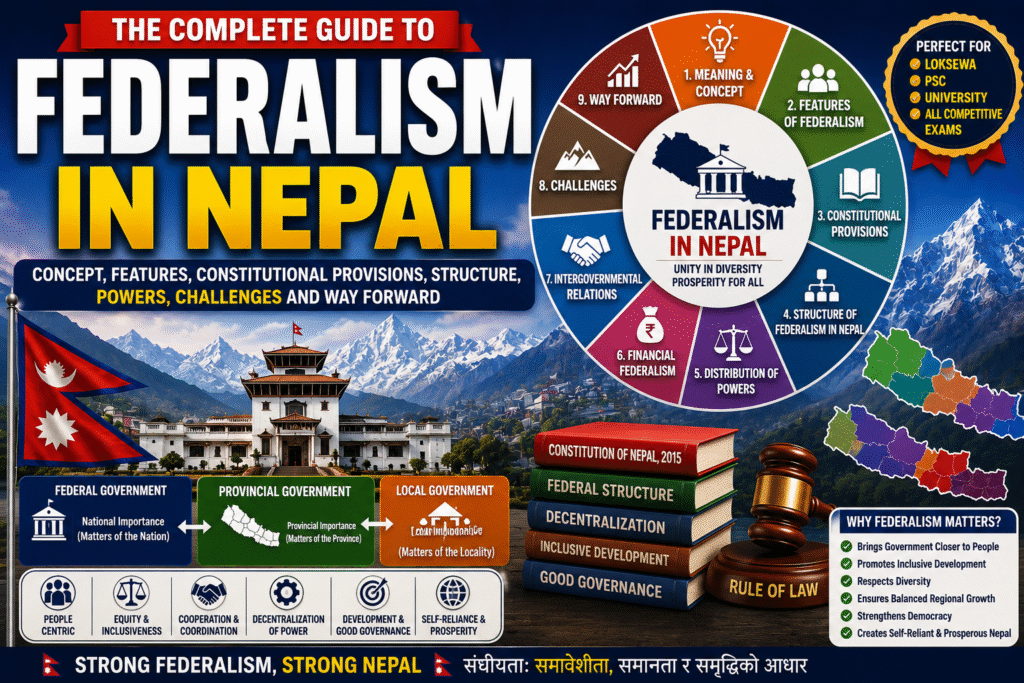
The importance of decision making has grown significantly in Nepal after the adoption of the Constitution of Nepal, 2015, which established a federal democratic republic with three levels of government. Today, decision making occurs simultaneously at the Federal, Provincial, and Local levels. Ministries formulate national policies, provincial governments adapt programmes to regional needs, and local governments make decisions that directly influence citizens’ daily lives. Effective coordination among these levels is essential to ensure consistency, accountability, and efficient public service delivery.
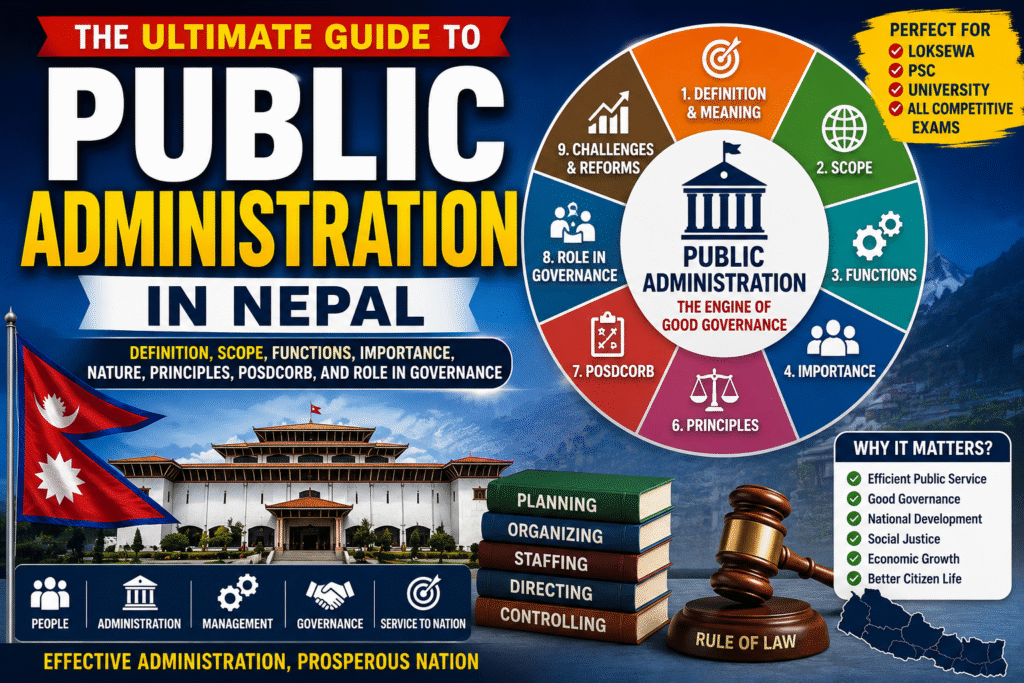
Decision making is also deeply interconnected with the flagship articles already published in our Public Administration series. Public Administration provides the overall framework within which administrative decisions are made. Organization Theory explains how organizational structures influence decision-making authority and communication. Public Policy transforms decisions into formal government action. Administrative Law ensures that every administrative decision complies with constitutional and legal principles. Good Governance demands transparency, accountability, participation, and fairness throughout the decision-making process. Civil Service supplies professional administrators responsible for implementing decisions, while Human Resource Management develops the skills and leadership required for sound judgment. Public Financial Administration provides the financial information needed for budgeting and resource allocation, and Federalism determines which level of government has the authority to make specific decisions.
International organizations such as the United Nations (UN), OECD, World Bank, and Asian Development Bank (ADB) consistently emphasize that evidence-based and participatory decision making is fundamental to effective governance and sustainable development. Modern governments increasingly rely on data analytics, digital governance, artificial intelligence, public consultation, and performance evaluation to improve the quality of administrative decisions.
For students preparing for Loksewa, Public Service Commission (PSC), Judicial Service, university examinations, and other competitive examinations, Decision Making is one of the most frequently examined topics. Questions commonly cover the meaning, characteristics, principles, process, models, types, factors influencing decisions, decision-making techniques, leadership, ethics, challenges, and the practical application of decision making in Nepal’s public administration system.
This comprehensive guide examines every major dimension of Decision Making in Public Administration, including its meaning, characteristics, objectives, principles, process, classical and modern models, types of decisions, influencing factors, Nepalese context, challenges, reforms, future trends, and examination-focused insights. Designed with international academic standards, strong SEO practices, and practical relevance, this article aims to become one of the most complete and authoritative resources on Decision Making in Public Administration available for Nepalese readers.
Meaning of Decision Making
Decision Making is the process of selecting the most appropriate course of action from among two or more available alternatives to achieve a specific objective.
In Public Administration, decision making involves choosing policies, programmes, administrative actions, or solutions that best serve the public interest while complying with constitutional principles, legal requirements, financial limitations, and ethical standards.
Every administrative activity ultimately depends upon decision making. Whether recruiting civil servants, preparing budgets, implementing public policies, responding to disasters, approving development projects, or delivering public services, administrators continuously make decisions that influence citizens’ lives.
Simply put,
Decision Making is the systematic process of identifying a problem, evaluating available alternatives, selecting the best option, implementing it, and reviewing the results.
Definitions of Decision Making
Different scholars have explained decision making from various perspectives.
Herbert A. Simon
Decision making is the heart of administration.
Simon argued that every administrative activity ultimately involves making choices among alternatives.
Chester I. Barnard
According to Barnard,
Decision making is one of the primary responsibilities of executives because organizational success depends upon the quality of executive decisions.
George R. Terry
According to Terry,
Decision making is the selection based on certain criteria from two or more possible alternatives.
Peter F. Drucker
Peter Drucker viewed decision making as
A systematic process that transforms knowledge into effective organizational action.
Although their wording differs, all these definitions emphasize one common idea:
Effective administration depends upon making informed, rational, and timely decisions.
Characteristics of Decision Making
Decision making possesses several important characteristics that distinguish it from other administrative activities.
Goal-Oriented
Every decision seeks to achieve a particular objective.
Government decisions may aim to improve education, healthcare, infrastructure, economic growth, social justice, environmental protection, or national security.
Continuous Process
Decision making is not a one-time activity.
Public administrators make decisions every day while planning, organizing, coordinating, supervising, evaluating, and controlling government programmes.
Choice Among Alternatives
Decision making exists only when multiple alternatives are available.
If only one possible action exists, no real decision needs to be made.
Rational Process
Effective decisions should be based on:
- Facts
- Evidence
- Research
- Laws
- Analysis
- Professional judgment
Rather than personal preferences or political bias.
Dynamic Nature
Administrative decisions must adapt to changing circumstances.
Political priorities, technological developments, economic conditions, public expectations, and emergencies often require governments to revise previous decisions.
Human-Centred
Although technology increasingly supports decision making, final decisions usually depend upon human judgment, experience, ethics, and leadership.
Future-Oriented
Decision making primarily concerns future actions.
Administrators evaluate present conditions to determine the most appropriate future course of action.
Responsibility-Based
Every administrative decision creates responsibility.
Decision makers remain accountable for the consequences of their choices.
Objectives of Decision Making
Decision making serves several important purposes within Public Administration.
Achieving Organizational Goals
The primary objective is to accomplish governmental objectives efficiently and effectively.
Solving Administrative Problems
Decision making identifies solutions for organizational challenges.
Improving Public Service Delivery
Sound decisions improve:
- Service quality
- Accessibility
- Efficiency
- Citizen satisfaction
Ensuring Proper Resource Utilization
Government resources are limited.
Decision making helps allocate:
- Budget
- Human resources
- Technology
- Infrastructure
efficiently.
Supporting Policy Implementation
Public policies become meaningful only after administrative decisions translate them into practical programmes.
Promoting Good Governance
Transparent and accountable decisions strengthen:
- Rule of Law
- Accountability
- Transparency
- Public participation
- Responsiveness
Reducing Uncertainty
Decision making minimizes uncertainty by evaluating available information before selecting a course of action.
Importance of Decision Making in Public Administration
Decision making influences nearly every aspect of government performance.
Its importance includes:
Foundation of Public Administration
Herbert Simon described decision making as the heart of Public Administration because every managerial function ultimately requires decisions.
Improves Organizational Efficiency
Timely and rational decisions improve productivity and administrative effectiveness.
Supports Good Governance
Good governance depends upon:
- Fair decisions
- Transparent procedures
- Public accountability
- Equal treatment
Strengthens Public Trust
Citizens develop confidence in government when decisions are:
- Fair
- Transparent
- Consistent
- Evidence-based
Facilitates Policy Success
Successful implementation of public policies depends upon sound administrative decisions.
Encourages Innovation
Modern decision making promotes:
- Creative problem solving
- Digital transformation
- Continuous improvement
Supports Sustainable Development
Effective governmental decisions contribute directly to:
- Economic growth
- Social inclusion
- Environmental protection
- National development
Principles of Effective Decision Making
Successful administrators generally follow several important principles.
Legality
Every decision must comply with:
- The Constitution
- Laws
- Regulations
- Administrative procedures
Public Interest
Government decisions should prioritize public welfare over personal or political interests.
Rationality
Decisions should be based upon objective analysis rather than emotions.
Transparency
Administrative decisions should be open and understandable whenever legally possible.
Accountability
Decision makers must accept responsibility for the outcomes of their decisions.
Participation
Where appropriate, citizens and stakeholders should participate in decision-making processes.
Timeliness
Delayed decisions often reduce administrative effectiveness.
Timely decisions improve responsiveness.
Evidence-Based Approach
Reliable data and research should guide public decisions.
Ethical Conduct
Integrity, honesty, impartiality, and fairness must guide every administrative decision.
Types of Decision Making
Public Administration involves various types of decisions depending upon organizational needs.
Programmed Decisions
These are routine decisions made according to established rules and procedures.
Examples include:
- Issuing citizenship recommendations
- Processing routine licenses
- Salary payments
- Leave approvals
Non-Programmed Decisions
These involve new, complex, or unusual situations requiring managerial judgment.
Examples include:
- Disaster response
- Constitutional disputes
- Major policy reforms
- Administrative restructuring
Strategic Decisions
Strategic decisions determine long-term organizational direction.
Examples:
- National development plans
- Civil service reforms
- Fiscal policy
Tactical Decisions
These support strategic objectives through medium-term planning.
Examples:
- Departmental annual plans
- Provincial development programmes
Operational Decisions
Operational decisions concern day-to-day administrative activities.
Examples:
- Office management
- Staff scheduling
- Routine supervision
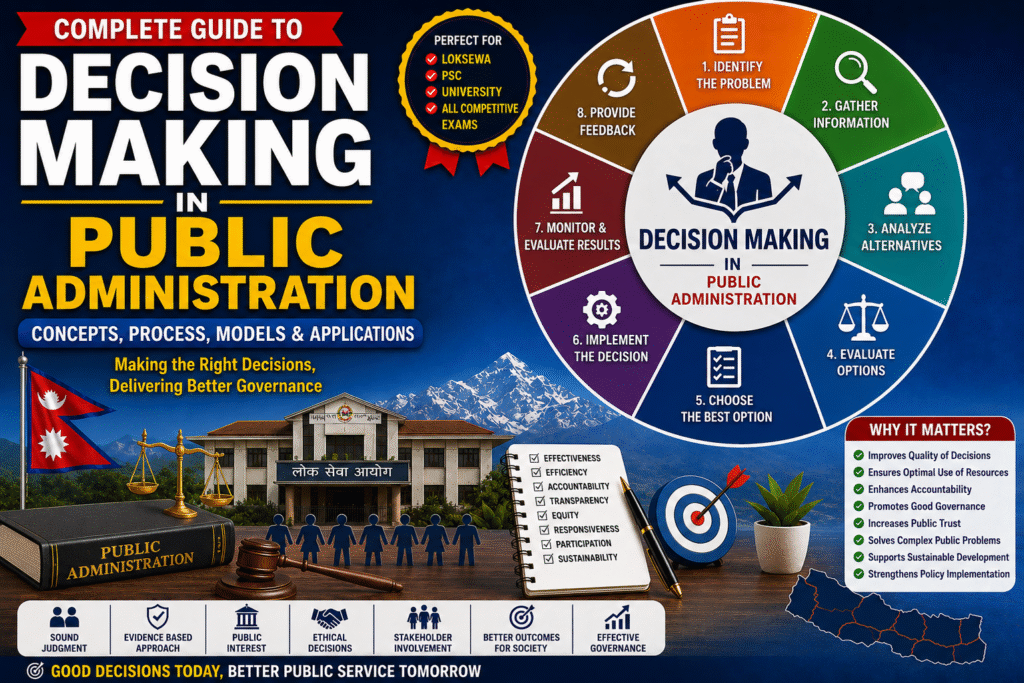
Decision-Making Process
Although different organizations follow different procedures, effective decision making generally follows a systematic process.
Step 1: Identify the Problem
Clearly define the issue requiring attention.
Accurate problem identification prevents inappropriate solutions.
Step 2: Collect Relevant Information
Gather reliable information from:
- Reports
- Statistics
- Experts
- Citizens
- Laws
- Previous experience
Quality information leads to better decisions.
Step 3: Generate Alternatives
Develop several possible solutions.
Considering multiple alternatives increases the likelihood of selecting the best option.
Step 4: Evaluate Alternatives
Compare alternatives based on:
- Cost
- Benefits
- Risks
- Feasibility
- Legal implications
- Public impact
Step 5: Select the Best Alternative
Choose the option that best achieves organizational objectives while serving the public interest.
Step 6: Implement the Decision
Communicate the decision clearly and allocate the necessary human, financial, and technical resources for implementation.
Step 7: Monitor and Evaluate
Assess outcomes to determine whether the decision achieved its intended objectives.
Feedback enables continuous improvement and supports better future decisions.
Models of Decision Making in Public Administration
Over the years, scholars have developed various models to explain how decisions are made within organizations. Some models assume that decision makers are completely rational, while others recognize that real-life administrative decisions are often influenced by limited information, political pressures, organizational constraints, uncertainty, and human behavior.
Understanding these models helps administrators choose the most appropriate approach according to the situation.
Rational Decision-Making Model
The Rational Model is one of the earliest and most influential approaches in Public Administration.
It assumes that decision makers:
- Clearly identify the problem.
- Gather complete information.
- Consider every possible alternative.
- Evaluate costs and benefits objectively.
- Select the best possible solution.
This model assumes that administrators are fully informed and capable of making logical decisions without bias.
Steps of the Rational Model
- Identify the problem.
- Define objectives.
- Collect complete information.
- Generate alternatives.
- Evaluate each alternative.
- Select the best option.
- Implement the decision.
- Evaluate the results.
Advantages
- Logical and systematic.
- Encourages evidence-based decisions.
- Reduces arbitrary judgments.
- Improves accountability.
Limitations
- Complete information is rarely available.
- Time and financial resources are limited.
- Political realities often influence decisions.
- Human beings cannot evaluate every possible alternative.
Although idealistic, the Rational Model remains a useful framework for policy formulation and strategic planning.
Bounded Rationality Model (Herbert A. Simon)
Herbert Simon challenged the Rational Model by arguing that administrators cannot always make perfectly rational decisions because they face numerous practical limitations.
He introduced the concept of Bounded Rationality.
According to Simon, decision makers operate under constraints such as:
- Limited information.
- Limited time.
- Limited resources.
- Limited cognitive capacity.
- Organizational pressures.
Therefore, administrators usually choose a solution that is good enough, rather than the theoretically perfect one.
Simon called this process Satisficing, a combination of the words satisfy and suffice.
Importance
Bounded Rationality reflects the realities of public administration more accurately than the classical Rational Model and is widely accepted in modern administrative theory.
Incremental Decision-Making Model (Charles E. Lindblom)
Charles Lindblom proposed the Incremental Model, also known as the “Science of Muddling Through.”
Instead of making major changes all at once, governments often make small, gradual adjustments to existing policies.
Characteristics
- Small policy changes.
- Limited alternatives.
- Practical and realistic.
- Continuous learning.
- Reduced political conflict.
Advantages
- Easier to implement.
- Lower administrative risk.
- Greater political acceptance.
- Allows gradual improvement.
Limitations
- May ignore major reforms.
- Can slow innovation.
- Existing problems may continue.
Many government reforms in Nepal are implemented incrementally rather than through sudden structural changes.
Mixed Scanning Model (Amitai Etzioni)
The Mixed Scanning Model combines the strengths of the Rational and Incremental approaches.
Administrators first examine broad strategic issues and then make detailed incremental decisions.
This approach balances long-term planning with practical implementation.
Advantages
- More flexible.
- Encourages strategic thinking.
- Reduces unnecessary risks.
- Suitable for complex government decisions.
Garbage Can Model (Cohen, March, and Olsen)
The Garbage Can Model explains decision making in highly complex organizations where problems, solutions, participants, and opportunities do not always appear in a logical sequence.
According to this model:
- Problems may exist before solutions.
- Solutions may search for problems.
- Decision opportunities arise unexpectedly.
- Organizational outcomes are often unpredictable.
Although unconventional, this model explains decision making in many large public institutions facing uncertainty and competing priorities.
Evidence-Based Decision-Making
Modern governments increasingly promote Evidence-Based Decision Making (EBDM).
Instead of relying on assumptions or political preferences alone, administrators use:
- Research findings.
- Official statistics.
- Policy evaluations.
- Performance indicators.
- Citizen feedback.
- Academic studies.
- International best practices.
Benefits
- Better policy outcomes.
- Greater transparency.
- Improved accountability.
- Efficient resource allocation.
- Increased public trust.
Organizations such as the World Bank, OECD, UNDP, and ADB strongly encourage evidence-based public administration.
Factors Affecting Decision Making
Many internal and external factors influence administrative decisions.
Organizational Structure
The structure of an organization determines:
- Authority.
- Communication.
- Coordination.
- Decision-making speed.
Well-designed organizations generally make better decisions.
Leadership
Effective leaders encourage:
- Participation.
- Innovation.
- Teamwork.
- Accountability.
Poor leadership often results in weak decisions.
Information Availability
High-quality information improves decision quality.
Incomplete or inaccurate information increases uncertainty.
Legal Framework
Public decisions must comply with:
- Constitution.
- Acts.
- Regulations.
- Administrative procedures.
Legal constraints significantly influence governmental decisions.
Political Environment
Government priorities, political leadership, public opinion, and electoral commitments frequently affect administrative choices.
Financial Resources
Budget limitations often determine which alternatives are feasible.
Organizational Culture
Organizations promoting integrity, innovation, and learning generally make more effective decisions.
Technology
Digital technologies improve:
- Data analysis.
- Information sharing.
- Monitoring.
- Service delivery.
Public Participation
Citizen consultation enhances legitimacy and improves policy acceptance.
Decision-Making Techniques
Public administrators use several practical techniques to improve decisions.
These include:
- Cost-Benefit Analysis.
- SWOT Analysis.
- Brainstorming.
- Delphi Technique.
- Scenario Planning.
- Risk Assessment.
- Decision Trees.
- Performance Evaluation.
- Benchmarking.
- Stakeholder Analysis.
These tools help compare alternatives objectively and support evidence-based governance.
Decision Making in Nepal
Decision making in Nepal has changed significantly after the implementation of the Constitution of Nepal, 2015.
Authority is now distributed among:
- Federal Government.
- Provincial Governments.
- Local Governments.
Each level makes decisions within its constitutional jurisdiction while coordinating with the others.
Examples include:
- Federal policy formulation.
- Provincial development planning.
- Municipal budget approval.
- Local infrastructure projects.
- Disaster management.
- Public health programmes.
- Education management.
Successful federal governance depends upon coordinated, transparent, and timely decision making across all three levels of government.
Major Challenges of Decision Making in Nepal
Despite ongoing reforms, several challenges remain:
- Bureaucratic delays.
- Political interference.
- Limited evidence-based planning.
- Weak coordination among governments.
- Insufficient data systems.
- Capacity gaps.
- Resistance to change.
- Financial constraints.
- Slow digital transformation.
- Inadequate monitoring and evaluation.
Addressing these issues is essential for improving public administration and citizen satisfaction.
Reform Measures
To strengthen decision making in Nepal, the following reforms are important:
- Promote evidence-based policymaking.
- Strengthen administrative capacity.
- Expand digital governance.
- Improve intergovernmental coordination.
- Enhance transparency and accountability.
- Encourage citizen participation.
- Develop leadership competencies.
- Improve data collection and analytics.
- Strengthen monitoring and evaluation systems.
- Foster a culture of innovation and continuous learning.
These reforms can improve the quality, speed, and legitimacy of public decisions.
Relationship with Our Previous Flagship Articles
Decision Making is not an isolated topic. It forms the connecting link among all major areas of Public Administration and strengthens the topical authority of our entire Public Administration category.
Public Administration
Public Administration provides the institutional framework within which administrative decisions are made. Planning, organizing, staffing, directing, coordinating, budgeting, and controlling all require continuous decision making.
Organization Theory
Organizational structure directly influences:
- Decision-making authority.
- Communication channels.
- Coordination.
- Speed of administrative action.
- Accountability mechanisms.
Centralized and decentralized structures produce different decision-making patterns.
Public Policy
Public policies are essentially decisions made by government authorities. Policy formulation, adoption, implementation, and evaluation all involve systematic decision-making processes.
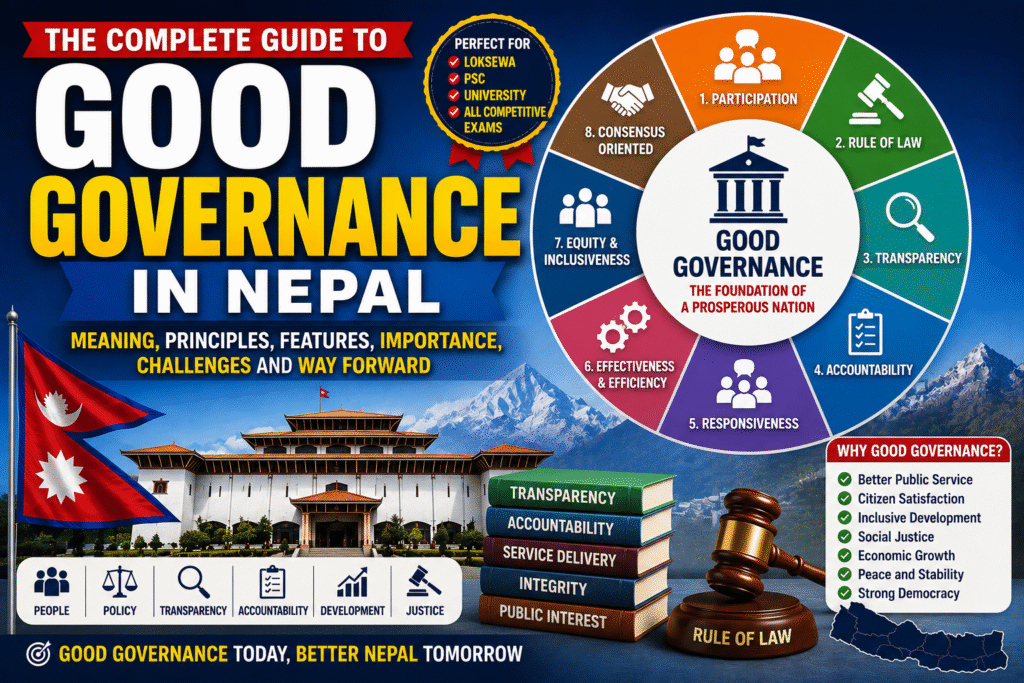
Good Governance
Good Governance requires decisions that are:
- Transparent.
- Accountable.
- Participatory.
- Responsive.
- Equitable.
- Consistent with the Rule of Law.
Poor decision making weakens governance and reduces public trust.
Civil Service in Nepal
Civil servants play a central role in:
- Advising policymakers.
- Preparing policy options.
- Implementing decisions.
- Monitoring outcomes.
- Providing technical expertise.
A professional civil service improves the quality of governmental decisions.
Administrative Law in Nepal
Administrative Law ensures that public decisions remain:
- Constitutional.
- Lawful.
- Fair.
- Reasonable.
- Free from abuse of power.
It also provides remedies against arbitrary administrative decisions.
Human Resource Management in Public Administration
Human Resource Management develops the competencies needed for effective decision making, including:
- Analytical skills.
- Leadership.
- Communication.
- Problem solving.
- Ethical judgment.
- Strategic thinking.
Public Financial Administration in Nepal
Budgeting and financial management require constant decisions regarding:
- Resource allocation.
- Expenditure priorities.
- Revenue mobilization.
- Procurement.
- Fiscal discipline.
Financial decisions significantly influence development outcomes.
Federalism in Nepal
Federalism distributes decision-making authority among:
- Federal Government.
- Provincial Governments.
- Local Governments.
Effective intergovernmental coordination is therefore essential for coherent public administration.
Future Trends in Decision Making
Public sector decision making is evolving rapidly due to technological advancement and changing governance expectations.
Data-Driven Governance
Governments increasingly use large datasets and analytics to support policy decisions and improve service delivery.
Artificial Intelligence (AI)
AI tools can assist administrators in forecasting, risk assessment, and policy analysis, although human judgment remains essential.
Digital Governance
Online platforms enable faster information sharing, citizen participation, and administrative coordination.
Participatory Decision Making
Citizens are increasingly involved through public consultations, digital feedback systems, community meetings, and participatory budgeting.
Real-Time Monitoring
Governments can now track programme performance and make corrective decisions more quickly through digital monitoring systems.
Evidence-Based Administration
Research, evaluation, and performance data are becoming increasingly important in policy and administrative decision making.
Quick Revision Table
| Topic | Key Point |
|---|---|
| Meaning | Selection of the best alternative |
| Nature | Continuous, goal-oriented, rational process |
| Main Objective | Achieve public goals efficiently |
| Rational Model | Best possible solution |
| Bounded Rationality | Satisficing under limitations |
| Incremental Model | Small gradual changes |
| Mixed Scanning | Strategic plus incremental approach |
| Evidence-Based | Decisions based on data and research |
| Core Principle | Legality and public interest |
| Nepal Context | Federal, provincial, and local decision making |
Frequently Asked Questions (FAQs)
What is Decision Making in Public Administration?
Decision Making in Public Administration is the process of selecting the most appropriate course of action from among available alternatives to achieve public objectives while ensuring legality, accountability, and public welfare.
Why is decision making called the heart of administration?
Herbert A. Simon described decision making as the heart of administration because every administrative function ultimately involves making choices regarding policies, programmes, resources, and organizational actions.
What is the difference between programmed and non-programmed decisions?
Programmed decisions are routine decisions made according to established rules and procedures.
Non-programmed decisions involve new, complex, or unusual situations that require managerial judgment and analysis.
What is bounded rationality?
Bounded rationality means that decision makers operate under limitations such as incomplete information, limited time, limited resources, and limited human cognitive capacity. Therefore, they often choose a satisfactory solution rather than a perfectly optimal one.
Which decision-making model is most realistic for public administration?
Many scholars consider Bounded Rationality and the Incremental Model more realistic because public administrators frequently make decisions under uncertainty, political pressure, and resource constraints.
Why is evidence-based decision making important?
Evidence-based decision making improves policy outcomes, transparency, accountability, efficient resource utilization, and public trust by relying on research, statistics, evaluations, and factual analysis.
Practice Questions
Short Questions
- Define Decision Making.
- State the characteristics of decision making.
- What is programmed decision making?
- Explain bounded rationality.
- What is evidence-based decision making?
Long Questions
- Explain the meaning, characteristics, objectives, and importance of decision making in Public Administration.
- Discuss the Rational and Bounded Rationality models of decision making.
- Critically evaluate the Incremental Model of decision making.
- Analyze the factors affecting decision making in public organizations.
- Examine the challenges of administrative decision making in Nepal and suggest appropriate reforms.
Conclusion
Decision Making is the core of Public Administration because every governmental action—from policy formulation and budgeting to service delivery and administrative reform—depends upon the quality of decisions made by public officials. Effective decision making requires clear objectives, reliable information, legal compliance, ethical judgment, stakeholder consultation, and continuous evaluation.
The study of decision-making models shows that public administrators do not always operate under ideal conditions. While the Rational Model provides a useful framework, real-world governance is often better explained by Bounded Rationality, Incremental decision making, and evidence-based approaches that recognize uncertainty, political influence, and resource limitations.
In Nepal, the federal system has made decision making more complex and more important. Federal, Provincial, and Local Governments must coordinate their decisions to ensure consistent policy implementation, efficient resource utilization, and responsive public service delivery. Strengthening evidence-based planning, digital governance, administrative capacity, transparency, and public participation will be essential for improving the quality of governmental decisions.
Ultimately, good governance is impossible without good decision making. Administrators who can analyze problems objectively, evaluate alternatives carefully, act ethically, and learn from outcomes become the foundation of an efficient, accountable, and citizen-centred public administration.
References
- Constitution of Nepal, 2015
- Herbert A. Simon – Administrative Behavior
- Chester I. Barnard – The Functions of the Executive
- Charles E. Lindblom – The Science of Muddling Through
- Amitai Etzioni – Mixed Scanning
- Peter F. Drucker – The Effective Executive
- OECD – Public Governance Reviews
- UNDP – Governance and Public Administration
- World Bank – Governance and Decision Making
- Asian Development Bank (ADB)