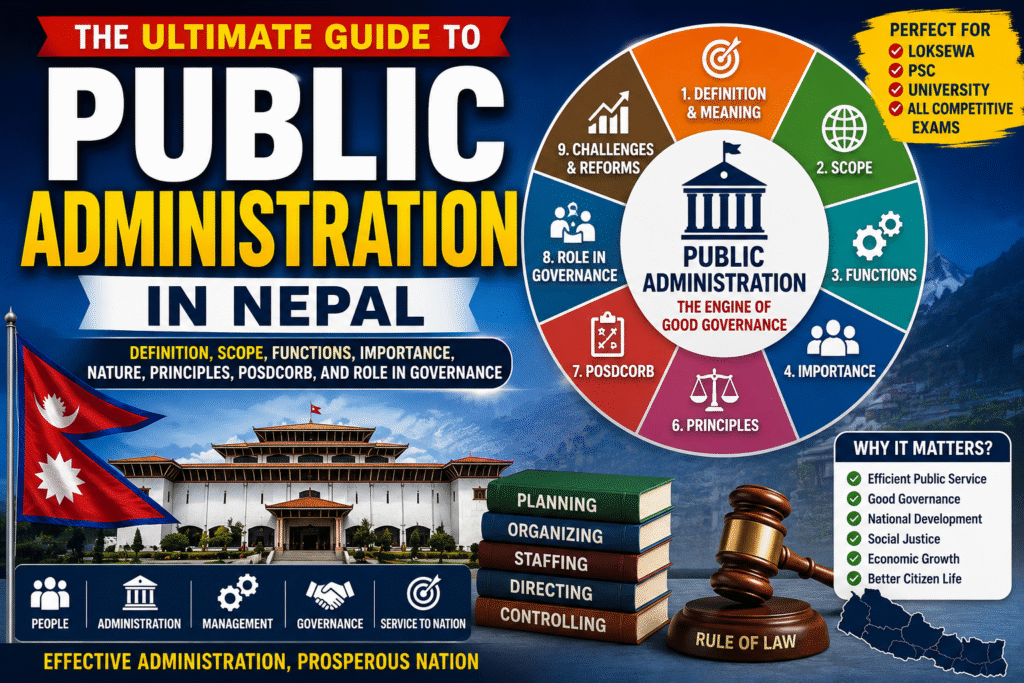
Public Administration: Definition, Scope, Functions, Importance and Role in Governance
Introduction: Understanding Public Administration
Every modern state requires an effective administrative system to transform government decisions, policies, and laws into practical results. A government may create excellent policies and development plans, but their success depends on how effectively those policies are implemented. This implementation mechanism is known as Public Administration.
Public Administration is one of the most important pillars of governance. It connects the government with citizens by providing essential public services, managing government institutions, maintaining law and order, implementing development programs, and ensuring public welfare.
From issuing citizenship certificates to managing public schools, hospitals, infrastructure projects, social security programs, and disaster response activities, public administration influences almost every aspect of citizens’ daily lives.
In democratic countries, public administration is not merely a system of government offices. It is a mechanism for achieving:
- Good governance
- Transparency
- Accountability
- Social justice
- Sustainable development
For Nepal, the importance of public administration has increased significantly after the adoption of the federal democratic system through the Constitution of Nepal 2072. The effective coordination of federal, provincial, and local governments depends largely on the strength of the administrative system.
In simple words:
Public Administration is the process through which government policies and decisions are implemented for the welfare of society.
Meaning of Public Administration
The term Public Administration consists of two words:
Public
The word “Public” refers to people, citizens, or society as a whole.
It represents activities and decisions related to:
- Public interest
- Citizen welfare
- Social development
- Government responsibilities
Administration
The word “Administration” is derived from the Latin word “Administrare”, which means:
- To serve
- To manage
- To direct
- To look after
Administration refers to the process of managing resources and activities to achieve specific objectives.
Therefore:
Public Administration means the management and execution of government activities for serving the public interest.
It includes the functioning of:
- Government institutions
- Civil servants
- Administrative agencies
- Public organizations
responsible for implementing government policies and delivering services to citizens.
Definition of Public Administration
Different scholars have defined public administration from different perspectives. Some emphasize government activities, while others focus on management, decision-making, and public service delivery.
Definition by Woodrow Wilson
Woodrow Wilson, widely known as the Father of Public Administration, defined public administration as:
“Public administration is the detailed and systematic execution of public law.”
According to Wilson, administration begins after laws and policies are formulated. The main responsibility of administration is to execute those decisions effectively.
Wilson’s ideas introduced the concept of:
Politics-Administration Dichotomy
which suggests:
- Politics decides what should be done.
- Administration determines how it should be done.
Definition by Luther Gulick
Luther Gulick defined public administration as:
“Public Administration is that part of the science of administration which has to do with government.”
Gulick emphasized that public administration deals specifically with government organizations and their management.
He introduced the famous concept:
POSDCORB
which explains administrative functions:
- Planning
- Organizing
- Staffing
- Directing
- Coordinating
- Reporting
- Budgeting
Definition by Herbert Simon
Herbert Simon viewed administration mainly as a process of decision-making.
According to Simon:
“The processes of administration are decision-making processes.”
He argued that every administrative activity involves making decisions among alternatives.
His approach is known as:
Decision-Making Approach to Public Administration
Definition by Max Weber
Max Weber explained public administration through his theory of bureaucracy.
According to Weber, an ideal administrative system should have:
- Clear hierarchy
- Division of work
- Written rules
- Professional officials
- Impersonal decision-making
His bureaucratic model became one of the foundations of modern civil service systems.
Evolution of Public Administration
Public Administration has continuously evolved according to changes in society, politics, economy, and technology.
The evolution can be divided into different stages:
Traditional Public Administration (1887–1940)
The development of modern public administration began with Woodrow Wilson’s famous essay:
“The Study of Administration” (1887)
During this period, administration was mainly concerned with:
- Efficiency
- Rules and procedures
- Hierarchical structure
- Neutral civil service
The main belief was that administration should function scientifically and professionally.
Major Features:
Politics-Administration Separation
Administration should be separate from political influence.
Rule-Based System
Officials should work according to established laws and procedures.
Efficiency Orientation
The focus was improving government performance.
Classical Public Administration (1920–1970)
The classical approach focused on organizational structure, efficiency, and administrative principles.
Major contributors:
- Max Weber
- Frederick Taylor
- Henri Fayol
- Luther Gulick
The main assumption was that organizations could be managed effectively through scientific principles.
Major Concepts:
Scientific Management
Frederick Taylor emphasized improving efficiency through scientific study of work.
Bureaucratic Theory
Max Weber explained bureaucracy as a rational organizational system.
Administrative Principles
Luther Gulick and others developed principles for effective administration.
New Public Administration (1960s onwards)
Traditional administration was criticized because it focused mainly on efficiency and ignored social issues.
The New Public Administration movement emerged after the:
Minnowbrook Conference (1968)
It emphasized:
- Social equity
- Citizen participation
- Public responsiveness
- Democratic values
The central idea was:
Administration should not only be efficient but also socially responsible.
New Public Management (1980s onwards)
New Public Management (NPM) developed as a response to the limitations of traditional bureaucracy.
It introduced private-sector management techniques into government organizations.
Major Features:
- Performance measurement
- Result-oriented management
- Competition
- Decentralization
- Customer-focused services
The main objective was:
Making government more efficient, effective, and responsive.
New Public Governance (Present Approach)
Modern governance recognizes that government alone cannot solve all social problems.
New Public Governance focuses on cooperation among:
- Government
- Private sector
- Civil society
- Citizens
Major Features:
- Collaboration
- Partnership
- Network governance
- Shared responsibility
In the digital era, concepts like:
- Digital Governance
- Smart Governance
- Open Government
have become important parts of public administration.
Why Public Administration Matters Today
Public Administration affects almost every area of citizens’ lives.
A strong administrative system helps:
- Implement government policies
- Deliver quality public services
- Manage development programs
- Maintain social order
- Promote economic growth
- Strengthen democracy
For developing countries like Nepal, effective public administration is essential for achieving sustainable development and improving people’s quality of life.
Nature of Public Administration
The nature of public administration refers to the basic features and characteristics that explain how public administration operates within a government system.
Public administration is not limited to managing government offices. It is a broad field that combines management, law, politics, economics, and social sciences to achieve public welfare.
The nature of public administration has changed over time. Traditional administration mainly focused on rules, procedures, and government machinery, whereas modern administration focuses on citizens, service delivery, innovation, and good governance.
The major aspects of the nature of public administration are:
1. Public-Oriented Nature
The primary objective of public administration is to serve society and protect public interest.
Unlike private administration, which mainly focuses on profit and business objectives, public administration focuses on:
- Citizen welfare
- Social justice
- Equal access to services
- Public interest
For example, government programs related to health, education, agriculture, and social security are designed for improving citizens’ lives.
2. Political Environment Influenced Nature
Public administration operates within a political system.
Although administrators are expected to remain professional and neutral, they work according to:
- Constitution
- Laws
- Government policies
- Decisions of elected representatives
In democratic systems, public administration acts as a bridge between political decisions and practical implementation.
3. Service Delivery-Oriented Nature
One of the most important roles of public administration is delivering essential services to citizens.
Examples:
- Education services
- Health facilities
- Citizenship and registration services
- Infrastructure development
- Security services
The effectiveness of a government is often judged by the quality of public services provided.
4. Dynamic Nature
Public administration is continuously changing according to social, economic, technological, and political changes.
Modern administrative reforms include:
- Digital governance
- Online public services
- Performance-based management
- Citizen participation
For example, Nepal has introduced digital systems such as electronic procurement and online government services.
5. Legal and Constitutional Nature
Public administration operates within a legal framework.
Administrative officials must perform their duties according to:
- Constitution
- Acts
- Regulations
- Government procedures
In Nepal, public administration is guided by the Constitution of Nepal 2072 and various laws related to governance and civil service.
6. Accountability-Based Nature
Public administration must be accountable to citizens and legal institutions.
Accountability ensures:
- Proper use of public resources
- Transparency in decisions
- Responsibility of officials
- Better service delivery
Mechanisms such as auditing, parliamentary monitoring, and public complaint systems help maintain accountability.
Scope of Public Administration
The scope of public administration refers to the areas and activities covered by public administration.
The scope has expanded significantly over time. Earlier, it was limited to government office management, but today it includes development, policy implementation, technology, and governance.
The scope can be divided into:
- Traditional Scope
- Modern Scope
Traditional Scope of Public Administration
Traditional public administration focused mainly on government machinery and internal administrative processes.
1. Government Organization
It includes:
- Structure of government institutions
- Administrative hierarchy
- Division of authority
- Responsibilities of officials
2. Executive Functions
Traditional administration focused on the activities of the executive branch.
It included:
- Implementation of laws
- Execution of government decisions
- Management of government operations
3. Bureaucracy Management
A major area was the management of civil servants.
It included:
- Recruitment
- Promotion
- Discipline
- Administrative procedures
4. Financial Administration
It covered:
- Government budgeting
- Revenue management
- Public expenditure control
Modern Scope of Public Administration
Modern public administration has become much broader because governments today perform various social and economic responsibilities.
1. Policy Implementation
Public administration converts government policies into practical programs.
For example:
A government agricultural policy requires administrative agencies to provide:
- Farmer support
- Extension services
- Subsidies
- Technical assistance
2. Development Administration
Development administration focuses on using administrative systems for national development.
It includes:
- Infrastructure development
- Poverty reduction programs
- Rural development
- Human development activities
For developing countries like Nepal, development administration plays a crucial role.
3. Public Service Delivery
Modern administration focuses on providing efficient and accessible services.
Major services include:
- Health
- Education
- Social security
- Transportation
- Public registration
4. E-Governance and Digital Administration
Technology has become an important part of modern public administration.
E-governance improves:
- Transparency
- Efficiency
- Accessibility
- Speed of service delivery
Examples:
- Online tax systems
- Digital government portals
- Electronic procurement systems
5. Disaster Management
Public administration plays a key role during emergencies.
Its responsibilities include:
- Disaster preparedness
- Rescue operations
- Relief management
- Rehabilitation
Nepal’s experience with earthquakes, floods, and landslides highlights the importance of disaster administration.
6. Public-Private Partnership (PPP)
Modern administration recognizes cooperation between government and private sectors.
PPP helps in:
- Infrastructure development
- Service improvement
- Resource mobilization
Characteristics of Public Administration
The major characteristics of public administration are:
| Characteristics | Explanation |
|---|---|
| Public Interest | Works for welfare of society |
| Accountability | Responsible to citizens and legal institutions |
| Legal Foundation | Operates according to laws and regulations |
| Continuity | Government services continue permanently |
| Political Environment | Works within political and constitutional systems |
| Service Motive | Focuses on public welfare rather than profit |
| Large Scale Operation | Works at federal, provincial and local levels |
Objectives of Public Administration
The main objectives of public administration are:
1. Implementation of Government Policies
The primary objective is to transform government decisions into practical actions.
Without effective administration, policies cannot produce desired results.
2. Public Service Delivery
Public administration aims to provide quality, accessible, and efficient services to citizens.
3. Maintaining Law and Order
Administration helps maintain:
- Peace
- Security
- Social stability
- Rule of law
4. Economic and Social Development
Public administration supports development through:
- Planning
- Resource management
- Project implementation
5. Ensuring Good Governance
Modern public administration promotes:
- Transparency
- Accountability
- Participation
- Efficiency
- Rule of law
6. Protecting Public Interest
Public administration ensures that government activities benefit all sections of society.
Functions of Public Administration
The functions of public administration explain the activities performed by administrative institutions to achieve public goals.
Luther Gulick explained administrative functions through the famous concept:
POSDCORB
P – Planning
Planning involves deciding:
- Objectives
- Strategies
- Required resources
- Future actions
Examples in Nepal:
- Periodic development plans
- Government annual programs
- Sectoral development plans
O – Organizing
Organizing means creating administrative structures and assigning responsibilities.
It includes:
- Establishing institutions
- Defining authority
- Dividing tasks
S – Staffing
Staffing refers to managing human resources.
It includes:
- Recruitment
- Training
- Promotion
- Performance evaluation
In Nepal, Public Service Commission (Lok Sewa Aayog) plays an important role in civil service recruitment.
D – Directing
Directing means providing:
- Leadership
- Guidance
- Motivation
- Instructions
to achieve administrative objectives.
CO – Coordinating
Coordination ensures cooperation among different administrative units.
It is especially important in Nepal’s federal system:
- Federal government
- Provincial governments
- Local governments
R – Reporting
Reporting provides information about administrative activities and progress.
It helps in:
- Monitoring
- Evaluation
- Accountability
B – Budgeting
Budgeting involves:
- Revenue management
- Public expenditure planning
- Financial control
Importance of Public Administration
Public administration is essential for the effective functioning of a state.
1. Effective Policy Implementation
Administration converts government decisions into practical outcomes.
2. Quality Public Service Delivery
It ensures citizens receive:
- Accessible services
- Timely services
- Fair services
3. Economic Development
Public administration supports development through:
- Planning
- Infrastructure management
- Resource allocation
4. Maintaining Social Order
It maintains:
- Law and order
- Security
- Stability
5. Promoting Good Governance
Effective administration strengthens:
- Transparency
- Accountability
- Citizen participation
6. Social Justice and Inclusion
Public administration helps provide equal opportunities and protect disadvantaged groups.
Public Administration in Nepal
Nepal’s public administration system has undergone significant changes with the transformation from a unitary system to a federal democratic system.
The Constitution of Nepal 2072 (2015) established a federal governance structure consisting of:
- Federal Government
- Provincial Government
- Local Government
This federal structure has increased the responsibilities and challenges of public administration.
An effective administrative system is essential for:
- Implementing constitutional provisions
- Delivering public services
- Managing development programs
- Ensuring good governance
- Strengthening democracy
Constitutional Basis of Public Administration in Nepal
The Constitution of Nepal provides the foundation for Nepal’s administrative system.
Important constitutional principles include:
1. Federal Administrative Structure
Nepal follows a three-level government system:
Federal → Provincial → Local
Each level has its own responsibilities and administrative institutions.
2. Inclusive Administration
The Constitution emphasizes inclusion and participation of different groups in state mechanisms.
The objective is to create:
- Representative administration
- Equal opportunities
- Social justice
3. Rule-Based Administration
Public administration functions according to:
- Constitution
- Federal laws
- Provincial laws
- Local regulations
This ensures legality and accountability in administrative actions.
Three Levels of Administration in Nepal
1. Federal Administration
The federal administration is responsible for national-level functions.
Major institutions include:
- Ministries
- Departments
- Constitutional bodies
- National agencies
Major Responsibilities:
- National policy formulation
- Foreign affairs
- National security
- Monetary policy
- Large infrastructure projects
Federal administration provides overall direction and coordination.
2. Provincial Administration
Provincial administration operates between federal and local governments.
Its major functions include:
- Provincial policy implementation
- Regional development programs
- Management of provincial services
- Coordination with local governments
Provincial ministries and offices are responsible for implementing provincial decisions.
3. Local Administration
Local governments are the closest administrative units to citizens.
They include:
- Rural municipalities
- Municipalities
- Sub-metropolitan cities
- Metropolitan cities
Major Responsibilities:
- Local infrastructure development
- Basic education management
- Basic health services
- Local registration services
- Local development activities
Local administration plays a direct role in improving citizens’ daily lives.
Challenges of Public Administration in Nepal
Although Nepal has made progress in administrative reform, several challenges remain.
1. Federal Coordination Challenges
Coordination among federal, provincial, and local governments remains a major challenge.
Issues include:
- Overlapping responsibilities
- Resource sharing problems
- Lack of clear coordination mechanisms
2. Administrative Capacity Problems
Some institutions face challenges related to:
- Skilled human resources
- Technical capacity
- Institutional effectiveness
3. Political Influence
Maintaining professional neutrality of administration is an important challenge.
A professional civil service requires:
- Merit-based recruitment
- Political neutrality
- Ethical standards
4. Service Delivery Problems
Citizens still experience challenges related to:
- Delay in services
- Complex procedures
- Limited accessibility
5. Digital Transformation Challenges
Although digital governance is expanding, challenges remain:
- Digital literacy
- Infrastructure limitations
- Data security concerns
Major Thinkers and Their Contributions to Public Administration
1. Woodrow Wilson (1856–1924)
Father of Public Administration
Major Contribution:
- Established public administration as an independent discipline
- Politics-Administration Dichotomy
- Emphasis on professional administration
Key Idea:
Politics decides, administration implements.
2. Max Weber (1864–1920)
Bureaucratic Theory
Weber considered bureaucracy a rational and efficient administrative system.
Major Features:
- Hierarchy
- Division of work
- Written rules
- Professional officials
- Impersonal decisions
Contribution:
His ideas became the foundation of modern civil service systems.
3. Frederick Winslow Taylor (1856–1915)
Scientific Management Theory
Taylor focused on improving organizational efficiency through scientific methods.
Major Principles:
- Scientific study of work
- Proper employee selection
- Training and development
- Cooperation between management and workers
4. Luther Gulick (1892–1993)
POSDCORB Concept
Gulick explained administrative functions through:
- Planning
- Organizing
- Staffing
- Directing
- Coordinating
- Reporting
- Budgeting
5. Herbert Simon (1916–2001)
Decision-Making Theory
Simon argued that administration is mainly a process of decision-making.
Important concept:
Bounded Rationality
Administrators cannot always make perfect decisions because of:
- Limited information
- Limited time
- Limited resources
6. Dwight Waldo (1913–2000)
Values and Democracy Approach
Waldo argued that administration cannot be completely separated from values.
Public administration must consider:
- Democracy
- Ethics
- Social justice
- Public values
Modern Concepts of Public Administration
1. New Public Management (NPM)
New Public Management emerged during the 1980s.
It introduced business management ideas into government administration.
Features:
- Performance measurement
- Result-based management
- Efficiency improvement
- Competition
- Customer-oriented services
Main Objective:
Making government more efficient and effective.
2. Good Governance
Good governance refers to effective, transparent, accountable, and participatory administration.
Major principles:
Transparency
Government actions should be open and understandable.
Accountability
Officials should be responsible for their decisions.
Participation
Citizens should participate in governance.
Rule of Law
All actions should follow legal principles.
Effectiveness
Resources should be used efficiently.
3. Digital Governance
Digital governance refers to using technology for improving government services.
Benefits:
- Faster service delivery
- Transparency improvement
- Reduced administrative burden
- Better citizen access
Examples:
- Online government services
- Electronic procurement
- Digital payment systems
4. New Public Governance (NPG)
New Public Governance focuses on cooperation among:
- Government
- Private sector
- Civil society
- Citizens
Main features:
- Collaboration
- Partnership
- Networks
- Shared responsibility
Traditional vs Modern Public Administration
| Traditional Administration | Modern Administration |
|---|---|
| Rule-oriented | Result-oriented |
| Centralized structure | Decentralized approach |
| Citizen as subject | Citizen as partner |
| Bureaucracy focused | Innovation focused |
| Limited technology | Digital governance |
Conclusion
Public Administration is the foundation of effective governance and public service delivery. It transforms government policies and decisions into practical actions that directly influence citizens’ lives.
From traditional bureaucratic systems to modern approaches like New Public Management and New Public Governance, public administration has continuously evolved according to changing social needs.
In Nepal’s federal democratic system, the role of public administration has become more important than ever. Effective coordination among federal, provincial, and local governments is essential for achieving good governance, sustainable development, and inclusive growth.
A professional, transparent, accountable, and citizen-centered public administration system is necessary for building a prosperous and democratic society.
Quick Revision Box A
Public Administration = Government Policies + Implementation Process + Public Service Delivery
Father of Public Administration: Woodrow Wilson
Politics-Administration Dichotomy: Woodrow Wilson
Bureaucratic Theory: Max Weber
POSDCORB: Luther Gulick
Decision-Making Approach: Herbert Simon
New Public Administration Focus: Social Equity
New Public Management Focus: Efficiency and Performance
New Public Governance Focus: Collaboration and Networks
Quick Revision Box B
Nature:
Public-oriented + Legal + Dynamic + Accountable + Service-based
Traditional Scope:
Organization + Bureaucracy + Executive functions
Modern Scope:
Policy implementation + Development + E-governance + Disaster management
POSDCORB:
Planning
Organizing
Staffing
Directing
Coordinating
Reporting
Budgeting
Main Objective:
Effective implementation of government policies for public welfare.
Frequently Asked Questions (FAQs)
What is Public Administration?
Public Administration is the process of implementing government policies and delivering public services for public welfare.
Who is the Father of Public Administration?
Woodrow Wilson is known as the Father of Public Administration.
What is POSDCORB?
POSDCORB is an administrative concept developed by Luther Gulick explaining seven functions of administration.
Why is Public Administration important?
It is important because it implements policies, delivers services, supports development, and promotes good governance.
What is the role of Public Administration in Nepal?
It implements constitutional provisions, manages government services, and supports development through federal, provincial, and local administration.
Loksewa Exam-Oriented Questions
Short Questions:
- Define Public Administration.
- Explain the characteristics of Public Administration.
- What is POSDCORB?
- Explain the concept of good governance.
Long Questions:
- Define Public Administration and explain its scope.
- Discuss the evolution of Public Administration.
- Explain the importance of Public Administration in governance.
- Describe the role of Public Administration in Nepal’s federal system.
- Explain the contribution of Woodrow Wilson and Max Weber to Public Administration.
MCQs for Loksewa Preparation
1. Who is known as the Father of Public Administration?
A. Max Weber
B. Woodrow Wilson
C. Herbert Simon
D. Luther Gulick
Answer: B. Woodrow Wilson
2. POSDCORB was introduced by:
A. Taylor
B. Weber
C. Gulick
D. Simon
Answer: C. Luther Gulick
3. Bureaucratic Theory was developed by:
A. Weber
B. Wilson
C. Waldo
D. Taylor
Answer: A. Max Weber
4. Scientific Management Theory is associated with:
A. Simon
B. Taylor
C. Weber
D. Gulick
Answer: B. Frederick Taylor
5. Decision-Making Theory was developed by:
A. Herbert Simon
B. Wilson
C. Weber
D. Waldo
Answer: A. Herbert Simon
Quick Revision Notes
Public Administration
Government activities + Policy implementation + Public service delivery
Important Scholars
| Scholar | Contribution |
|---|---|
| Woodrow Wilson | Father of Public Administration |
| Max Weber | Bureaucratic Theory |
| Taylor | Scientific Management |
| Gulick | POSDCORB |
| Herbert Simon | Decision Making |
| Dwight Waldo | Democratic Values |
Modern Approaches
Traditional Administration:
Rules + Hierarchy
New Public Management:
Efficiency + Performance
New Public Governance:
Collaboration + Networks