Management Functions in Public Administration (POSDCORB): Meaning, Evolution, Functions, Principles, Importance, Criticism, and Nepal Context
The Ultimate Guide for Loksewa, PSC, University Students, Researchers, and Competitive Examinations
Introduction
Every successful government, regardless of its size or political system, depends not only on good laws and sound policies but also on effective management. A constitution may establish governmental institutions, the legislature may enact laws, and policymakers may formulate ambitious public policies, but unless those institutions are managed efficiently, the desired public outcomes cannot be achieved. Roads remain unbuilt, schools fail to deliver quality education, hospitals become inefficient, budgets remain underutilized, and public trust gradually declines. For this reason, management is widely regarded as one of the most fundamental pillars of Public Administration.
In the field of Public Administration, management refers to the systematic process of planning governmental activities, organizing available resources, recruiting and developing competent personnel, directing employees, coordinating institutional efforts, reporting organizational performance, budgeting public resources, monitoring implementation, and evaluating outcomes. These functions ensure that public organizations operate efficiently, lawfully, transparently, and in the best interests of citizens.
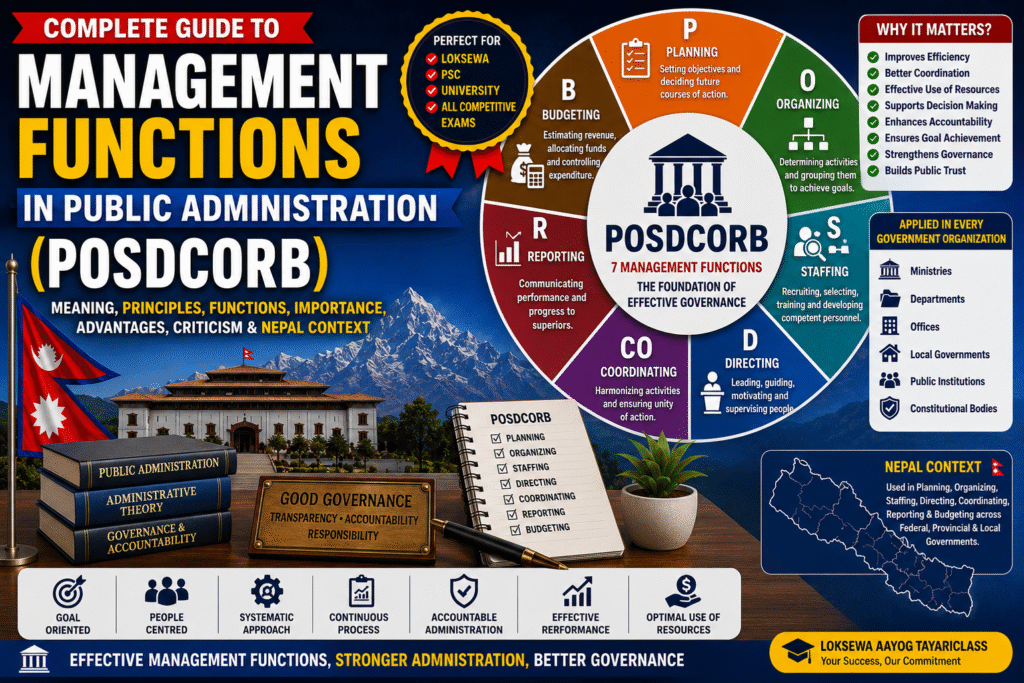
Among the many frameworks developed to explain administrative management, POSDCORB remains the most influential and enduring. Coined by Luther Gulick and elaborated with Lyndall Urwick in their landmark work Papers on the Science of Administration (1937), POSDCORB summarizes the seven core managerial functions of an executive:
- P – Planning
- O – Organizing
- S – Staffing
- D – Directing
- CO – Coordinating
- R – Reporting
- B – Budgeting
Although introduced nearly a century ago, POSDCORB continues to influence public administration across the world. Ministries, constitutional bodies, local governments, public corporations, international organizations, and development agencies still perform these seven managerial functions every day. Modern management theories have expanded the framework, yet its basic principles remain remarkably relevant in contemporary governance.
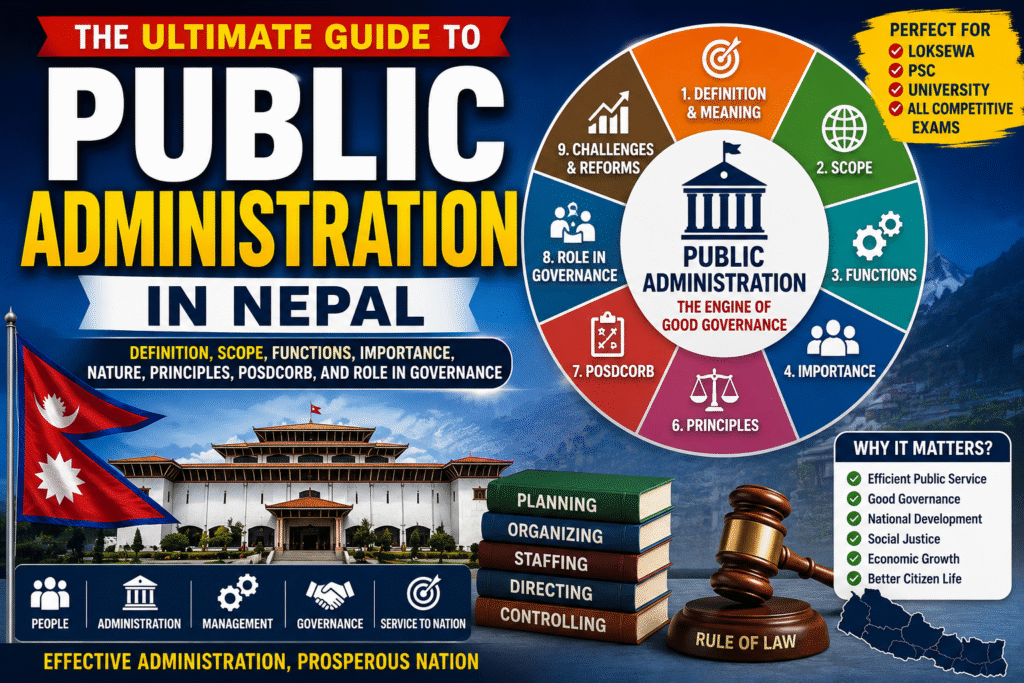
Management Functions are closely connected with every flagship article already published in this Public Administration series. Public Administration explains what government seeks to achieve, while management explains how those objectives are transformed into practical action. Organization Theory provides the organizational structure within which management functions operate. Decision Making supports every managerial activity because planning, organizing, staffing, budgeting, and controlling all require informed administrative decisions. Public Policy establishes governmental objectives, whereas management converts those policies into implementable programmes. Administrative Law ensures that every managerial action complies with constitutional and legal principles. Good Governance requires management systems that are transparent, accountable, responsive, equitable, and efficient. Civil Service supplies the professional workforce responsible for executing management functions, while Human Resource Management develops and motivates that workforce. Likewise, Public Financial Administration ensures that budgeting and financial control support effective public service delivery within Nepal’s federal governance structure.
The importance of management has increased significantly after the implementation of the Constitution of Nepal, 2015, which established Federal, Provincial, and Local Governments with clearly defined constitutional responsibilities. Each level of government now manages its own institutions, financial resources, development programmes, public personnel, and service delivery systems. Effective planning, coordination, budgeting, monitoring, and evaluation have therefore become more important than ever before.
Modern governments also face new administrative challenges that earlier generations rarely encountered. Digital transformation, artificial intelligence, climate change, cybersecurity, citizen participation, globalization, public-private partnerships, and evidence-based policymaking require managers to possess analytical skills, technological competence, ethical leadership, and strategic thinking. Today’s public manager is expected not merely to supervise employees but also to lead organizational change, encourage innovation, improve performance, manage risks, and strengthen public trust.
International organizations such as the United Nations (UN), Organisation for Economic Co-operation and Development (OECD), World Bank, and Asian Development Bank (ADB) consistently emphasize that effective public management is essential for achieving sustainable development, strengthening democratic governance, improving institutional capacity, and delivering high-quality public services. Countries with professional management systems generally demonstrate higher administrative efficiency, greater accountability, better financial discipline, and stronger citizen satisfaction.
For students preparing for Loksewa (Public Service Commission), Judicial Service, University examinations, and other competitive examinations, Management Functions constitute one of the most frequently tested topics. Questions often examine the meaning of management, POSDCORB, managerial principles, functions, significance, criticisms, practical applications, and relevance to Nepal’s public administration system. A clear understanding of these concepts is therefore indispensable not only for examination success but also for effective professional practice in the public sector.
This comprehensive guide explores every major dimension of Management Functions in Public Administration, including its meaning, evolution, characteristics, objectives, principles, POSDCORB functions, scholarly perspectives, criticisms, Nepalese context, administrative reforms, emerging trends, examination-oriented questions, and practical relevance. Written with international academic standards, strong SEO architecture, and reader-friendly explanations, this article is designed to serve as a definitive learning resource for students, researchers, civil servants, policymakers, and anyone seeking a deep understanding of public management.
Meaning of Management in Public Administration
Management is the process of utilizing human, financial, physical, technological, and informational resources efficiently and effectively to achieve organizational goals. In Public Administration, management goes beyond supervising employees—it involves planning government programmes, organizing institutions, coordinating departments, managing public resources, implementing policies, monitoring performance, and ensuring accountability to citizens.
Unlike private sector management, public management is guided by constitutional principles, public interest, legal accountability, transparency, equity, and democratic values. Every administrative activity carried out by governments ultimately depends upon effective management.
Simply stated,
Public Management is the systematic process of planning, organizing, staffing, directing, coordinating, reporting, budgeting, implementing, and evaluating governmental activities to achieve public objectives efficiently, lawfully, and responsibly.
Management transforms policies into action and administrative goals into measurable public outcomes.
Definitions of Management by Scholars
Throughout history, many scholars have defined management from different perspectives. Their contributions collectively form the foundation of modern Public Administration.
Luther Gulick
Luther Gulick viewed management primarily through the managerial functions performed by executives.
According to Gulick,
Management consists of Planning, Organizing, Staffing, Directing, Coordinating, Reporting, and Budgeting (POSDCORB).
This remains one of the most influential frameworks in Public Administration.
Henri Fayol
Henri Fayol regarded management as a universal administrative process applicable to all organizations.
According to Fayol,
To manage is to forecast and plan, to organize, to command, to coordinate, and to control.
His administrative principles continue to influence both public and private management.
Harold Koontz and Cyril O’Donnell
They defined management as:
The process of designing and maintaining an environment in which individuals, working together in groups, efficiently accomplish selected objectives.
Their definition highlights teamwork, leadership, and organizational effectiveness.
Peter F. Drucker
Peter Drucker emphasized management as a results-oriented discipline.
According to Drucker,
Management is the organ of society specifically charged with making resources productive.
He believed that effective management converts knowledge, people, and resources into meaningful organizational performance.
Mary Parker Follett
Mary Parker Follett described management as
The art of getting things done through people.
Her perspective highlighted leadership, cooperation, participation, and human relationships.
Chester I. Barnard
Barnard emphasized cooperation within organizations.
According to him,
Management succeeds only when executives create effective systems of cooperation among organizational members.
Nature of Management
Management possesses several characteristics that distinguish it from other organizational activities.
Goal-Oriented
Every managerial activity seeks to achieve predetermined organizational objectives.
Government ministries, municipalities, constitutional bodies, and public enterprises all work toward clearly defined public goals.
Continuous Process
Management is an ongoing activity.
Planning, organizing, staffing, directing, budgeting, and evaluation continue throughout the life of an organization.
Universal Process
Management exists in every type of organization.
Whether an institution is public or private, large or small, national or local, management remains essential.
Dynamic
Management adapts continuously to changing political, economic, social, technological, and environmental conditions.
Modern public managers must respond quickly to emerging challenges.
Human-Centred
Although technology supports administrative work, management ultimately depends upon people.
Leadership, motivation, communication, and teamwork remain central to organizational success.
Decision-Oriented
Every managerial function involves making decisions.
Planning, staffing, budgeting, coordination, and evaluation all require administrators to select the most appropriate course of action.
Multidisciplinary
Management draws knowledge from various disciplines including:
- Economics
- Political Science
- Sociology
- Psychology
- Law
- Statistics
- Information Technology
- Public Policy
This interdisciplinary nature makes management more effective in solving complex public problems.
Characteristics of Public Management
Public Management differs from private management in several important ways.
Public Interest
The primary objective is public welfare rather than profit.
Legal Authority
Every managerial action must comply with constitutional and legal provisions.
Political Accountability
Public managers remain accountable to elected representatives and ultimately to citizens.
Transparency
Government decisions should be open, fair, and understandable.
Equity
Public services should be delivered fairly to all citizens without discrimination.
Service Orientation
Citizen satisfaction is a major measure of administrative success.
Resource Stewardship
Public managers are responsible for protecting and utilizing taxpayers’ resources efficiently.
Objectives of Public Management
The major objectives include:
- Achieving governmental goals.
- Improving public service delivery.
- Ensuring efficient resource utilization.
- Strengthening organizational coordination.
- Promoting transparency and accountability.
- Supporting policy implementation.
- Enhancing employee performance.
- Encouraging innovation.
- Maintaining financial discipline.
- Building public trust.
Importance of Management in Public Administration
Management is often described as the backbone of public administration because it converts governmental intentions into practical results.
Its significance can be understood in several ways.
Converts Policies into Action
Public policies become meaningful only when they are effectively managed and implemented.
Improves Administrative Efficiency
Good management reduces duplication, delays, and wastage of public resources.
Enhances Service Delivery
Efficient management improves the quality, accessibility, and reliability of public services.
Promotes Good Governance
Management supports transparency, accountability, participation, responsiveness, and effectiveness.
Strengthens Organizational Performance
Clear objectives, proper coordination, and systematic monitoring improve institutional effectiveness.
Facilitates Sustainable Development
Well-managed public organizations contribute to long-term economic, social, and environmental progress.
Evolution of Public Management
The concept of management has evolved significantly over time.
Classical Era
Focused primarily on efficiency, hierarchy, specialization, and formal organizational structures.
Major contributors included:
- Frederick W. Taylor
- Henri Fayol
- Max Weber
Human Relations Era
Recognized the importance of motivation, communication, teamwork, and employee satisfaction.
Key scholars included:
- Elton Mayo
- Mary Parker Follett
- Chester Barnard
Behavioural Era
Emphasized decision making, leadership, organizational behaviour, and human psychology.
Major contributors included:
- Herbert A. Simon
- Douglas McGregor
- Chris Argyris
Modern Era
Management became more adaptive and systems-oriented.
Important developments included:
- Systems Theory
- Contingency Theory
- Strategic Management
- Performance Management
- Evidence-Based Management
Contemporary Era
Today’s public management increasingly emphasizes:
- Digital Governance
- Artificial Intelligence (AI)
- Data Analytics
- Citizen-Centred Service Delivery
- Collaborative Governance
- Innovation
- Sustainable Development
- Agile Management
Public managers are now expected to combine administrative expertise with technological competence, ethical leadership, and strategic thinking.
Introduction to POSDCORB
Among all management frameworks, POSDCORB remains the most influential in Public Administration.
The term was introduced by Luther Gulick and Lyndall Urwick in 1937 to describe the essential functions performed by public executives.
The acronym stands for:
- P – Planning
- O – Organizing
- S – Staffing
- D – Directing
- CO – Coordinating
- R – Reporting
- B – Budgeting
These seven functions provide a systematic framework for understanding how public organizations are managed.
Even in the twenty-first century, POSDCORB continues to serve as a foundational model for administrative practice, civil service training, public sector reforms, and competitive examinations.
POSDCORB Functions in Public Administration
The concept of POSDCORB, developed by Luther Gulick and Lyndall Urwick, summarizes the seven fundamental functions performed by every public manager. Although governments have become increasingly digital and complex, these functions continue to provide a practical framework for understanding how public organizations operate.
Rather than functioning independently, each element of POSDCORB is interconnected. Effective planning supports proper organization; organization facilitates staffing; staffing enables direction; direction strengthens coordination; coordination improves reporting; reporting supports informed budgeting; and budgeting provides the resources needed to implement future plans. This continuous cycle forms the operational backbone of Public Administration.
P – Planning
Meaning
Planning is the process of deciding in advance what should be done, how it should be done, when it should be done, where it should be done, and by whom it should be done. It is the starting point of all administrative activities because every government programme begins with a well-prepared plan.
Without planning, organizations tend to operate reactively, resulting in confusion, duplication of work, inefficient use of resources, and failure to achieve public objectives.
As Henri Fayol stated:
“To foresee is to plan.”
Objectives of Planning
Planning aims to:
- Define organizational goals.
- Establish priorities.
- Allocate available resources efficiently.
- Reduce uncertainty and administrative risks.
- Improve coordination among departments.
- Provide a roadmap for implementation.
- Measure future performance against predetermined objectives.
Characteristics of Planning
Effective planning is:
- Goal-oriented.
- Future-focused.
- Continuous.
- Flexible.
- Evidence-based.
- Realistic.
- Participatory.
- Systematic.
Types of Planning
Public organizations use different forms of planning depending on their objectives.
Strategic Planning
Long-term planning that establishes the overall direction of an organization.
Example:
- National development strategies.
- Long-term governance reforms.
- Civil service modernization programmes.
Tactical Planning
Medium-term planning designed to achieve strategic objectives.
Examples include:
- Ministry action plans.
- Provincial development programmes.
- Annual departmental work plans.
Operational Planning
Short-term planning focusing on routine administrative activities.
Examples include:
- Monthly office activities.
- Service delivery schedules.
- Daily administrative operations.
Importance of Planning
Planning helps public organizations:
- Improve efficiency.
- Reduce unnecessary expenditure.
- Coordinate institutional activities.
- Anticipate future challenges.
- Strengthen accountability.
- Improve public service delivery.
Planning also serves as the foundation for monitoring and evaluation because organizational performance can only be measured against previously established objectives.
Planning in Nepal
In Nepal, planning is carried out at three constitutional levels:
- Federal Government.
- Provincial Governments.
- Local Governments.
Institutions such as the National Planning Commission (NPC) play a vital role in national development planning, while ministries and local governments prepare sectoral and annual implementation plans.
O – Organizing
Meaning
Organizing is the process of arranging human, financial, physical, and informational resources into an effective structure so that organizational objectives can be achieved efficiently.
Planning determines what should be done, whereas organizing determines how the work will be arranged.
Objectives of Organizing
Organizing seeks to:
- Define responsibilities.
- Establish authority relationships.
- Improve coordination.
- Eliminate duplication.
- Promote specialization.
- Facilitate communication.
Elements of Organizing
Effective organizing involves:
- Division of work.
- Departmentalization.
- Delegation of authority.
- Chain of command.
- Coordination mechanisms.
- Resource allocation.
Importance of Organizing
A well-organized institution:
- Improves efficiency.
- Clarifies responsibilities.
- Enhances accountability.
- Speeds up decision making.
- Promotes teamwork.
- Reduces administrative conflict.
Organizing in Nepal
Government ministries, constitutional commissions, provincial ministries, municipalities, and public enterprises all operate through clearly defined organizational structures established by laws and administrative regulations.
S – Staffing
Meaning
Staffing refers to the process of acquiring, developing, utilizing, evaluating, and retaining competent human resources required to achieve organizational objectives.
Human resources remain the most valuable asset of any public organization.
Staffing Activities
Staffing includes:
- Human resource planning.
- Recruitment.
- Selection.
- Appointment.
- Placement.
- Training.
- Promotion.
- Performance appraisal.
- Career development.
- Retirement planning.
Objectives of Staffing
Staffing aims to:
- Recruit qualified personnel.
- Develop employee competencies.
- Improve productivity.
- Maintain motivation.
- Promote merit-based administration.
- Ensure continuity of public service.
Importance of Staffing
Effective staffing:
- Improves organizational performance.
- Enhances professionalism.
- Strengthens institutional capacity.
- Supports innovation.
- Builds public trust.
Staffing in Nepal
The Public Service Commission (Lok Sewa Aayog) plays a crucial role in ensuring merit-based recruitment for Nepal’s civil service, while different public organizations conduct employee development, training, and performance management according to applicable laws.
D – Directing
Meaning
Directing is the process of guiding, supervising, motivating, and leading employees toward achieving organizational goals.
Even the best organizational plans cannot succeed without effective leadership.
Components of Directing
Directing includes:
- Leadership.
- Communication.
- Motivation.
- Supervision.
- Conflict resolution.
- Team building.
Objectives of Directing
Directing seeks to:
- Improve employee performance.
- Encourage cooperation.
- Increase motivation.
- Achieve organizational objectives.
- Maintain discipline.
Importance of Directing
Effective direction:
- Improves productivity.
- Enhances employee morale.
- Encourages innovation.
- Reduces conflict.
- Builds organizational commitment.
Directing in Nepal
Public managers at all three levels of government supervise public employees, communicate organizational objectives, monitor programme implementation, and ensure compliance with laws and policies.
CO – Coordinating
Meaning
Coordination is the process of harmonizing the activities of different individuals, departments, and organizations to achieve common goals.
Luther Gulick regarded coordination as one of the most important responsibilities of public executives because government programmes often involve multiple agencies.
Types of Coordination
Internal Coordination
Occurs among departments within the same organization.
External Coordination
Occurs among different ministries, constitutional bodies, provincial governments, local governments, development partners, and civil society organizations.
Importance of Coordination
Coordination:
- Prevents duplication.
- Improves communication.
- Promotes teamwork.
- Enhances efficiency.
- Supports integrated service delivery.
- Strengthens policy implementation.
Coordination in Nepal
Federalism has made coordination more important than ever. Effective governance requires close cooperation among Federal, Provincial, and Local Governments, especially in areas such as education, health, disaster management, infrastructure development, and environmental protection.
R – Reporting
Meaning
Reporting is the process of systematically communicating organizational activities, achievements, challenges, financial performance, and future plans to higher authorities, stakeholders, and the public.
In Public Administration, reporting ensures that decision-makers remain informed about the progress of government programmes and that citizens can hold public institutions accountable.
Reporting is not merely preparing documents—it is an essential tool for transparency, accountability, monitoring, evaluation, and evidence-based governance.
Objectives of Reporting
Reporting aims to:
- Communicate organizational performance.
- Monitor programme implementation.
- Promote transparency.
- Facilitate informed decision making.
- Ensure administrative accountability.
- Support policy evaluation.
- Improve future planning.
Types of Reports
Public organizations prepare different reports depending on administrative needs.
Routine Reports
Prepared regularly.
Examples:
- Monthly progress reports.
- Quarterly reports.
- Annual reports.
Special Reports
Prepared for specific purposes.
Examples:
- Disaster assessment reports.
- Investigation reports.
- Audit reports.
- Committee reports.
Financial Reports
Provide information regarding:
- Revenue.
- Expenditure.
- Budget utilization.
- Financial performance.
Performance Reports
Evaluate whether organizational objectives have been achieved.
Importance of Reporting
Effective reporting:
- Improves transparency.
- Strengthens accountability.
- Supports evidence-based management.
- Builds public confidence.
- Facilitates parliamentary oversight.
- Improves organizational learning.
Reporting in Nepal
Government institutions regularly prepare:
- Annual Progress Reports.
- Ministry Performance Reports.
- Office Performance Reports.
- Auditor General Reports.
- Public Accounts Committee reports.
- Local Government Annual Reports.
These reports assist policymakers, Parliament, oversight institutions, and citizens in evaluating government performance.
B – Budgeting
Meaning
Budgeting is the process of estimating revenue, allocating financial resources, controlling expenditure, and monitoring financial performance to achieve organizational objectives.
Among all POSDCORB functions, budgeting directly determines whether governmental programmes can actually be implemented.
Without adequate financial planning, even well-designed policies cannot succeed.
Objectives of Budgeting
Budgeting seeks to:
- Allocate public resources efficiently.
- Control unnecessary expenditure.
- Improve financial accountability.
- Support development priorities.
- Ensure fiscal discipline.
- Promote value for money.
Budget Cycle
Public budgeting generally involves:
Budget Preparation
Estimating income and expenditure.
Budget Approval
Approval by the legislature or authorized body.
Budget Implementation
Utilizing allocated financial resources.
Financial Control
Monitoring expenditure.
Audit and Evaluation
Assessing whether public funds were used efficiently and legally.
Importance of Budgeting
Budgeting:
- Supports planning.
- Prioritizes public expenditure.
- Improves accountability.
- Prevents financial misuse.
- Strengthens fiscal responsibility.
- Promotes sustainable development.
Budgeting in Nepal
Nepal follows constitutional budgeting procedures involving:
- Ministry of Finance.
- National Planning Commission.
- Federal Parliament.
- Provincial Assemblies.
- Local Governments.
- Office of the Auditor General.
The annual national budget remains one of the government’s most important policy instruments.
Relationship Among POSDCORB Functions
Although POSDCORB is presented sequentially, its functions operate as an integrated management system.
For example:
- Planning determines objectives.
- Organizing creates the institutional structure.
- Staffing recruits competent personnel.
- Directing motivates employees.
- Coordinating harmonizes organizational activities.
- Reporting evaluates progress.
- Budgeting provides financial support.
Failure in one function often weakens the effectiveness of the others.
Advantages of POSDCORB
The POSDCORB framework offers several important benefits.
Systematic Management
It provides a logical framework for understanding managerial responsibilities.
Administrative Efficiency
Clearly defined functions improve organizational performance.
Better Coordination
The framework strengthens cooperation among departments.
Improved Accountability
Reporting and budgeting promote transparency and financial discipline.
Useful for Training
POSDCORB remains one of the easiest frameworks for teaching administrative management.
Practical Relevance
Despite being developed in 1937, its principles continue to guide public organizations worldwide.
Criticisms of POSDCORB
Although influential, POSDCORB has also received criticism.
Too Mechanistic
Critics argue that it emphasizes managerial functions while giving insufficient attention to human behaviour.
Ignores Political Reality
Public Administration operates within political environments, which POSDCORB only partially addresses.
Overlooks Informal Organizations
Employees often interact through informal relationships that influence organizational performance.
Less Suitable for Complex Governance
Modern governance increasingly involves networks, partnerships, citizen participation, and digital platforms that extend beyond traditional managerial functions.
Limited Attention to Innovation
The framework was developed before the emergence of:
- Artificial Intelligence.
- Digital Government.
- Big Data.
- Collaborative Governance.
- Agile Management.
Consequently, contemporary public management often supplements POSDCORB with newer management approaches.
POSDCORB in Nepal’s Public Administration
POSDCORB continues to guide management practices across Nepal’s public sector.
Examples include:
- Planning: National Planning Commission prepares development plans.
- Organizing: Ministries, departments, and constitutional bodies establish administrative structures.
- Staffing: Public Service Commission conducts merit-based recruitment.
- Directing: Secretaries, Chief Administrative Officers, and departmental heads supervise employees.
- Coordinating: Federal, Provincial, and Local Governments collaborate on shared responsibilities.
- Reporting: Ministries publish annual performance reports and submit progress reports to oversight institutions.
- Budgeting: Ministry of Finance formulates and implements the national budget in accordance with constitutional procedures.
Relationship with Our Previous Flagship Articles
Management Functions serve as the operational engine connecting every major topic within Public Administration.
- Public Administration explains the purpose of government, while Management Functions explain how governmental objectives are achieved in practice.
- Organization Theory provides the structural framework within which managers perform POSDCORB functions.
- Decision Making supports every management function because planning, staffing, budgeting, and coordination all require informed decisions.
- Public Policy defines government objectives, and management transforms those objectives into actionable programmes.
- Administrative Law ensures that managerial actions remain lawful, constitutional, and accountable.
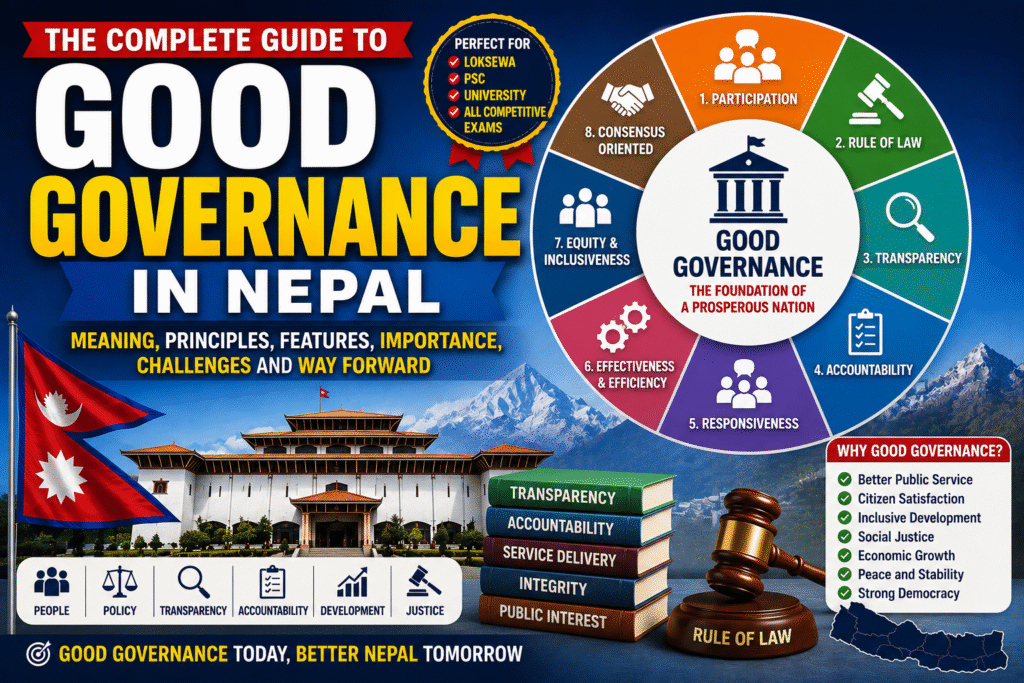
- Good Governance depends on effective planning, transparent reporting, sound budgeting, and responsive management.
- Civil Service in Nepal provides the professional workforce responsible for implementing management functions.
- Human Resource Management in Public Administration strengthens staffing, employee development, leadership, and performance management.
- Public Financial Administration in Nepal complements the budgeting function by ensuring efficient mobilization and utilization of public resources.
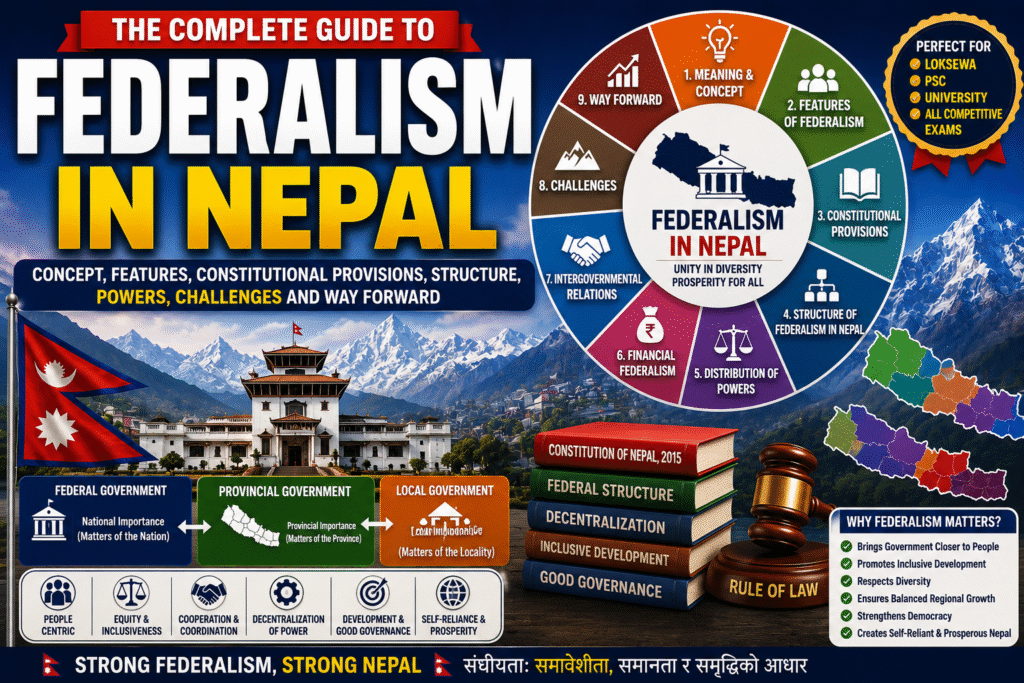
- Federalism in Nepal requires strong planning, coordination, and reporting among Federal, Provincial, and Local Governments.
Together, these articles create a comprehensive Public Administration knowledge ecosystem, strengthening your website’s topical authority.
Future Trends in Public Management
Modern public management continues to evolve.
Key emerging trends include:
- Artificial Intelligence (AI)-assisted administration.
- Digital governance and paperless offices.
- Data-driven performance management.
- Citizen-centric service delivery.
- Agile and adaptive management.
- Collaborative governance.
- Green public management.
- Smart government initiatives.
- Results-based management.
- Continuous organizational learning.
Future public managers will require not only administrative knowledge but also digital literacy, ethical leadership, analytical skills, and innovation.
Frequently Asked Questions (FAQs)
What is POSDCORB?
POSDCORB is an acronym introduced by Luther Gulick representing the seven core management functions: Planning, Organizing, Staffing, Directing, Coordinating, Reporting, and Budgeting.
Who developed POSDCORB?
Luther Gulick developed the POSDCORB concept, with significant contributions from Lyndall Urwick in Papers on the Science of Administration (1937).
Why is POSDCORB important in Public Administration?
It provides a systematic framework for managing public organizations efficiently, ensuring coordination, accountability, and effective service delivery.
Is POSDCORB still relevant today?
Yes. Although modern governance has introduced new management approaches, POSDCORB remains a foundational framework for understanding managerial responsibilities in the public sector.
How is POSDCORB applied in Nepal?
It is reflected in planning by the National Planning Commission, staffing through the Public Service Commission, budgeting by the Ministry of Finance, reporting by ministries and oversight bodies, and coordination across Nepal’s federal system.
Practice Questions
Short Questions
- Define Management in Public Administration.
- What does POSDCORB stand for?
- Explain the importance of planning.
- Differentiate between organizing and coordinating.
- State the major functions of budgeting.
Long Questions
- Explain the meaning, nature, and objectives of management in Public Administration.
- Discuss the POSDCORB functions with suitable examples.
- Critically evaluate the strengths and limitations of POSDCORB.
- Examine the relevance of POSDCORB in Nepal’s federal administrative system.
- Analyze the relationship between management functions and good governance.
Conclusion
Management Functions provide the practical foundation through which governments convert constitutional responsibilities, public policies, and development goals into effective administrative action. The POSDCORB framework, despite its historical origins, continues to offer a clear and systematic understanding of how public organizations plan, organize, staff, direct, coordinate, report, and manage public finances.
In Nepal, the importance of effective public management has grown significantly under the federal system, where multiple levels of government must coordinate resources, personnel, programmes, and budgets while remaining transparent, accountable, and citizen-focused. Modern governance also demands that traditional management principles be integrated with digital transformation, evidence-based decision making, innovation, and collaborative leadership.
For students, civil servants, researchers, and policymakers, a strong understanding of Management Functions is essential because these concepts underpin nearly every aspect of Public Administration. Mastering POSDCORB not only supports examination success but also equips future administrators with the knowledge and skills needed to build efficient, ethical, and responsive public institutions.
About the Author
Loksewa Aayog Tayariclass Editorial Team publishes research-based study materials, detailed notes, exam-focused articles, MCQs, and high-quality learning resources for Loksewa (PSC), university students, and competitive examination aspirants in Nepal. Our mission is to provide accurate, structured, easy-to-understand, and SEO-optimized educational content that supports effective learning and public administration excellence.