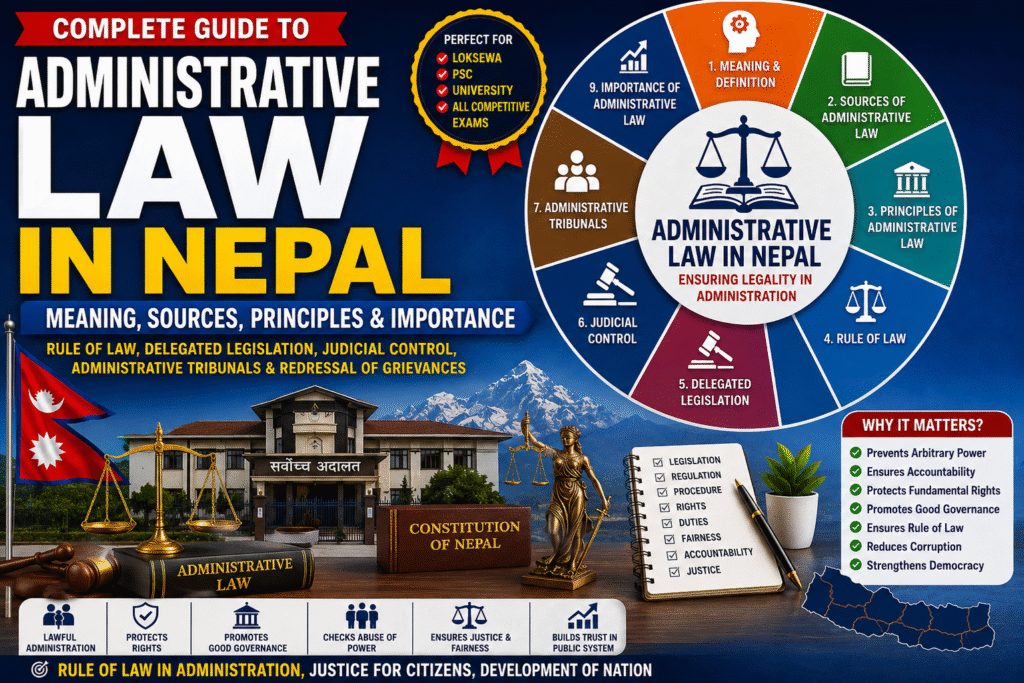
Administrative Law in Nepal: Meaning, Sources, Principles, Rule of Law, Delegated Legislation, Judicial Control, Administrative Tribunals, and Importance
The Ultimate Guide for Loksewa, PSC, University Students, and Competitive Examinations
Introduction
In every modern democratic state, governments perform numerous functions that directly affect the daily lives of citizens. From issuing citizenship certificates and passports to collecting taxes, regulating businesses, protecting the environment, delivering healthcare and education, maintaining public order, and implementing development projects, almost every governmental activity involves administrative action. As the responsibilities of governments continue to expand, it becomes essential to ensure that these administrative powers are exercised fairly, legally, transparently, and accountably. The branch of law that regulates these activities is known as Administrative Law.
Administrative Law is one of the most important branches of Public Administration because it establishes the legal framework within which public authorities perform their duties. While Public Administration focuses on how government policies are implemented, Administrative Law ensures that such implementation remains lawful, reasonable, and consistent with constitutional principles. It protects citizens from arbitrary administrative decisions while enabling public institutions to function efficiently.
Administrative Law has become increasingly important in Nepal following the promulgation of the Constitution of Nepal, 2015, which transformed the country into a Federal Democratic Republic. The federal system distributes executive authority among the Federal, Provincial, and Local Governments. Consequently, thousands of administrative decisions are made every day by ministries, departments, constitutional bodies, regulatory agencies, provincial governments, and local governments. Administrative Law provides the legal principles that guide these institutions and define the limits of their powers.
The relationship between Administrative Law and Public Policy is equally significant. Public policies express the government’s objectives and priorities, whereas Administrative Law provides the legal mechanisms through which those policies are implemented. A well-designed policy cannot achieve its intended objectives unless public officials implement it within the framework of law. Similarly, Civil Service plays a central role in translating public policies into action, making Administrative Law an essential guide for civil servants in carrying out their official responsibilities.
Administrative Law is also closely linked with Good Governance. Principles such as transparency, accountability, participation, responsiveness, efficiency, and the Rule of Law cannot be realized without an effective administrative legal system. Likewise, the success of Federalism in Nepal depends upon clear legal rules governing the powers, responsibilities, and accountability of all three levels of government.
Unlike Constitutional Law, which primarily establishes the structure of the state and guarantees fundamental rights, Administrative Law governs the day-to-day functioning of public administration. It regulates how government authorities make decisions, exercise discretionary powers, issue licenses, collect taxes, enforce regulations, resolve disputes, and provide public services.
In recent decades, Administrative Law has expanded rapidly due to globalization, technological advancement, digital governance, environmental regulation, public procurement, consumer protection, social welfare programmes, and increasing public expectations. Modern governments perform far more functions than traditional governments, making Administrative Law one of the fastest-growing fields of public law.
For students preparing for Loksewa, Public Service Commission examinations, universities, judicial service examinations, and other competitive examinations, Administrative Law is a core subject. Questions frequently appear regarding its meaning, characteristics, sources, principles, delegated legislation, judicial control, administrative tribunals, natural justice, and relationship with Constitutional Law and Public Administration.
This comprehensive guide explains every major aspect of Administrative Law in Nepal, including its meaning, definitions, characteristics, objectives, historical development, constitutional basis, sources, principles, delegated legislation, judicial control, administrative tribunals, administrative discretion, administrative accountability, challenges, reforms, and future prospects. The article is designed to provide a complete conceptual understanding while remaining highly relevant for competitive examinations and practical governance.
Understanding the Concept of Law
Before understanding Administrative Law, it is important to understand the broader concept of Law.
Law refers to a system of legally enforceable rules established by competent authorities to regulate human behaviour, maintain public order, protect rights, resolve disputes, and promote justice within society.
Every organized society requires laws because individuals, organizations, and governments interact continuously. Without legal rules, governance would become arbitrary, public confidence would decline, and conflicts could not be resolved fairly.
Laws perform several important functions:
- Maintaining peace and public order.
- Protecting individual rights and freedoms.
- Regulating relationships among citizens, organizations, and government.
- Ensuring justice and equality before the law.
- Promoting social and economic stability.
- Supporting democratic governance.
As governments expanded their responsibilities during the twentieth century, traditional legal principles alone became insufficient to regulate increasingly complex administrative activities. This led to the emergence of Administrative Law as a specialized branch of public law.
Meaning of Administrative Law
Administrative Law is the branch of public law that governs the organization, powers, functions, procedures, and accountability of administrative authorities.
It regulates how government agencies exercise their legal powers while ensuring that administrative actions remain fair, reasonable, transparent, and consistent with the Constitution and other laws.
Administrative Law seeks to balance two equally important objectives:
- Enabling public authorities to perform their administrative responsibilities efficiently.
- Protecting citizens against arbitrary, unreasonable, or unlawful administrative actions.
Thus, Administrative Law acts as a bridge between governmental authority and citizens’ rights.
Unlike private law, which regulates relationships among private individuals, Administrative Law governs the relationship between public authorities and the public.
Scholarly Definitions of Administrative Law
Several scholars have defined Administrative Law from different perspectives.
According to Sir Ivor Jennings:
Administrative Law is the law relating to the administration. It determines the organization, powers, duties, and functions of administrative authorities.
Similarly, A. V. Dicey, although initially skeptical about Administrative Law in England, acknowledged its importance in regulating governmental powers under the Rule of Law.
Modern scholars generally define Administrative Law as the body of legal principles governing administrative action, administrative discretion, delegated legislation, administrative justice, and judicial review.
Despite differences in wording, all definitions emphasize three common elements:
- Regulation of administrative authorities.
- Exercise of public power according to law.
- Protection of citizens against misuse of administrative authority.
Why Administrative Law is Important
Administrative Law has become indispensable in modern governance because governments perform an enormous range of administrative functions.
Without Administrative Law:
- Administrative decisions could become arbitrary.
- Citizens’ rights might be violated.
- Public officials could misuse discretionary powers.
- Government accountability would weaken.
- Public confidence in administration would decline.
- Democratic governance would be undermined.
Administrative Law therefore promotes both efficient administration and the protection of individual rights.
It transforms governmental power into responsible public authority, ensuring that administrative decisions remain lawful, transparent, accountable, and subject to review.
Characteristics of Administrative Law
Administrative Law possesses several distinctive characteristics that differentiate it from other branches of law. These characteristics explain its unique role in regulating public administration and ensuring that governmental powers are exercised within legal limits.
Understanding these characteristics is particularly important for Loksewa, PSC, judicial service, and university examinations because they are frequently asked in both objective and descriptive questions.
It is a Branch of Public Law
Administrative Law is one of the major branches of Public Law because it regulates the relationship between government authorities and citizens.
Unlike Private Law, which governs relationships among private individuals or organizations, Administrative Law focuses on the powers, duties, responsibilities, and accountability of public authorities.
Its primary concern is ensuring that administrative institutions act according to law while protecting the rights and interests of citizens.
It Regulates Administrative Authorities
The central purpose of Administrative Law is to regulate administrative bodies such as:
- Ministries
- Government Departments
- Constitutional Bodies
- Regulatory Authorities
- Public Corporations
- Local Governments
- Provincial Governments
- Independent Commissions
It defines:
- Their powers.
- Their duties.
- Their procedures.
- Their legal limitations.
- Their accountability mechanisms.
Thus, Administrative Law provides the legal foundation for public administration.
It Ensures Rule of Law
One of the most important characteristics of Administrative Law is that it upholds the Rule of Law.
Every administrative authority, regardless of its position or power, must operate within the limits established by the Constitution and other laws.
No administrative official is above the law.
Every administrative action must have legal authority.
This principle protects citizens from arbitrary governmental action.
It Protects Citizens’ Rights
Administrative Law safeguards individuals against:
- Abuse of power.
- Arbitrary decisions.
- Unreasonable actions.
- Administrative negligence.
- Unlawful detention.
- Discrimination.
- Procedural unfairness.
Citizens may challenge unlawful administrative decisions through judicial review and other legal remedies.
Thus, Administrative Law serves as an important mechanism for protecting constitutional rights.
It is Dynamic and Evolving
Administrative Law continuously evolves in response to:
- Technological advancement.
- Economic development.
- Environmental concerns.
- Globalization.
- Federal governance.
- Digital administration.
- Public sector reforms.
As governments undertake new responsibilities, Administrative Law expands accordingly.
Its dynamic nature distinguishes it from many traditional legal disciplines.
It is Closely Connected with Public Administration
Administrative Law and Public Administration are closely related but not identical.
Public Administration focuses on the management and implementation of government policies.
Administrative Law establishes the legal framework within which those administrative activities must operate.
Without Administrative Law, public administration could become arbitrary.
Without Public Administration, Administrative Law would remain largely theoretical.
Therefore, the two disciplines complement each other.
It Controls Administrative Discretion
Government officials frequently exercise discretionary powers while performing administrative duties.
Examples include:
- Granting licenses.
- Issuing permits.
- Allocating public resources.
- Approving development projects.
- Recruiting personnel.
- Regulating businesses.
Administrative Law ensures that such discretion is exercised:
- Fairly.
- Reasonably.
- Transparently.
- Without discrimination.
- Within legal limits.
Discretion must never become arbitrary power.
It Promotes Accountability
Administrative authorities remain accountable through various legal mechanisms such as:
- Judicial Review.
- Parliamentary Oversight.
- Constitutional Bodies.
- Administrative Appeals.
- Audit Systems.
- Public Accountability Mechanisms.
Administrative Law strengthens democratic governance by making public officials answerable for their decisions.
Objectives of Administrative Law
Administrative Law has developed to achieve several important objectives within modern democratic governance.
Its major objectives include the following.
Ensuring Lawful Administration
The foremost objective of Administrative Law is to ensure that every administrative authority exercises its powers according to law.
Government officials cannot act merely on personal preference or political influence.
Every administrative decision must have legal authority.
Protecting Individual Rights
Administrative Law protects citizens from unlawful administrative actions.
It guarantees that administrative authorities respect:
- Fundamental Rights.
- Equality before the law.
- Procedural fairness.
- Natural justice.
- Due process.
This protection strengthens public confidence in government.
Promoting Good Governance
Administrative Law supports the principles of Good Governance by encouraging:
- Transparency.
- Accountability.
- Responsiveness.
- Participation.
- Rule of Law.
- Efficiency.
- Integrity.
This directly connects Administrative Law with our previous flagship article on Good Governance in Nepal.
Improving Administrative Efficiency
Clear legal procedures reduce confusion, inconsistency, and administrative delays.
Administrative Law establishes standardized procedures for:
- Decision-making.
- Licensing.
- Regulation.
- Enforcement.
- Appeals.
- Public service delivery.
Standardization improves administrative efficiency.
Preventing Abuse of Power
Administrative authorities often exercise extensive discretionary powers.
Administrative Law ensures that such powers are not used:
- Arbitrarily.
- Unreasonably.
- Politically.
- Discriminatorily.
- Corruptly.
Legal control discourages misuse of public authority.
Strengthening Public Confidence
When administrative authorities consistently act according to law, citizens develop trust in public institutions.
Public confidence is essential for democratic governance and effective public administration.
Scope of Administrative Law
The scope of Administrative Law has expanded considerably as governments have assumed wider responsibilities.
Today, Administrative Law covers almost every aspect of governmental administration.
Its major areas include:
Administrative Organization
- Ministries.
- Departments.
- Boards.
- Commissions.
- Public Enterprises.
- Regulatory Authorities.
Administrative Powers
Administrative Law regulates powers relating to:
- Licensing.
- Inspection.
- Taxation.
- Regulation.
- Investigation.
- Enforcement.
- Public Procurement.
- Public Service Delivery.
Delegated Legislation
Administrative agencies frequently make detailed rules under authority granted by Parliament.
Administrative Law governs:
- Rule-making.
- Regulations.
- Directives.
- Notifications.
- Administrative Orders.
Administrative Adjudication
Many disputes are resolved through specialized administrative bodies rather than ordinary courts.
Administrative Law regulates these quasi-judicial institutions.
Judicial Review
Courts examine whether administrative authorities have acted:
- Lawfully.
- Reasonably.
- Fairly.
- Constitutionally.
Judicial Review is one of the strongest safeguards against administrative abuse.
Administrative Accountability
Administrative Law establishes accountability through:
- Parliamentary control.
- Judicial review.
- Audit.
- Ombudsman-type institutions.
- Constitutional commissions.
- Citizen participation.
Nature of Administrative Law
Administrative Law possesses several unique features.
Practical
Unlike many theoretical legal disciplines, Administrative Law directly influences daily governmental activities.
Every administrative decision is governed by Administrative Law.
Procedural
Administrative Law focuses heavily on procedures.
It determines:
- How decisions should be made.
- Who may make them.
- What procedures must be followed.
- What remedies are available.
Procedural fairness is one of its defining characteristics.
Regulatory
Administrative Law regulates governmental behaviour rather than private conduct.
Its emphasis lies in controlling public authority.
Protective
Administrative Law simultaneously protects:
- Citizens.
- Public Interest.
- Government Legitimacy.
- Democratic Governance.
Thus, it balances administrative efficiency with individual liberty.
Administrative Law vs Constitutional Law
Although closely related, Administrative Law and Constitutional Law are distinct branches of public law.
| Constitutional Law | Administrative Law |
|---|---|
| Establishes the structure of the State. | Regulates day-to-day administration. |
| Defines powers of constitutional organs. | Regulates administrative authorities and agencies. |
| Protects Fundamental Rights. | Protects citizens from unlawful administrative action. |
| Concerned with constitutional principles. | Concerned with administrative procedures and decisions. |
| Broader in scope. | More specialized and operational. |
In simple terms:
Constitutional Law establishes the framework of government, while Administrative Law governs how that government functions on a daily basis.
Administrative Law vs Public Administration
These two concepts are complementary but fundamentally different.
| Public Administration | Administrative Law |
|---|---|
| Concerned with implementing public policies. | Concerned with legality of administrative actions. |
| Focuses on management and service delivery. | Focuses on legal regulation and accountability. |
| Studies administrative organization and management. | Studies legal principles governing administration. |
| Answers “How should administration be managed?” | Answers “How should administration act lawfully?” |
A competent civil servant requires knowledge of both disciplines.
Public Administration provides administrative skills, whereas Administrative Law provides the legal framework within which those skills must be exercised.
Historical Development of Administrative Law
Administrative Law developed gradually as governments expanded their functions beyond maintaining law and order. During the nineteenth and twentieth centuries, states began providing education, healthcare, infrastructure, social security, environmental protection, and economic regulation. This expansion increased administrative powers and created the need for legal mechanisms to control those powers.
In Nepal, the importance of Administrative Law has grown significantly after the adoption of the Constitution of Nepal, 2015, which introduced a federal governance system. The creation of Federal, Provincial, and Local Governments has multiplied administrative institutions and decisions, making clear legal rules and accountability mechanisms more essential than ever.
Today, Administrative Law continues to evolve alongside digital governance, administrative reforms, public service modernization, and increasing public expectations for transparent and accountable administration.
Exam Tip
In Loksewa descriptive answers, relate Administrative Law to our previous flagship topics:
- Public Administration implements government functions.
- Public Policy determines government objectives.
- Civil Service executes administrative decisions.
- Administrative Law ensures those decisions remain lawful.
- Good Governance reflects the quality, transparency, and accountability of that lawful administration.
- Federalism determines which level of government has the authority to act.
This integrated explanation demonstrates higher-level understanding and strengthens analytical answers.
Sources of Administrative Law
Administrative Law does not originate from a single legal document. Instead, it develops from multiple constitutional, legislative, judicial, and administrative sources that collectively regulate governmental administration.
Understanding these sources is essential because they provide the legal authority upon which administrative institutions exercise their powers.
In Nepal, Administrative Law derives its legitimacy from the Constitution, Acts enacted by Parliament, delegated legislation, judicial decisions, administrative rules, and well-established legal principles.
Constitution of Nepal, 2015
The Constitution of Nepal, 2015 is the supreme source of Administrative Law.
Every administrative authority derives its legal existence and powers directly or indirectly from the Constitution.
The Constitution establishes:
- Federal Democratic Republican governance.
- Separation of powers.
- Rule of Law.
- Fundamental Rights.
- Directive Principles, Policies and Obligations of the State.
- Distribution of powers among Federal, Provincial, and Local Governments.
- Constitutional Bodies.
- Judicial Review.
No administrative authority may act contrary to constitutional provisions.
Therefore, every administrative decision must remain consistent with the Constitution.
Acts of Parliament
After the Constitution, legislation enacted by the Federal Parliament serves as the most important source of Administrative Law.
Acts define:
- Administrative powers.
- Institutional responsibilities.
- Regulatory authority.
- Administrative procedures.
- Citizens’ rights.
- Appeal mechanisms.
- Enforcement powers.
Examples include:
- Good Governance (Management and Operation) Act, 2064
- Right to Information Act, 2064
- Public Procurement Act, 2063
- Civil Service Act
- Local Government Operation Act, 2074
- Environment Protection Act
- Administrative Procedure–related legislation
These laws provide the legal basis for administrative action.
Delegated Legislation
Modern legislatures cannot draft every detailed administrative rule.
Therefore, Parliament often authorizes administrative authorities to formulate detailed regulations for implementing Acts.
These subordinate laws include:
- Rules.
- Regulations.
- Directives.
- Orders.
- Notifications.
- Guidelines.
- Codes of Conduct.
Collectively, these are known as Delegated Legislation or Subordinate Legislation.
Delegated legislation increases administrative flexibility while allowing Parliament to concentrate on broader policy matters.
However, delegated legislation must always remain consistent with the parent Act and the Constitution.
Judicial Decisions
Courts play a significant role in developing Administrative Law.
Whenever courts interpret statutes, review administrative decisions, or resolve disputes involving public authorities, their judgments become valuable legal precedents.
In Nepal, the Supreme Court has contributed significantly to Administrative Law through:
- Constitutional interpretation.
- Judicial Review.
- Protection of Fundamental Rights.
- Interpretation of administrative powers.
- Development of principles of Natural Justice.
Judicial decisions therefore strengthen legality, accountability, and administrative fairness.
Administrative Rules and Circulars
Government ministries and departments issue numerous administrative instructions to ensure uniform implementation of laws and policies.
These include:
- Office Orders.
- Circulars.
- Directives.
- Operational Manuals.
- Service Standards.
- Administrative Guidelines.
Although their legal status differs from Acts enacted by Parliament, they remain important sources of day-to-day administrative regulation.
Customs and Administrative Practices
Certain long-established administrative practices gradually acquire legal recognition through consistent usage.
Such customs may influence administrative procedures where no specific statutory provision exists.
However, administrative customs cannot override constitutional or statutory provisions.
International Treaties and Conventions
Nepal participates in numerous international agreements concerning:
- Human Rights.
- Environmental Protection.
- Labour Standards.
- Sustainable Development.
- Anti-Corruption.
- Good Governance.
Where incorporated into domestic law, these international commitments influence Administrative Law and public administration.
Rule of Law
One of the most fundamental principles governing Administrative Law is the Rule of Law.
The Rule of Law means that government authority must always be exercised according to law rather than arbitrary discretion.
Every individual—whether an ordinary citizen, minister, civil servant, or public institution—is equally subject to the law.
Government officials cannot exercise power merely because they possess authority.
Every administrative action must have legal justification.
A. V. Dicey’s Concept of Rule of Law
British constitutional scholar A. V. Dicey explained the Rule of Law through three fundamental principles.
Supremacy of Law
No person may be punished or deprived of rights except according to law.
Government cannot act arbitrarily.
Every administrative decision requires legal authority.
Equality Before Law
Every individual is equal before the ordinary courts regardless of position or status.
No public official enjoys unrestricted legal privilege.
This principle promotes fairness and accountability.
Predominance of Legal Spirit
Citizens’ rights are effectively protected through an independent judiciary and constitutional principles.
Courts serve as guardians against administrative abuse.
Importance of Rule of Law
The Rule of Law:
- Prevents arbitrary government.
- Protects Fundamental Rights.
- Promotes accountability.
- Encourages transparency.
- Builds public confidence.
- Supports democracy.
- Ensures administrative fairness.
Administrative Law exists largely to translate the Rule of Law into practical governmental administration.
Principles of Natural Justice
Administrative authorities frequently make decisions affecting citizens’ rights.
Therefore, these decisions must be fair.
The legal principles ensuring fairness are collectively known as Natural Justice.
Natural Justice does not necessarily depend upon detailed statutory provisions.
Instead, it represents universal principles of procedural fairness recognized throughout democratic legal systems.
Rule Against Bias (Nemo Judex in Causa Sua)
This Latin maxim means:
No one should be a judge in his or her own cause.
Administrative decisions must be free from:
- Personal interest.
- Financial interest.
- Political influence.
- Family relationships.
- Institutional prejudice.
Decision-makers must remain impartial.
Justice must not only be done but must also appear to be done.
Right to Fair Hearing (Audi Alteram Partem)
This principle means:
Hear the other side before making a decision.
No administrative authority should impose penalties or make adverse decisions without providing an opportunity for the affected person to present their case.
A fair hearing generally includes:
- Notice of allegations.
- Opportunity to present evidence.
- Opportunity to respond.
- Reasoned decision.
This principle protects procedural fairness.
Speaking Orders
Administrative authorities should explain the reasons behind their decisions.
Reasoned decisions:
- Increase transparency.
- Improve accountability.
- Facilitate judicial review.
- Build public confidence.
Citizens deserve to understand why a particular administrative decision has been made.
Administrative Discretion
Modern governments cannot anticipate every possible situation through legislation.
Therefore, administrative authorities often receive discretionary powers.
Administrative discretion means the legal authority to choose among several reasonable alternatives while implementing laws.
Examples include:
- Granting licenses.
- Issuing permits.
- Approving building plans.
- Awarding contracts.
- Regulating businesses.
- Allocating public resources.
Discretion provides flexibility.
However, discretion is not unlimited power.
Limits on Administrative Discretion
Administrative discretion must always be exercised:
- According to law.
- Fairly.
- Reasonably.
- In good faith.
- Without discrimination.
- Without corruption.
- For legitimate public purposes.
Improper use of discretion may be challenged before the courts.
Delegated Legislation
As governments perform increasingly complex functions, legislatures cannot draft every detailed administrative rule.
Therefore, Parliament delegates limited law-making powers to administrative authorities.
This process is known as Delegated Legislation.
Delegated legislation enables administrative agencies to formulate detailed technical rules required for effective implementation of Acts.
Forms of Delegated Legislation
Common forms include:
- Rules.
- Regulations.
- Orders.
- Directives.
- Notifications.
- Bye-laws.
- Circulars.
Although these instruments have legal effect, they remain subordinate to the parent Act.
Advantages of Delegated Legislation
Delegated legislation offers several advantages:
- Saves Parliamentary time.
- Provides administrative flexibility.
- Utilizes technical expertise.
- Responds quickly to changing situations.
- Facilitates efficient implementation.
- Supports specialized regulation.
For these reasons, delegated legislation has become an indispensable feature of modern governance.
Disadvantages of Delegated Legislation
Despite its advantages, delegated legislation presents certain risks:
- Possibility of excessive executive power.
- Limited parliamentary scrutiny.
- Potential misuse of authority.
- Reduced democratic oversight.
- Complexity for ordinary citizens.
Therefore, effective legal control remains essential.
Doctrine of Ultra Vires
One of the most important doctrines in Administrative Law is the Doctrine of Ultra Vires.
The Latin expression Ultra Vires means:
Beyond the legal powers.
If an administrative authority acts beyond the powers granted by the Constitution or legislation, such action becomes Ultra Vires and may be declared invalid by the courts.
Conversely, actions taken within legal authority are known as Intra Vires.
The Doctrine of Ultra Vires protects citizens by ensuring that administrative authorities remain within the limits prescribed by law.
Exam Tip
In analytical answers, connect these concepts logically:
The Constitution grants powers → Acts of Parliament define those powers → Delegated Legislation provides detailed implementation rules → Administrative Discretion allows flexibility in applying them → Natural Justice ensures fairness in decision-making → The Rule of Law requires all actions to remain within legal limits → The Doctrine of Ultra Vires enables courts to invalidate actions taken beyond those limits.
Presenting the concepts in this sequence demonstrates a clear understanding of how Administrative Law operates in practice.
Judicial Control of Administrative Action
In a democratic state governed by the Rule of Law, administrative authorities cannot exercise unlimited powers. Although governments require sufficient authority to implement laws and public policies efficiently, those powers must always remain subject to legal supervision.
One of the strongest mechanisms for ensuring lawful administration is Judicial Control.
Judicial control refers to the power of courts to examine the legality, fairness, and constitutionality of administrative actions. When administrative authorities exceed their legal powers, violate constitutional provisions, ignore principles of natural justice, or misuse discretionary authority, the judiciary has the authority to review such actions and provide appropriate remedies.
In Nepal, the Supreme Court, High Courts, and other competent courts play a vital role in protecting citizens against unlawful administrative actions and maintaining the Rule of Law.
Judicial control does not interfere with legitimate administrative functions. Instead, it ensures that public authorities exercise their powers within the limits established by the Constitution and the law.
Objectives of Judicial Control
Judicial control seeks to achieve several important objectives.
It aims to:
- Ensure legality in administrative action.
- Protect Fundamental Rights.
- Prevent abuse of administrative power.
- Promote accountability.
- Uphold the Rule of Law.
- Ensure procedural fairness.
- Maintain public confidence in government institutions.
- Strengthen constitutional governance.
Thus, judicial control serves as an essential safeguard against arbitrary administration.
Grounds for Judicial Review
Courts generally intervene only when administrative authorities violate legal or constitutional principles.
The major grounds for judicial review include:
Lack of Jurisdiction
An administrative authority may exercise only those powers that have been legally granted.
If it performs functions beyond its legal authority, the action becomes invalid.
Example:
A Local Government attempts to regulate a subject that falls exclusively within Federal jurisdiction.
Ultra Vires
As discussed earlier, Ultra Vires means acting beyond legal authority.
Whenever an administrative authority exceeds the powers granted by legislation, courts may declare its decision void.
This doctrine protects citizens from unlawful governmental action.
Violation of Natural Justice
Administrative decisions may also be invalid if authorities fail to follow principles of natural justice.
Examples include:
- Refusing an opportunity to be heard.
- Acting with bias.
- Making decisions without giving reasons.
- Ignoring procedural fairness.
Courts frequently intervene in such situations.
Abuse of Discretion
Administrative discretion must always be exercised reasonably and for legitimate public purposes.
Judicial review may occur where discretion is exercised:
- Arbitrarily.
- Mala fide (in bad faith).
- For personal gain.
- Under political influence.
- Discriminatorily.
- Without relevant considerations.
Error of Law
Administrative authorities sometimes misinterpret statutory provisions.
If a decision is based upon an incorrect interpretation of law, courts may correct the error.
Constitutional Violation
Every administrative action must remain consistent with the Constitution.
Courts may invalidate administrative decisions that violate:
- Fundamental Rights.
- Constitutional provisions.
- Federal distribution of powers.
- Constitutional principles.
Constitutional Remedies in Nepal
The Constitution of Nepal empowers the judiciary to issue constitutional remedies for protecting legal and constitutional rights.
These remedies include several important writs.
Habeas Corpus
“Habeas Corpus” means produce the body.
This writ protects individuals against unlawful detention.
If a person is illegally detained by public authorities, the court may order immediate release.
Mandamus
Mandamus means we command.
The court directs a public authority to perform a legal duty that it has failed or refused to perform.
Example:
A government office unlawfully refuses to issue a citizenship certificate despite fulfilling all legal requirements.
Certiorari
Through Certiorari, a higher court may quash an unlawful decision made by a lower administrative authority or quasi-judicial body.
This remedy corrects jurisdictional or legal errors.
Prohibition
A writ of Prohibition prevents a lower administrative authority or tribunal from proceeding beyond its legal jurisdiction.
It acts before the unlawful action is completed.
Quo Warranto
Quo Warranto literally means by what authority.
The court examines whether a person is legally entitled to hold a public office.
If the appointment is unlawful, the court may remove that person from office.
Administrative Tribunals
Modern governments perform highly specialized administrative functions.
Ordinary courts often cannot resolve every administrative dispute quickly or efficiently.
Therefore, specialized adjudicatory bodies known as Administrative Tribunals have developed.
Administrative Tribunals are quasi-judicial institutions established by law to resolve disputes arising from administrative decisions.
They combine administrative expertise with judicial procedures.
Characteristics of Administrative Tribunals
Administrative Tribunals generally possess the following characteristics:
- Established by statute.
- Specialized jurisdiction.
- Faster decision-making.
- Technical expertise.
- Less formal procedures.
- Lower litigation costs.
- Quasi-judicial powers.
Although they resemble courts, tribunals are not ordinary judicial institutions.
Importance of Administrative Tribunals
Administrative Tribunals contribute significantly to effective governance by:
- Reducing the workload of ordinary courts.
- Providing speedy justice.
- Resolving technical disputes efficiently.
- Improving administrative accountability.
- Enhancing access to justice.
- Supporting specialized decision-making.
They have become increasingly important in modern administrative states.
Administrative Accountability
Administrative power must always be accompanied by accountability.
Administrative accountability means that public officials remain answerable for the legality, fairness, efficiency, and effectiveness of their decisions.
Without accountability, administrative authority may easily be abused.
Mechanisms of Administrative Accountability in Nepal
Nepal has established several institutional mechanisms to ensure administrative accountability.
Parliamentary Control
Parliament supervises executive administration through:
- Question Hour.
- Committee investigations.
- Budget approval.
- Policy debates.
- Public Accounts Committee.
- Legislative oversight.
Parliament represents democratic accountability.
Judicial Control
Courts ensure that administrative authorities act according to law.
Judicial review remains one of the strongest safeguards against administrative abuse.
Constitutional Bodies
Independent constitutional institutions strengthen accountability.
Important examples include:
- Commission for the Investigation of Abuse of Authority (CIAA)
- Office of the Auditor General
- National Human Rights Commission
- Election Commission
- National Information Commission
- Public Service Commission
These institutions investigate misconduct, promote transparency, and strengthen constitutional governance.
Internal Administrative Control
Government departments themselves maintain internal accountability through:
- Departmental supervision.
- Internal audit.
- Performance evaluation.
- Administrative inspections.
- Financial control.
- Disciplinary procedures.
Citizen Participation
Citizens contribute to accountability through:
- Public hearings.
- Social audits.
- Right to Information.
- Media scrutiny.
- Civil society organizations.
- Public complaints.
Modern governance increasingly recognizes citizens as active participants rather than passive beneficiaries.
Administrative Law under Federalism in Nepal
The adoption of federalism has significantly expanded the scope of Administrative Law.
Instead of one centralized administration, Nepal now operates through three constitutionally recognized levels of government:
- Federal Government.
- Provincial Governments.
- Local Governments.
Each level exercises distinct administrative powers within its constitutional jurisdiction.
Administrative Law therefore plays a crucial role in:
- Clarifying institutional responsibilities.
- Preventing jurisdictional conflicts.
- Regulating intergovernmental coordination.
- Promoting cooperative federalism.
- Protecting citizens’ rights across all levels of government.
As federal governance continues to mature, Administrative Law will become even more important for maintaining consistency, accountability, and legal certainty.
Contemporary Challenges of Administrative Law in Nepal
Despite constitutional reforms, several challenges continue to affect administrative governance.
Major challenges include:
- Political interference in administration.
- Delays in administrative decision-making.
- Weak implementation of laws.
- Limited institutional capacity.
- Corruption and abuse of authority.
- Inconsistent administrative practices.
- Inadequate digital governance.
- Poor intergovernmental coordination.
- Limited public awareness of legal remedies.
- Slow dispute resolution.
Addressing these challenges requires both legal and administrative reforms.
Reform Measures
Administrative Law in Nepal can be strengthened through:
- Professionalizing the Civil Service.
- Expanding digital governance.
- Simplifying administrative procedures.
- Strengthening judicial independence.
- Enhancing transparency and accountability.
- Improving intergovernmental coordination.
- Promoting continuous training for public officials.
- Increasing citizen participation.
- Strengthening monitoring and evaluation systems.
- Encouraging evidence-based administrative reforms.
These measures support efficient, lawful, and citizen-centred public administration.
International Best Practices
Many countries have strengthened Administrative Law through innovative governance reforms.
Examples include:
- United Kingdom: Strong judicial review and parliamentary oversight.
- France: Specialized administrative courts (Conseil d’État).
- India: Robust constitutional remedies and active judicial review.
- New Zealand: Transparent and citizen-focused public administration.
- Singapore: Efficient digital administration with strong accountability mechanisms.
Nepal can adapt these practices while respecting its constitutional framework and federal governance system.
Exam Tip
When answering analytical questions, connect Administrative Law with the five flagship articles already covered:
- Public Administration explains how government functions.
- Public Policy determines what government intends to achieve.
- Civil Service implements policies through administrative action.
- Good Governance evaluates whether administration is transparent, accountable, and effective.
- Federalism distributes administrative authority among Federal, Provincial, and Local Governments.
- Administrative Law provides the legal framework that ensures all of these operate within constitutional and legal limits.
This integrated approach demonstrates conceptual depth and is highly valued in Loksewa, PSC, and university examinations.
Relationship Between Administrative Law and Public Administration
Administrative Law and Public Administration are among the most closely connected disciplines in governance. Although they are separate fields of study, they function together in practice.
Public Administration is concerned with organizing, managing, and implementing government programmes and public services. It focuses on efficiency, management, planning, coordination, leadership, and service delivery.
Administrative Law, on the other hand, establishes the legal framework within which those administrative activities must be performed. It ensures that administrative authorities exercise their powers according to the Constitution, legislation, and principles of natural justice.
In simple terms:
Public Administration explains how the government performs its functions, whereas Administrative Law explains how those functions must be performed lawfully.
For example, a Ministry of Health may formulate a programme to expand healthcare services. Public Administration manages the programme’s implementation, while Administrative Law ensures that contracts, recruitment, procurement, licensing, and administrative decisions comply with the law.
Thus, Public Administration emphasizes efficiency, whereas Administrative Law emphasizes legality. Together, they create an administration that is both effective and accountable.
Relationship Between Administrative Law and Public Policy
Administrative Law and Public Policy are also inseparable components of modern governance.
Public Policy identifies national goals and determines what the government intends to accomplish.
Administrative Law provides the legal mechanisms necessary to implement those policies.
For example:
If the Government adopts a National Education Policy, Administrative Law governs:
- Recruitment of teachers.
- School registration.
- Administrative procedures.
- Licensing.
- Budget utilization.
- Procurement processes.
- Appeals against administrative decisions.
Therefore,
Public Policy determines the destination, while Administrative Law provides the legal roadmap for reaching that destination.
No public policy can be successfully implemented without a strong administrative legal framework.
Relationship Between Administrative Law and Civil Service
The Civil Service is the operational machinery of government.
Civil servants make thousands of administrative decisions every day regarding taxation, licensing, procurement, regulation, social security, education, health, agriculture, and public service delivery.
Administrative Law guides civil servants by:
- Defining legal authority.
- Establishing administrative procedures.
- Regulating discretionary powers.
- Protecting citizens’ rights.
- Promoting accountability.
- Preventing misuse of authority.
Every competent civil servant should therefore possess a sound understanding of Administrative Law.
Relationship Between Administrative Law and Good Governance
Administrative Law is one of the strongest legal foundations of Good Governance.
Good Governance promotes:
- Transparency.
- Accountability.
- Participation.
- Rule of Law.
- Responsiveness.
- Equity.
- Effectiveness.
- Integrity.
Administrative Law transforms these principles into enforceable legal obligations.
For example:
- The Rule of Law prevents arbitrary administrative action.
- Natural Justice guarantees fair decision-making.
- Judicial Review promotes accountability.
- Administrative procedures improve transparency.
- Constitutional remedies protect citizens’ rights.
Thus, Administrative Law converts the ideals of Good Governance into practical administrative reality.
Importance of Administrative Law in Nepal
Administrative Law has become increasingly important after the adoption of federal governance.
Its significance can be understood from several perspectives.
Protects Constitutional Governance
Administrative Law ensures that all administrative institutions function within the constitutional framework.
Promotes Rule of Law
It prevents arbitrary decision-making and requires every administrative authority to justify its actions according to law.
Protects Fundamental Rights
Citizens receive legal protection against unlawful administrative decisions through judicial remedies and constitutional safeguards.
Strengthens Good Governance
Administrative Law promotes transparency, accountability, fairness, and responsible public administration.
Supports Federal Administration
Federal, Provincial, and Local Governments exercise administrative powers within clearly defined constitutional boundaries.
Administrative Law regulates these relationships.
Encourages Professional Administration
Legal procedures improve consistency, professionalism, and administrative discipline.
Builds Public Trust
Lawful and transparent administration increases citizens’ confidence in public institutions.
Quick Revision Table
| Topic | Key Point |
|---|---|
| Meaning | Law governing administrative authorities and their powers |
| Nature | Branch of Public Law |
| Main Objective | Ensure lawful, fair, and accountable administration |
| Supreme Source | Constitution of Nepal, 2015 |
| Major Sources | Constitution, Acts, Delegated Legislation, Judicial Decisions, Administrative Rules |
| Core Principles | Rule of Law, Natural Justice, Accountability |
| Important Doctrine | Ultra Vires |
| Judicial Remedies | Habeas Corpus, Mandamus, Certiorari, Prohibition, Quo Warranto |
| Accountability | Parliament, Judiciary, Constitutional Bodies, Citizens |
| Federal Relevance | Regulates administration at Federal, Provincial, and Local levels |
Frequently Asked Questions (FAQs)
What is Administrative Law?
Administrative Law is the branch of public law that regulates the powers, functions, procedures, and accountability of administrative authorities while protecting citizens against unlawful administrative actions.
Why is Administrative Law important?
Administrative Law ensures that public authorities exercise their powers lawfully, fairly, transparently, and accountably. It protects citizens’ rights and strengthens democratic governance.
What is the difference between Constitutional Law and Administrative Law?
Constitutional Law establishes the structure and powers of the State, whereas Administrative Law regulates the day-to-day functioning of administrative authorities within that constitutional framework.
What is Delegated Legislation?
Delegated Legislation refers to rules, regulations, directives, and orders made by administrative authorities under powers delegated by Parliament through an Act.
What is Judicial Review?
Judicial Review is the power of courts to examine whether administrative actions are lawful, constitutional, reasonable, and procedurally fair.
What is the Doctrine of Ultra Vires?
The Doctrine of Ultra Vires means that an administrative authority cannot exercise powers beyond those granted by law. Any action taken beyond legal authority may be declared invalid by the courts.
Practice Questions
Short Questions
- Define Administrative Law.
- Explain the characteristics of Administrative Law.
- What is Delegated Legislation?
- State the principles of Natural Justice.
- Explain the Doctrine of Ultra Vires.
Long Questions
- Discuss the meaning, characteristics, objectives, and importance of Administrative Law.
- Explain the major sources of Administrative Law in Nepal.
- Analyze the role of Judicial Review in controlling administrative action.
- Discuss the relationship between Administrative Law and Good Governance.
- Evaluate the importance of Administrative Law under Nepal’s federal system.
Conclusion
Administrative Law is the legal foundation that enables modern governments to exercise administrative authority responsibly while protecting the rights and interests of citizens. As governments undertake increasingly complex responsibilities, the need for clear legal standards governing administrative action becomes even more important.
In Nepal, the Constitution of Nepal, 2015 has significantly expanded the scope of Administrative Law by introducing a federal system in which administrative powers are shared among Federal, Provincial, and Local Governments. This transformation has made Administrative Law indispensable for ensuring coordination, legality, accountability, and consistency across all levels of government.
Administrative Law is closely interconnected with Public Administration, Public Policy, Civil Service, Good Governance, and Federalism. Public Policy defines governmental objectives, Public Administration organizes implementation, the Civil Service executes administrative functions, Good Governance establishes standards of accountability and transparency, while Administrative Law ensures that every administrative action remains lawful and constitutionally valid.
Although Nepal continues to face challenges such as political interference, implementation gaps, administrative delays, and institutional capacity constraints, ongoing reforms in digital governance, transparency, judicial oversight, and public sector modernization provide opportunities to strengthen administrative justice.
Ultimately, Administrative Law is not merely a collection of legal rules—it is the cornerstone of democratic governance. By ensuring that public power is exercised according to law, fairly, transparently, and in the public interest, Administrative Law safeguards constitutional values, strengthens public trust, and contributes to building an efficient, accountable, and citizen-centred administration in Nepal.
References
- Constitution of Nepal, 2015
- Administrative Procedure Act (relevant Nepalese legal framework where applicable)
- Good Governance (Management and Operation) Act, 2064
- Local Government Operation Act, 2074
- Public Procurement Act, 2063
- Right to Information Act, 2064
- A. V. Dicey – Introduction to the Study of the Law of the Constitution
- Ivor Jennings – The Law and the Constitution
- H. W. R. Wade & C. F. Forsyth – Administrative Law
- M. P. Jain & S. N. Jain – Principles of Administrative Law
- National Planning Commission, Nepal
- Public Service Commission, Nepal
About the Author
Loksewa Aayog Tayariclass publishes research-based study materials, comprehensive notes, MCQs, and exam-oriented educational resources for Loksewa, PSC, judicial service, and university students in Nepal. Our mission is to simplify complex administrative, legal, governance, and constitutional topics through accurate, well-structured, and learner-friendly content.