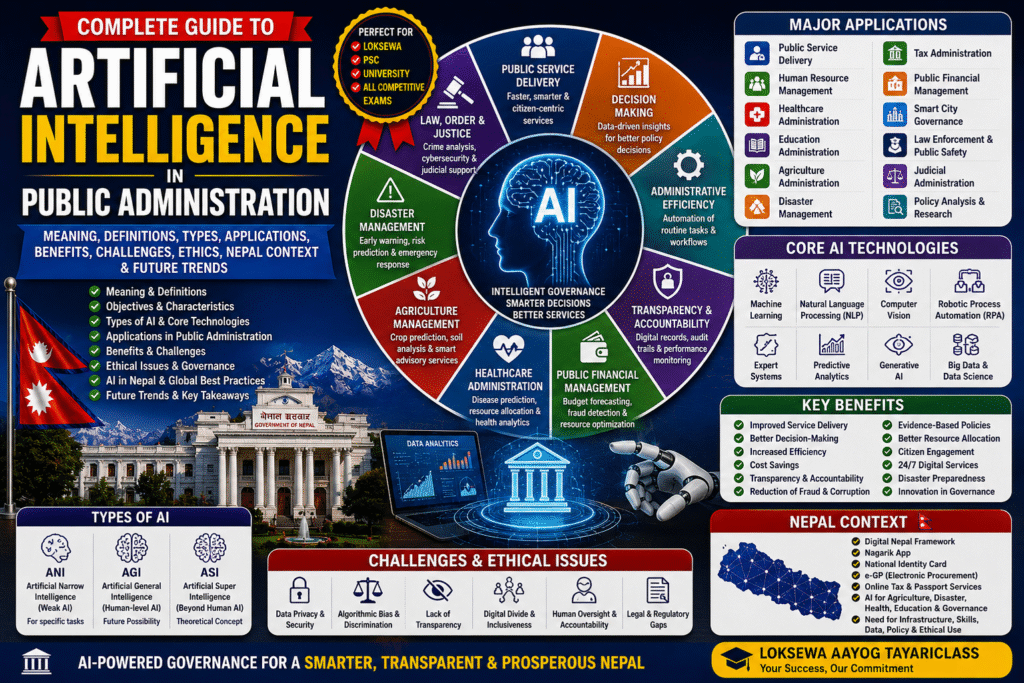
Artificial Intelligence in Public Administration: Meaning, Definitions, Types, Applications, Benefits, Challenges, Ethics, Nepal Context, and Future Trends
Introduction
The twenty-first century has witnessed an unprecedented technological revolution that is fundamentally transforming the way governments function, make decisions, and deliver public services. Among the many technological innovations shaping the future of governance, Artificial Intelligence (AI) has emerged as one of the most influential and transformative forces in modern Public Administration. From intelligent chatbots that answer citizens’ queries to predictive analytics that assist policymakers, AI is rapidly redefining how governments interact with citizens, allocate resources, detect fraud, improve public service delivery, and respond to complex societal challenges.
To fully appreciate the role of AI in government, it is helpful to first understand the broader concepts of [Governance in Public Administration], [E-Governance in Public Administration], and [Decision Making in Public Administration]. Governance establishes the principles through which public institutions create public value, while E-Governance introduces digital technologies into administrative processes. Artificial Intelligence represents the next stage of this evolution by enabling governments not only to digitize services but also to analyze vast amounts of data, automate routine administrative tasks, predict future needs, and support evidence-based policymaking.
Artificial Intelligence is no longer a futuristic concept limited to scientific research or private technology companies. Governments around the world—including Estonia, Singapore, South Korea, the United Kingdom, the United States, and the United Arab Emirates—are increasingly integrating AI into public administration to improve healthcare, taxation, education, policing, disaster management, transportation, judicial administration, and social welfare programmes. These initiatives demonstrate that AI has become a strategic tool for creating smarter, faster, more transparent, and citizen-centric governments.
For Nepal, Artificial Intelligence presents significant opportunities to modernize public administration and strengthen federal governance. AI has the potential to improve digital public services, enhance policy analysis, support disaster risk management, strengthen agricultural extension services, optimize healthcare delivery, improve tax administration, and make government services more accessible to citizens living in remote areas. At the same time, Nepal must carefully address important challenges such as digital infrastructure, data quality, cybersecurity, privacy protection, ethical governance, institutional capacity, and legal regulation to ensure that AI is used responsibly and inclusively.
However, Artificial Intelligence should not be viewed merely as a technological innovation. In Public Administration, AI is best understood as a decision-support system that complements—rather than replaces—human judgment. While AI can process information faster than humans and identify patterns within enormous datasets, public administrators remain responsible for ethical leadership, accountability, transparency, fairness, and protecting the public interest. Therefore, successful AI-enabled governance requires an appropriate balance between technological innovation and democratic values.
This comprehensive guide explores Artificial Intelligence in Public Administration from both theoretical and practical perspectives. It examines the meaning, definitions, historical evolution, objectives, characteristics, principles, types of AI, major technologies, administrative applications, benefits, risks, ethical issues, governance frameworks, Nepal’s emerging AI initiatives, global best practices, and future trends. Whether you are preparing for Loksewa (PSC) examinations, studying Public Administration at the university level, conducting academic research, or simply interested in the future of government, this article provides a complete and practical understanding of how Artificial Intelligence is reshaping contemporary Public Administration.
Meaning of Artificial Intelligence (AI)
Artificial Intelligence (AI) refers to the ability of computer systems and digital machines to perform tasks that normally require human intelligence. These tasks include learning from data, recognizing patterns, understanding language, solving problems, making predictions, reasoning, and supporting decision-making.
In Public Administration, Artificial Intelligence is used to assist governments in improving administrative efficiency, enhancing public service delivery, supporting evidence-based policymaking, detecting fraud, managing public resources, and providing citizen-centric digital services.
Unlike traditional computer programs that simply follow predefined instructions, AI systems can analyze large volumes of information, identify relationships within data, continuously improve their performance through learning, and generate recommendations for public administrators.
Simply stated,
Artificial Intelligence is the capability of machines and computer systems to simulate human intelligence in order to solve problems, learn from experience, make informed decisions, and perform complex administrative tasks efficiently.
In the context of Public Administration, AI should be viewed as an intelligent assistant that enhances human decision-making rather than replacing public officials. Governments remain responsible for ensuring that AI systems operate fairly, transparently, ethically, and in accordance with the law.
Definitions of Artificial Intelligence
Because Artificial Intelligence is an interdisciplinary field combining computer science, mathematics, psychology, cognitive science, public policy, and engineering, scholars and international organizations define it from different perspectives.
John McCarthy (Father of Artificial Intelligence)
John McCarthy, who coined the term Artificial Intelligence in 1956, defined AI as:
“The science and engineering of making intelligent machines, especially intelligent computer programs.”
This definition emphasizes the development of machines capable of performing tasks that normally require human intelligence.
Stuart Russell and Peter Norvig
According to Russell and Norvig, authors of Artificial Intelligence: A Modern Approach,
Artificial Intelligence is the study of intelligent agents that perceive their environment and take actions that maximize their chances of achieving specific goals.
This definition highlights decision-making and goal-oriented behaviour.
European Commission
The European Commission describes AI as:
Systems that display intelligent behaviour by analysing their environment and taking actions—with some degree of autonomy—to achieve specific objectives.
This definition emphasizes responsible and autonomous decision-making.
OECD Perspective
The Organisation for Economic Co-operation and Development (OECD) defines an AI system as:
A machine-based system that can, for explicit or implicit objectives, infer from the input it receives how to generate outputs such as predictions, content, recommendations, or decisions that influence real or virtual environments.
This definition is widely used in discussions of AI governance and public policy.
UNESCO Perspective
UNESCO views Artificial Intelligence as a transformative technology that should be developed and deployed in ways that respect:
- Human rights.
- Human dignity.
- Diversity.
- Inclusion.
- Transparency.
- Accountability.
- Sustainable development.
UNESCO strongly advocates ethical AI for governments and public institutions.
Simple Definition
In simple words,
Artificial Intelligence is the ability of computers and machines to think, learn, analyse information, solve problems, and assist humans in making better decisions.
Historical Evolution of Artificial Intelligence
Artificial Intelligence did not emerge suddenly. It has evolved through decades of scientific research, technological innovation, and increasing computational power.
Understanding this evolution helps explain why AI has become a critical component of modern Public Administration.
Phase 1: The Birth of AI (1950–1960)
The intellectual foundations of AI were laid during the 1950s.
Key developments included:
- Alan Turing’s work on machine intelligence.
- The Turing Test (1950).
- The Dartmouth Conference (1956), where the term Artificial Intelligence was officially introduced by John McCarthy.
This period established AI as an academic discipline.
Phase 2: Rule-Based Expert Systems (1960s–1980s)
Researchers developed computer systems capable of solving specialized problems using predefined rules.
Examples included:
- Medical diagnosis systems.
- Engineering support systems.
- Financial decision systems.
- Administrative advisory systems.
Although useful, these systems lacked the ability to learn independently.
Phase 3: Machine Learning Revolution (1990s–2010)
Advances in computing power and digital data enabled machines to learn from experience rather than relying solely on programmed rules.
Governments began using AI for:
- Fraud detection.
- Tax administration.
- Pattern recognition.
- Predictive analysis.
- Risk assessment.
Machine Learning marked a major breakthrough in practical AI applications.
Phase 4: Deep Learning and Big Data (2010–Present)
The combination of:
- Massive digital datasets.
- Cloud computing.
- Powerful processors.
- Advanced algorithms.
led to rapid progress in:
- Speech recognition.
- Image recognition.
- Language translation.
- Autonomous systems.
- Intelligent public services.
Many governments now integrate AI into digital governance strategies.
Phase 5: Generative AI and Intelligent Government
The latest phase is characterized by Generative AI, capable of creating text, images, software code, summaries, and analytical reports.
Governments are exploring its use for:
- Drafting administrative documents.
- Assisting policy analysis.
- Summarizing legislation.
- Improving citizen communication.
- Supporting public service helpdesks.
- Knowledge management.
Despite these opportunities, governments must ensure that AI-generated outputs are verified by qualified officials and comply with legal and ethical standards.
Relationship Between AI and Public Administration
Artificial Intelligence is not a separate discipline isolated from Public Administration. Instead, it strengthens almost every administrative function.
AI supports:
- Evidence-based policymaking.
- Administrative decision-making.
- Public financial management.
- Human resource management.
- Public health administration.
- Disaster management.
- Urban planning.
- Smart governance.
- Regulatory enforcement.
- Citizen engagement.
AI therefore complements many concepts you have already studied, including Management Functions (POSDCORB), Leadership, Decision Making, Governance, E-Governance, and Administrative Ethics, creating a more intelligent and responsive public administration system.
AI, Machine Learning, Deep Learning, and Data Science: Understanding the Difference
Students often confuse these closely related terms. Understanding their relationship is essential.
Artificial Intelligence (AI)
AI is the broad field focused on creating machines capable of performing tasks that typically require human intelligence.
Examples:
- Virtual assistants.
- Intelligent chatbots.
- Fraud detection systems.
- Decision-support tools.
Machine Learning (ML)
Machine Learning is a subset of AI.
Instead of following only fixed rules, ML systems learn from historical data and improve their performance over time.
Examples:
- Tax fraud prediction.
- Disease outbreak forecasting.
- Traffic prediction.
- Public expenditure analysis.
Deep Learning (DL)
Deep Learning is a specialized branch of Machine Learning that uses artificial neural networks inspired by the human brain.
Applications include:
- Facial recognition.
- Voice recognition.
- Automatic translation.
- Medical image analysis.
- Satellite image interpretation.
Data Science
Data Science involves collecting, cleaning, analysing, and interpreting data to generate useful insights.
While AI focuses on creating intelligent behaviour, Data Science focuses on extracting knowledge from data. In government, the two fields frequently work together to support evidence-based governance.
Quick Comparison
| Concept | Primary Focus | Example in Public Administration |
|---|---|---|
| Artificial Intelligence | Intelligent decision-making | AI chatbot for citizen services |
| Machine Learning | Learning from data | Predicting tax evasion patterns |
| Deep Learning | Complex pattern recognition | Facial verification for digital identity |
| Data Science | Data analysis and insights | Analysing health or education datasets |
Objectives of Artificial Intelligence in Public Administration
Artificial Intelligence is not adopted in government simply because it is an advanced technology. Its primary purpose is to help governments deliver better governance, improve administrative efficiency, support evidence-based decision-making, and create greater public value.
In Public Administration, AI serves as a strategic tool that enables governments to become more proactive, transparent, responsive, citizen-centric, and data-driven.
The major objectives of Artificial Intelligence in Public Administration are explained below.
1. To Improve Public Service Delivery
One of the foremost objectives of AI is to provide faster, smarter, and more accessible public services.
AI-powered systems can assist citizens by:
- Answering queries through chatbots.
- Providing 24/7 digital assistance.
- Automating service requests.
- Guiding citizens through application processes.
- Personalizing government services.
Benefits
- Faster service delivery.
- Reduced waiting time.
- Improved citizen satisfaction.
- Better accessibility.
2. To Support Evidence-Based Decision Making
Public administrators make decisions that affect millions of people.
AI helps decision-makers by analysing:
- Large datasets.
- Historical records.
- Real-time information.
- Statistical trends.
- Citizen feedback.
- Geographic information.
Instead of relying solely on intuition, governments can make more informed and objective decisions.
3. To Increase Administrative Efficiency
Many administrative activities are repetitive and time-consuming.
AI automates routine tasks such as:
- Document classification.
- File management.
- Appointment scheduling.
- Data entry.
- Report generation.
- Workflow management.
Automation allows public officials to devote more time to complex policy and management responsibilities.
4. To Improve Resource Allocation
Governments operate with limited financial, human, and physical resources.
AI helps optimize resource allocation by predicting:
- Budget requirements.
- Healthcare demand.
- Traffic congestion.
- Disaster risks.
- Agricultural production.
- Infrastructure maintenance needs.
Better forecasting improves the efficiency of public expenditure.
5. To Detect Fraud and Corruption
Artificial Intelligence can identify suspicious patterns that humans might overlook.
Applications include:
- Tax fraud detection.
- Procurement fraud monitoring.
- Financial irregularity analysis.
- Social benefit verification.
- Identity fraud prevention.
AI strengthens accountability and protects public resources.
6. To Enhance Transparency
AI can improve transparency by:
- Publishing open government data.
- Monitoring administrative performance.
- Tracking service delivery.
- Generating public dashboards.
- Supporting audit systems.
These mechanisms increase public trust in government institutions.
7. To Strengthen Disaster Management
Governments increasingly use AI to predict and respond to disasters.
Applications include:
- Flood prediction.
- Earthquake damage assessment.
- Weather forecasting.
- Wildfire monitoring.
- Emergency response coordination.
Early warning systems save lives and reduce economic losses.
8. To Improve Policy Formulation
AI analyses complex information that assists policymakers in:
- Evaluating existing policies.
- Predicting policy outcomes.
- Identifying emerging issues.
- Measuring programme effectiveness.
This supports smarter and more adaptive public policies.
9. To Promote Citizen-Centric Governance
Modern public administration places citizens at the centre of governance.
AI contributes by:
- Personalizing government services.
- Reducing administrative complexity.
- Improving accessibility.
- Providing multilingual digital assistance.
- Offering faster grievance resolution.
Citizen satisfaction becomes a key performance indicator.
10. To Build Smart Government
Ultimately, AI aims to transform traditional government into Smart Government, where public services are:
- Predictive.
- Integrated.
- Data-driven.
- Efficient.
- Transparent.
- Responsive.
- Sustainable.
Characteristics of Artificial Intelligence in Public Administration
Artificial Intelligence possesses several characteristics that distinguish it from conventional information systems.
1. Learning Capability
Unlike traditional software, AI systems can improve their performance by learning from data and previous experiences.
2. Reasoning Ability
AI can evaluate different alternatives and recommend appropriate courses of action based on available information.
3. Pattern Recognition
AI identifies hidden relationships and trends within large datasets.
Examples include:
- Tax evasion patterns.
- Disease outbreaks.
- Crime hotspots.
- Traffic congestion.
4. Predictive Capability
AI forecasts future events using historical and real-time data.
Governments use prediction for:
- Budget planning.
- Disaster preparedness.
- Disease surveillance.
- Population growth.
- Infrastructure demand.
5. Automation
AI performs repetitive administrative tasks automatically, improving efficiency while reducing manual errors.
6. Adaptability
AI systems continuously improve as they receive new information.
This enables governments to respond more effectively to changing public needs.
7. Data-Driven Intelligence
AI depends upon high-quality data rather than assumptions.
The accuracy of AI recommendations largely depends on the quality, completeness, and reliability of available data.
8. Speed and Scalability
AI processes enormous amounts of information much faster than humans.
Governments can therefore analyse nationwide datasets within minutes rather than weeks.
9. Continuous Operation
Unlike human workers, AI-powered systems can operate continuously, providing public services 24 hours a day and seven days a week.
10. Decision Support
Perhaps the most important characteristic in Public Administration is that AI primarily supports human decision-making rather than replacing public officials.
Final responsibility always remains with accountable public authorities.
Principles of Responsible Artificial Intelligence
As AI becomes increasingly influential in governance, governments must ensure that it is developed and used responsibly.
The following principles are widely recognized by organizations such as the OECD, UNESCO, European Commission, and many national governments.
1. Human-Centred Approach
AI should always serve human welfare and promote the public interest.
Technology must support people—not replace democratic governance.
2. Transparency
Citizens should understand how important AI-assisted decisions are made.
Governments should explain:
- Why a decision was made.
- What information was used.
- How AI influenced the outcome.
Transparent AI strengthens public trust.
3. Accountability
Even when AI assists decision-making, public officials remain legally and ethically accountable for final decisions.
Responsibility cannot be transferred to algorithms.
4. Fairness and Non-Discrimination
AI systems must treat all citizens fairly regardless of:
- Gender.
- Age.
- Disability.
- Ethnicity.
- Religion.
- Economic status.
- Geographic location.
Governments should regularly test AI systems for bias and discrimination.
5. Privacy and Data Protection
AI often relies on large amounts of personal data.
Governments must ensure:
- Secure data storage.
- Lawful data collection.
- Confidentiality.
- Compliance with privacy laws.
- Responsible data sharing.
6. Security and Reliability
AI systems should be secure against cyber threats and operate consistently even under challenging conditions.
Regular testing and monitoring are essential.
7. Inclusiveness
Digital transformation should benefit everyone, including:
- Rural communities.
- Persons with disabilities.
- Elderly citizens.
- Marginalized groups.
Inclusive AI reduces digital inequality.
8. Sustainability
AI should contribute to sustainable development by improving environmental management, public services, and efficient use of public resources.
Types of Artificial Intelligence
AI is commonly classified according to its capability.
1. Artificial Narrow Intelligence (ANI)
Also called Weak AI, ANI is designed to perform specific tasks.
Examples:
- Voice assistants.
- AI chatbots.
- Recommendation systems.
- Fraud detection software.
- Facial recognition.
Today, nearly all government AI applications fall under ANI.
2. Artificial General Intelligence (AGI)
AGI refers to a hypothetical AI capable of performing any intellectual task that a human can perform.
Characteristics include:
- Human-like reasoning.
- Learning across multiple domains.
- General problem-solving.
AGI has not yet been achieved and remains an active area of research.
3. Artificial Super Intelligence (ASI)
ASI refers to a theoretical form of AI that would surpass human intelligence across virtually all domains.
Potential capabilities include:
- Advanced scientific discovery.
- Complex strategic reasoning.
- Autonomous innovation.
At present, ASI remains speculative rather than a practical reality.
Core AI Technologies Used in Government
Modern AI systems rely on several complementary technologies.
- Machine Learning (ML): Learns from data to improve predictions and decisions.
- Deep Learning: Uses neural networks for complex tasks such as image and speech recognition.
- Natural Language Processing (NLP): Enables computers to understand, analyse, and generate human language; useful for chatbots, document analysis, and multilingual services.
- Computer Vision: Allows systems to interpret images and videos for applications such as traffic management, facial verification, and infrastructure monitoring.
- Robotic Process Automation (RPA): Automates repetitive administrative tasks like data entry, form processing, and workflow management.
- Predictive Analytics: Uses historical data to forecast future events such as disease outbreaks, tax compliance risks, or disaster impacts.
Objectives of Artificial Intelligence in Public Administration
Artificial Intelligence is introduced into Public Administration not merely to automate government processes but to improve the overall quality of governance. Governments around the world are increasingly using AI to enhance decision-making, deliver efficient public services, strengthen accountability, optimize resource utilization, and create more citizen-centric institutions.
The major objectives of Artificial Intelligence in Public Administration are discussed below.
1. To Improve Public Service Delivery
One of the foremost objectives of AI is to provide faster, more accurate, and citizen-friendly public services.
AI-powered systems can process applications, answer citizen queries, verify documents, and provide government services with minimal delay.
Examples
- AI chatbots for government portals.
- Automated passport verification.
- Digital grievance handling.
- Online licence processing.
- Smart citizen helpdesks.
Importance
- Reduces waiting time.
- Improves service quality.
- Enhances citizen satisfaction.
- Expands 24/7 government services.
2. To Support Evidence-Based Decision-Making
Public administrators make decisions that affect millions of citizens.
AI helps decision-makers by:
- Analysing large datasets.
- Identifying hidden patterns.
- Forecasting future trends.
- Evaluating policy alternatives.
- Providing predictive insights.
This enables governments to make informed and evidence-based decisions rather than relying solely on intuition or incomplete information.
3. To Increase Administrative Efficiency
Many administrative activities are repetitive and time-consuming.
AI automates routine tasks such as:
- Document classification.
- Data entry.
- File management.
- Appointment scheduling.
- Workflow management.
- Report generation.
Automation allows public officials to focus on more complex and strategic responsibilities.
4. To Strengthen Transparency and Accountability
AI-supported digital systems automatically record administrative activities, creating detailed audit trails.
These records make it easier to:
- Monitor government performance.
- Evaluate administrative efficiency.
- Detect irregularities.
- Strengthen institutional accountability.
Transparency improves public trust in government.
5. To Reduce Corruption and Fraud
Artificial Intelligence can identify suspicious patterns that may indicate corruption or financial misconduct.
Applications include:
- Procurement monitoring.
- Tax fraud detection.
- Benefit fraud identification.
- Financial transaction analysis.
- Risk assessment.
AI helps governments detect irregularities that might otherwise remain unnoticed.
6. To Improve Resource Allocation
Governments must allocate limited public resources efficiently.
AI assists by:
- Forecasting future demand.
- Prioritizing resource distribution.
- Optimizing budgets.
- Predicting infrastructure needs.
- Supporting disaster preparedness.
Better planning leads to improved public value.
7. To Enhance Citizen Engagement
AI enables governments to interact with citizens more effectively through:
- Virtual assistants.
- Multilingual chatbots.
- Personalized digital services.
- Automated feedback systems.
- Intelligent grievance management.
These technologies strengthen communication between governments and citizens.
8. To Improve Policy Formulation
AI analyses vast quantities of administrative and socio-economic data.
This helps governments:
- Evaluate existing policies.
- Predict policy impacts.
- Identify emerging issues.
- Design more effective public programmes.
Evidence-based policymaking reduces policy failure.
9. To Strengthen Disaster Management
AI supports governments in:
- Flood prediction.
- Earthquake risk assessment.
- Weather forecasting.
- Emergency response planning.
- Resource deployment.
Real-time data improves disaster preparedness and response.
10. To Promote Innovation in Governance
Artificial Intelligence encourages governments to adopt innovative administrative practices.
Innovation includes:
- Smart cities.
- Digital governance.
- Intelligent transportation.
- Predictive healthcare.
- Automated regulatory compliance.
Innovation enables governments to respond effectively to changing societal needs.
Characteristics of Artificial Intelligence in Public Administration
Artificial Intelligence possesses several distinctive characteristics that make it valuable in modern governance.
1. Learning Capability
Unlike traditional software, AI systems continuously improve by learning from data and experience.
2. Data-Driven
AI depends on large volumes of high-quality data.
The quality of AI decisions largely depends upon the quality of available data.
3. Predictive Ability
AI can forecast future events based on historical information.
Examples include:
- Disease outbreaks.
- Traffic congestion.
- Revenue collection.
- Disaster risks.
4. Automation
AI automates repetitive administrative processes while reducing manual effort.
5. Adaptability
AI systems improve their performance as new information becomes available.
6. Speed
AI processes enormous quantities of information within seconds.
7. Accuracy
When properly designed and trained, AI often performs repetitive analytical tasks with high accuracy.
However, accuracy depends on reliable data and appropriate human oversight.
8. Scalability
AI systems can simultaneously provide services to millions of users without proportionally increasing administrative costs.
9. Continuous Operation
Unlike humans, AI systems can operate continuously, providing 24-hour digital government services.
10. Decision Support
AI assists public administrators by providing recommendations and analytical insights.
Importantly, AI supports decision-making but should not replace human accountability, especially in matters involving legal rights, ethics, and public interest.
Principles of Responsible Artificial Intelligence
Artificial Intelligence in government must be implemented responsibly to protect citizens’ rights and maintain public trust.
The following principles are widely recognized by organizations such as the OECD, UNESCO, and the European Commission.
1. Human-Centred Approach
AI should serve people and promote public welfare.
Human dignity and public interest must remain the highest priorities.
2. Transparency
Citizens should understand when AI is being used and how important decisions are made.
Transparent AI strengthens trust in government.
3. Accountability
Governments remain responsible for decisions made with AI assistance.
Public officials cannot transfer legal or ethical responsibility to algorithms.
4. Fairness
AI systems should avoid discrimination based on:
- Gender.
- Ethnicity.
- Disability.
- Economic status.
- Geographic location.
- Social background.
Fairness is essential for democratic governance.
5. Privacy Protection
Governments must safeguard citizens’ personal information through:
- Secure databases.
- Responsible data use.
- Strong privacy policies.
- Data minimization where appropriate.
6. Security
AI systems should be protected against:
- Cyberattacks.
- Data manipulation.
- Unauthorized access.
- System failures.
Cybersecurity is fundamental to trustworthy AI.
7. Reliability
Government AI systems should produce consistent, accurate, and dependable results.
Regular testing and evaluation are necessary to maintain reliability.
8. Inclusiveness
AI-powered public services should be accessible to:
- Rural populations.
- Persons with disabilities.
- Elderly citizens.
- Digitally disadvantaged communities.
Inclusive AI supports equitable governance.
9. Explainability
When AI influences important government decisions, those decisions should be explainable and understandable to citizens and oversight bodies.
10. Ethical Governance
Artificial Intelligence should always operate in accordance with:
- Constitutional values.
- Human rights.
- Democratic principles.
- Rule of law.
- Administrative ethics.
Technology should strengthen—not undermine—good governance.
Types of Artificial Intelligence
Artificial Intelligence is commonly classified according to its capabilities.
1. Artificial Narrow Intelligence (ANI)
Also known as Weak AI, ANI is designed to perform specific tasks.
Examples include:
- Government chatbots.
- Facial recognition systems.
- Fraud detection software.
- Language translation tools.
Today, nearly all AI applications used in public administration belong to this category.
2. Artificial General Intelligence (AGI)
AGI refers to hypothetical systems capable of performing any intellectual task that humans can perform.
Although extensively researched, AGI has not yet been achieved.
3. Artificial Super Intelligence (ASI)
ASI refers to a theoretical stage where machine intelligence would surpass human intelligence across virtually all domains.
At present, ASI remains a speculative concept discussed mainly in academic and policy debates rather than a technology used in government.
Core Artificial Intelligence Technologies Used in Public Administration
Artificial Intelligence is not a single technology. Instead, it is a combination of several advanced technologies that work together to help governments analyse data, automate administrative processes, improve decision-making, and deliver high-quality public services.
Understanding these technologies is essential because modern digital governments increasingly rely on them to address complex administrative challenges.
1. Machine Learning (ML)
Machine Learning is a branch of Artificial Intelligence that enables computer systems to learn from data without being explicitly programmed for every situation.
Instead of following fixed rules, Machine Learning identifies patterns, improves through experience, and makes increasingly accurate predictions over time.
Government Applications
- Tax fraud detection.
- Budget forecasting.
- Public health prediction.
- Crime pattern analysis.
- Social welfare targeting.
- Traffic prediction.
Example
A tax authority can use Machine Learning to identify unusual financial transactions that may indicate tax evasion.
2. Natural Language Processing (NLP)
Natural Language Processing enables computers to understand, interpret, and generate human language.
NLP allows governments to communicate with citizens more efficiently.
Applications
- AI chatbots.
- Virtual assistants.
- Automatic translation.
- Speech recognition.
- Document summarization.
- Citizen complaint analysis.
Example
Many government websites now use AI chatbots to answer frequently asked questions twenty-four hours a day.
3. Computer Vision
Computer Vision enables machines to interpret and analyse digital images and videos.
Government Applications
- Facial recognition.
- Traffic monitoring.
- Border security.
- Disaster damage assessment.
- Infrastructure inspection.
- Identity verification.
Example
Digital identity systems can verify a citizen’s photograph automatically before approving online services.
4. Expert Systems
Expert Systems imitate the decision-making ability of experienced professionals using predefined knowledge and logical rules.
Although newer AI techniques have become more common, Expert Systems remain valuable for structured administrative decisions.
Applications
- Legal advisory systems.
- Medical diagnosis.
- Agricultural extension.
- Regulatory compliance.
- Administrative guidance.
5. Robotic Process Automation (RPA)
Robotic Process Automation automates repetitive administrative tasks.
Unlike physical robots, RPA consists of software robots that perform routine office work.
Applications
- Processing applications.
- Data entry.
- Invoice verification.
- Payroll processing.
- File management.
- Record updating.
RPA significantly reduces administrative workload and processing time.
6. Predictive Analytics
Predictive Analytics combines Artificial Intelligence with statistical models to forecast future events.
Government Applications
- Disease outbreaks.
- Natural disasters.
- Budget forecasting.
- Revenue estimation.
- Population growth.
- Infrastructure planning.
Governments can make proactive decisions instead of reacting after problems occur.
7. Generative Artificial Intelligence
Generative AI is one of the newest developments in Artificial Intelligence.
Unlike traditional AI, Generative AI creates new content, including:
- Text.
- Reports.
- Images.
- Software code.
- Policy summaries.
- Administrative drafts.
Government Applications
- Drafting policy documents.
- Preparing meeting summaries.
- Citizen communication.
- Translation services.
- Knowledge management.
- Educational content.
Public officials should always review AI-generated content before official use to ensure accuracy, legality, and compliance with government policies.
Applications of Artificial Intelligence in Public Administration
Artificial Intelligence is transforming nearly every area of government administration. Rather than replacing public officials, AI enhances their ability to make informed decisions, improve service delivery, and manage public resources efficiently.
1. AI in Public Service Delivery
Citizen service delivery is one of the fastest-growing applications of AI.
Governments increasingly use AI-powered digital platforms to provide faster, more accessible, and more convenient public services.
Applications
- AI chatbots.
- Online helpdesks.
- Digital service portals.
- Appointment scheduling.
- Document verification.
- Virtual assistants.
Benefits
- Reduced waiting time.
- Continuous 24-hour services.
- Higher citizen satisfaction.
- Lower administrative costs.
2. AI in Decision Making
Decision-making is a core function of Public Administration.
AI supports administrators by:
- Analysing large datasets.
- Identifying trends.
- Predicting future outcomes.
- Evaluating policy alternatives.
- Supporting evidence-based governance.
Importantly, AI provides recommendations, while final decisions remain the responsibility of accountable public officials.
3. AI in Human Resource Management
Governments manage thousands of public employees.
AI improves Human Resource Management through:
- Recruitment screening.
- Workforce planning.
- Performance analysis.
- Training recommendations.
- Employee engagement.
- Succession planning.
These applications help build a more competent and efficient civil service.
4. AI in Public Financial Management
Artificial Intelligence strengthens financial governance by improving budgeting, expenditure monitoring, revenue administration, and financial accountability.
Applications
- Budget forecasting.
- Tax administration.
- Fraud detection.
- Financial auditing.
- Procurement monitoring.
- Expenditure analysis.
AI contributes to better financial discipline and transparency.
5. AI in Healthcare Administration
Healthcare systems generate enormous amounts of information.
AI assists governments in:
- Disease surveillance.
- Hospital management.
- Medical diagnosis support.
- Vaccine distribution.
- Health resource allocation.
- Predicting disease outbreaks.
These technologies improve both healthcare quality and administrative efficiency.
6. AI in Education Administration
Educational institutions increasingly rely on AI for administrative and academic support.
Applications
- Student performance analysis.
- Learning management systems.
- Digital examinations.
- Personalized learning.
- Resource planning.
- Academic analytics.
AI helps governments improve educational planning and quality.
7. AI in Agriculture Administration
Agriculture remains a critical sector in many developing countries, including Nepal.
AI supports governments through:
- Crop prediction.
- Pest detection.
- Weather forecasting.
- Irrigation management.
- Soil analysis.
- Agricultural advisory services.
These applications contribute to food security and sustainable agricultural development.
8. AI in Disaster Management
Artificial Intelligence plays an increasingly important role in disaster preparedness and emergency response.
Applications
- Flood forecasting.
- Earthquake damage assessment.
- Landslide monitoring.
- Weather prediction.
- Emergency resource allocation.
- Rescue coordination.
For a disaster-prone country like Nepal, AI has significant potential to strengthen disaster risk reduction and improve early warning systems.
9. AI in Smart City Administration
Many cities around the world are adopting AI to become smarter, more sustainable, and more efficient.
Applications
- Intelligent traffic management.
- Smart street lighting.
- Waste management.
- Water supply monitoring.
- Air quality monitoring.
- Public safety systems.
Smart city initiatives improve urban governance and citizens’ quality of life.
10. AI in Law Enforcement and Public Safety
Law enforcement agencies use AI to support crime prevention and public safety.
Applications include:
- Crime pattern analysis.
- Predictive policing (subject to legal and ethical safeguards).
- Surveillance support.
- Missing person identification.
- Cybercrime detection.
- Emergency response coordination.
Because these applications can affect individual rights, governments should implement strong legal oversight, transparency, and accountability mechanisms.
11. AI in Tax Administration
Tax authorities increasingly use AI to improve compliance and efficiency.
Applications
- Risk-based taxpayer selection.
- Fraud detection.
- Revenue forecasting.
- Automated taxpayer assistance.
- Compliance monitoring.
These systems improve revenue collection while reducing administrative burdens.
12. AI in Judicial Administration
Artificial Intelligence can support—but not replace—the judiciary.
Potential applications include:
- Case management.
- Legal research.
- Document classification.
- Court scheduling.
- Translation of legal documents.
- Judgment search systems.
Judicial independence, due process, and human oversight remain essential whenever AI tools are used in courts.
Scholar’s Insight
Professor Herbert A. Simon, a Nobel Prize-winning scholar and pioneer in decision theory, emphasized that administrative decision-making can be strengthened by computational systems that assist in analysing complex information. Modern Artificial Intelligence builds upon this idea by enabling governments to process vast amounts of data, generate insights, and support rational administrative decisions. However, AI should complement—not replace—human judgment, ethical reasoning, and democratic accountability.
Benefits of Artificial Intelligence in Public Administration
Artificial Intelligence is transforming Public Administration by enabling governments to deliver faster, smarter, and more citizen-oriented services. When implemented responsibly, AI can improve administrative efficiency, strengthen governance, optimize public resource management, and enhance citizens’ trust in public institutions.
The following are the major benefits of Artificial Intelligence in Public Administration.
1. Improved Public Service Delivery
One of the most significant advantages of AI is its ability to improve the speed, accessibility, and quality of public services.
AI-powered systems allow citizens to access government services at any time without unnecessary delays.
Examples
- Online citizen assistance.
- Digital document verification.
- Automated application processing.
- Virtual government helpdesks.
- Intelligent appointment scheduling.
Administrative Benefits
- Faster service delivery.
- Reduced waiting time.
- Improved citizen satisfaction.
- Better accessibility for remote communities.
2. Better Decision-Making
Governments generate enormous volumes of administrative data every day.
AI analyses this information to identify:
- Hidden patterns.
- Emerging risks.
- Future trends.
- Policy alternatives.
- Performance indicators.
As a result, policymakers can make more informed, evidence-based decisions.
3. Increased Administrative Efficiency
Routine administrative tasks consume significant government resources.
AI automates activities such as:
- Data entry.
- Document classification.
- Record management.
- Workflow monitoring.
- Report preparation.
Automation enables public officials to focus on strategic planning and public service improvement.
4. Cost Savings
By automating repetitive tasks and improving operational efficiency, AI can reduce:
- Administrative expenses.
- Paper-based processes.
- Processing delays.
- Human errors.
- Resource wastage.
Although AI requires initial investment, long-term operational savings can be substantial.
5. Enhanced Transparency
AI-powered digital systems automatically record administrative activities.
These digital records improve:
- Transparency.
- Public accountability.
- Audit readiness.
- Performance monitoring.
- Public trust.
Transparent systems reduce opportunities for manipulation and unauthorized decision-making.
6. Reduction of Corruption and Fraud
Artificial Intelligence can analyse millions of transactions and identify suspicious patterns that may indicate:
- Procurement fraud.
- Tax evasion.
- Duplicate beneficiaries.
- Financial irregularities.
- Identity fraud.
AI strengthens integrity by supporting continuous monitoring and early detection of irregularities.
7. Evidence-Based Policymaking
Traditional policymaking often relied on limited information.
AI enables governments to analyse:
- Population trends.
- Economic indicators.
- Citizen feedback.
- Health statistics.
- Environmental conditions.
This helps policymakers design more effective public policies.
8. Personalized Citizen Services
Artificial Intelligence enables governments to deliver services based on citizens’ specific needs.
Examples include:
- Personalized notifications.
- Customized digital services.
- Targeted welfare programmes.
- Multilingual government assistance.
Citizen-centred governance improves public satisfaction and inclusion.
9. Better Disaster Management
AI strengthens disaster preparedness through:
- Early warning systems.
- Flood prediction.
- Earthquake damage assessment.
- Landslide monitoring.
- Emergency response coordination.
For countries such as Nepal, AI has considerable potential to improve disaster risk reduction.
10. Continuous Government Services
Unlike conventional office systems, AI-powered digital services can operate 24 hours a day and 7 days a week.
Citizens can therefore access many government services regardless of office hours.
11. Improved Public Financial Management
AI contributes to better financial governance by supporting:
- Budget forecasting.
- Revenue estimation.
- Public expenditure monitoring.
- Financial auditing.
- Procurement analysis.
These applications strengthen fiscal discipline and accountability.
12. Increased Citizen Participation
Artificial Intelligence supports citizen engagement through:
- Digital consultations.
- Online feedback systems.
- Sentiment analysis.
- Social media monitoring.
- Public opinion analysis.
Governments can better understand citizens’ expectations and improve policy responsiveness.
Challenges of Artificial Intelligence in Public Administration
Despite its enormous potential, AI also presents significant administrative, legal, ethical, technical, and institutional challenges.
Successful implementation requires careful planning, effective regulation, and responsible governance.
1. Data Privacy Concerns
AI depends upon large volumes of personal and administrative data.
Improper data management may lead to:
- Privacy violations.
- Unauthorized surveillance.
- Identity theft.
- Data misuse.
Governments must establish strong data protection frameworks.
2. Cybersecurity Risks
AI systems may become targets of:
- Cyberattacks.
- Malware.
- Data breaches.
- System manipulation.
- Digital espionage.
Strong cybersecurity measures are therefore essential.
3. Algorithmic Bias
AI systems may unintentionally discriminate if trained using biased or incomplete data.
Bias can affect:
- Recruitment.
- Welfare distribution.
- Law enforcement.
- Credit assessment.
- Public service access.
Governments must regularly evaluate AI systems for fairness.
4. Lack of Transparency
Some AI models function as “black boxes,” making it difficult to explain how decisions were reached.
Limited transparency may reduce public trust and accountability.
5. Digital Divide
Not all citizens have equal access to:
- Internet connectivity.
- Digital devices.
- Digital literacy.
Governments must ensure that AI does not exclude rural communities, elderly citizens, or marginalized groups.
6. High Initial Investment
Developing AI systems often requires significant investment in:
- Infrastructure.
- Software.
- Skilled personnel.
- Data management.
- Cybersecurity.
Developing countries may face financial and technical constraints.
7. Shortage of Skilled Human Resources
Effective AI implementation requires experts in:
- Data science.
- Machine learning.
- Cybersecurity.
- Public administration.
- Digital governance.
Many governments still face shortages of qualified professionals.
8. Legal and Regulatory Challenges
Rapid technological development often progresses faster than legislation.
Governments must establish legal frameworks governing:
- AI accountability.
- Data protection.
- Ethical standards.
- Liability.
- Human oversight.
9. Overdependence on Technology
Governments should avoid excessive reliance on AI.
Human judgment remains essential, particularly in matters involving:
- Constitutional rights.
- Administrative justice.
- Public ethics.
- National security.
- Emergency decision-making.
10. Public Trust
Citizens may hesitate to accept AI-assisted government decisions if they believe systems are unfair, inaccurate, or lack transparency.
Building trust requires:
- Public awareness.
- Transparency.
- Accountability.
- Ethical governance.
Ethical Issues in Artificial Intelligence
Artificial Intelligence raises important ethical questions because government decisions directly affect citizens’ rights, opportunities, and well-being.
Public Administration therefore requires Responsible AI, where technological innovation is balanced with democratic values.
Major ethical concerns include:
- Protection of human rights.
- Privacy and confidentiality.
- Transparency of algorithms.
- Accountability for AI-assisted decisions.
- Fairness and non-discrimination.
- Prevention of algorithmic bias.
- Human oversight of critical decisions.
- Responsible use of citizens’ data.
- Digital inclusion and accessibility.
- Ethical leadership in digital governance.
As emphasized by UNESCO’s Recommendation on the Ethics of Artificial Intelligence, governments should ensure that AI promotes human dignity, justice, inclusiveness, sustainability, and respect for fundamental freedoms.
AI Governance Frameworks
Recognizing both the opportunities and risks of AI, several international organizations have developed principles to guide responsible AI governance.
OECD AI Principles
The OECD recommends that AI systems should be:
- Innovative.
- Trustworthy.
- Human-centred.
- Transparent.
- Accountable.
- Secure.
- Respectful of human rights.
UNESCO Recommendation on the Ethics of AI
UNESCO emphasizes:
- Human dignity.
- Inclusiveness.
- Environmental sustainability.
- Gender equality.
- Privacy protection.
- International cooperation.
European Union AI Act
The European Union has introduced a risk-based regulatory framework that classifies AI systems according to their potential impact and imposes stricter requirements on high-risk applications.
This approach illustrates how governments can encourage innovation while protecting citizens’ rights.
Artificial Intelligence in Nepal
Artificial Intelligence is still at an emerging stage in Nepal; however, its importance is increasing rapidly with the expansion of digital governance, ICT infrastructure, data-driven policymaking, and innovation. The Government of Nepal, academic institutions, private technology companies, financial institutions, and development partners have started exploring AI-based solutions to improve public administration, public service delivery, and economic development.
Although Nepal has not yet adopted a comprehensive national AI strategy comparable to countries such as Singapore or the United Kingdom, several ongoing initiatives indicate that the country is gradually moving toward AI-enabled governance.
Current AI Initiatives in Nepal
Several government institutions have already begun adopting digital technologies that provide a foundation for future AI applications.
Major initiatives include:
- Digital Nepal Framework as the national roadmap for digital transformation.
- Nagarik App, integrating multiple public services through a single digital platform.
- National Identity Card (NID) for secure digital identification and future digital authentication.
- Electronic Government Procurement (e-GP) for transparent procurement processes.
- Online Tax Administration by the Inland Revenue Department.
- Online Passport Services and digital appointment systems.
- Expansion of government data centres and cloud-based digital infrastructure.
- Increasing adoption of digital payment systems across government services.
These initiatives create the digital ecosystem upon which future AI-powered public services can be built.
Potential Applications of AI in Nepal
Artificial Intelligence has enormous potential to improve governance in Nepal.
1. Agriculture
AI can support Nepal’s agriculture sector through:
- Crop disease detection.
- Weather forecasting.
- Smart irrigation.
- Soil analysis.
- Market price prediction.
- Agricultural advisory services.
These technologies can increase productivity and strengthen food security.
2. Disaster Risk Management
Nepal is highly vulnerable to:
- Earthquakes.
- Floods.
- Landslides.
- Glacial Lake Outburst Floods (GLOFs).
- Forest fires.
AI can improve:
- Early warning systems.
- Satellite image analysis.
- Disaster prediction.
- Emergency resource allocation.
- Rescue planning.
3. Healthcare Administration
AI can assist Nepal’s healthcare system through:
- Disease surveillance.
- Medical image analysis.
- Telemedicine support.
- Hospital resource management.
- Predictive public health planning.
4. Education Administration
AI may help improve education through:
- Personalized learning.
- Digital assessment.
- Learning analytics.
- Administrative planning.
- Student performance monitoring.
5. Revenue Administration
Tax administration can benefit from AI by:
- Detecting tax evasion.
- Risk-based auditing.
- Revenue forecasting.
- Automated taxpayer assistance.
6. Public Service Delivery
Future AI-powered government services may include:
- Intelligent citizen helpdesks.
- Multilingual government chatbots.
- Automated grievance management.
- Smart document verification.
- Digital administrative assistants.
Challenges for Nepal
Despite these opportunities, Nepal faces several obstacles in implementing AI effectively.
Major challenges include:
- Limited digital infrastructure.
- Inadequate high-quality administrative data.
- Shortage of AI professionals.
- Limited investment in research and innovation.
- Cybersecurity concerns.
- Weak legal and regulatory frameworks.
- Digital divide between urban and rural areas.
- Low digital literacy among sections of the population.
- Ethical and privacy concerns.
Addressing these challenges will require coordinated efforts from government, academia, the private sector, and civil society.
Global Best Practices
Many countries have successfully integrated Artificial Intelligence into Public Administration. Their experiences provide valuable lessons for Nepal.
Estonia
Estonia is regarded as one of the world’s most digitally advanced governments.
Its achievements include:
- Secure digital identity.
- AI-supported public services.
- Electronic voting.
- Digital healthcare.
- Integrated government databases.
Estonia demonstrates how digital infrastructure and trust can transform governance.
Singapore
Singapore’s Smart Nation Initiative integrates AI across transportation, healthcare, urban planning, and public services.
The government uses AI for:
- Intelligent traffic management.
- Predictive healthcare.
- Digital public services.
- Urban sustainability.
- Administrative decision support.
South Korea
South Korea consistently ranks among the world’s leading countries in the United Nations E-Government Development Index (EGDI).
The country uses AI for:
- Public service delivery.
- Smart cities.
- Digital education.
- Intelligent transportation.
- Government innovation.
United Arab Emirates (UAE)
The UAE became one of the first countries to appoint a Minister of State for Artificial Intelligence.
AI is widely applied in:
- Government services.
- Healthcare.
- Policing.
- Transportation.
- Smart city initiatives.
This reflects a strong national commitment to AI-driven governance.
United Kingdom
The UK has developed national AI policies focusing on:
- Ethical AI.
- Responsible innovation.
- Public sector modernization.
- Research collaboration.
- Regulatory oversight.
Its experience highlights the importance of balancing innovation with public trust.
Future of Artificial Intelligence in Public Administration
Artificial Intelligence will continue to reshape governments over the coming decades.
Future trends include:
- AI-assisted policymaking.
- Predictive governance.
- Hyper-personalized public services.
- Smart cities.
- Autonomous administrative systems.
- Digital twins for urban planning.
- AI-supported climate governance.
- Intelligent disaster management.
- Real-time policy evaluation.
- Human-AI collaborative decision-making.
However, future success will depend not only on technological advancement but also on ethical governance, legal safeguards, institutional capacity, cybersecurity, transparency, and citizen trust.
Key Takeaways
- Artificial Intelligence is transforming Public Administration by improving efficiency, transparency, accountability, and service delivery.
- AI supports—not replaces—public administrators in making informed decisions.
- Core AI technologies include Machine Learning, Natural Language Processing, Computer Vision, Robotic Process Automation, Predictive Analytics, and Generative AI.
- AI is increasingly used in healthcare, education, taxation, public finance, agriculture, disaster management, law enforcement, and smart city administration.
- Responsible AI requires transparency, fairness, accountability, privacy protection, cybersecurity, and human oversight.
- Nepal has laid an important digital foundation through the Digital Nepal Framework, Nagarik App, National Identity Card, and electronic government services, but further investment in infrastructure, skills, and regulation is needed.
- Countries such as Estonia, Singapore, South Korea, the UAE, and the UK provide valuable models for AI-enabled governance.
Frequently Asked Questions (FAQs)
1. What is Artificial Intelligence in Public Administration?
Artificial Intelligence in Public Administration refers to the use of AI technologies to improve government decision-making, public service delivery, administrative efficiency, transparency, and citizen engagement.
2. How does AI improve public administration?
AI helps governments automate routine tasks, analyse large datasets, detect fraud, support evidence-based policymaking, improve public services, and optimize the use of public resources.
3. What are the major applications of AI in government?
Major applications include healthcare administration, education, taxation, public finance, agriculture, disaster management, smart cities, law enforcement, judicial administration, and digital public services.
4. What are the main challenges of AI in Public Administration?
Key challenges include data privacy, cybersecurity, algorithmic bias, lack of transparency, legal and ethical issues, shortage of skilled professionals, infrastructure limitations, and the digital divide.
5. Why is Responsible AI important?
Responsible AI ensures that government AI systems are transparent, accountable, fair, secure, respectful of human rights, and subject to meaningful human oversight.
Scholar’s Corner
Herbert A. Simon argued that administrative decision-making can be improved through analytical and computational methods that help decision-makers process complex information more effectively. Modern Artificial Intelligence extends this vision by supporting evidence-based governance while preserving human accountability.
Stuart Russell and Peter Norvig describe AI as the study of intelligent agents that perceive their environment and take actions to achieve specific goals. In Public Administration, these intelligent systems can enhance planning, forecasting, and service delivery.
The OECD emphasizes that AI should be innovative, trustworthy, human-centred, transparent, robust, and accountable.
UNESCO stresses that Artificial Intelligence must always respect human dignity, human rights, diversity, inclusion, and environmental sustainability.
Together, these perspectives reinforce an important principle: Artificial Intelligence is a powerful tool for strengthening Public Administration, but good governance ultimately depends on ethical leadership, democratic institutions, and responsible public officials.
Conclusion
Artificial Intelligence has emerged as one of the most transformative innovations in contemporary Public Administration. By enabling governments to analyse vast amounts of information, automate routine administrative processes, strengthen evidence-based policymaking, and improve citizen-centred service delivery, AI has the potential to fundamentally reshape how public institutions operate. Nevertheless, technology alone cannot guarantee good governance. The effectiveness of AI depends on transparent institutions, accountable leadership, robust legal frameworks, secure digital infrastructure, and respect for democratic values and human rights.
For Nepal, AI presents a unique opportunity to accelerate administrative modernization, improve public service delivery, strengthen disaster management, enhance financial governance, and support inclusive national development. Building this future will require investments in digital infrastructure, skilled human resources, research, cybersecurity, and responsible regulation. If implemented thoughtfully and ethically, Artificial Intelligence can become a catalyst for a more efficient, transparent, innovative, and citizen-centric public administration that delivers greater public value for present and future generations.
References
- Russell, S., & Norvig, P. Artificial Intelligence: A Modern Approach.
- John McCarthy. Artificial Intelligence Research Papers.
- OECD. OECD Principles on Artificial Intelligence.
- UNESCO. Recommendation on the Ethics of Artificial Intelligence.
- United Nations. UN E-Government Survey.
- World Bank. GovTech and Digital Government Resources.
- European Commission. Artificial Intelligence Policy and Regulation.
- Constitution of Nepal, 2015.
- Digital Nepal Framework, Government of Nepal.
- Ministry of Communication and Information Technology (MoCIT), Nepal.
- National Information Technology Center (NITC), Nepal.
Suggested Related Articles
-
- Good Governance in Nepal
- Public Policy in Nepal
- Administrative Law in Nepal
- Leadership in Public Administration
- Administrative Ethics in Public Administration
- Public Accountability in Public Administration
- Decision Making in Public Administration
- Management Functions in Public Administration (POSDCORB)
- Organization Theory in Public Administration
- Human Resource Management in Public Administration
- Civil Service in Nepal
- Public Financial Administration in Nepal
About the Author
Loksewa Aayog Tayariclass publishes research-based study materials, comprehensive notes, exam-focused MCQs, and high-quality educational resources for Loksewa (PSC), university students, researchers, and lifelong learners in Nepal. Our mission is to simplify complex concepts through accurate, well-structured, and SEO-optimized content while promoting excellence in Public Administration education.