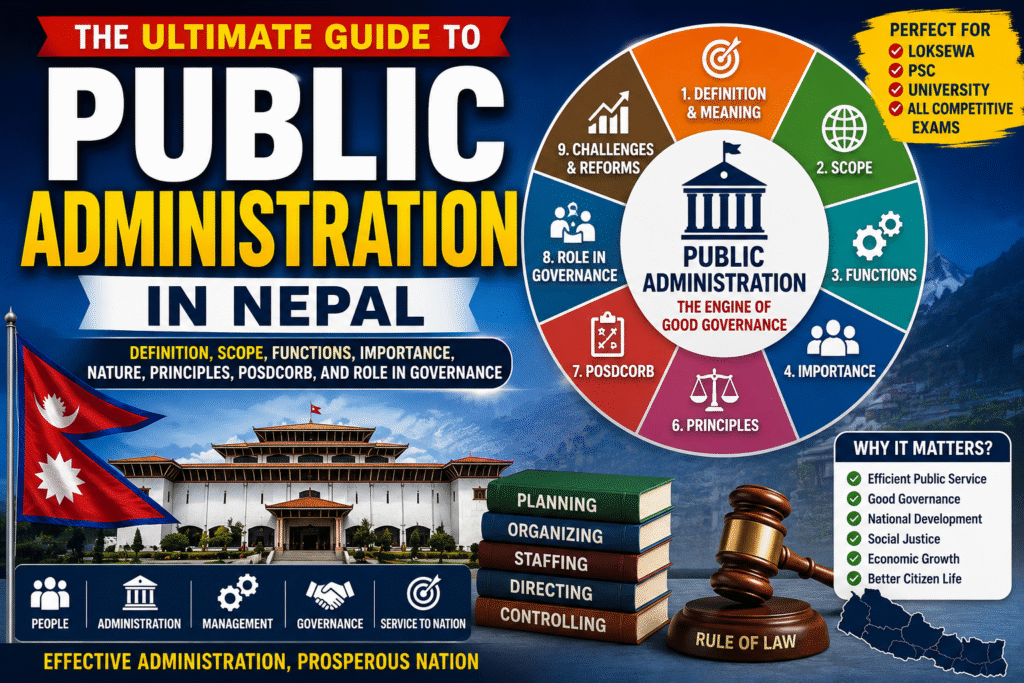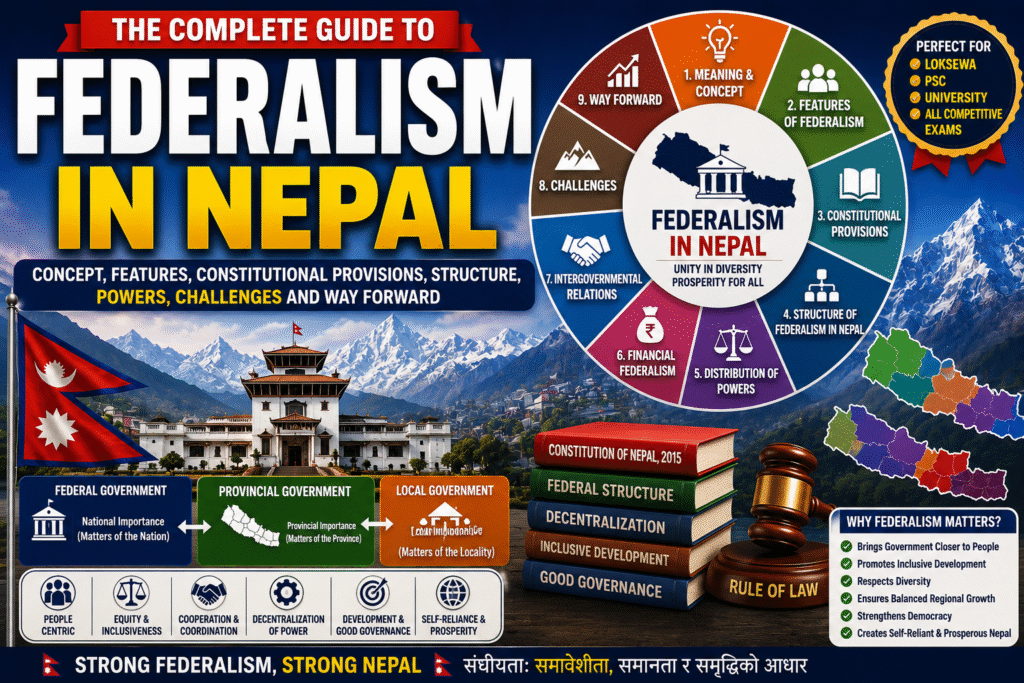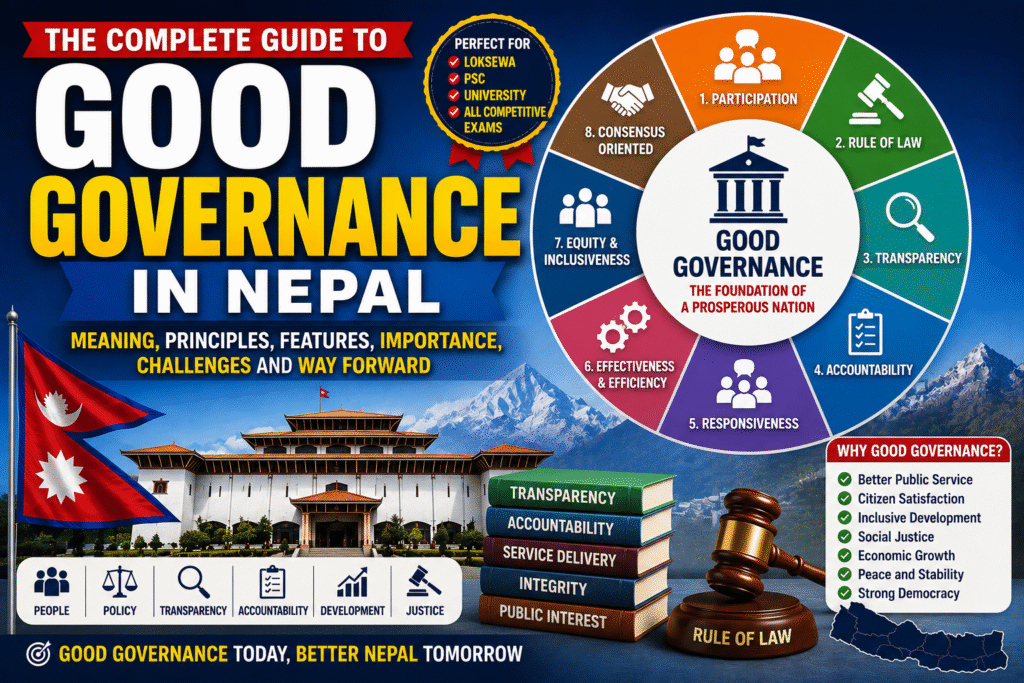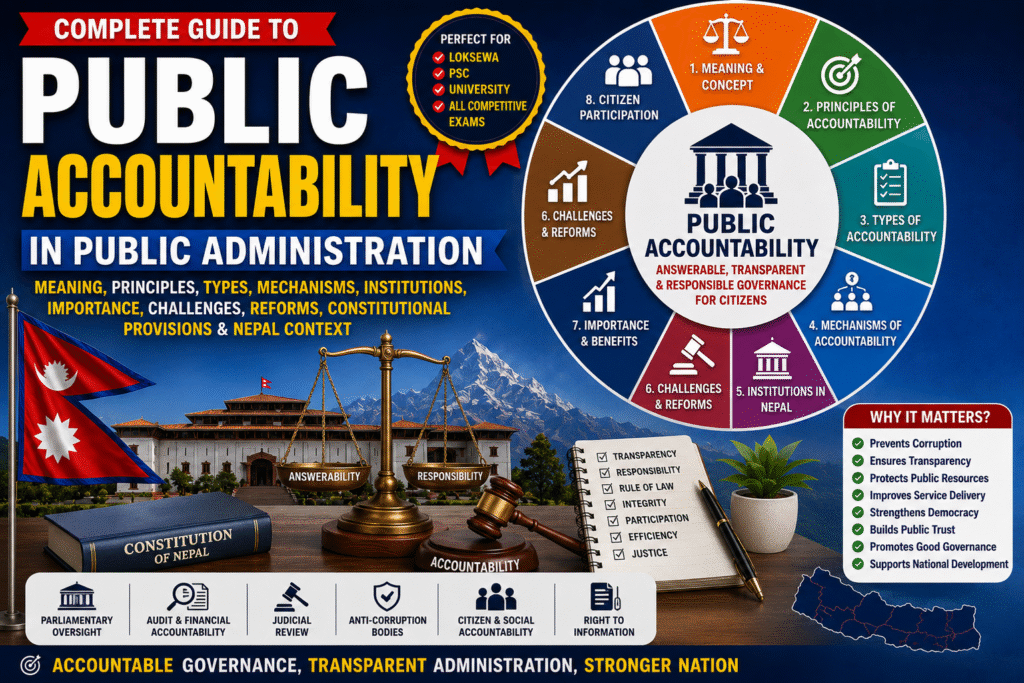
Public Accountability in Public Administration: Meaning, Types, Principles, Mechanisms, Importance, Challenges, and Nepal Context
The Ultimate Guide for Loksewa, PSC, University Students, Researchers, and Competitive Examinations
Introduction
No democratic government can survive for long without public accountability. Citizens entrust governments with enormous powers—the authority to make laws, collect taxes, spend public money, implement development programmes, regulate society, and protect constitutional rights. However, these powers are not unlimited. Every public official, institution, and government must remain answerable for how authority is exercised and how public resources are utilized. This obligation to explain actions, justify decisions, accept responsibility, and face consequences when necessary is known as Public Accountability.
In modern Public Administration, accountability is far more than a legal requirement. It is the foundation of democratic governance, administrative ethics, institutional integrity, and public trust. Governments that are accountable generally deliver better public services, manage public resources more efficiently, reduce corruption, strengthen the rule of law, and enjoy greater legitimacy among citizens. Conversely, weak accountability often leads to corruption, abuse of authority, policy failures, financial irregularities, declining public confidence, and poor governance.
Public Accountability has become increasingly important in the twenty-first century. Rapid technological advancement, digital governance, social media, open data initiatives, citizen participation, and global governance standards have fundamentally changed public expectations. Today’s citizens no longer expect governments merely to deliver services—they expect governments to explain their decisions, disclose information, consult stakeholders, respect constitutional values, and remain transparent in every stage of governance. Consequently, accountability has evolved from being a narrow administrative obligation into a comprehensive governance philosophy.
Scholars from different traditions have emphasized the central role of accountability in Public Administration. Dwight Waldo argued that democratic administration cannot exist without responsible and accountable public officials. Herbert Simon emphasized rational administrative behaviour supported by responsibility and organizational accountability. Woodrow Wilson, while advocating the professionalization of administration, also stressed the importance of administrative responsibility. More recently, organizations such as the United Nations (UN), Organisation for Economic Co-operation and Development (OECD), World Bank, Transparency International, and the Asian Development Bank (ADB) have consistently identified accountability as one of the essential pillars of good governance and sustainable development.
Public Accountability is deeply interconnected with every major concept studied in Public Administration. Public Administration exists to serve citizens, and accountability ensures that this purpose is fulfilled responsibly. Organization Theory determines reporting relationships and control mechanisms that facilitate accountability. Decision Making requires administrators to justify why one alternative was chosen over another. Management Functions (POSDCORB) incorporate reporting, budgeting, supervision, and coordination, all of which strengthen accountability. Public Policy requires policymakers to explain policy objectives, implementation strategies, and outcomes. Administrative Law provides legal mechanisms to review administrative actions and protect citizens from arbitrary decisions. Good Governance cannot exist without transparency, accountability, participation, responsiveness, and the rule of law. Civil Service ensures that public officials perform their duties professionally and ethically, while Human Resource Management develops integrity, discipline, leadership, and performance evaluation systems that reinforce accountability. Likewise, Public Financial Administration promotes financial accountability through budgeting, auditing, expenditure control, and fiscal transparency, whereas Federalism in Nepal introduces multi-level accountability among Federal, Provincial, and Local Governments.
The importance of accountability has increased significantly in Nepal after the promulgation of the Constitution of Nepal, 2015. The Constitution establishes numerous institutions designed to ensure public accountability, including Parliament, the Office of the Auditor General, the Commission for the Investigation of Abuse of Authority (CIAA), the Public Service Commission (PSC), the National Information Commission, the Election Commission, the Judiciary, and various parliamentary committees. Together, these institutions monitor the exercise of public power, safeguard constitutional values, protect citizens’ rights, and promote transparent governance.
Despite these institutional arrangements, accountability remains one of the greatest challenges facing many developing countries. Administrative delays, political interference, weak institutional coordination, corruption, limited transparency, inadequate monitoring systems, insufficient citizen participation, and uneven enforcement of laws continue to hinder effective governance. Strengthening accountability therefore remains essential for improving public service delivery, ensuring fiscal responsibility, protecting democratic institutions, and achieving sustainable national development.
For students preparing for Loksewa (Public Service Commission), Judicial Service, University examinations, and other competitive examinations, Public Accountability is one of the most important and frequently examined topics. Questions commonly focus on its meaning, objectives, characteristics, principles, types, accountability mechanisms, constitutional provisions, challenges, reform strategies, and practical application within Nepal’s administrative system. A thorough understanding of this concept is therefore indispensable for both academic success and professional excellence.
This comprehensive guide explores every major dimension of Public Accountability in Public Administration, including its meaning, scholarly definitions, historical evolution, characteristics, objectives, principles, types, elements, accountability mechanisms, constitutional framework, Nepalese context, challenges, reform measures, international best practices, future trends, examination-oriented questions, and practical relevance. Written in a structured, reader-friendly, research-oriented, and SEO-optimized format, this article is designed to function as a complete learning resource—offering readers the depth of a textbook while remaining accessible to competitive examination aspirants and general learners alike.
Meaning of Public Accountability
Public Accountability refers to the obligation of public officials, government institutions, and public organizations to explain, justify, and take responsibility for their decisions, actions, and use of public resources before citizens and legally authorized oversight bodies. It also requires that officials face appropriate consequences when they fail to perform their duties lawfully, ethically, or effectively.
In democratic governance, accountability is not simply about identifying mistakes. It is a continuous process that promotes transparency, responsibility, integrity, responsiveness, and public trust.
In simple words,
Public Accountability is the duty of public officials and institutions to answer for their actions, justify their decisions, remain transparent in the exercise of public authority, and accept responsibility for the outcomes of those decisions.
It is one of the fundamental pillars upon which democratic administration, constitutional government, and good governance are built.
Definitions by Scholars
Different scholars have explained accountability from various perspectives. Together, their views provide a comprehensive understanding of the concept.
Mark Bovens
Mark Bovens, one of the leading scholars on accountability, defines it as:
“A relationship in which an actor has an obligation to explain and justify his or her conduct to a forum, which can question and judge that conduct and may impose consequences.”
This definition emphasizes three essential components:
- Answerability
- Justification
- Consequences
Dennis F. Thompson
Dennis Thompson explains accountability as:
The obligation of public officials to explain and justify their actions to those who have the authority to evaluate them.
His definition highlights democratic responsibility and institutional oversight.
Dwight Waldo
Dwight Waldo viewed accountability as an essential democratic value.
According to Waldo,
Public administration must always remain responsible and accountable to democratic institutions and ultimately to the citizens it serves.
He believed efficiency alone is insufficient; public administration must also protect democratic principles.
Herbert A. Simon
Although Herbert Simon focused primarily on decision making, he argued that administrative decisions should be rational, lawful, and supported by clear responsibility.
His work implies that accountability ensures administrative decisions remain objective, evidence-based, and open to review.
UNDP (United Nations Development Programme)
UNDP identifies accountability as:
One of the core principles of Good Governance that requires public institutions and officials to be answerable for their decisions, actions, and performance.
OECD
According to the Organisation for Economic Co-operation and Development (OECD),
Accountability ensures that public officials are responsible for exercising authority and managing public resources in accordance with laws, ethical standards, and public expectations.
Historical Evolution of Public Accountability
The concept of accountability has evolved alongside the development of government and administrative systems.
Ancient Period
Early rulers were generally accountable only to monarchs, religious authorities, or traditional customs.
Public participation in governance was extremely limited.
Constitutional Government
The emergence of constitutionalism introduced the principle that governmental authority should be exercised according to law rather than personal discretion.
This significantly strengthened administrative accountability.
Democratic Era
With the spread of representative democracy, governments became increasingly accountable to:
- Citizens
- Legislatures
- Independent courts
- Audit institutions
- Constitutional bodies
New Public Management (1980s–1990s)
The New Public Management movement expanded accountability by emphasizing:
- Performance measurement.
- Results-oriented administration.
- Customer-focused public services.
- Financial responsibility.
- Managerial efficiency.
Contemporary Governance
Modern accountability extends beyond traditional legal control.
Today’s governments are expected to demonstrate accountability through:
- Transparency.
- Citizen participation.
- Open government.
- Digital governance.
- Social accountability.
- Ethical leadership.
- Data-driven decision making.
Nature of Public Accountability
Public Accountability possesses several distinctive characteristics.
Continuous Process
Accountability does not occur only after decisions are made.
It operates throughout:
- Planning
- Policy formulation
- Implementation
- Monitoring
- Evaluation
Democratic Value
Accountability protects democracy by ensuring governments remain answerable to citizens.
Legal Obligation
Public officials must act according to constitutional provisions, statutes, regulations, and administrative procedures.
Ethical Responsibility
Accountability also requires honesty, integrity, fairness, and professionalism.
Citizen-Oriented
The ultimate beneficiaries of accountability are citizens.
Government exists to serve the public interest rather than private interests.
Performance-Based
Modern accountability evaluates not only whether procedures were followed but also whether expected results were achieved.
Multidimensional
Accountability includes:
- Political accountability.
- Administrative accountability.
- Financial accountability.
- Legal accountability.
- Professional accountability.
- Ethical accountability.
- Social accountability.
Characteristics of Public Accountability
Effective accountability systems generally possess the following characteristics.
Transparency
Government information should be open, accessible, and understandable.
Answerability
Officials must explain and justify their decisions.
Responsibility
Every public official should understand and fulfill assigned duties.
Enforceability
Failure to comply with legal or ethical standards should result in appropriate consequences.
Responsiveness
Government institutions should respond promptly to public needs and concerns.
Fairness
Accountability mechanisms must operate impartially and consistently.
Rule of Law
All administrative actions must remain subject to constitutional and legal control.
Public Participation
Citizens should have opportunities to monitor, question, and influence governmental decisions.
Objectives of Public Accountability
The primary objectives include:
- Promoting transparency.
- Preventing corruption.
- Strengthening democratic governance.
- Protecting public resources.
- Improving administrative performance.
- Building citizen trust.
- Encouraging ethical conduct.
- Enhancing service delivery.
- Supporting evidence-based decision making.
- Ensuring compliance with laws.
Importance of Public Accountability
Public Accountability performs numerous essential functions within democratic governance.
Strengthens Democracy
Democracy requires governments to remain answerable to the people.
Accountability transforms political authority into public responsibility.
Promotes Good Governance
Transparency, participation, responsiveness, efficiency, and the rule of law all depend upon effective accountability systems.
Prevents Corruption
Regular oversight discourages:
- Abuse of authority.
- Misuse of public funds.
- Nepotism.
- Fraud.
- Administrative misconduct.
Improves Public Service Delivery
Accountable institutions are more likely to provide efficient, timely, and citizen-focused services.
Enhances Administrative Efficiency
Performance monitoring encourages better utilization of public resources.
Builds Public Trust
Citizens develop confidence in governments that operate transparently and responsibly.
Supports Sustainable Development
Accountable institutions create a stable environment for long-term social and economic development.
Core Elements of Public Accountability
Although accountability systems differ across countries, most include the following essential elements.
Responsibility
Clearly defined duties and legal authority.
Transparency
Access to accurate and timely public information.
Answerability
Officials must explain and justify their conduct.
Enforcement
Violations should lead to appropriate legal, administrative, or disciplinary action.
Oversight
Independent institutions monitor governmental performance.
Participation
Citizens, civil society, media, and stakeholders contribute to accountability through public engagement.
Evaluation
Performance and outcomes should be continuously assessed to improve future governance.
These elements work together to ensure that public power is exercised responsibly, lawfully, and in the public interest.
Principles of Public Accountability
Public Accountability is governed by a set of fundamental principles that ensure governmental authority is exercised responsibly, lawfully, ethically, and in the public interest. These principles serve as the foundation of democratic governance and guide the conduct of public officials at every level of government.
1. Principle of Responsibility
Responsibility is the foundation of accountability.
Every public official must clearly understand:
- Their assigned duties.
- Their legal authority.
- Their administrative obligations.
- Their performance expectations.
Without clearly defined responsibilities, accountability cannot function effectively.
2. Principle of Answerability
Answerability means that public officials must explain and justify their decisions, actions, and performance whenever questioned by competent authorities or citizens.
Public officials should be able to answer questions such as:
- Why was this decision taken?
- Why was public money spent in this manner?
- Were legal procedures followed?
- Were public interests protected?
Answerability promotes transparency and public confidence.
3. Principle of Transparency
Transparency requires government information, decisions, procedures, and financial activities to remain open and accessible.
Transparent administration enables citizens to understand:
- Government decisions.
- Budget utilization.
- Policy implementation.
- Administrative performance.
Transparency is often regarded as the first step toward accountability.
4. Principle of Rule of Law
All governmental actions must conform to:
- The Constitution.
- Acts of Parliament.
- Administrative laws.
- Rules and regulations.
- Judicial decisions.
No public authority is above the law.
This principle directly connects accountability with our previous flagship article on Administrative Law in Nepal.
5. Principle of Integrity
Public officials must perform their duties honestly, impartially, fairly, and ethically.
Integrity requires:
- Honesty.
- Professionalism.
- Impartiality.
- Avoidance of conflicts of interest.
- Respect for public resources.
6. Principle of Public Participation
Citizens should have opportunities to participate in governance through:
- Public consultations.
- Public hearings.
- Community meetings.
- Social audits.
- Digital participation platforms.
- Feedback mechanisms.
Participation strengthens democratic accountability.
7. Principle of Responsiveness
Governments should respond promptly to:
- Citizens’ complaints.
- Public grievances.
- Administrative problems.
- Emerging societal needs.
Responsive administration builds trust between government and citizens.
8. Principle of Fairness
Administrative decisions should be:
- Objective.
- Non-discriminatory.
- Consistent.
- Equitable.
Every citizen should receive equal treatment under the law.
9. Principle of Enforcement
Accountability requires consequences.
When misconduct occurs, appropriate action should follow, including:
- Administrative discipline.
- Financial recovery.
- Criminal prosecution.
- Judicial review.
- Removal from office.
Without enforcement, accountability loses its effectiveness.
10. Principle of Continuous Improvement
Modern accountability is not limited to identifying mistakes.
It also encourages:
- Organizational learning.
- Institutional reform.
- Innovation.
- Better service delivery.
- Performance improvement.
Types of Public Accountability
Accountability operates through multiple dimensions. Each type serves a distinct purpose while collectively strengthening democratic governance.
1. Political Accountability
Political accountability ensures that elected representatives remain answerable to citizens.
This occurs through:
- Elections.
- Parliamentary debates.
- Question Hour.
- Parliamentary committees.
- Votes of confidence.
- Public opinion.
Example (Nepal)
The Prime Minister and Council of Ministers remain accountable to the House of Representatives under the Constitution of Nepal.
2. Administrative Accountability
Administrative accountability applies to civil servants and public officials.
They remain accountable to:
- Senior officials.
- Department heads.
- Ministries.
- Constitutional bodies.
- Administrative regulations.
It emphasizes:
- Proper implementation.
- Professional conduct.
- Administrative discipline.
- Service quality.
This type directly relates to our Civil Service in Nepal article.
3. Legal Accountability
Legal accountability requires every public official to obey:
- The Constitution.
- Administrative laws.
- Acts.
- Regulations.
- Court decisions.
Officials acting beyond legal authority may face judicial review.
This links directly with Administrative Law in Nepal.
4. Judicial Accountability
Courts ensure that public authorities exercise power lawfully.
Judicial accountability includes:
- Judicial review.
- Constitutional interpretation.
- Protection of fundamental rights.
- Review of administrative actions.
In Nepal, the Supreme Court plays a vital role in maintaining constitutional accountability.
5. Financial Accountability
Financial accountability focuses on proper management of public money.
It includes:
- Budget preparation.
- Expenditure control.
- Procurement.
- Accounting.
- Auditing.
- Financial reporting.
Institutions involved include:
- Ministry of Finance.
- Office of the Auditor General.
- Parliamentary Public Accounts Committee.
This directly connects with our article on Public Financial Administration in Nepal.
6. Professional Accountability
Public officials are expected to perform according to professional standards.
Examples include:
- Civil servants.
- Doctors.
- Engineers.
- Teachers.
- Auditors.
- Judges.
Professional accountability promotes competence and ethical conduct.
7. Ethical Accountability
Ethical accountability goes beyond legal compliance.
It requires:
- Honesty.
- Integrity.
- Impartiality.
- Fairness.
- Respect for citizens.
- Avoidance of corruption.
Good governance depends heavily upon ethical accountability.
8. Social Accountability
Social accountability refers to direct citizen participation in monitoring government performance.
Mechanisms include:
- Public hearings.
- Citizen report cards.
- Community scorecards.
- Social audits.
- Civil society monitoring.
- Media investigations.
Modern democracies increasingly encourage social accountability.
9. Democratic Accountability
Democratic accountability combines:
- Elections.
- Parliamentary oversight.
- Judicial review.
- Citizen participation.
- Media freedom.
- Transparency.
It ensures that governmental power ultimately belongs to the people.
Internal and External Accountability
Accountability mechanisms may be classified into two broad categories.
Internal Accountability
Internal accountability operates within government organizations.
Examples include:
- Supervisory control.
- Departmental monitoring.
- Internal audit.
- Performance appraisal.
- Administrative inspection.
Internal accountability helps organizations identify problems before they become serious.
External Accountability
External accountability operates outside government organizations.
Examples include:
- Parliament.
- Judiciary.
- Auditor General.
- CIAA.
- National Information Commission.
- Media.
- Civil society.
- Citizens.
External accountability strengthens democratic oversight.
Horizontal and Vertical Accountability
Modern governance also distinguishes accountability according to institutional relationships.
Horizontal Accountability
Occurs among state institutions having equal constitutional status.
Examples include:
- Parliament overseeing the Executive.
- Judiciary reviewing Executive actions.
- Auditor General auditing government expenditure.
- Constitutional Commissions monitoring administration.
Vertical Accountability
Occurs between citizens and government.
Examples include:
- Elections.
- Public participation.
- Public consultations.
- Right to Information.
- Public grievances.
- Citizen feedback.
Vertical accountability reinforces democratic legitimacy.
Accountability Framework
An effective accountability framework generally follows this sequence:
Assignment of Authority → Performance of Duties → Transparency → Reporting → Evaluation → Answerability → Oversight → Corrective Action → Continuous Improvement
Every stage reinforces institutional integrity and strengthens public trust.
Accountability Cycle
Public accountability is not a one-time event but a continuous cycle.
Planning → Implementation → Monitoring → Reporting → Evaluation → Public Feedback → Corrective Action → Improved Planning
This cycle mirrors modern results-based management and demonstrates that accountability is embedded throughout the administrative process—not merely at the end.
Importantly, this accountability cycle also connects naturally with our previous flagship articles on Decision Making, Management Functions (POSDCORB), Public Policy, and Good Governance, illustrating how these concepts work together to create an effective and citizen-centred public administration system.
Mechanisms of Public Accountability
Public accountability is meaningful only when governments establish effective mechanisms to ensure that public officials remain answerable for their actions. These mechanisms work together to monitor administrative performance, prevent abuse of authority, protect public resources, and strengthen democratic governance.
Modern democracies rely on a combination of constitutional, legal, administrative, financial, political, judicial, and social mechanisms to maintain accountability.
1. Constitutional Accountability
The Constitution is the highest legal instrument governing public authority. It establishes the powers, duties, limitations, and accountability of public institutions.
Constitutional accountability ensures that:
- Public officials exercise only constitutionally authorized powers.
- Fundamental rights are protected.
- Government institutions remain within constitutional limits.
- Independent constitutional bodies perform oversight functions.
Nepal Context
The Constitution of Nepal, 2015 establishes several constitutional institutions responsible for ensuring accountability, including:
- Parliament
- Judiciary
- Office of the Auditor General
- Public Service Commission
- Commission for the Investigation of Abuse of Authority (CIAA)
- Election Commission
- National Natural Resources and Fiscal Commission
These institutions collectively safeguard constitutional governance.
2. Parliamentary Accountability
In parliamentary democracies, the Executive is accountable to the Legislature.
Parliament ensures accountability through:
- Question Hour
- Parliamentary debates
- Committee investigations
- Budget approval
- Public Accounts Committee (PAC)
- Votes of confidence and no-confidence
- Annual reports of constitutional bodies
Parliament also reviews government policies, expenditure, and administrative performance.
Nepal Context
The Federal Parliament of Nepal continuously supervises governmental activities through committee systems and legislative oversight.
3. Judicial Accountability
Courts ensure that administrative actions comply with constitutional and legal principles.
Judicial accountability includes:
- Judicial review
- Interpretation of laws
- Protection of fundamental rights
- Review of administrative decisions
- Issuance of constitutional writs
The judiciary protects citizens against arbitrary governmental actions.
Nepal Context
The Supreme Court of Nepal exercises judicial review and has the authority to invalidate unconstitutional governmental actions.
This mechanism directly reinforces the principles discussed in our Administrative Law in Nepal article.
4. Administrative Accountability
Administrative accountability operates within government organizations.
Senior officials monitor subordinate officials through:
- Supervision
- Performance appraisal
- Departmental inspections
- Internal audit
- Service standards
- Administrative discipline
Effective supervision improves efficiency and service quality.
Nepal Context
Secretaries, Department Heads, Chief Administrative Officers, and Office Chiefs regularly monitor administrative performance throughout Nepal’s federal administrative system.
5. Financial Accountability
Financial accountability ensures that public funds are collected, managed, and spent according to law.
Major components include:
- Budget preparation
- Financial control
- Public procurement
- Accounting
- Internal audit
- External audit
- Financial reporting
Financial accountability protects taxpayers’ money and promotes fiscal discipline.
Nepal Context
Important institutions include:
- Ministry of Finance
- Financial Comptroller General Office
- Office of the Auditor General
- Public Accounts Committee
These institutions strengthen public financial management.
6. Audit as an Accountability Mechanism
Auditing independently examines whether public resources have been managed efficiently, effectively, and legally.
Major objectives include:
- Detecting irregularities.
- Preventing misuse of funds.
- Improving financial management.
- Strengthening public confidence.
Types of audit include:
- Financial Audit
- Compliance Audit
- Performance Audit
- Internal Audit
The Office of the Auditor General plays a central role in Nepal’s accountability system.
7. Anti-Corruption Institutions
Corruption weakens accountability and undermines public trust.
Specialized anti-corruption agencies investigate:
- Abuse of authority.
- Illegal enrichment.
- Bribery.
- Procurement irregularities.
- Misuse of public office.
Nepal Context
The Commission for the Investigation of Abuse of Authority (CIAA) is Nepal’s principal constitutional anti-corruption institution.
Its functions include:
- Investigating abuse of authority.
- Filing corruption cases.
- Preventing corruption.
- Promoting integrity.
8. Right to Information (RTI)
Information is essential for accountability.
The Right to Information enables citizens to obtain government information regarding:
- Public expenditure.
- Government decisions.
- Administrative procedures.
- Development projects.
- Public contracts.
Greater transparency improves public oversight.
Nepal Context
The Right to Information Act, 2007 guarantees citizens’ access to public information.
The National Information Commission oversees implementation of RTI laws.
9. Public Participation
Citizens themselves are powerful accountability actors.
Public participation strengthens accountability through:
- Public consultations.
- Citizen feedback.
- Community meetings.
- Public hearings.
- Participatory planning.
- Grievance mechanisms.
Citizen participation improves governmental responsiveness.
10. Social Accountability
Social accountability refers to direct monitoring of government by citizens and civil society.
Common tools include:
- Social audits.
- Public hearings.
- Citizen report cards.
- Community scorecards.
- Civil society monitoring.
- Investigative journalism.
Social accountability complements formal governmental oversight.
11. Media Accountability
Independent media plays an essential watchdog role.
Media contributes by:
- Investigating corruption.
- Publishing government performance.
- Informing citizens.
- Promoting transparency.
- Encouraging public debate.
A free press strengthens democratic accountability.
12. Digital Accountability
Modern governments increasingly use digital technologies to improve accountability.
Examples include:
- E-Governance
- Online budgeting
- Digital procurement
- Open data portals
- Electronic grievance systems
- Real-time service tracking
Digital accountability increases transparency while reducing opportunities for corruption.
Institutional Framework of Public Accountability in Nepal
Nepal has developed a comprehensive accountability system involving multiple constitutional and statutory institutions.
Parliament
- Legislative oversight
- Budget approval
- Committee investigations
- Executive accountability
Judiciary
- Judicial review
- Protection of constitutional rights
- Review of administrative actions
Office of the Auditor General
- External audit
- Financial accountability
- Performance audit
- Compliance audit
Commission for the Investigation of Abuse of Authority (CIAA)
- Investigation of corruption
- Prevention of abuse of authority
- Promotion of integrity
Public Service Commission (PSC)
- Merit-based recruitment
- Fair selection processes
- Protection of professional civil service
National Information Commission
- Implementation of RTI
- Promotion of transparency
- Protection of citizens’ right to information
Election Commission
- Ensures free and fair elections
- Strengthens democratic accountability
National Vigilance Centre
- Administrative monitoring
- Corruption prevention
- Institutional integrity
Challenges of Public Accountability in Nepal
Despite significant constitutional progress, several challenges remain.
Political Interference
Frequent political influence may reduce administrative neutrality.
Corruption
Misuse of authority continues to undermine public trust.
Weak Institutional Coordination
Oversight institutions sometimes operate without effective coordination.
Limited Transparency
Public information is not always easily accessible.
Bureaucratic Delays
Lengthy administrative procedures reduce responsiveness.
Weak Enforcement
Laws may exist, but consistent implementation remains challenging.
Limited Citizen Awareness
Many citizens remain unaware of their accountability rights.
Capacity Constraints
Some public institutions lack adequate human and technological resources.
Reform Measures
To strengthen accountability, Nepal should prioritize:
- Strengthening constitutional institutions.
- Enhancing parliamentary oversight.
- Expanding digital governance.
- Improving financial transparency.
- Protecting whistleblowers.
- Promoting merit-based civil service.
- Strengthening performance management.
- Expanding social accountability mechanisms.
- Improving coordination among oversight bodies.
- Encouraging evidence-based policymaking.
- Increasing citizen awareness regarding constitutional rights.
- Integrating Artificial Intelligence responsibly while protecting privacy and transparency.
International Best Practices
Countries with strong accountability systems commonly adopt the following practices:
- Open Government initiatives.
- Digital public services.
- Independent audit institutions.
- Strong parliamentary committees.
- Transparent procurement systems.
- Citizen participation platforms.
- Performance-based budgeting.
- Open data policies.
- Ethical leadership programmes.
- Independent anti-corruption agencies.
Organizations such as the United Nations (UN), OECD, World Bank, and Transparency International consistently recommend these practices as essential components of modern democratic governance.
Future Trends in Public Accountability
Public accountability is evolving rapidly alongside technological and institutional change.
Emerging trends include:
- Artificial Intelligence-assisted governance.
- Data-driven accountability.
- Real-time performance monitoring.
- Open Government Data.
- Blockchain for public records.
- Digital public participation.
- Results-Based Management.
- Environmental accountability.
- Climate governance accountability.
- Collaborative governance.
- Global accountability standards.
Future public administrators will need to combine legal knowledge, ethical leadership, digital competence, and citizen-centred governance to maintain public trust.
Conclusion
Public Accountability is one of the cornerstones of democratic Public Administration. It ensures that governmental authority is exercised responsibly, transparently, lawfully, and in the public interest. Through principles such as answerability, transparency, responsibility, integrity, and the rule of law, accountability strengthens citizen trust, improves administrative performance, and promotes good governance.
In Nepal, the Constitution of 2015 has established a robust framework of accountability through institutions such as Parliament, the Judiciary, the Office of the Auditor General, the CIAA, the Public Service Commission, and the National Information Commission. However, realizing the full potential of this framework requires stronger institutional capacity, effective enforcement, digital innovation, ethical leadership, and active citizen participation.
As governments become increasingly complex, accountability must evolve beyond traditional administrative control. Modern public administration requires transparent decision-making, evidence-based policies, digital governance, and meaningful public engagement. Ultimately, accountability is not merely a mechanism for identifying failures—it is a continuous commitment to responsible governance, constitutional values, and high-quality public service that benefits every citizen.
About the Author
Loksewa Aayog Tayariclass Editorial Team is dedicated to publishing research-based educational content for Loksewa (PSC), university students, researchers, and competitive examination aspirants in Nepal. Our articles combine academic accuracy, practical insights, and SEO best practices to help learners understand Public Administration, Governance, Public Policy, Administrative Law, and other important subjects through comprehensive and reliable study resources.