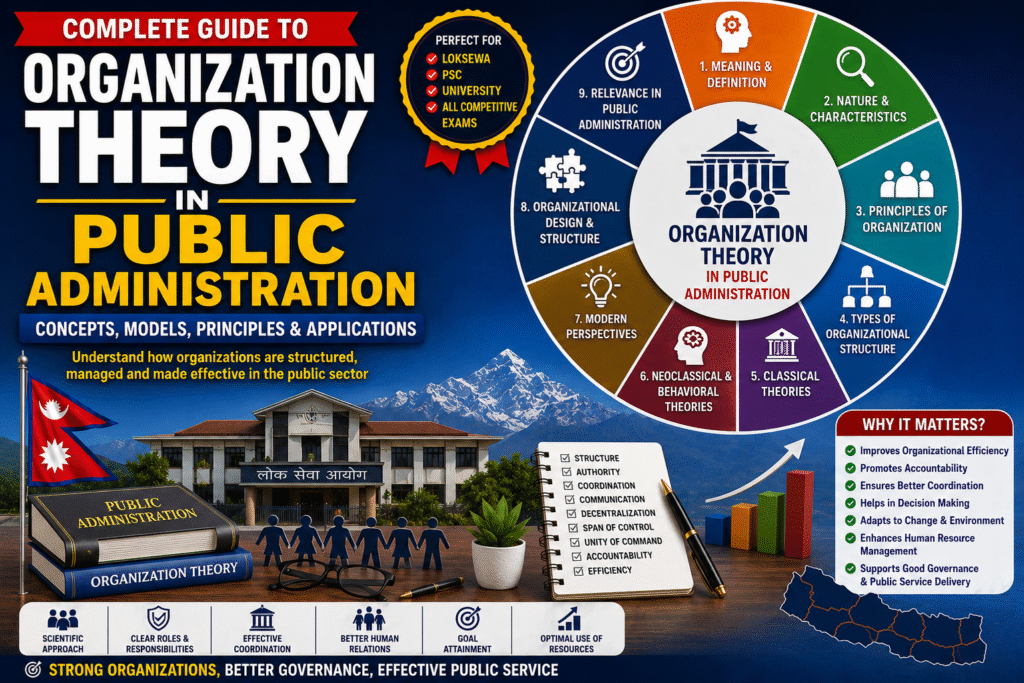
Organization Theory in Public Administration: Meaning, Evolution, Principles, Classical and Modern Theories, Importance, and Relevance in Nepal
The Ultimate Guide for Loksewa, PSC, University Students, and Competitive Examinations
Introduction
No public institution can achieve its objectives without a well-designed organization. Governments formulate policies, enact laws, collect taxes, deliver public services, manage public finances, maintain national security, provide education and healthcare, and implement development programmes through organizations. Whether it is a ministry, constitutional commission, municipality, public corporation, university, or local government office, every administrative function is performed through an organizational structure that defines authority, responsibility, coordination, and accountability.
This reality makes Organization Theory one of the most fundamental concepts in Public Administration. It explains how organizations are created, how authority is distributed, how employees coordinate their work, how decisions are made, how communication flows, how leadership functions, and how institutions adapt to changing political, economic, technological, and social environments. Understanding Organization Theory is therefore essential for designing efficient, accountable, and citizen-oriented public institutions.
In the early development of Public Administration, scholars believed that there was a single “best way” to organize government institutions. Early classical theorists emphasized hierarchy, specialization, formal rules, division of labour, unity of command, and centralized authority. Their objective was to maximize efficiency by creating disciplined administrative systems capable of delivering predictable results.
However, as societies became more complex, scholars realized that organizations are not merely mechanical structures. They are also social systems composed of individuals with different motivations, values, emotions, skills, and expectations. Consequently, Organization Theory gradually expanded to include behavioural approaches, human relations perspectives, systems theory, contingency theory, organizational culture, organizational learning, institutional theory, network governance, and digital-era governance.
Today, Organization Theory is no longer limited to explaining organizational charts or administrative hierarchy. It has become an interdisciplinary field that draws knowledge from public administration, management, sociology, psychology, economics, political science, organizational behaviour, and information technology. Modern public organizations must respond to globalization, digital transformation, artificial intelligence, climate change, fiscal constraints, citizen participation, and rapidly changing public expectations. As a result, organizational flexibility, innovation, collaboration, and evidence-based management have become just as important as traditional administrative discipline.
The importance of Organization Theory has increased significantly in Nepal after the adoption of the Constitution of Nepal, 2015, which established a federal democratic republic. Federalism has transformed Nepal’s administrative landscape by distributing governmental authority among the Federal Government, Provincial Governments, and Local Governments. New ministries, provincial institutions, municipalities, rural municipalities, constitutional bodies, and intergovernmental coordination mechanisms have emerged, making organizational design and coordination more important than ever before.
Modern public organizations in Nepal must now coordinate across multiple levels of government while maintaining transparency, accountability, efficiency, responsiveness, and constitutional compliance. Achieving these objectives requires a sound understanding of organizational principles and administrative theory.
Organization Theory is also closely connected with all the flagship topics previously covered in this Public Administration series.
Public Administration provides the broader administrative framework within which organizations operate. Public Policy determines organizational priorities and resource allocation. Good Governance emphasizes transparency, accountability, participation, and responsiveness in organizational performance. Civil Service supplies the professional workforce that enables organizations to function effectively. Administrative Law establishes the legal authority governing organizational decisions and administrative actions. Human Resource Management develops the employees who drive organizational performance. Public Financial Administration provides the financial resources necessary for organizational operations, while Federalism defines the constitutional distribution of organizational authority across different levels of government.
International organizations such as the United Nations (UN), World Bank, OECD, and Asian Development Bank (ADB) consistently emphasize that strong public institutions are essential for sustainable development, democratic governance, and effective public service delivery. Well-designed organizations improve coordination, reduce duplication, enhance accountability, strengthen policy implementation, and increase public trust in government.
For students preparing for Loksewa, Public Service Commission (PSC), Judicial Service, university examinations, and other competitive examinations, Organization Theory is one of the most important areas of study. Questions frequently cover classical theories, scientific management, bureaucracy, administrative principles, human relations, systems theory, contingency theory, organizational structure, coordination, authority, communication, leadership, organizational behaviour, and public sector reforms.
This comprehensive guide examines every major dimension of Organization Theory, including its meaning, characteristics, objectives, evolution, principles, classical and modern theories, organizational structures, contemporary relevance, Nepalese context, challenges, reforms, and future trends. Written according to international academic standards while remaining examination-oriented and SEO-friendly, this article serves as a complete reference for students, researchers, civil servants, and everyone interested in understanding how public organizations function in modern governance.
Understanding Organization
Before studying Organization Theory, it is essential to understand the concept of an organization.
An organization is a structured group of people who work together in a coordinated manner to achieve common goals and objectives.
Every organization consists of:
- People.
- Defined objectives.
- Division of work.
- Authority and responsibility.
- Coordination mechanisms.
- Communication systems.
- Resources.
- Rules and procedures.
Organizations exist in both the public and private sectors.
Examples include:
- Ministries.
- Constitutional Commissions.
- Provincial Governments.
- Local Governments.
- Public Enterprises.
- Universities.
- Schools.
- Hospitals.
- International Organizations.
- Non-Governmental Organizations (NGOs).
Although their purposes may differ, all organizations require effective planning, coordination, leadership, communication, and management.
Meaning of Organization Theory
Organization Theory is the systematic study of how organizations are designed, structured, managed, coordinated, and improved to achieve their objectives efficiently and effectively.
It explains:
- How organizations are formed.
- How authority is distributed.
- How employees interact.
- How decisions are made.
- How communication flows.
- How organizational performance can be improved.
- How organizations respond to internal and external changes.
Organization Theory combines concepts from management, sociology, psychology, economics, and public administration to understand organizational behaviour and institutional performance.
In simple terms:
Organization Theory is the study of how organizations function, how they are managed, and how they can be designed to achieve public goals efficiently, effectively, and accountably.
Scholarly Definitions
According to Chester I. Barnard:
An organization is a system of consciously coordinated activities of two or more persons.
According to Herbert A. Simon:
Organization Theory seeks to explain how administrative organizations make decisions and coordinate human activities.
According to Dwight Waldo:
Public organizations are instruments through which governments pursue public purposes and implement public policies.
These definitions demonstrate that organizations are not merely formal structures but dynamic systems involving people, authority, communication, and cooperation.
Evolution of Organization Theory
Organization Theory has evolved significantly over the past century in response to changing administrative needs and advances in social science.
Its development can broadly be divided into the following stages:
Classical Organization Theory
Focused on hierarchy, specialization, formal authority, and administrative efficiency.
Major contributors include:
- Frederick W. Taylor.
- Henri Fayol.
- Max Weber.
Neo-Classical Theory
Emphasized human behaviour, informal organizations, employee motivation, and interpersonal relationships.
Major contributors include:
- Elton Mayo.
- Chester Barnard.
- Mary Parker Follett.
Modern Organization Theory
Viewed organizations as open systems interacting with their environment.
Major perspectives include:
- Systems Theory.
- Contingency Theory.
- Organizational Development.
- Organizational Culture.
- Learning Organization.
- Institutional Theory.
Contemporary Organization Theory
Modern organizations increasingly focus on:
- Digital Governance.
- Innovation.
- Artificial Intelligence.
- Citizen-Centred Services.
- Network Governance.
- Collaborative Administration.
- Agile Organizations.
- Data-Driven Decision Making.
These developments have transformed public organizations into more flexible, adaptive, and technology-enabled institutions.
Characteristics of Organization Theory
Organization Theory possesses several distinctive characteristics that explain why it has become one of the core disciplines of Public Administration. These characteristics help administrators understand how organizations operate, adapt, and achieve their objectives in an increasingly complex environment.
Goal-Oriented
Every organization exists to achieve specific objectives.
In public administration, organizations are established to deliver public services, implement government policies, enforce laws, promote development, maintain public order, and protect citizens’ rights.
Without clearly defined objectives, organizations cannot function effectively.
Structured System
Organization Theory views organizations as structured systems in which authority, responsibility, communication, and coordination are arranged systematically.
Each position has defined duties, reporting relationships, and decision-making authority.
A clear organizational structure minimizes confusion and improves accountability.
Human-Centred
Organizations are composed of people rather than merely buildings, rules, or procedures.
Employees bring knowledge, skills, experience, attitudes, values, and creativity that influence organizational performance.
Modern Organization Theory therefore emphasizes employee motivation, leadership, teamwork, organizational culture, and human behaviour alongside formal structures.
Dynamic and Adaptive
Organizations continuously interact with their external environment.
Political changes, technological innovation, globalization, economic crises, climate change, demographic shifts, and changing citizen expectations require organizations to adapt constantly.
Modern organizations must therefore remain flexible and responsive rather than rigid.
Interdisciplinary
Organization Theory integrates knowledge from several academic disciplines, including:
- Public Administration
- Management
- Sociology
- Psychology
- Economics
- Political Science
- Organizational Behaviour
- Information Technology
This interdisciplinary approach provides a comprehensive understanding of organizational performance.
Decision-Oriented
Every organization makes decisions daily.
Organization Theory studies:
- Decision-making processes.
- Authority relationships.
- Information flow.
- Problem-solving techniques.
- Strategic planning.
- Leadership behaviour.
Better decision-making improves organizational effectiveness.
Open System Perspective
Modern organizations are open systems.
They continuously exchange:
- Information.
- Resources.
- Technology.
- Human capital.
- Financial resources.
with their external environment.
Success depends upon effective interaction with stakeholders rather than internal efficiency alone.
Objectives of Organization Theory
Organization Theory seeks to improve both organizational performance and administrative effectiveness.
Its major objectives include:
Improving Organizational Efficiency
Organizations should utilize available resources economically while producing maximum public benefit.
Efficiency minimizes waste and improves service delivery.
Enhancing Coordination
Government organizations contain numerous departments and specialized units.
Organization Theory develops mechanisms that improve coordination among these units.
Effective coordination reduces duplication and administrative conflict.
Clarifying Authority and Responsibility
Each employee should clearly understand:
- Duties.
- Authority.
- Accountability.
- Reporting relationships.
Clearly defined responsibilities improve discipline and performance.
Supporting Effective Decision-Making
Organization Theory helps administrators design systems that facilitate timely, evidence-based, and rational decision-making.
Improving Communication
Effective communication strengthens:
- Coordination.
- Employee motivation.
- Public service delivery.
- Organizational learning.
Poor communication often leads to misunderstanding, delay, and conflict.
Increasing Organizational Flexibility
Modern organizations must adapt rapidly to changing political, technological, economic, and social environments.
Organization Theory encourages institutional learning and innovation.
Promoting Accountability
Clearly defined organizational structures improve accountability by identifying who is responsible for each administrative decision.
Strengthening Public Service Delivery
Ultimately, Organization Theory seeks to improve the quality, accessibility, efficiency, and responsiveness of public services.
Principles of Organization
Effective organizations generally follow several universally accepted principles.
Principle of Division of Work
Work should be divided among employees according to specialization and expertise.
Specialization increases productivity, efficiency, and professional competence.
Principle of Unity of Command
Each employee should receive instructions from only one immediate superior.
Multiple supervisors often create confusion and conflict.
Principle of Unity of Direction
Activities pursuing similar objectives should operate under a common plan and leadership.
This promotes organizational coherence.
Principle of Hierarchy
Authority should flow from higher to lower administrative levels through a clearly defined chain of command.
Hierarchy ensures discipline and accountability.
Principle of Span of Control
Managers should supervise a reasonable number of subordinates.
An excessively large span reduces effective supervision, while an extremely narrow span increases administrative costs.
Principle of Delegation
Senior officials should delegate appropriate authority to subordinate officials while retaining overall responsibility.
Delegation improves efficiency and develops managerial capacity.
Principle of Coordination
Different departments must cooperate to achieve organizational objectives.
Coordination prevents duplication and conflict.
Principle of Flexibility
Organizations should adapt their structures and procedures according to changing circumstances.
Rigid organizations often struggle in dynamic environments.
Principle of Simplicity
Organizational structures should remain as simple as possible while effectively achieving organizational objectives.
Complex structures increase administrative costs and reduce responsiveness.
Essential Elements of Organization
Every organization consists of several fundamental elements.
These include:
Objectives
Organizations exist to achieve predetermined goals.
People
Employees are the most valuable organizational resource.
Without competent personnel, organizational objectives cannot be achieved.
Authority
Authority gives officials the legal power to make decisions and direct organizational activities.
Responsibility
Every position carries specific responsibilities.
Responsibility must correspond with authority.
Communication
Communication enables coordination, information sharing, and decision-making.
Effective communication strengthens organizational performance.
Coordination
Coordination integrates the activities of different units toward common objectives.
Leadership
Leadership motivates employees, resolves conflicts, promotes innovation, and guides organizational change.
Resources
Organizations require:
- Human Resources.
- Financial Resources.
- Physical Resources.
- Information Resources.
- Technological Resources.
Importance of Organization Theory in Public Administration
Organization Theory plays a vital role in improving governance and administrative performance.
Its importance includes:
Improves Administrative Efficiency
Well-designed organizations perform public functions more efficiently.
Strengthens Accountability
Clearly defined authority improves administrative responsibility.
Enhances Service Delivery
Efficient organizational structures improve citizen satisfaction.
Supports Policy Implementation
Public policies require capable organizations for successful implementation.
Encourages Innovation
Modern organizational approaches promote continuous improvement and institutional learning.
Facilitates Good Governance
Organization Theory strengthens:
- Transparency.
- Accountability.
- Participation.
- Responsiveness.
- Rule of Law.
Supports Federal Governance
Federal systems require coordination among multiple governmental organizations.
Organization Theory provides mechanisms for effective institutional cooperation.
Formal and Informal Organizations
Organizations generally contain both formal and informal structures.
Formal Organization
A formal organization is deliberately created through official rules, laws, and administrative procedures.
Characteristics include:
- Official hierarchy.
- Defined authority.
- Written rules.
- Fixed responsibilities.
- Legal recognition.
Examples:
- Ministry of Finance.
- Public Service Commission.
- Nepal Rastra Bank.
- Municipal Office.
Informal Organization
Informal organizations develop naturally through interpersonal relationships among employees.
Characteristics include:
- Personal relationships.
- Informal communication.
- Social interaction.
- Trust.
- Group cooperation.
Although unofficial, informal organizations significantly influence employee morale, communication, and productivity.
Organizational Structure
Organizational structure refers to the formal arrangement of authority, responsibility, communication, and coordination within an organization.
An effective structure answers four important questions:
- Who makes decisions?
- Who reports to whom?
- Who performs which tasks?
- How do departments coordinate?
A well-designed organizational structure improves efficiency, accountability, and service delivery.
Centralization and Decentralization
Centralization
Decision-making authority remains concentrated at higher administrative levels.
Advantages
- Uniform decisions.
- Strong control.
- Better policy consistency.
Limitations
- Slower decisions.
- Reduced flexibility.
- Limited employee participation.
Decentralization
Decision-making authority is delegated to lower organizational levels.
Advantages
- Faster decisions.
- Greater local responsiveness.
- Improved innovation.
- Higher employee motivation.
Limitations
- Possible inconsistency.
- Coordination challenges.
- Greater monitoring requirements.
Nepal’s federal system increasingly emphasizes decentralized administration while maintaining national coordination.
Relationship with Our Previous Flagship Articles
Organization Theory serves as the institutional foundation connecting every article we have already published.
- Public Administration explains what government does, while Organization Theory explains how government institutions are designed to perform those functions.
- Public Policy defines goals, and organizations convert those goals into action.
- Good Governance depends upon well-structured, transparent, accountable, and responsive organizations.
- Civil Service provides the human resources that operate organizations.
- Administrative Law gives organizations their legal authority and procedural framework.
- Human Resource Management develops, motivates, and retains the people working within organizations.
- Public Financial Administration supplies the financial resources required for organizational functioning.
- Federalism in Nepal distributes organizational responsibilities among Federal, Provincial, and Local Governments, making coordination and organizational design even more critical.
Together, these articles create an interconnected knowledge network that reflects how modern public administration actually functions.
Classical Organization Theory
Classical Organization Theory emerged during the late nineteenth and early twentieth centuries when governments and industries sought methods to improve efficiency, discipline, productivity, and administrative control. Classical theorists believed that organizations should be designed scientifically and managed through clearly defined principles, formal structures, specialization, and hierarchy.
Their central objective was to discover the “best way” to organize administrative institutions.
Although modern public administration has evolved considerably, classical theories continue to influence the organizational structure of ministries, constitutional bodies, public corporations, local governments, and civil services throughout the world, including Nepal.
The three most influential contributors to Classical Organization Theory are:
- Frederick Winslow Taylor
- Henri Fayol
- Max Weber
Scientific Management Theory (Frederick W. Taylor)
Frederick Winslow Taylor is widely known as the Father of Scientific Management.
Taylor argued that organizational efficiency could be improved through scientific study rather than traditional trial-and-error methods.
According to Taylor, management should replace guesswork with scientific analysis to determine the most efficient method of performing each task.
Major Principles of Scientific Management
Science, Not Rule of Thumb
Every job should be performed according to scientifically tested methods instead of personal experience or habit.
Scientific Selection and Training
Employees should be selected based on their qualifications and abilities.
After recruitment, they should receive systematic training to improve their performance.
Cooperation Between Management and Workers
Managers and employees should cooperate rather than compete.
Mutual cooperation improves organizational productivity.
Equal Division of Responsibility
Management should focus on planning and supervision, while workers should concentrate on execution.
This promotes specialization and efficiency.
Contributions of Taylor
Taylor’s theory introduced several important management concepts:
- Standardization of work.
- Time and motion studies.
- Performance measurement.
- Scientific training.
- Productivity improvement.
- Efficiency-oriented management.
Many modern administrative systems continue to apply these principles in performance management and organizational improvement.
Criticisms of Taylor’s Theory
Despite its importance, Scientific Management has several limitations.
Critics argue that it:
- Treats employees like machines.
- Gives insufficient attention to human emotions.
- Reduces creativity.
- Encourages excessive supervision.
- Focuses more on efficiency than employee satisfaction.
Modern Human Resource Management attempts to balance efficiency with employee motivation and well-being.
Administrative Management Theory (Henri Fayol)
Henri Fayol is regarded as the Father of Administrative Management Theory.
While Taylor concentrated on individual work performance, Fayol focused on improving the management of the entire organization.
He believed that sound administrative principles could be applied universally across both public and private organizations.
Fayol’s Five Functions of Management
According to Fayol, managers perform five basic functions:
- Planning
- Organizing
- Commanding
- Coordinating
- Controlling
These functions continue to influence modern management education and administrative practice.
Fayol’s Fourteen Principles of Management
Fayol proposed fourteen universal management principles.
Division of Work
Specialization improves efficiency and expertise.
Authority and Responsibility
Managers must possess sufficient authority to perform assigned responsibilities.
Authority should always be accompanied by accountability.
Discipline
Employees should respect organizational rules and procedures.
Discipline promotes organizational stability.
Unity of Command
Each employee should receive orders from only one superior.
Unity of Direction
Activities with similar objectives should follow one common plan.
Subordination of Individual Interest
Organizational objectives should take precedence over individual interests.
Remuneration
Employees should receive fair compensation for their services.
Centralization
The degree of centralization should depend upon organizational circumstances.
Scalar Chain
Authority should flow through a clear chain of command.
Order
Resources and personnel should be placed in their proper positions.
Equity
Managers should treat employees fairly and respectfully.
Stability of Tenure
Employee stability improves organizational performance.
Initiative
Employees should be encouraged to contribute ideas and innovations.
Esprit de Corps
Team spirit and organizational unity strengthen productivity.
Contributions of Fayol
Fayol’s theory remains highly relevant because it:
- Provides universal management principles.
- Strengthens organizational coordination.
- Improves administrative discipline.
- Clarifies managerial responsibilities.
- Supports effective organizational planning.
Many principles continue to guide public administration in Nepal.
Criticisms
Critics argue that Fayol’s principles:
- Are sometimes too general.
- May not suit every organizational context.
- Give limited attention to informal organizations and human behaviour.
Nevertheless, Fayol remains one of the most influential administrative thinkers.
Bureaucratic Theory (Max Weber)
Max Weber developed the Ideal Type Bureaucratic Model, which remains one of the most influential theories in Public Administration.
Weber believed that organizations function most effectively when authority is exercised according to legal rules rather than personal relationships.
His model aimed to create professional, impartial, and predictable administrative institutions.
Characteristics of Weberian Bureaucracy
Clearly Defined Hierarchy
Authority flows from higher to lower administrative levels through an established chain of command.
Division of Labour
Tasks are distributed according to specialization and expertise.
Rule-Based Administration
Administrative decisions are made according to written laws, regulations, and procedures.
Merit-Based Recruitment
Employees are selected according to qualifications rather than political influence or personal connections.
Impersonality
Officials perform duties objectively without personal bias or favoritism.
Career Service
Civil servants build long-term professional careers based on competence and experience.
Written Documentation
Administrative decisions are properly recorded to ensure accountability and continuity.
Importance of Weber’s Theory
Weber’s bureaucratic model provides the foundation for modern civil service systems.
Its contributions include:
- Professional administration.
- Merit-based recruitment.
- Administrative neutrality.
- Legal accountability.
- Institutional stability.
- Predictable decision-making.
Most constitutional democracies—including Nepal—continue to incorporate Weberian principles into their public administration systems.
Limitations of Bureaucracy
Despite its strengths, bureaucracy has been criticized for several reasons.
Common criticisms include:
- Excessive red tape.
- Slow decision-making.
- Overemphasis on rules.
- Limited innovation.
- Resistance to organizational change.
- Reduced flexibility.
Modern public sector reforms therefore seek to preserve the strengths of bureaucracy while increasing innovation, citizen orientation, and efficiency.
Neo-Classical Organization Theory
By the 1930s, scholars recognized that organizations are not simply formal structures governed by rules and hierarchy.
They are also social systems influenced by human behaviour, motivation, communication, leadership, and interpersonal relationships.
This realization gave rise to the Neo-Classical School of Organization Theory.
Unlike Classical Theory, which emphasized structure and efficiency, Neo-Classical Theory emphasized people.
Its central question became:
How can organizations improve performance by understanding human behaviour?
The major contributors include:
- Elton Mayo
- Chester Barnard
- Mary Parker Follett
Human Relations Theory (Elton Mayo)
Elton Mayo became famous through the Hawthorne Studies, conducted at the Western Electric Company in the United States.
The studies demonstrated that employee productivity is strongly influenced by psychological and social factors rather than physical working conditions alone.
Major Contributions
Mayo emphasized:
- Employee motivation.
- Informal organizations.
- Group dynamics.
- Leadership.
- Communication.
- Employee participation.
- Job satisfaction.
His work transformed the understanding of public organizations by recognizing employees as human beings rather than merely economic resources.
Chester Barnard’s Cooperative Systems Theory
Barnard viewed organizations as systems of cooperation among individuals.
According to Barnard, organizations succeed only when employees willingly cooperate to achieve common objectives.
He emphasized:
- Effective communication.
- Leadership.
- Organizational purpose.
- Willingness to cooperate.
- Acceptance of authority.
Barnard’s theory remains highly influential in contemporary organizational leadership.
Mary Parker Follett
Mary Parker Follett introduced several innovative ideas that remain highly relevant today.
She emphasized:
- Participatory management.
- Teamwork.
- Shared leadership.
- Conflict resolution.
- Employee empowerment.
- Collaborative decision-making.
Many principles of modern participatory governance and collaborative leadership reflect Follett’s pioneering work.
Modern Organization Theory
The rapid social, economic, political, and technological changes of the twentieth century demonstrated that organizations cannot be understood solely through formal structures or human relationships. Governments increasingly faced globalization, technological advancement, urbanization, environmental challenges, public expectations, and complex policy problems that required more adaptive and integrated organizational approaches.
As a result, Modern Organization Theory emerged to explain organizations as dynamic, open, and continuously evolving systems. Unlike Classical Theory, which emphasized structure, or Neo-Classical Theory, which emphasized human behaviour, Modern Organization Theory integrates both perspectives while recognizing the influence of the external environment.
Today, modern public organizations are expected to be innovative, flexible, collaborative, technology-driven, and citizen-centred.
Systems Theory
One of the most influential modern approaches is Systems Theory.
Systems Theory views an organization as an open system composed of several interdependent parts working together toward common objectives.
Rather than studying departments individually, Systems Theory examines how every component contributes to overall organizational performance.
Major Components of an Organizational System
Inputs
Resources entering the organization, such as:
- Human resources
- Financial resources
- Technology
- Information
- Laws and policies
- Infrastructure
Transformation Process
The organizational activities that convert inputs into useful outputs.
Examples include:
- Decision-making
- Planning
- Coordination
- Service delivery
- Policy implementation
Outputs
The goods or services produced by the organization.
Examples include:
- Public services
- Government programmes
- Infrastructure
- Administrative decisions
- Development projects
Feedback
Information received regarding organizational performance.
Feedback helps organizations:
- Identify weaknesses.
- Improve decision-making.
- Increase accountability.
- Adapt to changing circumstances.
Environment
Every organization operates within a broader environment consisting of:
- Political factors
- Economic conditions
- Social expectations
- Technological changes
- Legal framework
- International influences
Organizations must continuously adapt to these environmental changes.
Importance of Systems Theory
Systems Theory helps administrators understand that:
- Every department influences other departments.
- Coordination is essential.
- Organizational performance depends upon the interaction of all components.
- External factors significantly affect organizational success.
This perspective is highly relevant in Nepal’s federal administrative system, where coordination among federal, provincial, and local governments is essential.
Contingency Theory
Contingency Theory rejects the idea that there is one universally best organizational structure.
Instead, it argues that the most effective organizational design depends upon the specific situation or contingency.
Different organizations require different management approaches depending upon factors such as:
- Organizational size.
- Technology.
- Leadership style.
- Organizational objectives.
- Political environment.
- Economic conditions.
- Employee characteristics.
- External uncertainty.
This principle is often summarized as:
“There is no one best way to organize.”
Importance of Contingency Theory
Contingency Theory encourages managers to:
- Analyze situations carefully.
- Adapt organizational structures.
- Select appropriate leadership styles.
- Respond flexibly to changing environments.
Modern public administration increasingly follows this adaptive approach.
Institutional Theory
Institutional Theory explains how organizations are influenced not only by efficiency but also by social values, legal norms, traditions, culture, and public expectations.
Public organizations often adopt particular structures because they are considered legitimate and socially acceptable.
Examples include:
- Constitutional bodies.
- Independent audit institutions.
- Civil service commissions.
- Human rights commissions.
Their existence strengthens public confidence even when immediate economic benefits may not be obvious.
Organizational Culture Theory
Organizational Culture refers to the shared values, beliefs, norms, traditions, and behaviours that influence how employees work together.
A positive organizational culture promotes:
- Integrity.
- Innovation.
- Teamwork.
- Professionalism.
- Accountability.
- Citizen-oriented service.
A weak organizational culture may encourage:
- Corruption.
- Conflict.
- Poor communication.
- Low productivity.
- Resistance to change.
Developing a healthy organizational culture has become a major priority in public administration reforms worldwide.
Learning Organization
Peter Senge popularized the concept of the Learning Organization.
A learning organization continuously improves itself by encouraging:
- Knowledge sharing.
- Innovation.
- Continuous learning.
- Employee development.
- Organizational reflection.
- Adaptation.
Learning organizations respond more effectively to changing public needs and technological developments.
Network Governance
Modern governments increasingly work through partnerships rather than acting alone.
Network Governance emphasizes collaboration among:
- Government agencies.
- Private sector organizations.
- Civil society organizations.
- International organizations.
- Community groups.
This collaborative approach improves resource sharing, innovation, and public participation.
Digital Era Governance
Digital transformation has significantly reshaped organizational structures.
Modern public organizations increasingly utilize:
- E-Governance.
- Artificial Intelligence (AI).
- Big Data Analytics.
- Cloud Computing.
- Digital Service Delivery.
- Online Public Procurement.
- Electronic Document Management.
- Integrated Information Systems.
Digital governance improves:
- Efficiency.
- Transparency.
- Accountability.
- Citizen satisfaction.
Nepal has also expanded digital public services through initiatives such as the Nagarik App, online tax services, electronic procurement systems, and digital government platforms.
Organization Theory in the Context of Nepal
Organization Theory has become particularly important after the promulgation of the Constitution of Nepal, 2015, which introduced a federal democratic republic with three levels of government.
The organizational structure of Nepal now includes:
- Federal Government.
- Provincial Governments.
- Local Governments.
Each level has its own:
- Ministries.
- Departments.
- Constitutional responsibilities.
- Administrative systems.
- Financial authority.
- Human resources.
This federal structure requires effective:
- Organizational design.
- Coordination.
- Delegation.
- Communication.
- Financial management.
- Accountability.
Strong organizations are therefore essential for successful federal governance.
Major Challenges of Public Organizations in Nepal
Despite significant reforms, public organizations continue to face several challenges.
Major challenges include:
- Bureaucratic delays.
- Administrative red tape.
- Weak coordination.
- Political interference.
- Limited institutional capacity.
- Resistance to organizational change.
- Insufficient digital transformation.
- Human resource shortages.
- Weak performance management.
- Inefficient service delivery.
- Limited innovation.
- Public trust deficits.
Addressing these challenges requires continuous organizational reform.
Reform Measures
To strengthen public organizations in Nepal, several reforms are necessary.
These include:
- Strengthening merit-based civil service.
- Promoting evidence-based decision-making.
- Expanding digital governance.
- Improving organizational coordination.
- Simplifying administrative procedures.
- Enhancing transparency.
- Strengthening accountability mechanisms.
- Investing in leadership development.
- Encouraging organizational learning.
- Modernizing public service delivery.
- Promoting innovation.
- Improving citizen participation.
Future Trends in Organization Theory
Public organizations are evolving rapidly.
Future developments are expected in areas such as:
- Artificial Intelligence-assisted administration.
- Digital public services.
- Smart government.
- Data-driven governance.
- Agile organizations.
- Hybrid workplaces.
- Collaborative governance.
- Green public administration.
- Citizen-centred service design.
- Organizational resilience.
Future public administrators must therefore combine traditional administrative knowledge with digital, analytical, and leadership competencies.
Relationship with Our Previous Flagship Articles
Organization Theory serves as the structural foundation of the entire Public Administration discipline.
It connects naturally with all our previous pillar articles:
- Public Administration explains the functions of government, while Organization Theory explains how government institutions are structured to perform those functions.
- Public Policy identifies public goals, and organizations transform those goals into practical programmes.
- Good Governance depends on organizations that are transparent, accountable, efficient, and responsive.
- Civil Service in Nepal provides the skilled workforce that enables organizations to function effectively.
- Administrative Law in Nepal establishes the legal framework governing organizational authority and administrative action.
- Human Resource Management in Public Administration develops, motivates, and retains employees who contribute to organizational success.
- Public Financial Administration in Nepal supplies financial resources for organizational operations and service delivery.
- Federalism in Nepal distributes organizational authority across Federal, Provincial, and Local Governments, making effective organizational design and intergovernmental coordination even more important.
Together, these articles build a comprehensive and interconnected knowledge base, strengthening your website’s topical authority in Public Administration.
Frequently Asked Questions (FAQs)
What is Organization Theory?
Organization Theory is the systematic study of how organizations are designed, managed, coordinated, and improved to achieve their objectives efficiently and effectively.
Who is the Father of Scientific Management?
Frederick Winslow Taylor is known as the Father of Scientific Management.
Who proposed the Bureaucratic Theory?
Max Weber proposed the Bureaucratic Theory, emphasizing hierarchy, merit, rules, and legal authority.
What is the main idea of Contingency Theory?
Contingency Theory states that there is no single best way to organize or manage. The appropriate organizational structure depends on the situation.
Why is Organization Theory important in Nepal?
It helps public institutions improve coordination, accountability, efficiency, service delivery, and the effective implementation of Nepal’s federal governance system.
Practice Questions
Short Questions
- Define Organization Theory.
- Explain the characteristics of formal organizations.
- What is the difference between centralization and decentralization?
- State the major principles of Scientific Management.
- Explain Systems Theory.
Long Questions
- Discuss the evolution of Organization Theory from Classical to Contemporary approaches.
- Critically evaluate the contributions of Taylor, Fayol, and Weber.
- Explain the importance of Organization Theory in Public Administration with reference to Nepal.
- Analyze the role of organizational culture in improving public sector performance.
- Examine the challenges and reform measures of public organizations in Nepal.
Conclusion
Organization Theory is one of the foundational pillars of Public Administration because it explains how public institutions are designed, managed, coordinated, and continuously improved to achieve public goals. From the classical emphasis on hierarchy and efficiency to contemporary approaches that focus on innovation, collaboration, organizational learning, and digital governance, the theory has evolved alongside changing societal needs and governance challenges.
For Nepal, the significance of Organization Theory has increased in the federal era. Effective coordination among Federal, Provincial, and Local Governments, coupled with professional civil services, sound financial management, and accountable institutions, depends on well-designed organizations. As digital transformation and citizen expectations continue to reshape governance, public organizations must become more adaptive, transparent, and performance-oriented.
Ultimately, understanding Organization Theory equips administrators, policymakers, students, and civil servants with the knowledge needed to build institutions that deliver quality public services, strengthen democracy, and contribute to sustainable national development.
References
- Constitution of Nepal, 2015
- Chester I. Barnard – The Functions of the Executive
- Herbert A. Simon – Administrative Behavior
- Max Weber – Economy and Society
- Henri Fayol – General and Industrial Management
- Frederick W. Taylor – The Principles of Scientific Management
- Peter Senge – The Fifth Discipline
- UNDP – Public Administration and Governance
- OECD – Public Governance Reviews
- World Bank – Governance and Institutions