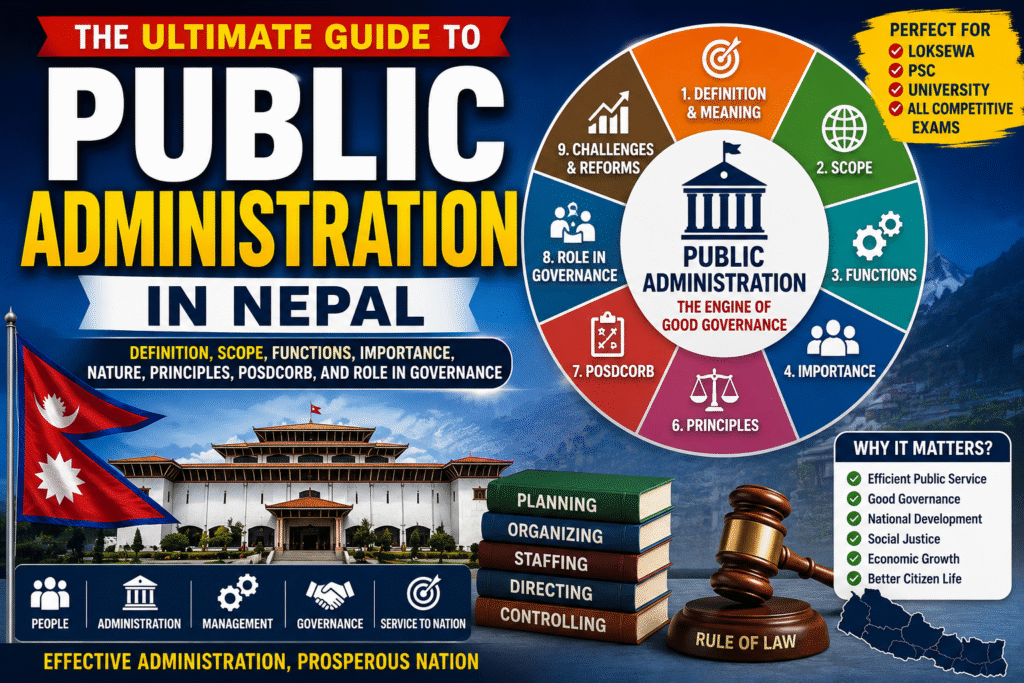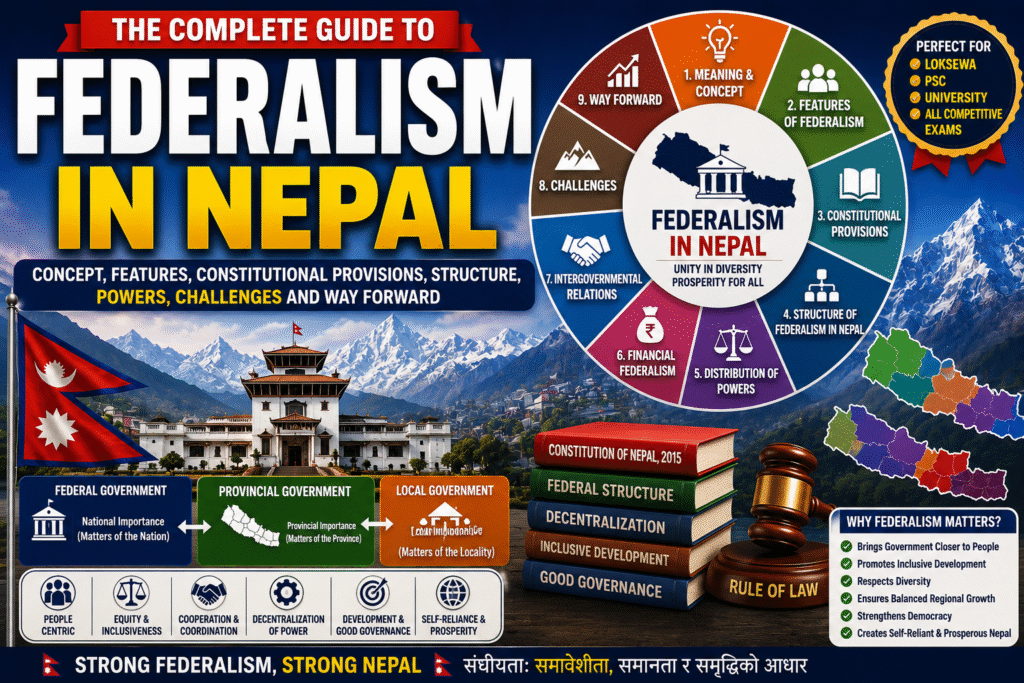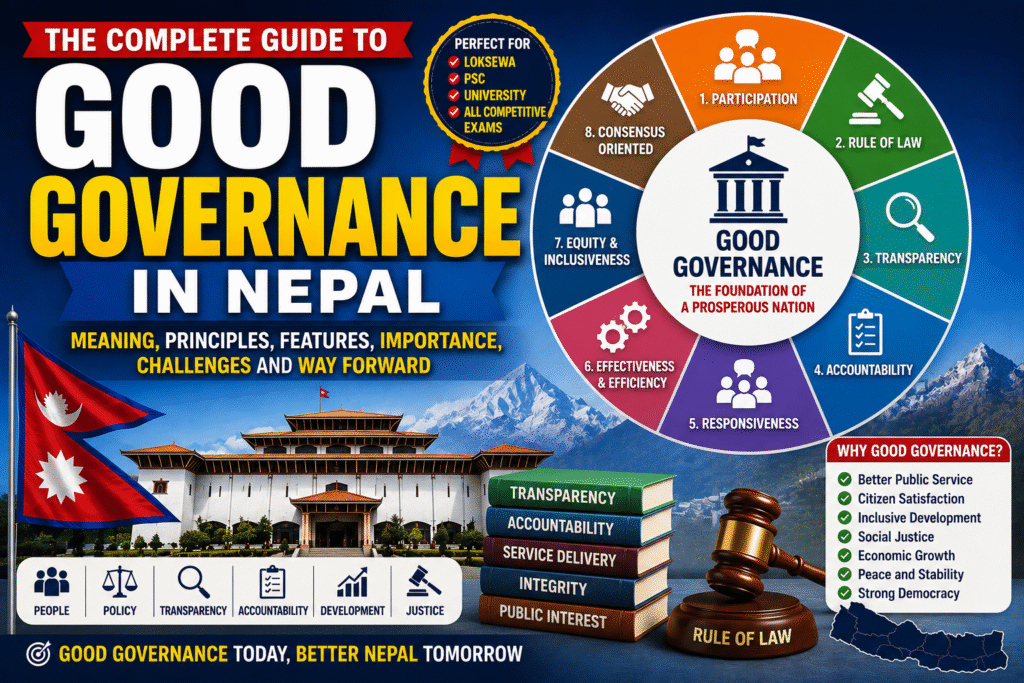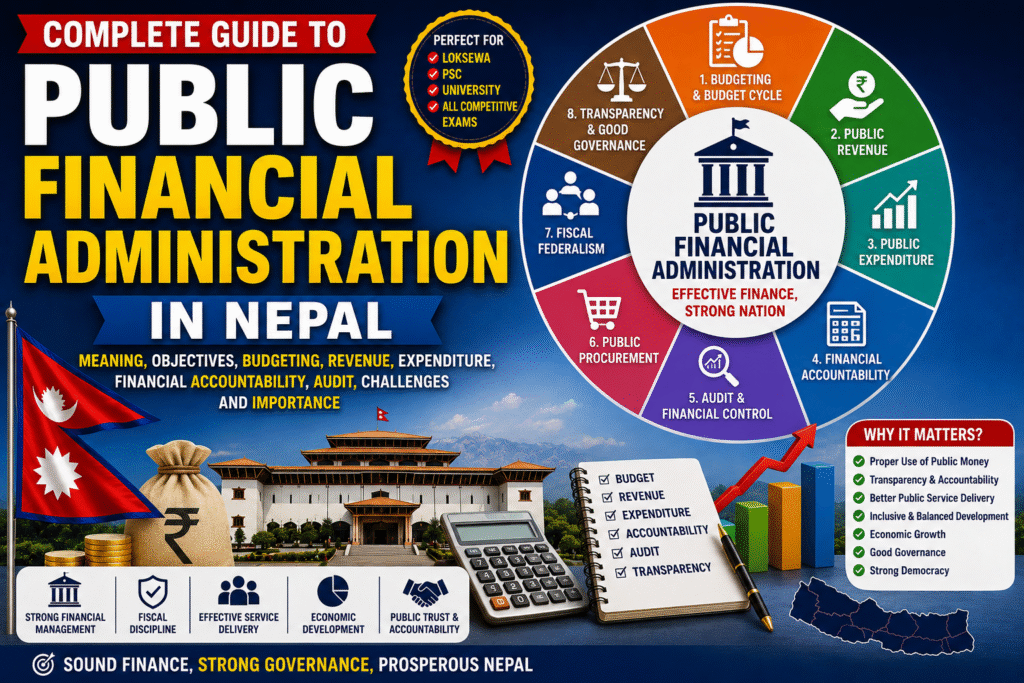
Public Financial Administration in Nepal: Meaning, Objectives, Budgeting, Public Expenditure, Revenue, Financial Accountability, Audit, Challenges, and Importance
The Ultimate Guide for Loksewa, PSC, University Students, and Competitive Examinations
Introduction
Every government requires financial resources to perform its constitutional responsibilities and fulfill the expectations of its citizens. Whether it is constructing roads and bridges, providing quality education and healthcare, maintaining national security, implementing social protection programmes, protecting the environment, or promoting economic development, none of these public functions can be carried out without effective financial management. Consequently, Public Financial Administration (PFA) has become one of the most fundamental pillars of modern Public Administration.
In every democratic state, citizens contribute financial resources to the government primarily through taxes, fees, duties, and other public revenues. These resources are entrusted to public institutions with the expectation that they will be managed responsibly, transparently, efficiently, and in accordance with the law. Public Financial Administration provides the institutional and legal framework through which governments collect revenue, prepare budgets, authorize expenditure, maintain financial records, conduct audits, and ensure accountability for every unit of public money.
Unlike private financial management, which focuses primarily on maximizing profit and shareholder value, Public Financial Administration is guided by the principles of public interest, accountability, transparency, equity, efficiency, economy, legality, and value for money. Every financial decision made by the government directly affects citizens because public resources originate from society and are intended to improve collective welfare rather than generate private profit.
The significance of Public Financial Administration has increased considerably in recent decades due to globalization, digital governance, fiscal decentralization, public sector reforms, and increasing public expectations regarding government accountability. Citizens today demand not only better public services but also greater transparency regarding how public funds are collected, allocated, and utilized. Consequently, governments across the world are strengthening financial management systems, adopting modern budgeting techniques, improving public procurement practices, expanding digital payment systems, and introducing evidence-based financial decision-making.
In Nepal, the importance of Public Financial Administration has grown substantially following the promulgation of the Constitution of Nepal, 2015, which established a federal democratic republican system. Under federalism, financial authority is distributed among the Federal Government, Provincial Governments, and Local Governments. Each level of government now prepares its own budget, mobilizes financial resources, manages public expenditure, and remains accountable for the effective use of public funds within its constitutional jurisdiction.
The Constitution, the Intergovernmental Fiscal Arrangement Act, the Financial Procedures and Fiscal Responsibility Act, the Public Procurement Act, the Local Government Operation Act, and various financial regulations collectively establish the legal framework governing public financial administration in Nepal. Constitutional institutions such as the Office of the Auditor General, the Public Accounts Committee, the Ministry of Finance, the Financial Comptroller General Office (FCGO), and provincial and local financial authorities play crucial roles in maintaining fiscal discipline and financial accountability.
Public Financial Administration is closely connected with all the flagship topics previously covered in this Public Administration series. Public Administration provides the institutional structure within which financial management takes place. Public Policy determines how financial resources are allocated to national priorities. Good Governance requires transparency, accountability, participation, efficiency, and integrity in financial decision-making. Civil Service supplies the professional workforce responsible for implementing financial rules and managing public resources. Administrative Law establishes the legal authority governing public finance, while Human Resource Management ensures that competent financial professionals administer government finances effectively. Federalism distributes fiscal responsibilities among different levels of government and requires strong intergovernmental financial coordination.
International organizations such as the World Bank, International Monetary Fund (IMF), Organisation for Economic Co-operation and Development (OECD), Asian Development Bank (ADB), and the United Nations (UN) consistently recognize sound Public Financial Administration as one of the most important foundations of sustainable development, democratic governance, and economic stability. Countries with effective public financial management systems generally experience stronger institutional capacity, lower levels of corruption, greater investor confidence, improved service delivery, and higher public trust.
For students preparing for Loksewa, Public Service Commission (PSC), Judicial Service, university examinations, and other competitive examinations, Public Financial Administration is one of the most important areas of study. Examination questions frequently focus on concepts such as budgeting, public expenditure, taxation, revenue administration, financial accountability, auditing, public procurement, fiscal federalism, financial control, treasury management, internal control systems, contemporary financial reforms, and Nepal’s constitutional financial framework.
This comprehensive guide examines every major aspect of Public Financial Administration, including its meaning, characteristics, objectives, principles, scope, budgeting process, public revenue, public expenditure, financial accountability, auditing, financial control, constitutional provisions, institutions, challenges, reforms, and future prospects in Nepal. Designed according to international academic standards while remaining examination-oriented and SEO-friendly, this article aims to serve as a complete reference for students, researchers, civil service aspirants, and anyone seeking an in-depth understanding of Public Financial Administration in Nepal.
Understanding Public Finance
Before studying Public Financial Administration, it is important to understand the meaning of Public Finance.
Public Finance refers to the management of government income, expenditure, borrowing, investments, budgeting, and financial policies undertaken to achieve public welfare and national development objectives.
Unlike private finance, which is concerned with the financial activities of individuals or business organizations, public finance focuses on the financial operations of governments.
It includes:
- Collection of public revenue.
- Preparation of government budgets.
- Allocation of financial resources.
- Public expenditure management.
- Borrowing and debt management.
- Financial accountability.
- Audit and financial control.
Public finance forms the economic foundation upon which governments perform their constitutional and administrative responsibilities.
Meaning of Public Financial Administration
Public Financial Administration (PFA) is the systematic process through which governments plan, mobilize, allocate, manage, monitor, and account for public financial resources in order to achieve public objectives efficiently, transparently, and lawfully.
It encompasses every stage of financial management, beginning with revenue collection and continuing through budgeting, expenditure, accounting, reporting, auditing, evaluation, and financial accountability.
In modern governance, Public Financial Administration is no longer limited to bookkeeping or budget preparation. It has evolved into a strategic management system that supports evidence-based policymaking, fiscal sustainability, citizen participation, digital governance, and results-oriented public service delivery.
In simple terms:
Public Financial Administration is the process of managing public money responsibly, transparently, and efficiently so that governments can deliver quality public services and promote sustainable national development.
Scholarly Definitions
According to L.D. White:
Financial Administration is that branch of public administration which deals with the collection, custody, and expenditure of public funds.
According to M.J.K. Thavaraj:
Public Financial Administration consists of all activities relating to the preparation, authorization, execution, and control of government budgets.
These definitions emphasize that Public Financial Administration is not confined to accounting but covers the entire financial management cycle of government.
Evolution of Public Financial Administration
The concept of Public Financial Administration has developed significantly over time.
Traditional Financial Administration
Historically, governments concentrated primarily on collecting taxes, maintaining treasury records, and ensuring legal compliance in public expenditure.
The primary concern was financial control rather than performance or service quality.
Budget-Centred Administration
As governments expanded their developmental responsibilities, budgeting became the central instrument for allocating public resources according to national priorities.
Financial planning gradually became integrated with public policy and economic development.
Public Financial Management (PFM)
Modern governments adopted broader Public Financial Management approaches emphasizing:
- Fiscal discipline.
- Transparency.
- Accountability.
- Performance budgeting.
- Internal control.
- Audit.
- Results-based management.
Digital Financial Governance
Today, governments increasingly use:
- Integrated Financial Management Information Systems (IFMIS).
- Electronic procurement.
- Digital treasury systems.
- Online tax administration.
- Electronic payments.
- Data-driven financial decision-making.
These innovations improve efficiency, reduce corruption, and strengthen public accountability.
Characteristics of Public Financial Administration
Public Financial Administration (PFA) possesses several distinctive characteristics that differentiate it from private financial management. These characteristics reflect its responsibility to safeguard public resources and ensure that government finances are managed in the public interest.
Understanding these characteristics is essential for Loksewa, PSC, Judicial Service, university examinations, and administrative practice, as they explain why financial administration occupies a central position within modern governance.
Public Interest-Oriented
The foremost characteristic of Public Financial Administration is that it serves the public interest rather than private profit.
Government financial decisions are intended to improve the welfare of citizens through investments in education, healthcare, infrastructure, agriculture, social security, environmental protection, disaster management, and national development.
Every financial decision should therefore prioritize collective welfare over individual or organizational gain.
Rule of Law-Based
Public Financial Administration operates strictly within the framework of constitutional and legal provisions.
Revenue collection, budgeting, expenditure, procurement, borrowing, and auditing must comply with applicable laws and regulations.
No public authority may spend public money without proper legal authorization.
This principle protects public resources from misuse and strengthens democratic governance.
Accountability-Oriented
Government institutions remain accountable to citizens for the management of public funds.
Financial accountability requires public officials to explain:
- How public money was collected.
- Where it was allocated.
- How it was utilized.
- Whether expected results were achieved.
Strong accountability promotes public confidence and responsible governance.
Transparency
Modern Public Financial Administration emphasizes openness in financial decision-making.
Citizens should have access to reliable information regarding:
- Government budgets.
- Revenue collection.
- Public expenditure.
- Procurement.
- Audit reports.
- Financial performance.
Transparency reduces corruption and strengthens democratic participation.
Continuous Process
Financial administration is not limited to annual budget preparation.
It is a continuous cycle involving:
- Financial Planning.
- Revenue Mobilization.
- Budget Formulation.
- Budget Approval.
- Budget Execution.
- Accounting.
- Financial Reporting.
- Internal Control.
- Audit.
- Evaluation.
Each stage supports responsible management of public finances.
Strategic in Nature
Modern Public Financial Administration is closely integrated with national planning and development.
Financial decisions influence:
- Economic growth.
- Poverty reduction.
- Infrastructure development.
- Human development.
- Social inclusion.
- Environmental sustainability.
Thus, financial administration has become an important strategic management function.
Results-Oriented
Traditional financial systems mainly emphasized legal compliance.
Modern systems also evaluate:
- Service delivery.
- Programme outcomes.
- Efficiency.
- Effectiveness.
- Value for money.
Governments increasingly focus on achieving measurable public results rather than simply spending allocated budgets.
Technology-Driven
Digital governance has transformed financial administration.
Governments increasingly utilize:
- Electronic Budget Systems.
- Online Tax Administration.
- Electronic Procurement.
- Digital Treasury Management.
- Integrated Financial Management Information Systems (IFMIS).
- Electronic Payment Systems.
- Financial Data Analytics.
Technology improves efficiency, accuracy, transparency, and financial control.
Objectives of Public Financial Administration
Public Financial Administration seeks to ensure that public resources are managed responsibly and contribute effectively to national development.
Its major objectives include:
Mobilizing Public Resources
Governments require adequate financial resources to perform constitutional responsibilities.
Public Financial Administration develops fair and efficient systems for mobilizing revenue through:
- Taxes.
- Customs Duties.
- Fees.
- Service Charges.
- Royalties.
- Public Enterprises.
- Grants.
- Borrowing.
Efficient Allocation of Resources
Financial resources are always limited.
Public Financial Administration seeks to allocate available resources according to national priorities and public needs.
Proper allocation improves social welfare and economic development.
Ensuring Financial Accountability
Every public institution must remain accountable for the management of public funds.
Financial accountability strengthens:
- Transparency.
- Public Trust.
- Democratic Governance.
- Institutional Credibility.
Supporting Public Policy Implementation
Government policies cannot succeed without adequate financial support.
Financial administration ensures that approved policies receive sufficient budgetary resources for implementation.
Promoting Fiscal Discipline
Governments must maintain sustainable financial management.
Fiscal discipline prevents:
- Excessive borrowing.
- Wasteful expenditure.
- Budget deficits.
- Financial instability.
Strengthening Good Governance
Effective financial administration supports:
- Accountability.
- Transparency.
- Participation.
- Rule of Law.
- Efficiency.
- Responsiveness.
Thus, financial administration contributes directly to Good Governance.
Supporting Sustainable Development
Responsible financial management enables governments to invest continuously in:
- Education.
- Health.
- Agriculture.
- Infrastructure.
- Climate Resilience.
- Digital Transformation.
These investments promote long-term national development.
Scope of Public Financial Administration
The scope of Public Financial Administration has expanded considerably over the past century.
Today it includes almost every financial activity performed by government institutions.
Its major areas include:
Financial Planning
Estimating future financial requirements and developing long-term fiscal strategies.
Revenue Administration
Managing government income through:
- Tax Administration.
- Customs Administration.
- Non-Tax Revenue.
- Grants.
- Foreign Assistance.
- Public Borrowing.
Budget Formulation
Preparing annual and medium-term government budgets.
Budget formulation determines how national resources will be allocated among competing priorities.
Budget Execution
Implementing approved budgets through authorized expenditure.
Budget execution converts financial plans into actual public programmes.
Public Expenditure Management
Ensuring that public expenditure remains:
- Efficient.
- Economical.
- Effective.
- Transparent.
- Accountable.
Government Accounting
Recording all financial transactions accurately.
Government accounting supports financial reporting and audit.
Treasury Management
Managing government cash flow, payments, receipts, and financial assets.
Effective treasury management ensures liquidity and financial stability.
Financial Reporting
Preparing financial statements that accurately reflect government financial performance.
Reliable reporting promotes accountability.
Internal Control
Internal control systems help prevent:
- Fraud.
- Corruption.
- Financial Irregularities.
- Wasteful Expenditure.
Strong internal control improves financial governance.
Audit
Independent examination of financial activities to ensure legality, accuracy, efficiency, and accountability.
Audit protects public resources.
Public Procurement
Managing the purchase of goods, works, and services using public funds.
Transparent procurement promotes value for money and reduces corruption.
Debt Management
Managing domestic and foreign borrowing responsibly to maintain long-term fiscal sustainability.
Principles of Public Financial Administration
Modern Public Financial Administration is guided by several fundamental principles.
Economy
Public money should be spent carefully while minimizing unnecessary costs.
Efficiency
Available resources should produce maximum output with minimum waste.
Effectiveness
Government expenditure should achieve intended policy objectives and public benefits.
Accountability
Public officials remain answerable for every financial decision and expenditure.
Transparency
Financial information should remain accessible and understandable to citizens.
Equity
Financial resources should be distributed fairly to promote balanced national development and social justice.
Value for Money
Government expenditure should provide the greatest possible benefit relative to its cost.
This principle combines:
- Economy.
- Efficiency.
- Effectiveness.
Fiscal Responsibility
Governments should maintain sustainable fiscal policies and avoid excessive financial burdens on future generations.
Major Functions of Public Financial Administration
Public Financial Administration performs several essential governmental functions.
These include:
- Revenue Mobilization.
- Budget Preparation.
- Budget Authorization.
- Budget Execution.
- Accounting.
- Treasury Management.
- Public Procurement.
- Financial Reporting.
- Internal Financial Control.
- Audit.
- Performance Evaluation.
- Financial Accountability.
Together, these functions ensure responsible management of public finances throughout the financial cycle.
Relationship with Our Previous Flagship Articles
Public Financial Administration does not operate independently. It is closely interconnected with every major field of Public Administration.
Public Administration
Public Administration provides the institutional framework through which financial decisions are implemented.
Public Policy
Public Policy determines national priorities, while Public Financial Administration provides the financial resources necessary to implement those priorities.
Good Governance
Financial transparency, accountability, participation, and integrity are essential components of Good Governance.
Civil Service
Professional civil servants manage budgeting, accounting, treasury operations, procurement, revenue administration, and financial reporting.
Administrative Law
Administrative Law establishes the legal authority governing revenue collection, public expenditure, procurement, financial accountability, and audit procedures.
Human Resource Management
Competent accountants, auditors, financial officers, economists, procurement specialists, and treasury officials are developed and managed through effective Human Resource Management.
Federalism
Federalism distributes financial authority among Federal, Provincial, and Local Governments.
Public Financial Administration ensures that this distribution operates efficiently through sound fiscal coordination, equitable resource allocation, and financial accountability across all three levels of government.
Exam Tip
When writing analytical answers, explain Public Financial Administration as the financial backbone of Public Administration. Public Administration cannot implement policies, deliver services, maintain infrastructure, or achieve development goals without effective financial planning, budgeting, expenditure management, accounting, audit, and accountability. Demonstrating these connections with our earlier flagship topics shows integrated understanding and is highly rewarded in Loksewa, PSC, university, and judicial service examinations.
Public Budget
At the heart of Public Financial Administration lies the Public Budget, which serves as the government’s most important financial and policy document. Every major government programme, development project, public service, and administrative activity depends upon the budget because it determines how public resources will be collected, allocated, and utilized during a fiscal year.
A budget is much more than a statement of income and expenditure. It reflects the government’s development priorities, economic strategy, social commitments, and governance philosophy. Through the budget, the government translates public policies into practical programmes and allocates financial resources to ministries, departments, constitutional bodies, provinces, and local governments.
For this reason, the budget is often described as the financial expression of government policy.
Meaning of Public Budget
A Public Budget is the government’s annual financial plan that estimates expected revenues and authorizes public expenditures for a specified fiscal year.
It provides detailed information regarding:
- Expected government income.
- Planned government expenditure.
- Sources of financing.
- Budget priorities.
- Development programmes.
- Fiscal policies.
The budget enables the government to utilize limited public resources in an organized, transparent, and accountable manner.
Objectives of the Public Budget
The preparation of a public budget serves several important objectives.
These include:
- Allocating resources efficiently.
- Promoting economic development.
- Reducing poverty and inequality.
- Maintaining fiscal discipline.
- Supporting implementation of public policies.
- Improving public service delivery.
- Strengthening accountability.
- Promoting balanced regional development.
- Encouraging sustainable economic growth.
Importance of the Public Budget
The public budget performs multiple roles in modern governance.
Financial Planning
It estimates future revenue and expenditure, allowing governments to prepare for upcoming financial obligations.
Policy Implementation
Government policies remain theoretical unless adequate financial resources are allocated through the budget.
The budget therefore transforms policy into action.
Resource Allocation
Financial resources are limited.
The budget determines how available resources should be distributed among competing sectors such as:
- Education.
- Health.
- Agriculture.
- Infrastructure.
- Defence.
- Social Protection.
- Environment.
Financial Control
The budget establishes spending limits for government institutions.
No public authority should exceed the approved allocation without legal authorization.
Public Accountability
Citizens can evaluate government priorities and financial performance by examining the approved budget and subsequent expenditure reports.
Principles of Budgeting
An effective public budget should follow several internationally accepted principles.
Principle of Annuality
A budget is generally prepared for one fiscal year.
This allows regular legislative review and accountability.
Principle of Unity
All government revenues and expenditures should be presented within a single comprehensive budget document.
This provides a complete picture of government finances.
Principle of Universality
All revenues and expenditures should be included without omission.
Hidden financial transactions reduce transparency.
Principle of Accuracy
Revenue estimates and expenditure projections should be realistic and based on reliable information.
Principle of Transparency
Budget information should be publicly available and understandable.
Transparency strengthens democratic accountability.
Principle of Accountability
Public officials responsible for managing public funds must remain answerable for their financial decisions.
Principle of Economy, Efficiency and Effectiveness
Government expenditure should:
- Minimize unnecessary costs.
- Maximize outputs.
- Achieve intended policy objectives.
These three principles collectively promote Value for Money.
Budget Cycle
Public budgeting follows a continuous cycle rather than a single event.
Although the exact procedures differ among countries, the budget cycle generally consists of the following stages.
1. Budget Formulation
Government ministries estimate financial requirements and submit budget proposals.
The Ministry of Finance reviews these proposals and prepares the national budget.
Budget formulation considers:
- Government priorities.
- Available revenue.
- Development plans.
- Economic conditions.
- Fiscal sustainability.
2. Budget Approval
The proposed budget is presented to the Legislature.
After discussion, amendment where necessary, and legislative approval, the budget receives legal authority.
Without legislative approval, public expenditure cannot normally proceed.
3. Budget Execution
Following approval, ministries and government agencies implement programmes according to the authorized budget.
Budget execution includes:
- Releasing funds.
- Procurement.
- Programme implementation.
- Financial management.
- Monitoring expenditure.
4. Accounting and Financial Reporting
All financial transactions must be accurately recorded.
Government accounting provides information regarding:
- Revenue collected.
- Expenditure incurred.
- Financial position.
- Budget utilization.
Reliable accounting supports effective financial control.
5. Audit and Evaluation
Independent audit institutions examine financial activities to determine whether public resources have been used legally, efficiently, and effectively.
Audit findings improve accountability and support future financial reforms.
Types of Budget
Modern governments utilize several budget systems depending upon administrative objectives.
Line-Item Budget
Expenditure is classified according to objects such as:
- Salaries.
- Office Expenses.
- Equipment.
- Travel.
- Construction.
This is the traditional budgeting system.
Performance Budget
Resources are allocated according to expected outputs and measurable performance indicators.
This system emphasizes efficiency and results.
Programme Budget
Expenditure is organized according to programmes rather than administrative departments.
Examples include:
- Education Programme.
- Health Programme.
- Agricultural Development Programme.
Zero-Based Budgeting (ZBB)
Every expenditure proposal must be fully justified each fiscal year.
Previous allocations do not automatically continue.
This approach encourages careful evaluation of spending priorities.
Medium-Term Expenditure Framework (MTEF)
Budget planning extends beyond a single fiscal year.
Governments prepare medium-term financial projections to improve fiscal stability and development planning.
Nepal has increasingly adopted this approach for strategic financial planning.
Public Revenue
Public Revenue refers to the income received by government from various sources to finance public expenditure.
Without adequate revenue, governments cannot perform constitutional and developmental responsibilities.
Major Sources of Public Revenue
Government revenue generally originates from:
Tax Revenue
The largest source of public income.
Examples include:
- Income Tax.
- Value Added Tax (VAT).
- Customs Duty.
- Excise Duty.
- Property Tax.
- Vehicle Tax.
Non-Tax Revenue
Income received through:
- Government Fees.
- Service Charges.
- Royalties.
- Fines.
- Dividends from Public Enterprises.
- Administrative Charges.
Grants
Financial assistance received from:
- Development Partners.
- International Organizations.
- Foreign Governments.
Public Borrowing
Governments may borrow funds domestically or internationally to finance development activities or manage fiscal deficits.
Responsible borrowing remains essential for long-term fiscal sustainability.
Public Expenditure
Public Expenditure refers to government spending undertaken to provide public goods, public services, and national development.
Effective expenditure management ensures that public money generates maximum public benefit.
Major Categories of Public Expenditure
Government expenditure generally includes:
- Administrative Expenditure.
- Development Expenditure.
- Capital Expenditure.
- Recurrent Expenditure.
- Social Protection.
- Education.
- Health.
- Infrastructure.
- Defence.
- Environmental Protection.
Balanced expenditure promotes sustainable development.
Government Accounting
Government Accounting is the systematic process of recording, classifying, summarizing, and reporting financial transactions of government institutions.
Government accounting supports:
- Budget control.
- Financial reporting.
- Audit.
- Accountability.
- Policy evaluation.
Reliable accounting strengthens financial transparency.
Treasury Management
Treasury Management refers to the administration of government cash resources.
It ensures that sufficient funds remain available to meet authorized expenditures while maintaining financial stability.
Treasury management includes:
- Cash Management.
- Payment Processing.
- Revenue Collection.
- Debt Servicing.
- Liquidity Management.
Modern treasury systems increasingly utilize digital financial technologies.
Internal Financial Control
Internal Financial Control consists of policies, procedures, and institutional mechanisms designed to safeguard public resources.
Its primary objectives include:
- Preventing fraud.
- Detecting financial irregularities.
- Promoting legal compliance.
- Improving operational efficiency.
- Protecting government assets.
- Ensuring reliable financial reporting.
Strong internal controls reduce corruption and improve public confidence.
Major Financial Institutions in Nepal
Several institutions play important roles in Nepal’s Public Financial Administration.
Ministry of Finance (MoF)
Responsible for national fiscal policy, budgeting, resource mobilization, financial planning, and economic management.
Financial Comptroller General Office (FCGO)
Responsible for government accounting, treasury management, financial reporting, and budget execution.
Office of the Auditor General (OAG)
An independent constitutional body responsible for auditing government revenues, expenditures, assets, liabilities, and financial management systems.
The OAG strengthens financial accountability by reporting audit findings to Parliament.
Public Accounts Committee (PAC)
A parliamentary committee that examines audit reports and holds government institutions accountable for financial irregularities.
National Planning Commission (NPC)
Coordinates national development priorities with public investment and medium-term expenditure planning.
Nepal Rastra Bank (NRB)
Acts as the central bank and supports public financial stability through monetary policy, banking regulation, and financial sector oversight.
Exam Tip
For analytical answers, remember the logical financial cycle:
Revenue Mobilization → Budget Formulation → Legislative Approval → Budget Execution → Government Accounting → Treasury Management → Internal Financial Control → Audit → Parliamentary Oversight → Financial Accountability → Improved Public Service Delivery.
Presenting Public Financial Administration as a complete financial cycle demonstrates higher-level conceptual understanding and is highly valued in Loksewa, PSC, university, and judicial service examinations.
Financial Accountability
Financial accountability is one of the most fundamental principles of Public Financial Administration. Since public money belongs to the citizens, every government institution and public official has a legal, ethical, and constitutional responsibility to ensure that public resources are collected, managed, and utilized honestly, efficiently, and for their intended purposes.
Financial accountability means that public officials must be able to explain and justify every financial decision they make. It requires openness, responsibility, proper documentation, legal compliance, and continuous oversight.
In democratic governance, financial accountability is not merely a financial requirement—it is an essential element of Good Governance, the Rule of Law, and public trust.
Objectives of Financial Accountability
Financial accountability seeks to:
- Protect public resources from misuse.
- Promote transparency in financial management.
- Prevent corruption and financial irregularities.
- Improve public confidence in government institutions.
- Ensure compliance with financial laws.
- Strengthen parliamentary oversight.
- Improve the efficiency and effectiveness of public expenditure.
- Promote responsible fiscal management.
Mechanisms of Financial Accountability in Nepal
Nepal has established several constitutional and legal mechanisms to ensure financial accountability.
These include:
Parliamentary Oversight
The Federal Parliament examines government financial performance through various committees, particularly the Public Accounts Committee (PAC).
Office of the Auditor General (OAG)
The Office of the Auditor General independently audits government institutions and submits annual reports to the President, which are later discussed in Parliament.
Internal Audit
Government agencies conduct internal audits to identify weaknesses before external audits occur.
Financial Reporting
Government institutions prepare financial reports according to established accounting standards.
Public Procurement System
Transparent procurement procedures help reduce corruption and ensure value for public money.
Right to Information
Citizens have the right to obtain information regarding government expenditure under Nepal’s legal framework.
Audit in Public Financial Administration
Audit is one of the strongest instruments of financial accountability.
It is an independent, objective, and systematic examination of government financial activities to determine whether public resources have been managed according to applicable laws, regulations, and accepted financial principles.
Audit strengthens transparency, improves financial discipline, and promotes public confidence.
Objectives of Audit
The major objectives of audit include:
- Verifying financial accuracy.
- Detecting fraud and corruption.
- Promoting legal compliance.
- Improving financial management.
- Strengthening accountability.
- Ensuring value for money.
- Recommending institutional improvements.
Types of Audit
Financial Audit
Examines whether financial statements accurately represent government financial activities.
Compliance Audit
Determines whether financial activities comply with constitutional provisions, laws, regulations, and administrative procedures.
Performance Audit
Evaluates whether government programmes have achieved economy, efficiency, and effectiveness.
Performance audit is increasingly important in modern public administration because it focuses on results rather than merely financial accuracy.
Internal Audit
Conducted within government organizations to improve internal financial control.
External Audit
Conducted independently by the Office of the Auditor General.
External audit enhances institutional credibility and parliamentary accountability.
Public Procurement
A significant portion of government expenditure is spent on purchasing goods, works, and consulting services.
This process is known as Public Procurement.
Public procurement involves acquiring public goods and services through transparent, competitive, economical, and accountable procedures.
Since procurement accounts for a substantial share of public expenditure, it is often one of the highest-risk areas for corruption and financial irregularities.
Therefore, effective procurement management is essential for good governance.
Principles of Public Procurement
Public procurement should follow these principles:
- Transparency.
- Fair Competition.
- Equal Opportunity.
- Value for Money.
- Accountability.
- Integrity.
- Economy.
- Efficiency.
Nepal’s Public Procurement Act and Public Procurement Regulations provide the legal framework governing procurement activities.
Fiscal Federalism in Nepal
The introduction of federalism has significantly transformed Nepal’s public financial administration.
Fiscal Federalism refers to the distribution of financial powers, expenditure responsibilities, and revenue sources among different levels of government.
The Constitution of Nepal allocates financial authority to:
- Federal Government.
- Provincial Governments.
- Local Governments.
Each level prepares its own budget, manages public expenditure, mobilizes certain revenue sources, and remains accountable for financial management within its constitutional jurisdiction.
Effective fiscal federalism requires:
- Clear constitutional responsibilities.
- Equitable revenue sharing.
- Fiscal transfers.
- Strong financial accountability.
- Intergovernmental coordination.
Major Challenges of Public Financial Administration in Nepal
Although Nepal has made significant progress in financial governance, several challenges remain.
Major challenges include:
- Delays in budget implementation.
- Low capital expenditure.
- Weak project management.
- Procurement delays.
- Financial irregularities.
- Corruption.
- Limited institutional capacity.
- Weak internal control systems.
- Inadequate coordination among governments.
- Dependence on foreign assistance.
- Increasing public debt.
- Limited digital financial integration.
- Shortage of skilled financial professionals.
Addressing these challenges is essential for improving governance and sustainable development.
Reform Measures
Nepal can strengthen Public Financial Administration through the following reforms:
- Modernizing public financial management systems.
- Expanding digital budgeting and accounting.
- Strengthening performance-based budgeting.
- Improving procurement transparency.
- Enhancing internal financial control.
- Building institutional capacity.
- Promoting merit-based financial administration.
- Strengthening parliamentary oversight.
- Increasing citizen participation in budgeting.
- Expanding open government financial data.
- Adopting international public sector accounting standards where appropriate.
These reforms will improve fiscal discipline, transparency, efficiency, and public trust.
International Best Practices
Many countries have successfully modernized their public financial administration systems.
Examples include:
- New Zealand: Results-based budgeting and transparent fiscal management.
- Singapore: Digital public financial management and strong anti-corruption systems.
- Canada: Medium-term fiscal planning and performance reporting.
- South Korea: Electronic procurement (KONEPS) and digital financial governance.
- United Kingdom: Parliamentary financial oversight and independent audit institutions.
Nepal can adapt these practices while considering its constitutional framework, federal structure, and development priorities.
Relationship with Previous Flagship Articles
This article naturally connects with every flagship article in our Public Administration category:
- Public Administration provides the institutional framework for financial management.
- Public Policy determines where financial resources are allocated.
- Good Governance requires transparency, accountability, participation, and integrity in financial decisions.
- Civil Service supplies the financial administrators responsible for budget execution.
- Administrative Law provides the legal framework governing public finance.
- Human Resource Management develops competent financial professionals.
- Federalism determines fiscal responsibilities among Federal, Provincial, and Local Governments.
Together, these topics create a comprehensive understanding of Nepal’s public administration system.
Quick Revision Table
| Topic | Key Point |
|---|---|
| Meaning | Management of public money |
| Main Objective | Efficient, transparent and accountable financial management |
| Revenue | Taxes, non-tax revenue, grants, borrowing |
| Budget | Annual financial plan of the government |
| Expenditure | Public spending for development and services |
| Audit | Financial, Compliance, Performance, Internal and External |
| Major Institution | Ministry of Finance |
| Constitutional Audit Body | Office of the Auditor General |
| Parliamentary Oversight | Public Accounts Committee |
| Core Principle | Value for Money (Economy + Efficiency + Effectiveness) |
Frequently Asked Questions (FAQs)
What is Public Financial Administration?
Public Financial Administration is the process of planning, collecting, allocating, managing, controlling, and auditing public financial resources to achieve government objectives efficiently and transparently.
Why is budgeting important?
A budget allocates financial resources according to government priorities and authorizes public expenditure.
What is financial accountability?
Financial accountability means that public officials are answerable for how public money is collected, managed, and spent.
What is the role of the Office of the Auditor General?
The Office of the Auditor General independently audits government financial activities and reports its findings to Parliament.
What is Fiscal Federalism?
Fiscal Federalism refers to the distribution of financial powers and responsibilities among different levels of government.
Practice Questions
Short Questions
- Define Public Financial Administration.
- Explain the objectives of public budgeting.
- What is financial accountability?
- Differentiate between financial audit and performance audit.
- Explain Fiscal Federalism.
Long Questions
- Explain the meaning, characteristics, objectives, and scope of Public Financial Administration.
- Discuss the complete budget cycle.
- Analyze the importance of financial accountability in Nepal.
- Explain the role of the Office of the Auditor General in strengthening Good Governance.
- Evaluate the major challenges of Public Financial Administration in Nepal and suggest suitable reforms.
Conclusion
Public Financial Administration is the financial backbone of modern Public Administration. It transforms public policies into practical development programmes by ensuring that financial resources are mobilized, allocated, utilized, monitored, and audited responsibly. Every public service—from education and healthcare to infrastructure, social protection, and environmental conservation—depends upon effective financial administration.
In Nepal, Public Financial Administration has become increasingly important after the adoption of the federal democratic system. The distribution of financial powers among Federal, Provincial, and Local Governments has created new opportunities for decentralized development while also demanding stronger coordination, accountability, and fiscal discipline. Institutions such as the Ministry of Finance, Financial Comptroller General Office, Office of the Auditor General, Public Accounts Committee, Nepal Rastra Bank, and local financial authorities collectively contribute to maintaining financial integrity and public trust.
Modern Public Financial Administration goes far beyond traditional accounting. It integrates strategic budgeting, performance management, digital governance, public procurement, financial reporting, internal control, audit, and evidence-based decision-making. International experience demonstrates that countries with sound financial administration enjoy stronger institutions, better public services, lower corruption, and higher levels of sustainable development.
Although Nepal continues to face challenges such as procurement delays, weak capital expenditure, capacity constraints, and financial irregularities, ongoing reforms in digital financial management, performance budgeting, transparency, and institutional strengthening provide a positive path forward. By embracing innovation, strengthening accountability, and investing in capable public institutions, Nepal can build a more efficient, transparent, and citizen-centred financial administration system.
Ultimately, Public Financial Administration is not merely about managing government funds—it is about ensuring that every rupee collected from citizens is used lawfully, efficiently, and effectively to improve people’s lives and advance national development.
References
- Constitution of Nepal, 2015
- Financial Procedures and Fiscal Responsibility Act, Nepal
- Intergovernmental Fiscal Arrangement Act, Nepal
- Public Procurement Act, Nepal
- Local Government Operation Act, 2074
- Office of the Auditor General, Nepal
- Ministry of Finance, Nepal
- Financial Comptroller General Office (FCGO)
- OECD – Public Financial Management
- IMF – Fiscal Transparency Code
- World Bank – Public Financial Management
- Asian Development Bank (ADB)