Public Policy in Nepal: Meaning, Process, Types, Models, Policy Cycle, Challenges, and Importance
The Ultimate Guide for Loksewa, PSC, University Students, and Competitive Examinations
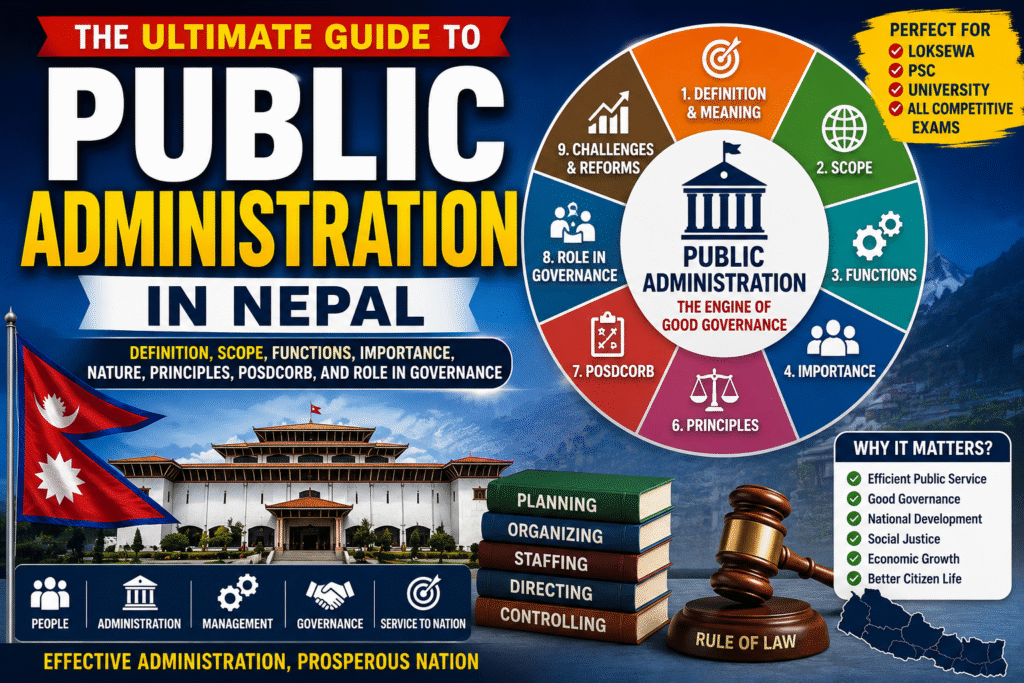
Introduction
Every government makes thousands of decisions every year. Some decisions concern education, healthcare, employment, taxation, agriculture, infrastructure, environmental protection, foreign affairs, and social welfare. However, governments cannot make these decisions randomly or without direction. They require a systematic framework that identifies public problems, establishes priorities, allocates resources, and guides governmental action. This systematic framework is known as Public Policy.
Public policy is one of the most important concepts in Public Administration because it serves as the bridge between government intentions and practical action. It determines what governments choose to do, how they do it, why they do it, and for whom they do it. Every successful development programme, legal reform, economic strategy, social protection initiative, or environmental regulation begins with a carefully designed public policy.
In modern democratic states, public policy is not merely a political decision. It is a comprehensive process involving problem identification, research, consultation, policy formulation, implementation, monitoring, evaluation, and continuous improvement. Effective public policies require collaboration among elected representatives, civil servants, constitutional bodies, experts, civil society organizations, the private sector, development partners, and citizens themselves.
In Nepal, the importance of public policy has increased significantly after the promulgation of the Constitution of Nepal, 2015, which established a federal democratic republican system. The Constitution has distributed powers among the Federal, Provincial, and Local Governments, requiring each level to formulate and implement policies within its constitutional jurisdiction. Consequently, policy coordination, evidence-based decision-making, intergovernmental cooperation, and citizen participation have become more important than ever before.
Public policy directly influences almost every aspect of citizens’ lives. Policies determine how schools operate, how hospitals provide services, how taxes are collected, how roads are constructed, how natural resources are managed, how social security programmes are delivered, and how economic growth is promoted. Therefore, the quality of public policy significantly affects governance, development, and public welfare.
For students preparing for Loksewa, Public Service Commission examinations, universities, and other competitive examinations, public policy is a core subject within Public Administration. It is closely connected with governance, democracy, constitutional law, public finance, civil service, development administration, and good governance. Questions on public policy frequently appear in objective examinations, descriptive papers, interviews, and academic research.
This comprehensive guide explains the meaning, characteristics, objectives, importance, policy-making process, policy cycle, policy models, types of public policy, institutional frameAAwork in Nepal, implementation challenges, policy evaluation, administrative reforms, and future prospects. It is designed to provide readers with both conceptual understanding and practical knowledge relevant to Nepal’s governance system.
Understanding Policy Before Public Policy
Before examining the concept of public policy, it is important to understand what the term policy itself means.
A policy is a deliberate course of action adopted to achieve specific objectives. It provides guidance for decision-making by establishing principles, priorities, and procedures that direct future actions.
Policies exist in many different settings.
For example:
- A school may adopt an admission policy.
- A company may establish a human resource policy.
- A hospital may implement a patient safety policy.
- A university may formulate an examination policy.
In each case, the policy provides direction and consistency in decision-making.
When such policies are formulated and implemented by governments to address public issues and promote public welfare, they become Public Policies.
Therefore, public policy differs from private organizational policy because its primary objective is to serve the interests of society as a whole rather than a particular institution.
Meaning of Public Policy
Public policy refers to the deliberate decisions, actions, laws, programmes, and strategies adopted by the government to solve public problems, achieve national objectives, and promote the welfare of citizens.
It is not limited to written documents or official announcements. Public policy also includes governmental actions, administrative decisions, regulations, and implementation mechanisms that influence society.
Public policy provides a roadmap for governmental action by defining priorities, allocating resources, establishing institutional responsibilities, and determining expected outcomes.
In simple terms, public policy answers four fundamental questions:
- What problem should the government address?
- Why should it be addressed?
- How should it be addressed?
- Who will implement the solution?
Thus, public policy serves as the foundation of modern governance and public administration.
Scholarly Definitions of Public Policy
Several renowned scholars have defined public policy from different perspectives.
According to Thomas R. Dye, public policy is:
“Whatever governments choose to do or not to do.”
This widely cited definition emphasizes that government inaction can also be considered a policy decision.
Similarly, James E. Anderson defines public policy as a purposive course of action followed by governmental actors in dealing with a public problem.
Despite differences in wording, most definitions highlight four common elements:
- Government action.
- Public interest.
- Goal-oriented decision-making.
- Problem-solving.
These common characteristics distinguish public policy from ordinary administrative decisions or private organizational policies.
Why Public Policy Matters
Public policy is essential because governments face limited resources but unlimited public needs.
Without clear public policies:
- Government programmes become inconsistent.
- Resources may be wasted.
- Development priorities become unclear.
- Public services lose effectiveness.
- Citizens lose confidence in government.
Effective public policy ensures that government actions remain coordinated, transparent, accountable, and focused on achieving measurable public outcomes.
For this reason, public policy is often regarded as the heart of public administration and the foundation of good governance.
Characteristics of Public Policy
Public policy possesses several distinctive characteristics that differentiate it from ordinary administrative decisions or private organizational policies. These characteristics explain why public policy is regarded as one of the central pillars of public administration and democratic governance.
Understanding these characteristics is particularly important for Loksewa and university examinations because they frequently appear in both objective and descriptive questions.
Goal-Oriented
Every public policy is designed to achieve one or more clearly defined public objectives.
Governments formulate policies not merely to respond to immediate situations but to solve public problems, promote national development, improve public welfare, and achieve long-term social, economic, and political goals.
For example:
- Education Policy aims to improve the quality and accessibility of education.
- Health Policy seeks to enhance public health services.
- Agricultural Policy focuses on increasing agricultural productivity and farmers’ welfare.
Thus, every public policy is purpose-driven rather than random.
Government-Centered
Public policy is formulated and implemented by government institutions or under governmental authority.
Although experts, civil society organizations, international agencies, and citizens may contribute to policy discussions, the ultimate responsibility for adopting and implementing public policy rests with the government.
This distinguishes public policy from private sector policies or organizational rules.
Public Interest Oriented
The primary purpose of public policy is to promote the welfare of society rather than the interests of a particular individual or organization.
Public policies aim to:
- Improve citizens’ quality of life.
- Protect public rights.
- Promote social justice.
- Support economic development.
- Ensure environmental sustainability.
- Maintain national security.
Therefore, public interest remains the guiding principle of public policy.
Dynamic and Flexible
Societies continuously evolve due to technological innovation, demographic changes, globalization, economic transformation, environmental challenges, and political developments.
Consequently, public policies must also adapt to changing circumstances.
Governments periodically review existing policies to:
- Correct implementation weaknesses.
- Incorporate new knowledge.
- Respond to emerging challenges.
- Improve effectiveness.
A successful policy is therefore flexible enough to accommodate changing public needs.
Continuous Process
Public policy is not a one-time governmental decision.
It is a continuous cycle involving:
- Problem identification.
- Research.
- Consultation.
- Policy formulation.
- Implementation.
- Monitoring.
- Evaluation.
- Revision.
Each stage contributes to improving future policies.
This continuous nature explains why policy reform is a permanent feature of modern governance.
Legally Supported
Many public policies derive authority from constitutional provisions, legislation, regulations, executive decisions, or administrative rules.
Legal backing ensures:
- Legitimacy.
- Accountability.
- Consistency.
- Enforceability.
Although some policy decisions may initially be administrative in nature, major national policies often require legislative support.
Resource-Based
Effective implementation requires adequate:
- Financial resources.
- Human resources.
- Technical expertise.
- Institutional capacity.
- Administrative coordination.
Even well-designed policies may fail if sufficient resources are unavailable.
Thus, resource availability is an essential characteristic of practical public policy.
Evidence-Based
Modern governments increasingly rely on evidence rather than assumptions when formulating policies.
Evidence may include:
- Research findings.
- Statistical analysis.
- Census data.
- Economic indicators.
- Public consultations.
- Expert recommendations.
- International best practices.
Evidence-based policymaking improves both policy quality and implementation outcomes.
Objectives of Public Policy
Governments formulate public policies to achieve multiple national objectives simultaneously.
The specific objectives vary depending on the policy area, but several broad objectives are common to most public policies.
Solving Public Problems
The primary objective of public policy is to identify and solve issues affecting society.
Examples include:
- Poverty.
- Unemployment.
- Inflation.
- Environmental pollution.
- Poor healthcare.
- Educational inequality.
- Infrastructure deficits.
Public policy provides organized solutions to these challenges.
Promoting National Development
Public policies guide economic, social, political, and environmental development.
Through appropriate policies, governments encourage:
- Economic growth.
- Industrial development.
- Agricultural modernization.
- Infrastructure expansion.
- Human capital development.
- Innovation.
Development therefore depends heavily upon effective public policies.
Improving Public Service Delivery
Governments formulate policies to enhance the quality, accessibility, efficiency, and reliability of public services.
Improved service delivery increases citizen satisfaction and strengthens confidence in public institutions.
Protecting Citizens’ Rights
Public policies protect constitutional rights and promote equal opportunities for all citizens.
Policies relating to education, health, employment, gender equality, disability inclusion, and social protection contribute to social justice.
Promoting Good Governance
Public policy supports the principles of:
- Transparency.
- Accountability.
- Rule of Law.
- Participation.
- Responsiveness.
- Efficiency.
Consequently, good governance and sound public policy reinforce each other.
Ensuring Sustainable Development
Modern public policies increasingly incorporate environmental sustainability.
Governments formulate policies that balance:
- Economic development.
- Social welfare.
- Environmental protection.
This integrated approach supports sustainable development for present and future generations.
Scope of Public Policy
Public policy influences almost every sector of national life.
Its scope has expanded considerably as governments assume greater responsibilities in addressing complex public issues.
Major areas covered by public policy include:
Economic Policy
- Fiscal policy.
- Monetary policy.
- Trade policy.
- Industrial policy.
- Employment policy.
Social Policy
- Education.
- Healthcare.
- Social security.
- Gender equality.
- Child protection.
- Poverty reduction.
Agricultural Policy
- Food security.
- Irrigation.
- Agricultural modernization.
- Rural development.
- Livestock promotion.
Environmental Policy
- Climate change.
- Forest conservation.
- Biodiversity.
- Pollution control.
- Disaster risk reduction.
Infrastructure Policy
- Transportation.
- Energy.
- Water supply.
- Urban development.
- Digital infrastructure.
Foreign Policy
- Diplomacy.
- International cooperation.
- Regional integration.
- Foreign trade.
- National security.
Administrative Policy
- Civil service reform.
- Digital governance.
- Administrative decentralization.
- Human resource management.
- Institutional development.
Nature of Public Policy
Public policy possesses several important features that explain how it functions in practice.
Its nature can be understood through the following dimensions.
Multi-Disciplinary
Public policy draws knowledge from:
- Political Science.
- Economics.
- Public Administration.
- Sociology.
- Law.
- Management.
- Environmental Studies.
- Statistics.
- Information Technology.
Therefore, policy analysis requires an interdisciplinary approach.
Future-Oriented
Policies focus on achieving long-term improvements rather than merely responding to immediate events.
They establish strategic direction for future governmental action.
Decision-Oriented
Public policy involves selecting the most appropriate course of action among several alternatives.
Decision-makers evaluate different policy options before adopting one.
Action-Oriented
A policy has little value unless it is effectively implemented.
Implementation therefore represents an integral component of public policy.
Citizen-Centred
Modern public policies increasingly emphasize citizens’ needs, expectations, participation, and satisfaction.
Citizen-centred governance improves both policy legitimacy and implementation success.
Public Policy vs Politics
Although closely related, politics and public policy are not identical.
| Politics | Public Policy |
|---|---|
| Focuses on acquiring and exercising political power. | Focuses on solving public problems through government action. |
| Concerned with political competition and leadership. | Concerned with decision-making and implementation. |
| Influenced by political ideology. | Guided by public interest and policy objectives. |
| Elections play a major role. | Policy implementation continues regardless of elections. |
Politics determines who governs, whereas public policy determines how public problems are addressed.
Public Policy vs Law
These two concepts are also distinct.
| Law | Public Policy |
|---|---|
| Legally binding rules enacted by competent authority. | Government decisions and actions aimed at achieving public goals. |
| Violations may result in legal sanctions. | May or may not require legislation. |
| Provides legal framework. | Provides administrative direction and strategic priorities. |
Many important public policies are eventually translated into laws, but not every policy immediately becomes legislation.
Public Policy vs Public Administration
Public policy and public administration complement each other.
| Public Policy | Public Administration |
|---|---|
| Determines what government intends to achieve. | Ensures that policies are implemented effectively. |
| Concerned primarily with policy formulation. | Concerned primarily with execution and management. |
| Focuses on decision-making. | Focuses on implementation, coordination, and service delivery. |
| Sets national priorities. | Converts priorities into practical outcomes. |
Public policy and public administration therefore function as two interconnected pillars of effective governance.
Exam Tip
In descriptive Loksewa answers, do not explain Public Policy, Public Administration, and Good Governance separately. Instead, demonstrate their relationship:
Good public policies provide direction, public administration implements those policies, and good governance reflects the quality and effectiveness of that implementation. This integrated explanation often makes answers stronger and more analytical.
Public Policy-Making Process
Public policy is not created through a single decision or isolated government action. It is the result of a systematic and continuous process involving problem identification, research, consultation, decision-making, implementation, monitoring, and evaluation. This structured approach ensures that government actions are rational, evidence-based, and responsive to public needs.
Although different countries may follow slightly different procedures, the policy-making process generally follows a common sequence known as the Public Policy Cycle.
Understanding this process is essential because it explains how governments transform public problems into practical solutions.
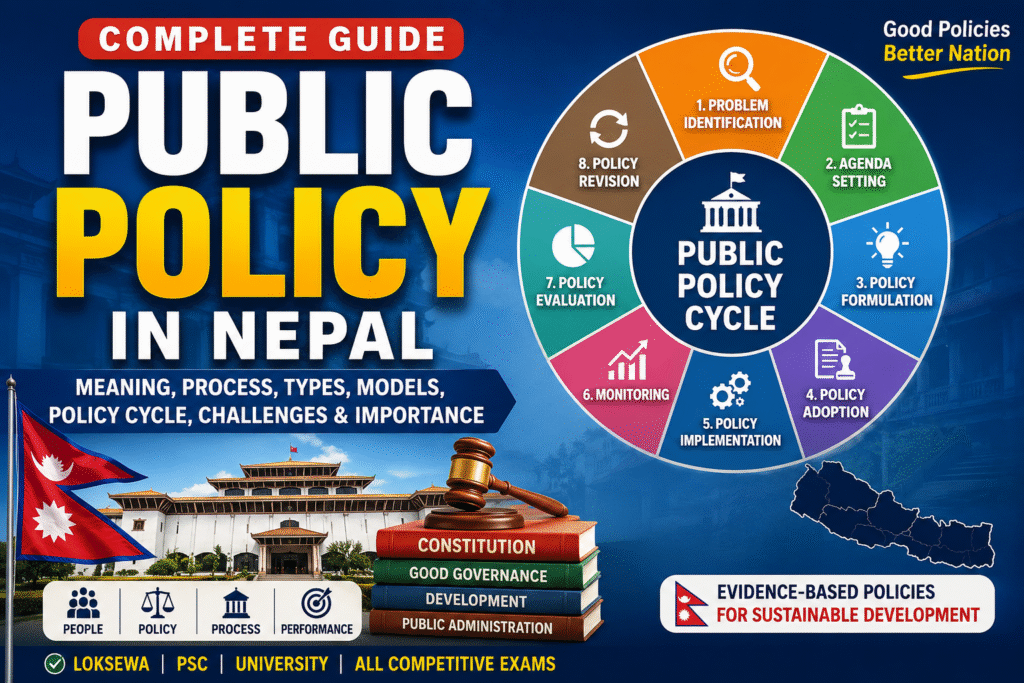
The Public Policy Cycle
The Public Policy Cycle is a systematic framework that illustrates the various stages through which a public policy passes from its initial conception to evaluation and improvement.
The cycle demonstrates that policy-making is continuous rather than linear. The findings from one stage often influence future policy decisions, making public policy an ongoing process of learning and improvement.
The major stages of the policy cycle are:
- Problem Identification
- Agenda Setting
- Policy Formulation
- Policy Adoption
- Policy Implementation
- Monitoring
- Policy Evaluation
- Policy Revision or Termination
Each stage plays a distinct role in ensuring effective governance.
Stage 1: Problem Identification
Every public policy begins with the recognition of a public problem that requires government intervention.
A public problem arises when existing conditions negatively affect society and cannot be adequately addressed by individuals or the private sector alone.
Problems may be identified through:
- Public complaints.
- Media reports.
- Academic research.
- Government studies.
- Parliamentary discussions.
- Court decisions.
- Civil society advocacy.
- International commitments.
- Statistical indicators.
For example, rising youth unemployment, increasing air pollution, declining agricultural productivity, or poor public healthcare services may all prompt governments to consider policy intervention.
However, not every social issue becomes a public policy issue. Governments must first determine whether the problem is significant enough to justify public action.
Stage 2: Agenda Setting
After identifying a public problem, policymakers decide whether it deserves official government attention.
This stage is known as Agenda Setting.
Since governments have limited financial resources, administrative capacity, and political time, they cannot address every issue simultaneously. Therefore, priorities must be established.
Issues are usually placed on the governmental agenda based on factors such as:
- Urgency.
- Public demand.
- Political commitment.
- Economic impact.
- Social consequences.
- Constitutional obligations.
- International commitments.
- Media attention.
For instance, following the 2015 Gorkha Earthquake, disaster management became one of Nepal’s highest national policy priorities.
Agenda setting ensures that government resources are directed toward the most important public concerns.
Stage 3: Policy Formulation
Once an issue enters the governmental agenda, the process of developing possible solutions begins.
Policy formulation is one of the most critical stages because the quality of the policy largely determines the success of its implementation.
During this stage, policymakers:
- Collect evidence.
- Conduct research.
- Consult experts.
- Analyze alternatives.
- Estimate costs.
- Assess risks.
- Consider legal implications.
- Evaluate social and environmental impacts.
The objective is to identify the most appropriate policy option capable of solving the identified problem effectively and efficiently.
Policy formulation is therefore both a technical and political process requiring careful analysis and broad consultation.
Stage 4: Policy Adoption
After various policy alternatives have been evaluated, the government formally selects and approves one of them.
This stage is known as Policy Adoption.
Depending on the nature of the policy, adoption may occur through:
- Cabinet decisions.
- Parliamentary approval.
- Executive orders.
- Ministerial decisions.
- Constitutional mechanisms.
- Provincial or local government decisions.
Once approved, the policy becomes an official course of governmental action.
Policy adoption also establishes legal authority, institutional responsibilities, and implementation arrangements.
Stage 5: Policy Implementation
Policy implementation is the process of translating approved policies into practical action.
Many excellent policies fail not because they are poorly designed but because they are inadequately implemented.
Implementation typically involves:
- Preparing implementation guidelines.
- Allocating financial resources.
- Assigning institutional responsibilities.
- Coordinating government agencies.
- Mobilizing human resources.
- Delivering public services.
- Supervising field activities.
In Nepal, implementation responsibilities often involve cooperation among Federal, Provincial, and Local Governments.
Effective implementation requires strong administrative capacity, intergovernmental coordination, and adequate financial support.
Stage 6: Monitoring
Implementation must be continuously monitored to determine whether activities are progressing according to plan.
Monitoring involves the regular collection of information regarding:
- Programme activities.
- Budget utilization.
- Institutional performance.
- Service delivery.
- Implementation challenges.
- Achievement of planned outputs.
Continuous monitoring enables governments to identify problems early and make necessary adjustments before major failures occur.
Monitoring therefore supports better management and accountability.
Stage 7: Policy Evaluation
Evaluation is a systematic assessment of whether the policy has achieved its intended objectives.
Unlike monitoring, which focuses on ongoing implementation, evaluation examines overall effectiveness and long-term impact.
Evaluation seeks answers to important questions such as:
- Were policy objectives achieved?
- Did citizens benefit?
- Were public resources used efficiently?
- What challenges emerged?
- Should the policy continue?
- Should modifications be introduced?
Evaluation may be conducted by:
- Government agencies.
- Independent commissions.
- Universities.
- Research institutions.
- International organizations.
- External experts.
Evidence generated through evaluation becomes valuable input for future policymaking.
Stage 8: Policy Revision or Termination
The final stage of the policy cycle involves deciding whether to:
- Continue the existing policy.
- Modify the policy.
- Expand the policy.
- Replace the policy.
- Terminate the policy.
Changing social conditions, technological advancement, economic transformation, environmental concerns, or evaluation findings may all require policy revision.
Thus, public policy remains a dynamic and evolving process rather than a permanent governmental decision.
Models of Public Policy
Public policy scholars have developed several theoretical models to explain how governments formulate policies. These models simplify complex policy processes and help us understand why governments make particular decisions.
Institutional Model
The Institutional Model views public policy as the official output of government institutions.
According to this model:
- Government institutions possess legitimate authority.
- Public policies derive legal validity from governmental decisions.
- Ministries, Parliament, courts, constitutional bodies, and administrative agencies play central roles.
This model emphasizes the importance of formal governmental structures in policymaking.
Rational Model
The Rational Model assumes that policymakers make decisions based on careful analysis and objective evidence.
Under this approach, policymakers:
- Clearly define objectives.
- Identify alternative solutions.
- Compare costs and benefits.
- Select the option producing maximum public benefit.
Although complete rationality is difficult in practice due to limited information and resources, this model provides an ideal framework for evidence-based policymaking.
Incremental Model
Developed by Charles Lindblom, the Incremental Model argues that governments rarely introduce radical policy changes.
Instead, policymakers generally make small, gradual adjustments to existing policies.
Incremental decision-making reduces uncertainty and political conflict while allowing governments to learn from previous experiences.
Many administrative reforms in Nepal have followed this gradual approach.
Group Model
The Group Model emphasizes the influence of organized interest groups on public policy.
Policy outcomes often reflect interaction among:
- Business associations.
- Professional organizations.
- Labour unions.
- Civil society organizations.
- Advocacy groups.
- Community organizations.
Governments balance competing interests while formulating policies.
Elite Model
According to the Elite Model, public policies are often shaped by a relatively small group of influential political, economic, and administrative leaders.
Although democratic systems encourage broad participation, elite decision-makers frequently exercise significant influence over national policies.
Systems Model
Proposed by David Easton, the Systems Model views public policy as the output of a political system responding to societal demands.
The model includes:
- Inputs: Public demands, problems, expectations, and support.
- Conversion Process: Government decision-making.
- Outputs: Public policies.
- Feedback: Public reaction influencing future policies.
This model highlights the continuous interaction between government and society.
Major Actors in Public Policy
Public policy is not formulated by a single institution. It is the result of cooperation, consultation, negotiation, and interaction among multiple actors.
In Nepal, the major policy actors include:
Political Executives
- Prime Minister.
- Council of Ministers.
- Provincial Ministers.
- Local Executives.
They provide political leadership and approve major policy decisions.
Parliament
Parliament plays an important role by:
- Enacting legislation.
- Debating policies.
- Providing oversight.
- Approving budgets.
- Holding the executive accountable.
Civil Service
Professional civil servants contribute by:
- Conducting policy research.
- Preparing policy drafts.
- Providing technical advice.
- Coordinating implementation.
- Monitoring progress.
Their expertise ensures administrative feasibility.
National Planning Commission (NPC)
The National Planning Commission plays a crucial role in national development policy by:
- Preparing periodic plans.
- Setting development priorities.
- Coordinating sectoral policies.
- Monitoring development outcomes.
- Advising the Government of Nepal on long-term strategic planning.
The NPC is one of Nepal’s most influential policy institutions, particularly in development planning.
Constitutional and Institutional Framework of Public Policy in Nepal
Public policy in Nepal operates within a constitutional and legal framework that defines governmental authority, distributes powers among different levels of government, and establishes institutions responsible for policy formulation, implementation, monitoring, and evaluation.
The Constitution of Nepal, 2015 serves as the supreme legal foundation for public policymaking. Every policy adopted by the government must be consistent with constitutional principles, fundamental rights, directive principles, and the federal structure of the state.
Unlike the unitary system that existed before 2015, Nepal’s federal governance structure has decentralized policymaking authority among the Federal, Provincial, and Local Governments. As a result, policy formulation has become more participatory, decentralized, and responsive to local needs.
Constitutional Basis of Public Policy
The Constitution of Nepal, 2015 does not define “public policy” in a single article. However, it provides the constitutional framework within which all public policies must be developed and implemented.
Several constitutional provisions directly influence public policymaking by establishing:
- Fundamental Rights.
- Directive Principles, Policies and Obligations of the State.
- Federal distribution of powers.
- Democratic governance.
- Rule of Law.
- Social justice.
- Inclusive governance.
- Sustainable development.
- Good governance.
- Accountability of public institutions.
Therefore, every public policy formulated in Nepal must align with these constitutional values.
Directive Principles, Policies, and Obligations of the State
One of the most important constitutional foundations of public policy is the Directive Principles, Policies and Obligations of the State.
These provisions provide long-term guidance for national governance and development.
They encourage governments to formulate policies that promote:
- Social justice.
- Economic prosperity.
- Inclusive development.
- Human dignity.
- Environmental protection.
- Balanced regional development.
- Scientific innovation.
- Employment generation.
- Poverty reduction.
- Sustainable use of natural resources.
Although these principles are generally not enforceable by courts in the same manner as Fundamental Rights, they serve as important policy guidelines for governments at all levels.
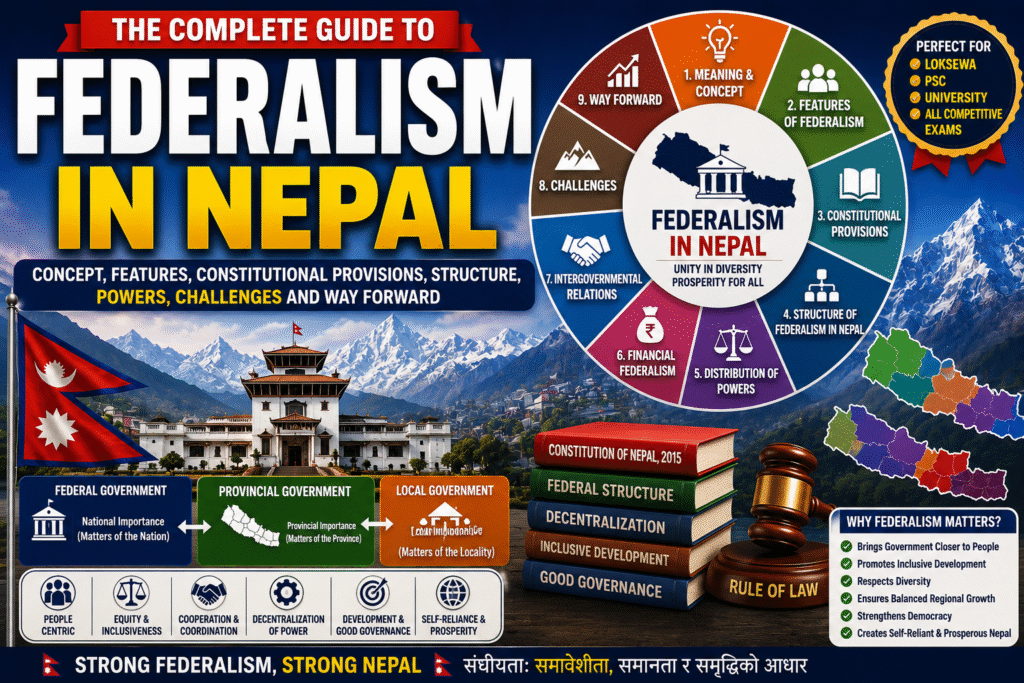
Distribution of Policy-Making Powers under Federalism
Federalism has fundamentally transformed policymaking in Nepal.
Instead of concentrating authority within the central government, the Constitution distributes legislative and executive powers among three levels of government.
Federal Government
The Federal Government formulates policies relating to matters of national importance, including:
- Foreign affairs.
- National defence.
- Monetary policy.
- Immigration.
- National transportation.
- International trade.
- Central taxation.
- National economic planning.
- Telecommunications.
- Aviation.
Federal policies establish the overall national direction.
Provincial Governments
Provincial Governments formulate policies within their constitutional jurisdiction.
Examples include:
- Provincial infrastructure.
- Provincial agriculture.
- Provincial tourism.
- Provincial industries.
- Provincial public health.
- Provincial education management.
- Provincial transportation.
Provincial policies address regional priorities while remaining consistent with the Constitution.
Local Governments
Local Governments possess authority to formulate policies relating to local governance and community development.
Their policy areas include:
- Basic education.
- Basic health services.
- Drinking water.
- Local roads.
- Agriculture extension.
- Local taxation.
- Waste management.
- Local markets.
- Disaster preparedness.
- Community development.
Local policymaking enables governments to respond directly to citizens’ needs.
Major Institutions Involved in Public Policy
Public policy is formulated and implemented through cooperation among numerous governmental institutions.
Each institution performs distinct but complementary responsibilities.
Parliament
Parliament is one of the most important policy institutions.
Its responsibilities include:
- Enacting legislation.
- Debating national policies.
- Approving government budgets.
- Holding the executive accountable.
- Reviewing policy performance.
Many national policies eventually become laws through parliamentary approval.
Council of Ministers
The Council of Ministers is the highest executive decision-making body.
It plays a central role in:
- Approving national policies.
- Determining government priorities.
- Coordinating ministries.
- Allocating responsibilities.
- Supervising implementation.
Cabinet decisions often initiate major policy reforms.
Office of the Prime Minister and Council of Ministers (OPMCM)
The OPMCM coordinates policy implementation across ministries and government agencies.
Its responsibilities include:
- Policy coordination.
- Administrative reform.
- Monitoring implementation.
- Inter-ministerial cooperation.
- Strategic governance.
It ensures coherence in government action.
National Planning Commission (NPC)
The National Planning Commission is Nepal’s premier advisory body for development policy.
Its major functions include:
- Preparing periodic development plans.
- Advising the Government on national priorities.
- Conducting policy research.
- Coordinating sectoral development strategies.
- Monitoring national development programmes.
- Evaluating development outcomes.
The NPC plays a crucial role in ensuring long-term policy consistency.
Ministries
Each ministry formulates sector-specific policies within its jurisdiction.
Examples include:
- Ministry of Finance.
- Ministry of Education, Science and Technology.
- Ministry of Health and Population.
- Ministry of Agriculture and Livestock Development.
- Ministry of Forests and Environment.
- Ministry of Home Affairs.
These ministries prepare policy proposals, regulations, implementation plans, and sectoral strategies.
Public Service Commission (PSC)
Although primarily responsible for merit-based recruitment, the Public Service Commission also advises the government on matters related to public personnel administration and civil service management.
Its recommendations influence administrative policy and institutional reforms.
Constitutional Bodies
Independent constitutional institutions contribute to public policy by promoting accountability and oversight.
Examples include:
- Commission for the Investigation of Abuse of Authority (CIAA).
- Office of the Auditor General.
- National Human Rights Commission (NHRC).
- National Information Commission.
- Election Commission.
These institutions help ensure that public policies are implemented lawfully and transparently.
Judiciary
The Judiciary contributes indirectly to public policy by interpreting constitutional provisions, protecting fundamental rights, and reviewing the legality of governmental actions.
Judicial decisions often influence future policymaking.
Types of Public Policy
Public policies can be classified in several ways depending on their objectives, scope, and methods of implementation.
Regulatory Policy
Regulatory policies establish rules and standards governing public and private activities.
Examples include:
- Environmental regulations.
- Consumer protection.
- Food safety standards.
- Financial regulations.
- Traffic regulations.
Their primary objective is to maintain order and protect public interests.
Distributive Policy
Distributive policies allocate public resources for societal benefit.
Examples include:
- Road construction.
- Irrigation projects.
- Educational scholarships.
- Rural electrification.
- Agricultural subsidies.
These policies aim to promote development and improve public welfare.
Redistributive Policy
Redistributive policies seek to reduce social and economic inequalities.
Examples include:
- Progressive taxation.
- Social security programmes.
- Poverty alleviation initiatives.
- Inclusive education programmes.
Such policies promote social justice and equity.
Constituent Policy
Constituent policies establish or reorganize governmental institutions and administrative structures.
Examples include:
- Constitutional reforms.
- Federal restructuring.
- Administrative reorganization.
- Creation of new constitutional bodies.
These policies shape the institutional framework of governance.
Policy Implementation Challenges in Nepal
Even well-designed public policies may fail if implementation is weak.
Major implementation challenges include:
- Political instability.
- Frequent policy changes.
- Limited institutional capacity.
- Weak intergovernmental coordination.
- Inadequate financial resources.
- Bureaucratic delays.
- Corruption.
- Insufficient monitoring.
- Lack of reliable data.
- Limited citizen participation.
Addressing these challenges requires stronger institutions, professional civil service, evidence-based decision-making, and effective coordination among all levels of government.
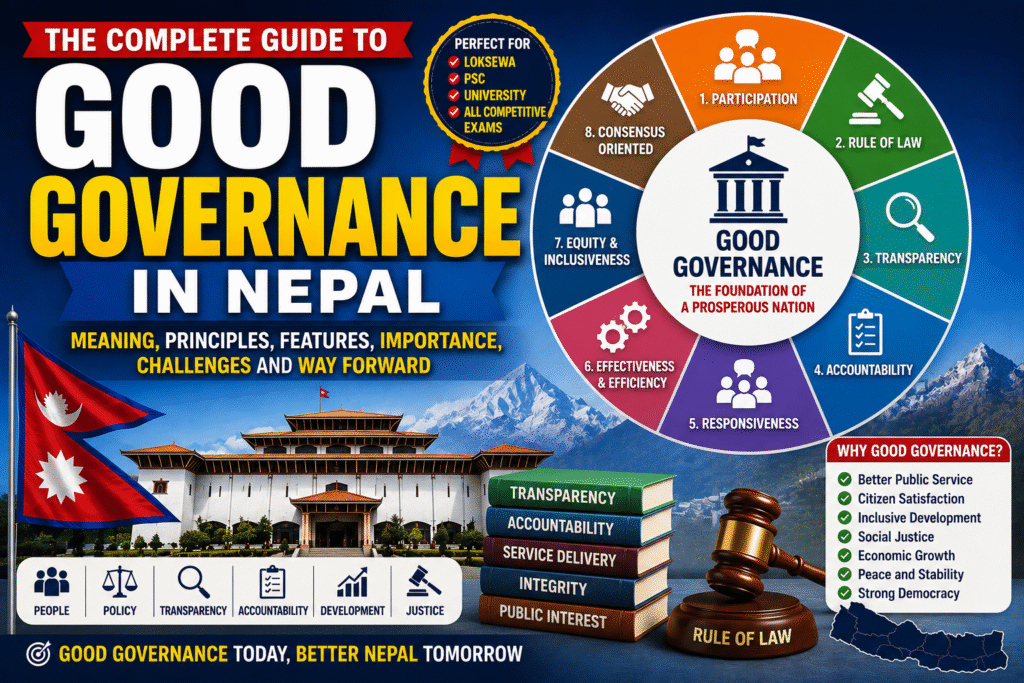
Public Policy and Good Governance
Public policy and good governance are closely interconnected.
Good governance improves policy quality by promoting:
- Transparency.
- Accountability.
- Participation.
- Rule of Law.
- Responsiveness.
- Efficiency.
- Inclusiveness.
Similarly, effective public policies strengthen good governance by improving public services and increasing public trust.
Neither can succeed without the other.
Public Policy and Sustainable Development Goals (SDGs)
Nepal has committed to achieving the United Nations Sustainable Development Goals (SDGs).
Public policies play a vital role in achieving these goals through:
- Poverty reduction.
- Quality education.
- Universal healthcare.
- Gender equality.
- Clean energy.
- Climate action.
- Sustainable cities.
- Economic growth.
- Institutional strengthening.
- Environmental conservation.
Well-designed public policies therefore serve as practical instruments for achieving sustainable development.
Exam Tip
In analytical answers, always relate Public Policy to Public Administration, Civil Service, Good Governance, and Federalism. Explain that Public Policy decides what the government intends to achieve, Public Administration and Civil Service implement those policies, while Good Governance measures how effectively, transparently, and accountably those policies are delivered under Nepal’s federal system.
This integrated approach demonstrates conceptual clarity and typically earns stronger marks in Loksewa and university examinations.
Policy Analysis
Designing a public policy is only the beginning of the policymaking process. Governments must also determine whether a proposed policy is appropriate, feasible, cost-effective, equitable, and capable of solving the identified public problem. This systematic examination is known as Policy Analysis.
Policy analysis is one of the most important components of modern public administration because it helps decision-makers choose the most effective policy alternative before implementation.
Rather than relying on assumptions or political preferences alone, policy analysis encourages governments to make evidence-based decisions using research, statistics, expert opinions, and stakeholder consultation.
In democratic societies, policy analysis improves transparency, accountability, and the quality of public decision-making.
Objectives of Policy Analysis
The primary objective of policy analysis is to assist policymakers in selecting the most effective solution to a public problem.
Specifically, policy analysis seeks to:
- Identify the root causes of public problems.
- Compare different policy alternatives.
- Estimate financial costs and expected benefits.
- Assess economic, social, and environmental impacts.
- Evaluate administrative feasibility.
- Minimize implementation risks.
- Improve policy effectiveness.
- Promote evidence-based decision-making.
Thus, policy analysis reduces uncertainty and improves the likelihood of successful policy implementation.
Major Steps in Policy Analysis
Although different institutions may follow different analytical methods, policy analysis generally includes the following stages:
1. Problem Definition
Clearly identifying the public problem is the first and most important step.
A poorly defined problem often leads to ineffective policy solutions.
2. Data Collection
Reliable information is collected from sources such as:
- Government reports.
- Census data.
- Research studies.
- Expert consultations.
- Public opinion surveys.
- International organizations.
Quality data improves the accuracy of policy recommendations.
3. Identification of Alternatives
Instead of proposing only one solution, analysts identify multiple policy options.
For example, to reduce unemployment, the government may consider:
- Vocational training.
- Tax incentives for industries.
- Entrepreneurship promotion.
- Public employment programmes.
4. Evaluation of Alternatives
Each alternative is assessed based on:
- Cost.
- Expected benefits.
- Administrative feasibility.
- Political acceptability.
- Social impact.
- Environmental consequences.
- Long-term sustainability.
5. Recommendation
After careful analysis, the most suitable policy option is recommended to decision-makers.
Recommendations should be objective, evidence-based, and aligned with national priorities.
Policy Evaluation
After implementation, governments must determine whether the policy has achieved its intended objectives.
This systematic assessment is known as Policy Evaluation.
Evaluation helps governments answer important questions such as:
- Has the policy solved the identified problem?
- Were objectives achieved?
- Were public resources used efficiently?
- What positive or negative impacts occurred?
- Should the policy continue, be revised, or be replaced?
Evaluation promotes learning and supports continuous improvement in policymaking.
Importance of Policy Evaluation
Policy evaluation contributes to effective governance by:
- Measuring policy performance.
- Improving accountability.
- Identifying implementation weaknesses.
- Supporting future policymaking.
- Increasing transparency.
- Ensuring efficient use of public resources.
- Promoting better public services.
Without evaluation, governments cannot determine whether public policies are producing meaningful results.
Criteria for Evaluating Public Policy
A well-designed public policy is generally evaluated using the following criteria:
| Criteria | Explanation |
|---|---|
| Effectiveness | Has the policy achieved its objectives? |
| Efficiency | Were resources used wisely? |
| Equity | Were benefits distributed fairly? |
| Sustainability | Can the policy continue over time? |
| Responsiveness | Did the policy address citizens’ needs? |
| Feasibility | Was implementation practical? |
| Accountability | Were institutions responsible for results? |
These criteria provide a comprehensive framework for assessing policy quality.
Public Policy Reforms in Nepal
As Nepal’s governance system evolves, continuous policy reform has become essential to address emerging challenges and changing public expectations.
Major policy reform priorities include:
- Strengthening evidence-based policymaking.
- Enhancing coordination among Federal, Provincial, and Local Governments.
- Improving policy implementation capacity.
- Expanding digital governance.
- Increasing citizen participation.
- Strengthening monitoring and evaluation systems.
- Simplifying administrative procedures.
- Promoting transparency and accountability.
- Developing professional policy research institutions.
- Encouraging innovation in public administration.
These reforms aim to create a more effective, responsive, and citizen-centred governance system.
Future of Public Policy in Nepal
The future of public policy in Nepal will be shaped by rapid technological advancement, federal governance, demographic changes, climate change, globalization, and increasing public expectations.
Future public policies are expected to focus on:
- Digital transformation of government services.
- Artificial Intelligence and data-driven decision-making.
- Climate-resilient development.
- Green economy.
- Inclusive economic growth.
- Evidence-based governance.
- Smart cities.
- Disaster resilience.
- Sustainable infrastructure.
- Innovation in public administration.
The future policymaker will require analytical thinking, technological competence, interdisciplinary knowledge, and a strong commitment to public service.
Public Policy at a Glance
| Aspect | Summary |
|---|---|
| Meaning | Government decisions and actions to solve public problems and achieve public objectives. |
| Constitutional Basis | Constitution of Nepal, 2015 |
| Policy Cycle | Problem Identification → Agenda Setting → Formulation → Adoption → Implementation → Monitoring → Evaluation → Revision |
| Major Actors | Parliament, Council of Ministers, Ministries, Civil Service, NPC, Constitutional Bodies, Judiciary |
| Objectives | Public welfare, development, service delivery, social justice, good governance |
| Major Challenges | Political interference, weak implementation, limited capacity, corruption, coordination problems |
| Future Direction | Evidence-based policymaking, digital governance, citizen participation, sustainable development |
Frequently Asked Questions (FAQs)
What is Public Policy?
Public policy is a deliberate course of governmental action designed to address public problems, promote public welfare, and achieve national objectives through laws, programmes, regulations, and administrative decisions.
Why is Public Policy important?
Public policy provides direction for government action, guides resource allocation, improves public service delivery, promotes good governance, and supports sustainable national development.
What is the Public Policy Cycle?
The Public Policy Cycle is a continuous process consisting of problem identification, agenda setting, policy formulation, policy adoption, implementation, monitoring, evaluation, and policy revision.
Who formulates Public Policy in Nepal?
Public policy is formulated through the combined efforts of the Council of Ministers, Parliament, Ministries, the National Planning Commission, Civil Servants, Constitutional Bodies, Provincial Governments, Local Governments, experts, and other stakeholders.
What is the relationship between Public Policy and Public Administration?
Public policy determines what the government intends to achieve, while public administration ensures how those policies are implemented efficiently and effectively. They are complementary components of governance.
Practice Questions
Short Questions
- Define Public Policy.
- Explain the characteristics of Public Policy.
- Differentiate between Public Policy and Law.
- What is Agenda Setting?
- State the major stages of the Public Policy Cycle.
Long Questions
- Explain the concept, characteristics, objectives, and importance of Public Policy.
- Discuss the Public Policy Cycle with suitable examples.
- Analyze the major policy-making institutions in Nepal.
- Evaluate the challenges of public policy implementation under federalism.
- Explain the relationship between Public Policy, Public Administration, Good Governance, and Civil Service.
Quick Revision Notes
- Public Policy is a goal-oriented course of government action to solve public problems.
- It is guided by the Constitution of Nepal, 2015, especially the Directive Principles, Policies, and Obligations of the State.
- The Public Policy Cycle includes problem identification, agenda setting, formulation, adoption, implementation, monitoring, evaluation, and revision.
- Major actors include Parliament, the Council of Ministers, Ministries, the National Planning Commission, Civil Service, Constitutional Bodies, and the Judiciary.
- Public policies can be Regulatory, Distributive, Redistributive, or Constituent.
- Effective policy implementation requires political commitment, institutional capacity, financial resources, intergovernmental coordination, and citizen participation.
- Evidence-based policymaking, digital governance, and continuous evaluation are essential for improving policy outcomes in Nepal.
Conclusion
Public policy is the foundation of effective governance because it transforms public needs into organized government action. From identifying national priorities to delivering public services, every stage of governance depends on well-designed and effectively implemented policies. In Nepal’s federal democratic system, public policy has become increasingly important as responsibilities are shared among the Federal, Provincial, and Local Governments.
The success of public policy depends not only on sound formulation but also on efficient implementation, continuous monitoring, objective evaluation, and timely reform. Institutions such as Parliament, the Council of Ministers, Ministries, the National Planning Commission, Civil Service, Constitutional Bodies, and Local Governments each play vital roles in this process. When these institutions coordinate effectively and policies are guided by evidence, transparency, accountability, and citizen participation, governance becomes more responsive and development outcomes improve.
Despite challenges such as political instability, implementation gaps, limited institutional capacity, and coordination issues, Nepal continues to strengthen its policymaking system through federal reforms, digital governance initiatives, and a growing emphasis on evidence-based decision-making. Looking ahead, the future of public policy lies in innovation, technology, sustainability, and inclusive governance.
Ultimately, strong public policies are indispensable for achieving good governance, protecting citizens’ rights, promoting sustainable development, and realizing the constitutional vision of a prosperous and equitable Nepal.
References
- Constitution of Nepal, 2015
- Good Governance (Management and Operation) Act, 2064
- National Planning Commission (NPC), Nepal
- Public Service Commission (PSC), Nepal
- Thomas R. Dye, Understanding Public Policy
- James E. Anderson, Public Policymaking
- UNDP Governance Reports
- World Bank – Governance and Public Sector Management
- OECD – Public Governance Publications
About the Author
Loksewa Aayog Tayariclass publishes research-based study materials, detailed notes, MCQs, exam-focused articles, and educational resources for Loksewa, PSC, and university students in Nepal. Our mission is to provide accurate, structured, and easy-to-understand learning materials that help aspirants succeed in competitive examinations.