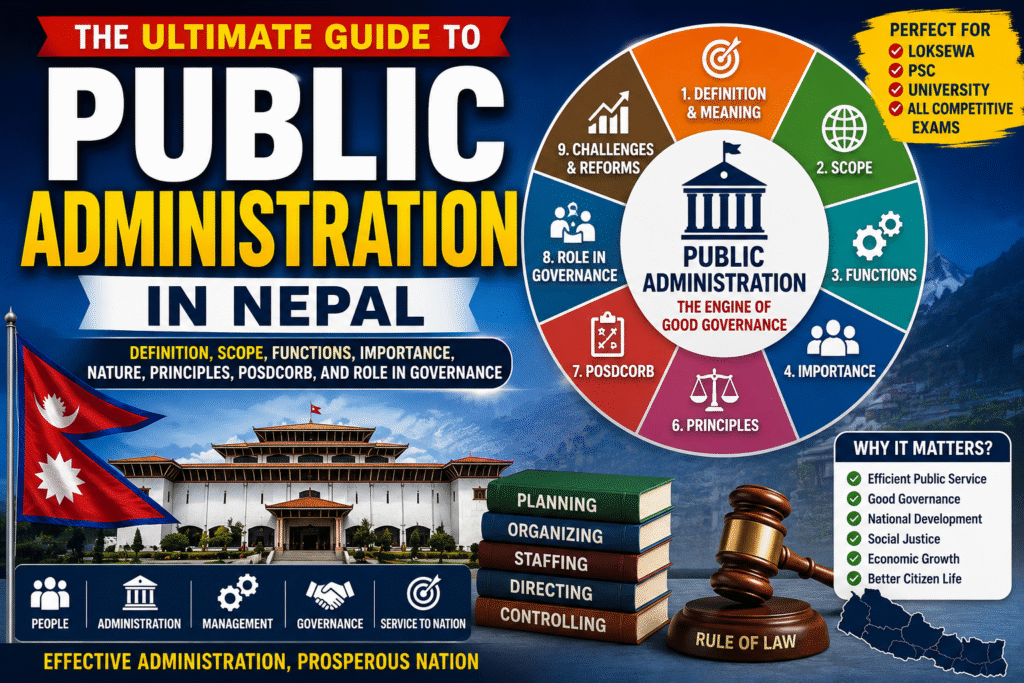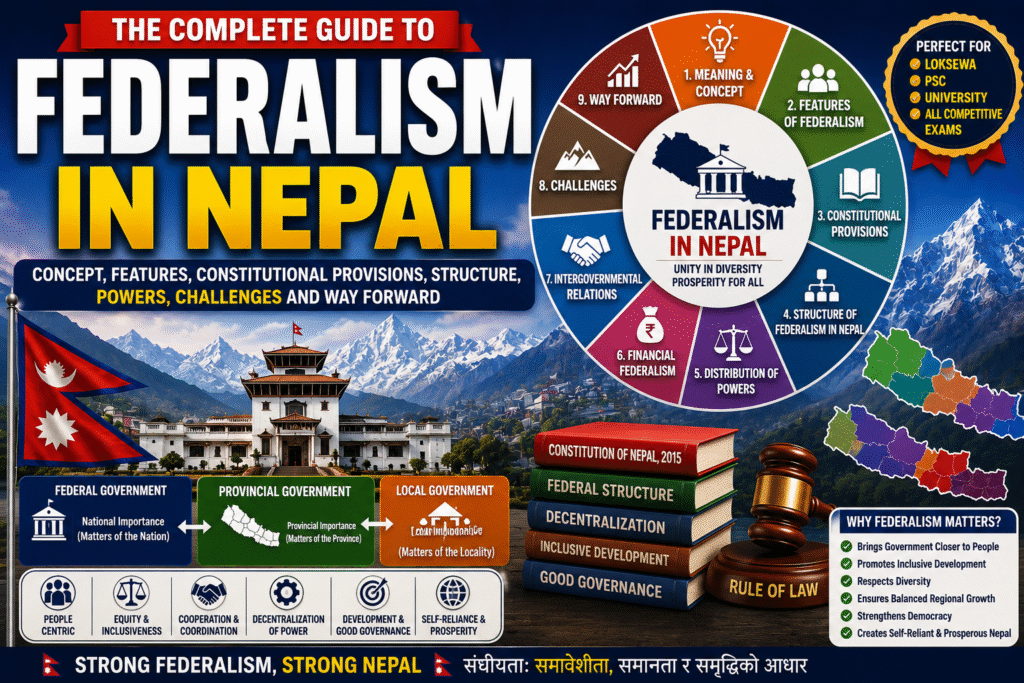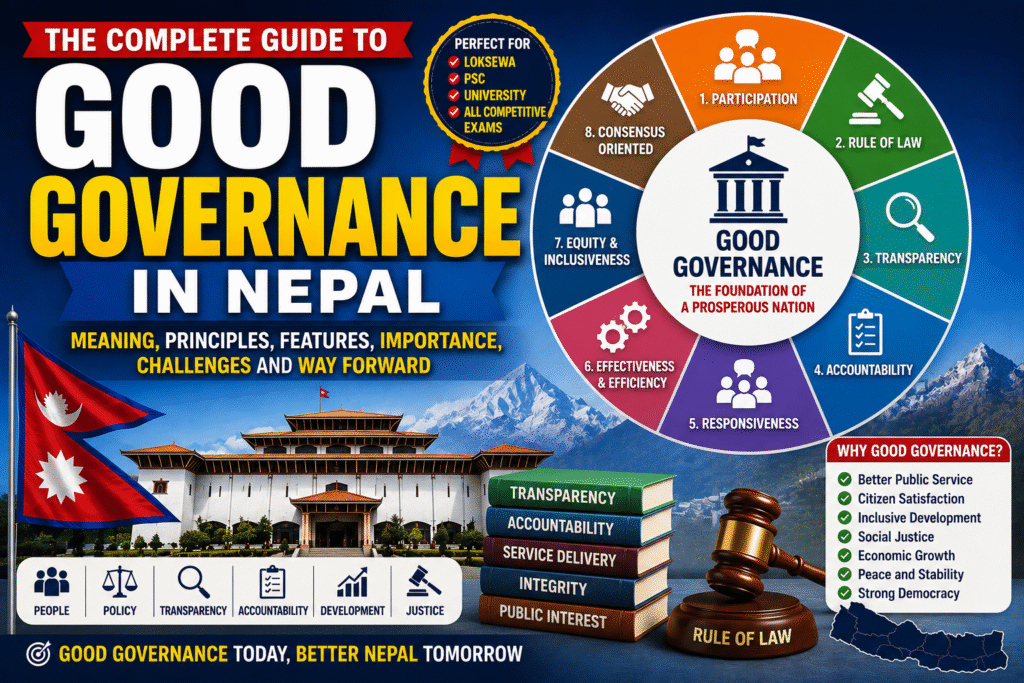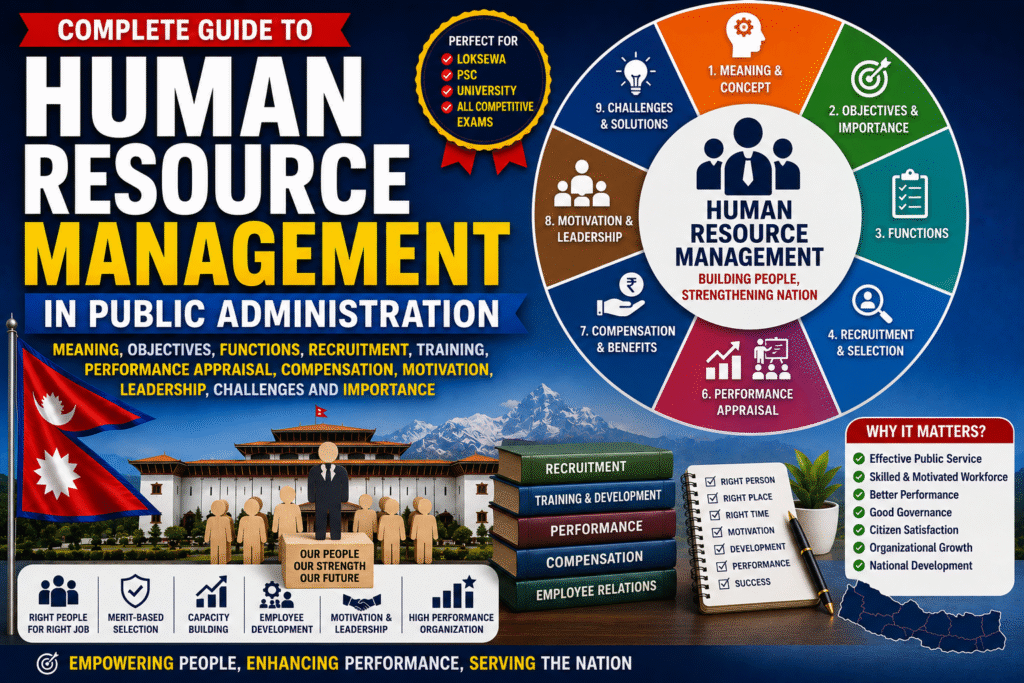
Human Resource Management in Public Administration: Meaning, Objectives, Functions, Recruitment, Training, Performance Appraisal, Challenges, and Importance in Nepal
The Ultimate Guide for Loksewa, PSC, University Students, and Competitive Examinations
Introduction
Human resources are the most valuable asset of any organization. Buildings, technology, financial resources, laws, and policies alone cannot achieve organizational goals unless they are managed by competent, motivated, and ethical people. In public administration, this reality becomes even more significant because the quality of government services depends largely on the knowledge, skills, integrity, and commitment of civil servants. Consequently, Human Resource Management (HRM) has become one of the most important pillars of modern public administration.
In the twenty-first century, governments are expected to deliver efficient, transparent, citizen-centred, and accountable public services. Citizens demand better healthcare, quality education, effective infrastructure, digital governance, environmental protection, social security, and prompt administrative services. Meeting these expectations requires not only sound public policies and adequate financial resources but also a professional and well-managed workforce. Human Resource Management provides the framework through which governments recruit, develop, motivate, evaluate, and retain competent public employees capable of delivering these services effectively.
Human Resource Management is much more than personnel administration. Traditional personnel administration mainly focused on recruitment, salary administration, leave management, and record keeping. Modern Human Resource Management adopts a strategic approach that emphasizes workforce planning, competency development, performance management, leadership development, employee motivation, organizational culture, succession planning, and continuous learning. It recognizes public employees not merely as administrative staff but as strategic partners in achieving national development goals.
The importance of Human Resource Management has increased considerably in Nepal following the promulgation of the Constitution of Nepal, 2015, which introduced a federal democratic governance system. Administrative responsibilities are now distributed among the Federal, Provincial, and Local Governments. Thousands of civil servants work across these three levels of government to implement laws, deliver public services, and execute development programmes. Managing such a large and diverse workforce requires effective human resource planning, merit-based recruitment, continuous training, fair performance evaluation, ethical leadership, and transparent administrative practices.
Human Resource Management is closely connected with the flagship topics already discussed in this Public Administration series. Public Administration provides the institutional framework within which government organizations operate, while Public Policy determines the goals that public institutions seek to achieve. Civil Service represents the professional workforce responsible for implementing those policies. Administrative Law establishes the legal framework governing the powers, duties, and accountability of public officials. Good Governance defines the standards of transparency, accountability, participation, and responsiveness expected from public institutions, whereas Federalism determines how administrative responsibilities are distributed among different levels of government. Human Resource Management integrates all these concepts by ensuring that the right people, possessing the right competencies and ethical values, are available to implement public responsibilities effectively.
International organizations such as the United Nations (UN), World Bank, Organisation for Economic Co-operation and Development (OECD), and the International Labour Organization (ILO) consistently emphasize that capable human resources are fundamental to sustainable development and effective governance. Countries with highly professional civil services generally achieve better policy implementation, stronger institutions, improved public trust, and higher levels of socio-economic development.
In Nepal, Human Resource Management plays a vital role in strengthening public institutions, improving service delivery, enhancing administrative efficiency, and promoting citizen satisfaction. Merit-based recruitment conducted by the Public Service Commission, capacity-building programmes provided by government training institutions, performance evaluation systems, leadership development initiatives, and ethical standards for public officials all contribute to building a competent civil service capable of meeting contemporary governance challenges.
For students preparing for Loksewa, Public Service Commission examinations, Judicial Service examinations, university courses, and other competitive examinations, Human Resource Management is a core area of study. Questions commonly focus on its meaning, evolution, objectives, principles, functions, recruitment systems, training and development, performance appraisal, motivation theories, leadership, human resource planning, contemporary reforms, and challenges in Nepal.
This comprehensive guide explains every major aspect of Human Resource Management in Public Administration, including its meaning, definitions, characteristics, objectives, scope, principles, functions, human resource planning, recruitment and selection, training and development, performance appraisal, motivation, leadership, employee relations, ethics, challenges, reforms, and future prospects in Nepal. The article is designed to provide conceptual clarity, practical understanding, and examination-oriented knowledge while maintaining international academic standards and strong SEO value for readers seeking authoritative information on Human Resource Management in Nepal.
Understanding Human Resources
Before studying Human Resource Management, it is important to understand the meaning of Human Resources.
Human resources refer to the people working within an organization who contribute their knowledge, skills, experience, creativity, values, and efforts toward achieving organizational goals. Unlike financial resources, buildings, machinery, or technology, human resources possess the unique ability to think, learn, innovate, solve problems, communicate, and adapt to changing circumstances.
In public administration, human resources include all public employees involved in delivering government services, implementing laws, formulating and executing policies, managing public institutions, and serving citizens. These include civil servants, administrative officers, technical experts, managers, professionals, and support staff working across Federal, Provincial, and Local Governments.
The effectiveness of public institutions depends not only on the number of employees but also on their competence, integrity, motivation, and commitment to public service.
Meaning of Human Resource Management (HRM)
Human Resource Management (HRM) is the systematic process of planning, acquiring, developing, motivating, utilizing, evaluating, and retaining human resources to achieve organizational objectives efficiently and effectively.
In the context of public administration, HRM involves managing government employees in a manner that promotes professionalism, accountability, efficiency, integrity, and citizen-oriented service delivery.
Modern HRM extends far beyond administrative record-keeping. It is a strategic management function that aligns human resource policies with the long-term goals of government institutions.
It ensures that:
- the right people are recruited,
- employees receive appropriate training,
- performance is evaluated fairly,
- motivation is maintained,
- ethical standards are upheld, and
- organizational capacity is continuously strengthened.
In simple terms:
Human Resource Management is the process of ensuring that public organizations have competent, motivated, ethical, and well-managed employees capable of delivering quality public services and achieving national development objectives.
Scholarly Definitions of Human Resource Management
Different scholars have explained Human Resource Management from complementary perspectives.
According to Edwin B. Flippo:
Human Resource Management is the planning, organizing, directing, and controlling of the procurement, development, compensation, integration, maintenance, and separation of human resources to accomplish organizational objectives.
According to Gary Dessler:
Human Resource Management refers to the policies and practices involved in carrying out the people or human resource aspects of a management position.
These definitions highlight that HRM is both a management function and a strategic process aimed at maximizing organizational effectiveness through people.
Evolution of Human Resource Management
Human Resource Management has evolved significantly over time.
Welfare Stage
The earliest approach focused mainly on employee welfare, working conditions, and basic labour protection.
Personnel Administration Stage
Organizations gradually introduced structured recruitment, salary administration, record keeping, and disciplinary procedures.
Human Relations Stage
Researchers recognized the importance of employee motivation, teamwork, communication, and leadership in improving productivity.
Human Resource Management Stage
Organizations began treating employees as valuable organizational assets rather than merely administrative staff.
Strategic workforce planning, competency development, and performance management became central priorities.
Strategic Human Resource Management (SHRM)
Today, HRM is closely integrated with organizational strategy.
Governments now focus on:
- Talent management.
- Leadership development.
- Digital competencies.
- Innovation.
- Diversity and inclusion.
- Succession planning.
- Evidence-based human resource decisions.
This modern strategic approach is increasingly relevant for Nepal’s evolving public administration under federal governance.
Characteristics of Human Resource Management
Human Resource Management (HRM) possesses several unique characteristics that distinguish it from traditional personnel administration. These characteristics explain why HRM has become a strategic function in modern public administration rather than merely an administrative support activity.
Understanding these characteristics is particularly important for Loksewa, PSC, Judicial Service, and university examinations, where conceptual clarity is often assessed through descriptive and analytical questions.
Human-Centred Management
The most distinctive characteristic of Human Resource Management is that it focuses on people rather than processes or machinery.
Buildings, technology, finance, and equipment are valuable organizational resources, but human resources remain the only assets capable of thinking, learning, innovating, communicating, and making decisions.
Therefore, HRM seeks to develop people’s knowledge, skills, motivation, creativity, and ethical behaviour to achieve organizational goals.
Strategic in Nature
Modern Human Resource Management is a strategic function.
Rather than simply maintaining employee records or processing salaries, HRM aligns workforce planning with the long-term objectives of the organization.
In public administration, this means ensuring that government institutions possess the right number of qualified employees with the appropriate competencies to implement national policies effectively.
Continuous Process
Human Resource Management is not a one-time activity.
It is a continuous cycle involving:
- Human Resource Planning.
- Recruitment.
- Selection.
- Placement.
- Orientation.
- Training.
- Performance Evaluation.
- Promotion.
- Career Development.
- Retirement Planning.
Each stage contributes to improving organizational effectiveness throughout an employee’s career.
Development-Oriented
Modern HRM emphasizes continuous learning and professional development.
Government employees must continuously update their knowledge because administrative responsibilities evolve with technological advancement, legal reforms, digital governance, globalization, and changing public expectations.
Training and capacity development are therefore integral components of HRM.
Goal-Oriented
Every HRM activity ultimately supports organizational objectives.
Recruitment, training, motivation, leadership development, and performance evaluation are not independent activities.
They are designed to ensure that employees contribute effectively to achieving public service goals.
Future-Oriented
Human Resource Management not only addresses present workforce needs but also prepares organizations for future challenges.
This includes:
- Succession Planning.
- Leadership Development.
- Talent Management.
- Workforce Forecasting.
- Digital Skills Development.
- Change Management.
Future-oriented HRM helps public institutions adapt to rapidly changing governance environments.
Integrated Function
Human Resource Management interacts closely with every other management function.
It supports:
- Planning.
- Organizing.
- Staffing.
- Directing.
- Coordinating.
- Controlling.
Similarly, HRM influences financial management, policy implementation, organizational development, and public service delivery.
Promotes Ethical Administration
In public administration, HRM is expected to cultivate:
- Integrity.
- Professionalism.
- Accountability.
- Transparency.
- Impartiality.
- Public Service Ethics.
Ethical human resource management strengthens public confidence in government institutions.
Objectives of Human Resource Management
Human Resource Management seeks to maximize both organizational performance and employee development.
Its major objectives include the following.
Recruiting Competent Employees
The first objective of HRM is to recruit capable individuals through a fair, transparent, and merit-based process.
In Nepal, this responsibility is primarily performed by the Public Service Commission (PSC) for civil service positions.
Merit-based recruitment ensures equal opportunity while improving administrative quality.
Developing Employee Competencies
Employees require continuous training to improve:
- Knowledge.
- Technical Skills.
- Administrative Skills.
- Leadership Ability.
- Communication Skills.
- Decision-Making Capacity.
- Digital Competence.
Capacity development enhances institutional effectiveness.
Improving Organizational Performance
Human Resource Management seeks to improve productivity through:
- Proper job placement.
- Effective supervision.
- Performance management.
- Employee motivation.
- Leadership development.
- Teamwork.
Better employee performance ultimately improves public service delivery.
Enhancing Employee Motivation
Motivated employees perform better than dissatisfied employees.
HRM therefore promotes motivation through:
- Fair compensation.
- Career opportunities.
- Recognition.
- Training.
- Promotion.
- Positive work environment.
Motivation improves both organizational performance and employee satisfaction.
Promoting Good Governance
Human Resource Management supports Good Governance by encouraging:
- Accountability.
- Transparency.
- Responsiveness.
- Professionalism.
- Citizen Orientation.
- Ethical Behaviour.
This directly connects HRM with our earlier flagship article on Good Governance in Nepal.
Strengthening Public Institutions
Competent employees strengthen institutional capacity.
Effective HRM contributes to:
- Better policy implementation.
- Improved service delivery.
- Administrative innovation.
- Organizational stability.
- Sustainable governance.
Scope of Human Resource Management
The scope of HRM has expanded significantly over the past several decades.
Modern HRM covers almost every aspect of managing people within public organizations.
Its major areas include:
Human Resource Planning
Forecasting future workforce requirements.
Determining:
- Number of employees.
- Required competencies.
- Future staffing needs.
- Organizational restructuring.
Recruitment and Selection
Attracting qualified candidates and selecting the most suitable individuals through transparent and merit-based procedures.
Placement and Orientation
Assigning newly recruited employees to appropriate positions and introducing them to organizational objectives, rules, values, and responsibilities.
Training and Development
Improving employee knowledge, professional skills, leadership abilities, technical competence, and managerial capacity.
Training prepares employees for present and future responsibilities.
Performance Management
Evaluating employee performance through objective criteria.
Performance management includes:
- Goal Setting.
- Monitoring.
- Performance Appraisal.
- Feedback.
- Performance Improvement.
Compensation and Benefits
Developing fair compensation systems including:
- Salary.
- Allowances.
- Pension.
- Insurance.
- Leave.
- Incentives.
- Employee Welfare.
Career Development
Helping employees achieve long-term professional growth through:
- Promotion.
- Job Rotation.
- Leadership Development.
- Advanced Training.
- Career Planning.
Employee Relations
Maintaining harmonious relationships among:
- Employees.
- Supervisors.
- Government Institutions.
- Employee Associations.
Healthy workplace relationships improve organizational effectiveness.
Occupational Health and Safety
Ensuring employees work in safe, healthy, and supportive environments.
Healthy employees are generally more productive and motivated.
Nature of Human Resource Management
Human Resource Management possesses several important features.
Multidisciplinary
HRM incorporates knowledge from:
- Management.
- Psychology.
- Sociology.
- Economics.
- Law.
- Political Science.
- Public Administration.
Its multidisciplinary character enables comprehensive workforce management.
Dynamic
Human Resource Management continuously evolves in response to:
- Technology.
- Artificial Intelligence.
- Digital Governance.
- Changing Workforce Expectations.
- Labour Market Changes.
- Administrative Reforms.
Developmental
The primary purpose of HRM is employee growth.
Organizations succeed when employees continuously improve their competencies.
Managerial
HRM is a core management function involving:
- Planning.
- Organizing.
- Staffing.
- Leading.
- Controlling.
Managers at every organizational level participate in HRM activities.
Service-Oriented
The ultimate purpose of HRM in public administration is improving public service delivery.
Citizens remain the final beneficiaries of effective human resource management.
Principles of Human Resource Management
Successful Human Resource Management is guided by several fundamental principles.
These principles promote fairness, professionalism, and organizational effectiveness.
Merit Principle
Recruitment, promotion, and career advancement should be based on competence, qualifications, and performance rather than political influence or personal connections.
Equality of Opportunity
Every eligible individual should receive equal opportunity in public employment without discrimination based on gender, ethnicity, religion, language, disability, or social background, consistent with constitutional and legal provisions.
Right Person for the Right Job
Employees should be placed in positions that match their education, skills, competencies, and experience.
Proper placement improves productivity and job satisfaction.
Continuous Learning
Training should not end after recruitment.
Employees require lifelong learning to adapt to changing technologies, laws, administrative reforms, and public expectations.
Accountability
Every public employee must remain accountable for their decisions, performance, and use of public resources.
Transparency
HR decisions should be transparent, objective, and based on clearly defined procedures.
Transparency strengthens public trust in government institutions.
Relationship of HRM with Our Previous Flagship Articles
Human Resource Management is the practical link connecting all six flagship topics already published.
- Public Administration provides the institutional system where HRM operates.
- Public Policy determines government priorities that employees must implement.
- Civil Service supplies the professional workforce managed through HRM.
- Administrative Law establishes the legal framework governing recruitment, promotion, discipline, and public employment.
- Good Governance defines the ethical and accountability standards expected from public employees.
- Federalism distributes human resource responsibilities among Federal, Provincial, and Local Governments.
Therefore, Human Resource Management is not an isolated discipline. It is the operational mechanism that enables all other public administration concepts to function effectively in practice.
Exam Tip
In analytical answers, explain HRM as the “people dimension” of Public Administration. A strong public administration system requires sound public policies, competent civil servants, effective administrative law, good governance, and a capable human resource management system. Linking these concepts demonstrates a comprehensive understanding and is highly valued in Loksewa, PSC, and university examinations.
Human Resource Planning (HRP)
One of the most important functions of Human Resource Management is Human Resource Planning (HRP). Every organization must ensure that it has the right number of employees with the appropriate qualifications, skills, and competencies available at the right time and in the right positions.
Without proper planning, an organization may face either a shortage of qualified employees or an excess workforce, both of which reduce efficiency and increase administrative costs.
In public administration, Human Resource Planning helps governments anticipate future workforce needs arising from population growth, technological advancement, policy reforms, federal restructuring, retirement of employees, expansion of public services, and changing development priorities.
Human Resource Planning is therefore a strategic process that links organizational goals with future human resource requirements.
Meaning of Human Resource Planning
Human Resource Planning is the systematic process of forecasting an organization’s future human resource needs and developing appropriate strategies to ensure that qualified employees are available when required.
It involves answering several important questions:
- How many employees will be needed?
- What qualifications should they possess?
- When will they be required?
- Where should they be deployed?
- What training will they require?
- How can future leadership positions be filled?
Effective planning enables organizations to avoid both staff shortages and unnecessary recruitment.
Objectives of Human Resource Planning
The major objectives of Human Resource Planning include:
- Ensuring the availability of competent employees.
- Matching workforce supply with organizational demand.
- Supporting efficient implementation of public policies.
- Reducing recruitment delays.
- Preparing future organizational leaders.
- Improving productivity.
- Promoting efficient utilization of human resources.
- Supporting long-term organizational development.
- Reducing unnecessary administrative expenditure.
Importance of Human Resource Planning
Human Resource Planning has become increasingly important due to rapid changes in governance, technology, and public expectations.
Its importance includes:
Supporting Strategic Planning
Human Resource Planning ensures that workforce development aligns with long-term governmental objectives.
Improving Service Delivery
Adequate staffing enables public institutions to provide timely and efficient services to citizens.
Managing Workforce Changes
Governments frequently experience:
- Retirement.
- Promotion.
- Transfer.
- Organizational restructuring.
- Creation of new institutions.
Human Resource Planning helps manage these transitions effectively.
Supporting Federal Governance
Under Nepal’s federal system, human resource planning is essential for balancing workforce requirements among Federal, Provincial, and Local Governments.
Proper planning reduces duplication, shortages, and administrative inefficiency.
Steps in Human Resource Planning
Although organizations may adopt different models, Human Resource Planning generally involves the following stages.
1. Analysis of Organizational Objectives
Human resource planning begins with understanding organizational goals.
Government priorities determine future staffing requirements.
2. Assessment of Current Human Resources
Organizations analyze their existing workforce by examining:
- Number of employees.
- Educational qualifications.
- Skills.
- Experience.
- Age distribution.
- Retirement projections.
- Performance levels.
This assessment identifies current strengths and weaknesses.
3. Forecasting Future Human Resource Demand
The organization estimates future workforce requirements based on:
- Population growth.
- New government programmes.
- Digital transformation.
- Policy reforms.
- Expansion of services.
- Economic development.
4. Forecasting Human Resource Supply
Organizations estimate whether qualified employees will be available through:
- Existing workforce.
- Internal promotions.
- Recruitment.
- Training.
- Labour market availability.
5. Identifying Human Resource Gaps
The difference between future demand and available supply is known as the human resource gap.
Organizations then determine whether additional recruitment, training, restructuring, or redeployment is necessary.
6. Developing Human Resource Strategies
Appropriate strategies may include:
- Recruitment.
- Capacity development.
- Promotion.
- Succession planning.
- Job redesign.
- Digital skills development.
- Leadership programmes.
7. Monitoring and Evaluation
Human Resource Planning is a continuous process.
Organizations regularly review workforce performance and revise plans according to changing circumstances.
Job Analysis
Before recruiting employees, organizations must clearly understand what each job requires.
This process is known as Job Analysis.
Job Analysis is the systematic process of collecting, studying, and documenting information about a particular job.
It identifies:
- Duties.
- Responsibilities.
- Skills.
- Qualifications.
- Experience.
- Working conditions.
- Competencies required.
Accurate job analysis improves recruitment quality and employee performance.
Components of Job Analysis
Job Analysis generally produces two important documents.
Job Description
A Job Description explains:
- Job title.
- Duties.
- Responsibilities.
- Reporting relationships.
- Working conditions.
- Organizational position.
It describes the job itself.
Job Specification
Job Specification identifies the qualifications required to perform the job successfully.
It includes:
- Education.
- Experience.
- Technical skills.
- Communication ability.
- Physical requirements.
- Professional competencies.
It describes the employee rather than the job.
Recruitment
Recruitment is one of the most visible functions of Human Resource Management.
Recruitment is the process of attracting qualified candidates to apply for vacant positions within an organization.
Its purpose is to create a sufficiently large pool of competent applicants from which the best candidates can be selected.
Effective recruitment strengthens institutional capacity and improves public confidence.
Objectives of Recruitment
Recruitment seeks to:
- Attract qualified candidates.
- Ensure equal opportunity.
- Promote merit-based selection.
- Increase organizational competitiveness.
- Strengthen workforce quality.
- Support diversity and inclusion.
Sources of Recruitment
Recruitment may be conducted through:
Internal Sources
- Promotion.
- Transfer.
- Job Rotation.
- Internal Competition.
Advantages include:
- Lower cost.
- Employee motivation.
- Organizational experience.
- Faster placement.
External Sources
- Public advertisements.
- Competitive examinations.
- Universities.
- Professional organizations.
- Employment services.
- Online recruitment platforms.
External recruitment introduces new knowledge and broader competition.
Recruitment in Nepal’s Public Administration
In Nepal, recruitment to the Civil Service is primarily conducted through the Public Service Commission (PSC).
The PSC plays a vital constitutional role in ensuring:
- Merit-based recruitment.
- Fair competition.
- Equal opportunity.
- Transparency.
- Professionalism.
- Political neutrality.
This constitutional arrangement strengthens public trust in government employment.
Selection
Recruitment attracts applicants.
Selection identifies the most suitable candidate.
Selection is the systematic process of evaluating applicants and choosing those who best satisfy the requirements of the position.
Unlike recruitment, which encourages many applications, selection narrows the applicant pool to identify the most qualified individuals.
Common Selection Methods
Government organizations commonly use:
- Written Examinations.
- Interviews.
- Practical Tests.
- Psychological Assessments.
- Medical Examinations.
- Background Verification.
- Document Verification.
Each method evaluates different competencies.
Placement
Placement refers to assigning newly selected employees to appropriate positions within the organization.
Effective placement follows the principle of:
The Right Person in the Right Job at the Right Time.
Proper placement improves:
- Job satisfaction.
- Productivity.
- Employee retention.
- Organizational effectiveness.
Orientation
Orientation introduces newly appointed employees to their organization.
It familiarizes employees with:
- Organizational mission.
- Vision.
- Rules.
- Administrative procedures.
- Organizational culture.
- Rights and responsibilities.
- Ethical standards.
Orientation reduces uncertainty and helps employees become productive more quickly.
Training and Development
Recruitment alone cannot guarantee administrative excellence.
Employees must continuously update their knowledge and competencies.
Training and Development therefore constitute one of the most important investments in Human Resource Management.
Training improves current job performance, whereas development prepares employees for future responsibilities and leadership roles.
Objectives of Training
Training seeks to:
- Improve professional knowledge.
- Enhance technical skills.
- Increase productivity.
- Develop leadership.
- Improve communication.
- Promote innovation.
- Strengthen ethical behaviour.
- Support digital governance.
Types of Training
Government institutions commonly provide:
Induction Training
Provided immediately after recruitment.
Introduces employees to organizational systems.
On-the-Job Training
Employees learn while performing actual duties.
Off-the-Job Training
Training conducted through workshops, seminars, academic programmes, and specialized institutions.
Refresher Training
Updates employees regarding:
- New laws.
- Digital technologies.
- Administrative reforms.
- Public policies.
- Management techniques.
Capacity Building
Capacity Building refers to the continuous process of strengthening the knowledge, skills, institutional systems, leadership, and organizational capabilities required for effective governance.
Unlike training, which often focuses on individuals, capacity building also improves organizational structures, procedures, and institutional culture.
In Nepal, capacity building has become increasingly important under federalism, where Federal, Provincial, and Local Governments require competent personnel to discharge their constitutional responsibilities effectively.
Exam Tip
When answering analytical questions, connect these concepts logically:
Human Resource Planning identifies future workforce needs → Job Analysis defines the work and required competencies → Recruitment attracts qualified candidates → Selection identifies the most suitable applicants → Placement assigns them appropriately → Orientation introduces them to the organization → Training and Development improve their competencies → Capacity Building strengthens both employees and institutions for long-term public service excellence.
Presenting the HRM process in this sequence demonstrates systematic understanding and earns higher marks in Loksewa, PSC, and university examinations.
Performance Appraisal
Recruiting competent employees is only the beginning of effective Human Resource Management. Public organizations must also evaluate whether employees are performing their duties efficiently, ethically, and in accordance with organizational objectives. This systematic evaluation process is known as Performance Appraisal.
Performance Appraisal is the formal process of assessing an employee’s work performance, achievements, competencies, behaviour, and potential over a specified period.
In modern public administration, performance appraisal is not intended merely to identify poor performance. Rather, it is a management tool that promotes continuous improvement, recognizes achievement, identifies training needs, supports career development, and strengthens institutional performance.
A fair and transparent appraisal system motivates employees while helping organizations achieve higher standards of public service delivery.
Objectives of Performance Appraisal
Performance appraisal serves several important purposes.
Its major objectives include:
- Evaluating employee performance objectively.
- Identifying strengths and weaknesses.
- Determining training requirements.
- Supporting promotion and career development.
- Improving organizational productivity.
- Encouraging accountability.
- Motivating employees through recognition.
- Strengthening transparency in personnel management.
- Supporting succession planning.
Importance of Performance Appraisal
An effective appraisal system benefits both employees and organizations.
Its importance includes:
Improving Individual Performance
Employees understand their strengths, weaknesses, and areas requiring improvement.
Supporting Promotion Decisions
Objective performance information helps ensure that promotions are based on merit rather than personal influence.
Identifying Training Needs
Performance evaluation reveals competency gaps that can be addressed through targeted training programmes.
Increasing Accountability
Employees become more responsible when performance standards are clearly communicated and fairly evaluated.
Improving Public Service Delivery
Higher employee performance ultimately results in better services for citizens.
Methods of Performance Appraisal
Public organizations employ various appraisal techniques.
The most common methods include:
Confidential Report System
A traditional system in which supervisors prepare confidential performance reports.
Although widely used, this method may suffer from subjectivity if clear evaluation criteria are absent.
Rating Scale Method
Employees are evaluated against predetermined performance indicators such as:
- Quality of work.
- Productivity.
- Leadership.
- Communication.
- Discipline.
- Teamwork.
Management by Objectives (MBO)
Managers and employees jointly establish measurable performance goals.
Performance is then evaluated according to the achievement of these agreed objectives.
360-Degree Feedback
Performance information is collected from multiple sources, including:
- Supervisors.
- Colleagues.
- Subordinates.
- Stakeholders.
- Self-assessment.
This provides a more comprehensive evaluation.
Key Performance Indicators (KPIs)
Organizations establish measurable performance indicators such as:
- Service delivery time.
- Citizen satisfaction.
- Budget utilization.
- Project completion rates.
- Policy implementation outcomes.
Modern governments increasingly adopt KPI-based performance management.
Compensation and Benefits
Employees expect fair compensation for their contribution to organizational objectives.
Compensation includes all financial and non-financial rewards provided in exchange for employees’ services.
An effective compensation system improves motivation, retention, and organizational commitment.
Components of Compensation
Compensation generally includes:
- Basic Salary.
- Dearness Allowance.
- Housing Benefits.
- Medical Benefits.
- Pension.
- Insurance.
- Paid Leave.
- Performance Incentives.
- Retirement Benefits.
Government compensation systems should remain fair, transparent, equitable, and financially sustainable.
Employee Motivation
Even highly qualified employees may underperform if they lack motivation.
Human Resource Management therefore seeks to create an environment where employees willingly contribute their best efforts toward organizational goals.
Employee motivation refers to the internal and external factors that encourage individuals to perform their duties enthusiastically and responsibly.
Importance of Motivation
Motivated employees generally demonstrate:
- Higher productivity.
- Greater innovation.
- Better teamwork.
- Higher job satisfaction.
- Lower absenteeism.
- Stronger organizational commitment.
- Improved public service quality.
Major Motivation Theories
Understanding motivational theories helps administrators design better workplace policies.
Maslow’s Hierarchy of Needs
Abraham Maslow suggested that human needs progress through five levels:
- Physiological Needs.
- Safety Needs.
- Social Needs.
- Esteem Needs.
- Self-Actualization Needs.
Organizations should address these needs progressively to motivate employees effectively.
Herzberg’s Two-Factor Theory
Frederick Herzberg classified workplace factors into:
Hygiene Factors
- Salary.
- Working conditions.
- Job security.
- Organizational policies.
These prevent dissatisfaction.
Motivational Factors
- Achievement.
- Recognition.
- Responsibility.
- Promotion.
- Personal Growth.
These increase genuine motivation and job satisfaction.
McGregor’s Theory X and Theory Y
Douglas McGregor proposed two contrasting assumptions regarding employee behaviour.
Theory X
Assumes employees dislike work and require close supervision.
Theory Y
Assumes employees are responsible, self-motivated, and capable of creativity when provided with appropriate opportunities.
Modern public administration increasingly supports Theory Y.
Leadership in Human Resource Management
Leadership is one of the most influential factors affecting organizational performance.
A manager administers systems.
A leader inspires people.
Effective public leaders encourage innovation, teamwork, accountability, ethical conduct, and citizen-centred service delivery.
Characteristics of Effective Public Leaders
Successful administrative leaders generally demonstrate:
- Integrity.
- Vision.
- Accountability.
- Communication Skills.
- Emotional Intelligence.
- Decision-Making Ability.
- Professional Competence.
- Adaptability.
- Ethical Behaviour.
These qualities strengthen institutional credibility and public trust.
Employee Relations
Healthy relationships between management and employees contribute significantly to organizational effectiveness.
Employee relations involve maintaining cooperation, mutual respect, communication, and conflict resolution within the workplace.
Positive employee relations promote:
- Teamwork.
- Organizational harmony.
- Employee satisfaction.
- Productivity.
- Institutional stability.
Discipline in Public Administration
Discipline refers to employees’ willingness to comply with organizational rules, legal requirements, ethical standards, and professional responsibilities.
Administrative discipline ensures orderly functioning of government institutions.
Fair disciplinary procedures protect both organizational integrity and employees’ legal rights.
Ethics in Human Resource Management
Modern Human Resource Management places strong emphasis on ethics.
Public employees exercise authority on behalf of citizens.
Therefore, ethical conduct becomes essential for maintaining democratic legitimacy.
Core Ethical Principles
Public officials should demonstrate:
- Integrity.
- Honesty.
- Impartiality.
- Accountability.
- Transparency.
- Respect for Law.
- Confidentiality.
- Professional Responsibility.
- Respect for Human Rights.
Ethical administration enhances public confidence in government institutions.
Human Resource Management under Federalism in Nepal
The federal structure introduced by the Constitution of Nepal, 2015 has transformed public sector human resource management.
Government employees now serve at three constitutional levels:
- Federal Government.
- Provincial Governments.
- Local Governments.
Each level possesses distinct administrative responsibilities.
Human Resource Management must therefore ensure:
- Appropriate staff distribution.
- Merit-based recruitment.
- Capacity development.
- Intergovernmental coordination.
- Professional standards.
- Uniform administrative ethics.
Effective HRM strengthens cooperative federalism while respecting constitutional autonomy.
Challenges of Human Resource Management in Nepal
Despite significant reforms, Nepal continues to face several human resource management challenges.
Major challenges include:
- Political interference in personnel decisions.
- Limited merit-based career progression.
- Skill shortages in technical sectors.
- Unequal distribution of skilled employees.
- Inadequate training opportunities.
- Weak performance evaluation systems.
- Resistance to organizational change.
- Digital competency gaps.
- Brain drain of highly skilled professionals.
- Limited leadership development.
- Coordination challenges under federalism.
Addressing these issues remains essential for strengthening public administration.
Reform Measures for Strengthening HRM in Nepal
Human Resource Management can be improved through several strategic reforms.
Important reform measures include:
- Strengthening merit-based recruitment.
- Modernizing performance appraisal systems.
- Expanding competency-based training.
- Promoting digital human resource management.
- Investing in leadership development.
- Encouraging continuous professional learning.
- Strengthening ethical governance.
- Improving succession planning.
- Enhancing intergovernmental coordination.
- Adopting evidence-based HR policies.
- Creating citizen-oriented organizational cultures.
These reforms support efficient, accountable, and future-ready public institutions.
International Best Practices
Several countries have established globally recognized human resource management systems.
Examples include:
- Singapore: Meritocracy, continuous training, leadership development, and digital HR systems.
- United Kingdom: Competency-based recruitment and performance management across the Civil Service.
- Canada: Diversity, inclusion, professional development, and transparent public sector recruitment.
- New Zealand: Citizen-centred HR practices and flexible workforce management.
- South Korea: Digital governance, innovation, and technology-driven public service management.
Nepal can adapt these practices while respecting its constitutional framework, administrative traditions, and development priorities.
Exam Tip
When writing descriptive or analytical answers, present HRM as a complete cycle:
Human Resource Planning → Job Analysis → Recruitment → Selection → Placement → Orientation → Training & Development → Performance Appraisal → Compensation → Motivation → Leadership → Employee Relations → Ethics → Continuous Capacity Building.
Presenting HRM as an integrated management system demonstrates conceptual maturity and is highly valued in Loksewa, PSC, university, and judicial service examinations.
Relationship Between Human Resource Management and Public Administration
Human Resource Management and Public Administration are inseparable disciplines. Public Administration provides the organizational framework through which governments formulate policies, deliver public services, and implement development programmes. Human Resource Management ensures that these institutions possess competent, ethical, and motivated employees capable of performing these responsibilities effectively.
In simple terms:
Public Administration manages government institutions, whereas Human Resource Management manages the people who make those institutions function.
Without qualified human resources, even the most well-designed administrative systems cannot achieve their intended objectives. Likewise, effective Human Resource Management has little value without a sound administrative structure in which employees can contribute meaningfully.
Modern public administration therefore considers Human Resource Management one of its core strategic functions.
Relationship Between Human Resource Management and Public Policy
Public Policy defines the goals that governments seek to achieve, while Human Resource Management provides the workforce required to transform those goals into practical outcomes.
For example, if the Government of Nepal introduces a new education policy, its successful implementation depends upon:
- Recruiting qualified teachers.
- Training education officers.
- Developing administrative leadership.
- Monitoring employee performance.
- Ensuring accountability.
Thus, Human Resource Management serves as the operational mechanism through which public policies are translated into public services.
Public Policy determines what should be achieved, whereas Human Resource Management ensures that capable people are available to achieve it.
Relationship Between Human Resource Management and Civil Service
The Civil Service represents the largest organized workforce within public administration.
Human Resource Management governs almost every stage of a civil servant’s professional career, including:
- Human Resource Planning.
- Recruitment.
- Selection.
- Placement.
- Training.
- Promotion.
- Performance Appraisal.
- Career Development.
- Retirement.
Consequently, an efficient Civil Service cannot exist without an effective Human Resource Management system.
Similarly, HRM achieves its objectives primarily through a professional, merit-based, and politically neutral Civil Service.
Relationship Between Human Resource Management and Administrative Law
Administrative Law provides the legal framework within which Human Resource Management operates.
Recruitment procedures, disciplinary actions, promotion, transfers, employee rights, and administrative accountability are all regulated by law.
Administrative Law ensures that Human Resource Management remains:
- Fair.
- Transparent.
- Accountable.
- Constitutional.
- Non-discriminatory.
Without Administrative Law, personnel decisions could easily become arbitrary or politically motivated.
Relationship Between Human Resource Management and Good Governance
Good Governance emphasizes:
- Accountability.
- Transparency.
- Participation.
- Rule of Law.
- Responsiveness.
- Efficiency.
- Equity.
Human Resource Management transforms these governance principles into administrative practice.
For example:
- Merit-based recruitment promotes fairness.
- Performance appraisal strengthens accountability.
- Ethics training improves integrity.
- Leadership development enhances responsiveness.
- Capacity building increases administrative efficiency.
Thus, Human Resource Management is one of the strongest institutional foundations of Good Governance.
Relationship Between Human Resource Management and Federalism
Federalism has fundamentally transformed Human Resource Management in Nepal.
Following the Constitution of Nepal, 2015, administrative responsibilities are shared among:
- Federal Government.
- Provincial Governments.
- Local Governments.
This new governance structure requires effective coordination in:
- Workforce Planning.
- Staff Adjustment.
- Capacity Development.
- Leadership Development.
- Administrative Standards.
- Employee Mobility.
Human Resource Management therefore plays a critical role in ensuring that each level of government possesses competent personnel capable of exercising its constitutional responsibilities.
Importance of Human Resource Management in Nepal
The significance of Human Resource Management has increased considerably in recent years due to administrative modernization, digital transformation, federal restructuring, and growing citizen expectations.
Its major importance includes:
Improving Public Service Delivery
Competent and motivated employees deliver faster, more efficient, and citizen-centred public services.
Strengthening Administrative Capacity
Continuous training and professional development improve institutional competence and policy implementation.
Promoting Meritocracy
Transparent recruitment and promotion systems ensure that public positions are filled according to competence rather than personal or political influence.
Supporting Good Governance
Human Resource Management strengthens transparency, accountability, professionalism, and ethical administration.
Enhancing Organizational Productivity
Well-managed employees contribute to higher organizational performance and better utilization of public resources.
Facilitating Administrative Reform
Modern HRM supports innovation, digital governance, organizational restructuring, and evidence-based decision-making.
Building Public Trust
Professional and ethical public employees strengthen citizens’ confidence in government institutions.
Supporting National Development
Capable human resources enable governments to implement development plans effectively and achieve long-term national objectives.
Quick Revision Table
| Topic | Key Point |
|---|---|
| Meaning | Strategic management of people in organizations |
| Main Objective | Right person in the right job at the right time |
| Nature | Strategic, continuous, developmental and people-centred |
| Core Functions | Planning, Recruitment, Selection, Training, Performance Appraisal, Compensation, Motivation |
| Key Principle | Merit-based management |
| Public Sector Focus | Professional, ethical and accountable civil service |
| Constitutional Context | Federal governance under the Constitution of Nepal, 2015 |
| Major Goal | Efficient, citizen-centred public service delivery |
Frequently Asked Questions (FAQs)
What is Human Resource Management?
Human Resource Management is the strategic process of planning, recruiting, developing, motivating, evaluating, and retaining employees to achieve organizational objectives efficiently and effectively.
Why is Human Resource Management important in Public Administration?
Human Resource Management ensures that government institutions have competent, ethical, and motivated employees capable of implementing laws, policies, and public programmes effectively.
What is the difference between Personnel Administration and Human Resource Management?
Personnel Administration mainly focuses on administrative functions such as recruitment, salary administration, and record keeping.
Human Resource Management adopts a broader strategic approach that includes workforce planning, leadership development, performance management, employee motivation, organizational culture, and long-term capacity building.
What is Human Resource Planning?
Human Resource Planning is the process of forecasting future workforce requirements and ensuring that qualified employees are available to meet organizational needs.
Why is training important in Human Resource Management?
Training improves employee knowledge, technical skills, leadership abilities, productivity, and adaptability while supporting better public service delivery.
What is Performance Appraisal?
Performance Appraisal is the systematic evaluation of employee performance to improve productivity, identify training needs, support promotions, and strengthen organizational effectiveness.
Practice Questions
Short Questions
- Define Human Resource Management.
- State the objectives of Human Resource Management.
- Explain Human Resource Planning.
- What is Job Analysis?
- Define Performance Appraisal.
- Explain the importance of employee motivation.
Long Questions
- Explain the meaning, characteristics, objectives, and scope of Human Resource Management.
- Discuss the major functions of Human Resource Management in Public Administration.
- Analyze the importance of Human Resource Management under Nepal’s federal governance system.
- Explain the relationship between Human Resource Management and Good Governance.
- Evaluate the major challenges of Human Resource Management in Nepal and suggest appropriate reform measures.
Conclusion
Human Resource Management is one of the most critical pillars of modern Public Administration because it determines how effectively governments utilize their most valuable resource—their people. While constitutions establish the framework of the State, public policies define national priorities, administrative law regulates governmental authority, and the civil service delivers public programmes, Human Resource Management ensures that the right individuals possess the knowledge, skills, ethics, and motivation necessary to perform these responsibilities successfully.
In Nepal, the transition to a federal democratic system has further increased the importance of Human Resource Management. The distribution of administrative responsibilities among Federal, Provincial, and Local Governments requires strategic workforce planning, merit-based recruitment, continuous capacity development, effective leadership, transparent performance management, and strong ethical standards. These elements are essential for strengthening institutional capacity and improving public service delivery across all levels of government.
Modern Human Resource Management extends beyond traditional personnel administration. It embraces strategic planning, digital transformation, competency development, evidence-based decision-making, diversity and inclusion, leadership development, and continuous organizational learning. These practices enable governments to respond effectively to rapidly changing administrative, technological, and social environments.
Despite ongoing challenges such as political interference, skill shortages, inconsistent performance evaluation, and institutional capacity constraints, Nepal has significant opportunities to strengthen its public administration through comprehensive human resource reforms. By investing in professional development, promoting meritocracy, embracing digital governance, and fostering ethical leadership, the country can build a highly competent, accountable, and citizen-centred public service.
Ultimately, Human Resource Management is not merely about managing employees—it is about developing capable public institutions that can translate constitutional values, public policies, and development aspirations into meaningful outcomes for every citizen. As Nepal continues its journey toward good governance and sustainable development, effective Human Resource Management will remain a decisive factor in building a responsive, transparent, and future-ready public administration.
References
- Constitution of Nepal, 2015
- Civil Service Act and Civil Service Rules (Nepal)
- Public Service Commission (PSC), Nepal
- Good Governance (Management and Operation) Act, 2064
- Local Government Operation Act, 2074
- Gary Dessler – Human Resource Management
- Edwin B. Flippo – Personnel Management
- Michael Armstrong – Armstrong’s Handbook of Human Resource Management Practice
- OECD – Public Employment and Management
- United Nations Development Programme (UNDP)
- International Labour Organization (ILO)
- World Bank – Governance and Public Sector Management
About the Author
Loksewa Aayog Tayariclass publishes research-based study materials, detailed notes, MCQs, and exam-focused educational resources for Loksewa, PSC, judicial service, and university students in Nepal. Our mission is to provide accurate, well-structured, and learner-friendly content that simplifies public administration, governance, constitutional law, and public sector management.