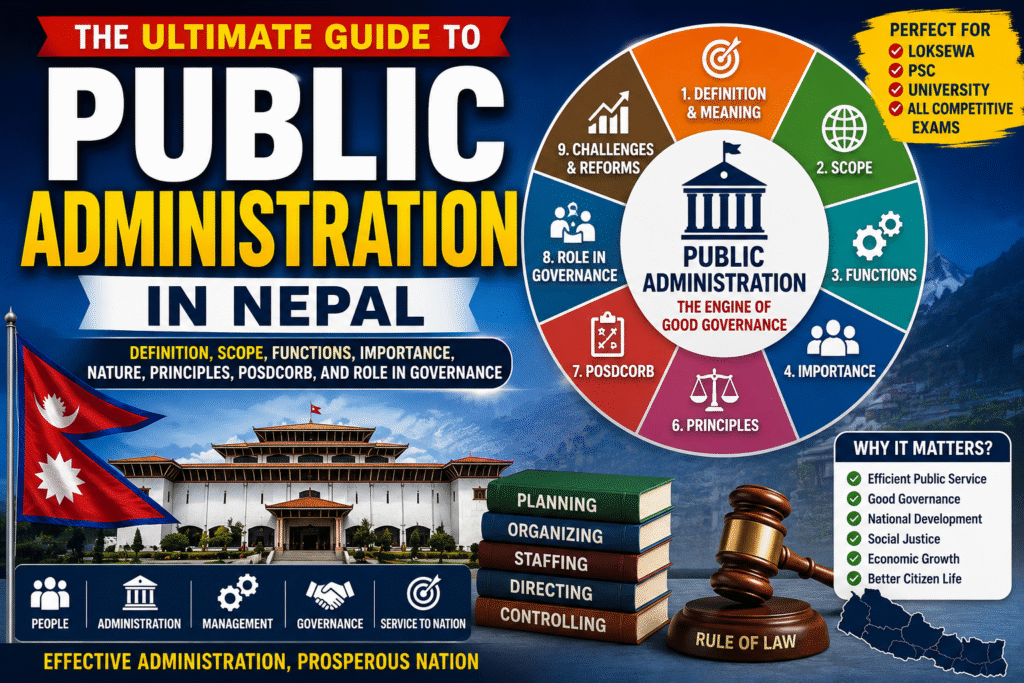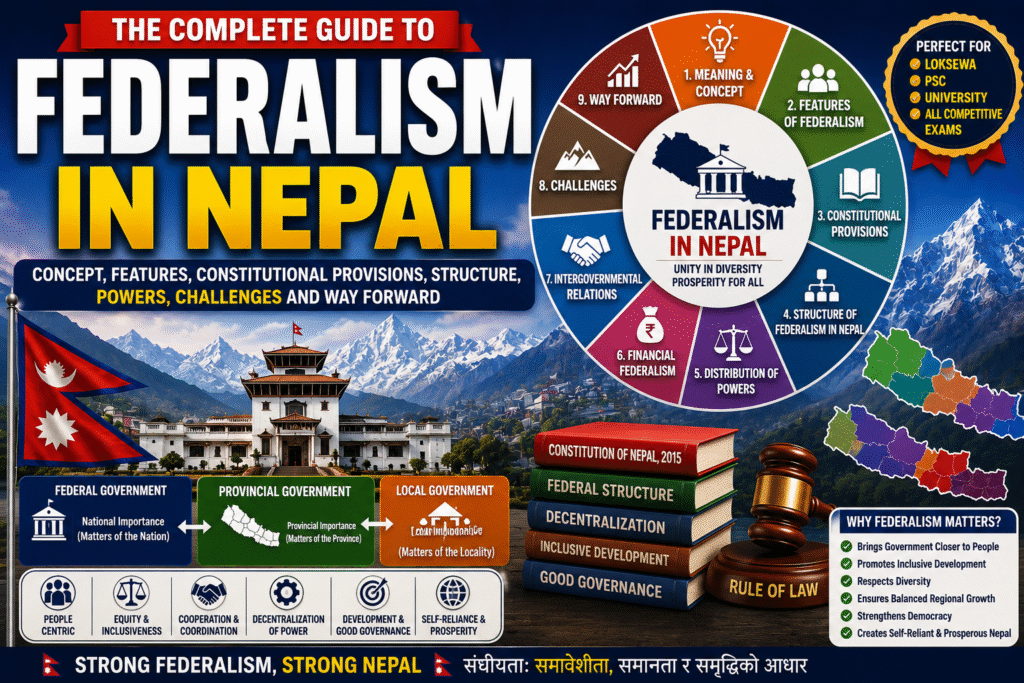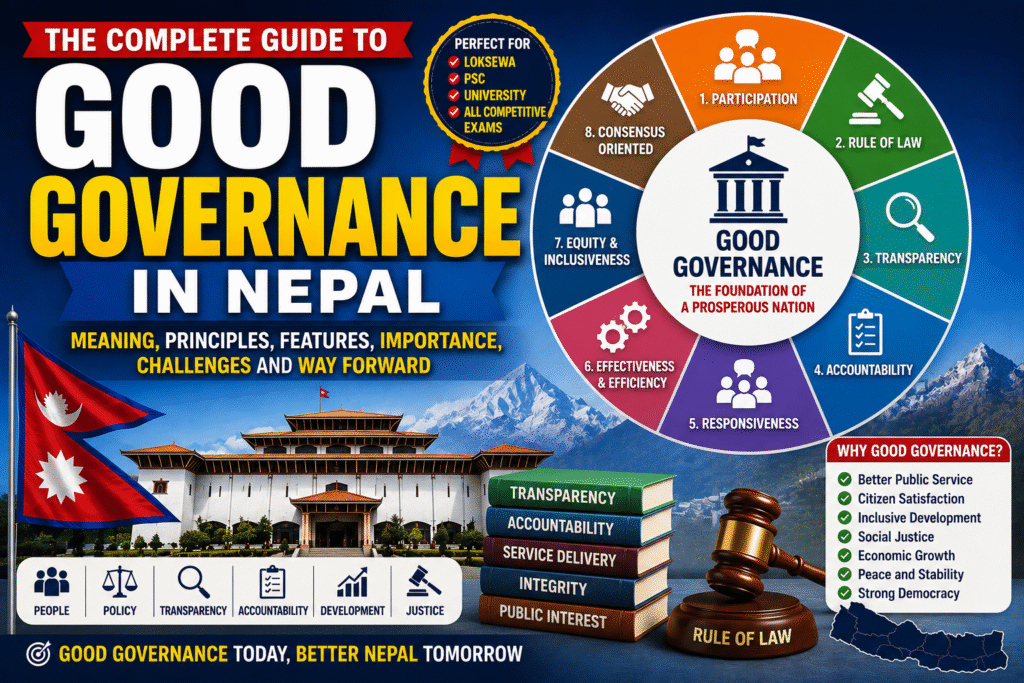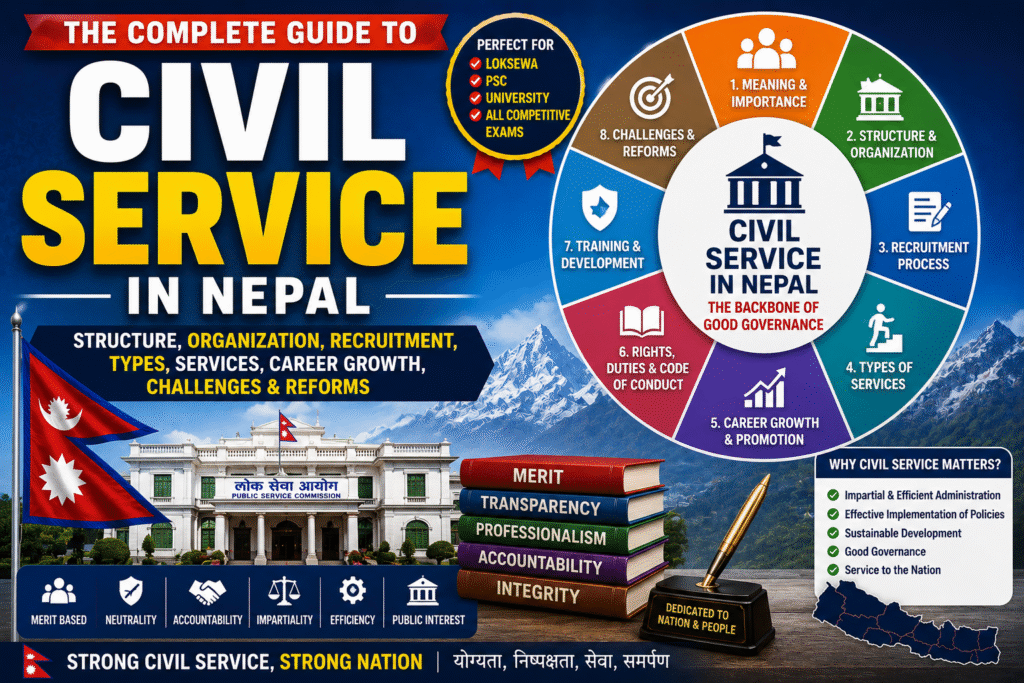
Civil Service in Nepal: Meaning, Features, Constitutional Provisions, Functions, Structure, Recruitment, Challenges, and Reforms
The Ultimate Guide for Loksewa, PSC, University Students, and Competitive Examinations
Introduction
A country’s progress depends not only on its political leadership but also on the efficiency, integrity, and professionalism of the public officials who transform government policies into practical results. While elected representatives formulate laws, determine national priorities, and make policy decisions, it is the Civil Service that ensures these decisions are implemented effectively and continuously. Regardless of changes in political leadership, the civil service remains the permanent administrative machinery that maintains the day-to-day functioning of the government.
Every modern state requires a professional administrative system capable of delivering public services, implementing development programmes, maintaining public records, managing government finances, advising political executives, and safeguarding the rule of law. This permanent administrative system is known as the Civil Service. It serves as the operational backbone of government and plays a decisive role in promoting good governance, ensuring policy continuity, and supporting national development.
In democratic countries, citizens judge the effectiveness of government largely through the quality of public services they receive. Whether obtaining citizenship certificates, passports, business registrations, land records, social security benefits, educational services, healthcare, or disaster relief, citizens interact primarily with civil servants rather than elected leaders. Therefore, the efficiency, responsiveness, transparency, and ethical conduct of civil servants directly influence public trust in government.
In Nepal, the importance of the civil service has increased significantly following the adoption of the Constitution of Nepal, 2015 and the implementation of the federal system of governance. Federalism has redistributed governmental powers among the Federal, Provincial, and Local levels, creating new administrative responsibilities and requiring stronger coordination among public institutions. Consequently, Nepal’s civil service is expected to become more citizen-centred, accountable, efficient, transparent, and service-oriented than ever before.
The Constitution envisions a professional civil service that is politically neutral, merit-based, inclusive, accountable, and dedicated to public welfare. Recruitment through competitive examinations conducted by the Public Service Commission (PSC), constitutional safeguards, administrative reforms, digital governance initiatives, and citizen-oriented service delivery mechanisms all contribute to strengthening the civil service system.
For students preparing for Loksewa, Public Service Commission examinations, universities, and other competitive examinations, the civil service is one of the most important topics within Public Administration. It is closely connected with constitutional law, governance, federalism, public personnel administration, administrative ethics, public policy, and human resource management. Questions relating to civil service frequently appear in objective, short-answer, and analytical examinations.
This comprehensive guide explains the meaning, historical evolution, constitutional foundation, characteristics, objectives, structure, recruitment process, functions, principles, civil service under federalism, major challenges, administrative reforms, and future prospects of the civil service in Nepal. It also highlights the relationship between civil service, democracy, public administration, and good governance, providing readers with a complete conceptual understanding of one of the most significant institutions of the modern state.
Understanding Public Service Before Civil Service
Before studying the concept of the civil service, it is important to distinguish between Public Service and Civil Service, as these two terms are often used interchangeably despite having different meanings.
Public service refers to all services provided by the government for the welfare and benefit of citizens. These services include education, healthcare, law enforcement, transportation, social security, disaster management, infrastructure development, environmental protection, taxation, public administration, and many other governmental functions.
Public services are therefore the activities performed for the public interest, whereas civil service refers to the permanent body of government employees responsible for performing many of these activities.
In simple terms:
- Public Service refers to what the government provides.
- Civil Service refers to who provides many of those services.
Although civil servants constitute the largest segment of public servants, not every individual working in the public sector is necessarily part of the civil service. Employees of public enterprises, security agencies, constitutional bodies, and certain autonomous institutions may belong to different public service systems governed by separate legal frameworks.
Understanding this distinction is essential because civil service represents only one, albeit the most significant, component of the broader public service system.
Meaning of Civil Service
Civil service refers to the permanent professional administrative body of government officials appointed through legally established procedures to implement laws, execute public policies, deliver public services, advise political executives, and manage governmental administration in accordance with the Constitution and laws of the country.
Unlike political leaders, who change through elections or political appointments, civil servants generally continue serving the government irrespective of changes in political leadership. This continuity enables governments to maintain institutional stability, preserve administrative experience, and ensure uninterrupted public service delivery.
Civil service is therefore often described as the permanent executive branch of government, functioning as the bridge between political decisions and administrative implementation.
The effectiveness of government policies depends largely upon the competence, integrity, professionalism, and commitment of the civil service responsible for implementing them.
Scholarly Perspectives
Different scholars and international organizations have defined civil service from various perspectives, but they all emphasize its professional, permanent, and non-political nature.
According to Encyclopaedia Britannica, the civil service is the body of government officials employed in civil occupations that are neither political nor judicial.
Similarly, public administration scholars describe the civil service as a professional administrative institution responsible for implementing public policies and ensuring continuity in government administration.
Despite differences in wording, these definitions share four common characteristics:
- Permanence.
- Professionalism.
- Political neutrality.
- Public service orientation.
These characteristics distinguish civil service from political institutions and reinforce its role as the administrative backbone of the state.
Why Civil Service Matters
The civil service is one of the most important institutions in any democratic government because it transforms governmental decisions into practical outcomes.
Without an efficient civil service:
- Laws cannot be implemented effectively.
- Development projects cannot be executed properly.
- Public services become inefficient.
- Administrative continuity is disrupted.
- Citizens lose confidence in government.
An effective civil service therefore contributes directly to national development, democratic stability, good governance, and social welfare.
For this reason, many scholars describe the civil service as the engine of public administration and the permanent machinery of government.
Historical Evolution of Civil Service in Nepal
The civil service in Nepal has evolved through different political systems, constitutional changes, and administrative reforms. From the centralized Rana administration to the modern federal democratic system established under the Constitution of Nepal, 2015, Nepal’s civil service has undergone significant transformation in terms of structure, recruitment, inclusiveness, and responsibilities.
Understanding this historical development is essential because it explains why Nepal’s civil service operates in its current form and highlights the reforms that have shaped public administration over time.
Civil Service during the Rana Regime (1846–1951)
During the Rana regime, Nepal’s administrative system was highly centralized and controlled by the ruling Rana family. Government positions were largely filled through personal loyalty, family connections, and hereditary privilege rather than merit or open competition.
The civil service functioned primarily to support the interests of the ruling elite rather than to provide citizen-centred public services. Public participation in governance was minimal, administrative transparency was absent, and modern personnel management practices had not yet developed.
Although some administrative institutions were established during this period, the concept of a professional, impartial, and merit-based civil service was largely absent.
Civil Service after the Democratic Revolution of 1951
The political transformation of 1951 marked the beginning of modern public administration in Nepal.
Following the end of the Rana regime, Nepal initiated administrative modernization with the objective of creating a professional bureaucracy capable of supporting democratic governance and national development.
Several important reforms were introduced during this period:
- Expansion of government ministries.
- Modern administrative organization.
- Introduction of merit-based recruitment.
- Establishment of personnel administration systems.
- Increased emphasis on education and professional qualifications.
This period laid the foundation for Nepal’s contemporary civil service.
Establishment of the Public Service Commission
One of the most significant milestones in Nepal’s administrative history was the establishment of the Public Service Commission (PSC).
The PSC introduced open competitive examinations for government recruitment, replacing arbitrary appointment practices with merit-based selection.
This reform significantly strengthened:
- Fair recruitment.
- Administrative professionalism.
- Equal employment opportunities.
- Public confidence in government recruitment.
Today, the PSC remains one of Nepal’s most respected constitutional institutions and serves as the guardian of merit in the civil service.
Civil Service under the Panchayat System (1960–1990)
During the Panchayat era, Nepal experienced significant expansion of governmental administration.
The civil service grew rapidly due to increasing governmental responsibilities in:
- Education.
- Health.
- Agriculture.
- Infrastructure development.
- Rural development.
- Public administration.
Although administrative capacity expanded, political centralization limited bureaucratic independence. Decision-making remained concentrated at the central level, and citizen participation in governance was restricted.
Nevertheless, several administrative reforms introduced during this period contributed to the institutional development of Nepal’s bureaucracy.
Civil Service after the Restoration of Multiparty Democracy (1990)
The restoration of multiparty democracy in 1990 brought renewed emphasis on democratic governance, accountability, transparency, and public sector reform.
Administrative reforms during this period focused on:
- Improving public service delivery.
- Strengthening accountability.
- Enhancing transparency.
- Increasing citizen participation.
- Promoting decentralization.
- Professionalizing the civil service.
The concept of Good Governance gained increasing importance, and administrative institutions were encouraged to become more responsive to citizens’ needs.
Civil Service under the Federal Democratic Republic
The promulgation of the Constitution of Nepal, 2015 introduced the most significant administrative transformation in Nepal’s history.
Federalism fundamentally restructured the organization of government by establishing three constitutionally recognized levels:
- Federal Government
- Provincial Governments
- Local Governments
This transformation required substantial changes in Nepal’s civil service system.
Major reforms included:
- Employee adjustment (Civil Servant Adjustment).
- Redistribution of administrative responsibilities.
- Strengthening provincial administration.
- Expanding local government capacity.
- Clarifying constitutional powers.
- Improving intergovernmental coordination.
Today, Nepal’s civil service functions within a federal administrative framework that emphasizes cooperation, coordination, and coexistence among all three levels of government.
Objectives of Civil Service
The primary objective of the civil service is to implement government policies effectively while serving citizens in accordance with the Constitution and laws.
A professional civil service contributes not only to administrative efficiency but also to democratic governance, national development, and social justice.
The major objectives of the civil service include:
Implement Government Policies
Civil servants translate governmental decisions into practical programmes and administrative actions.
Without effective implementation, even the best public policies cannot produce meaningful results.
Deliver Public Services
Providing quality public services remains one of the most important responsibilities of the civil service.
These services include:
- Education
- Healthcare
- Agriculture
- Revenue administration
- Social security
- Citizenship services
- Infrastructure management
- Disaster response
- Environmental protection
Efficient service delivery improves citizens’ quality of life and strengthens public trust.
Maintain Administrative Continuity
Political governments change through elections, but public administration must continue functioning without interruption.
The civil service ensures institutional continuity regardless of political change.
This stability is essential for effective governance and long-term national development.
Promote Good Governance
Civil servants play a central role in promoting:
- Transparency.
- Accountability.
- Responsiveness.
- Integrity.
- Efficiency.
- Rule of law.
- Citizen participation.
Thus, civil service is one of the most important instruments for achieving good governance.
Support National Development
Development programmes in agriculture, infrastructure, education, healthcare, tourism, industry, and environmental management are largely implemented by civil servants.
Their administrative competence directly influences the success of national development plans.
Safeguard Public Interest
Civil servants are expected to perform their duties impartially and prioritize public welfare over personal or political interests.
Protecting public interest is one of the fundamental ethical responsibilities of the civil service.
Characteristics of Civil Service
Although civil service systems vary across countries, most professional civil services share several common characteristics.
Permanence
Unlike political executives, civil servants generally remain in government service until retirement, subject to applicable laws and regulations.
This permanence provides administrative stability and institutional memory.
Merit-Based Recruitment
Modern civil service emphasizes recruitment based on merit, qualifications, competence, and competitive examinations rather than political influence or personal relationships.
In Nepal, this principle is safeguarded by the Public Service Commission (PSC).
Political Neutrality
Civil servants are expected to remain politically impartial while faithfully implementing the policies of the elected government.
Political neutrality ensures fairness, professionalism, and continuity in administration.
Professionalism
Civil servants are trained professionals possessing specialized knowledge, technical expertise, and administrative skills.
Continuous training and capacity development enhance institutional performance and improve public service delivery.
Accountability
Civil servants are accountable for their decisions, actions, and performance.
They are responsible to:
- The Constitution.
- Applicable laws.
- Government.
- Oversight institutions.
- Ultimately, the citizens they serve.
Accountability strengthens public confidence and promotes responsible administration.
Public Service Orientation
The fundamental purpose of the civil service is to serve the public.
Citizen-centred administration requires civil servants to perform their duties honestly, efficiently, respectfully, and without discrimination.
Rule-Based Administration
Civil servants perform their responsibilities according to constitutional provisions, statutory laws, administrative rules, and established procedures.
Rule-based administration promotes fairness, predictability, and equality before the law.
Fundamental Principles of Civil Service
A modern democratic civil service is built upon several guiding principles that shape its organization and functioning.
The most important principles include:
- Merit
- Neutrality
- Integrity
- Accountability
- Professionalism
- Efficiency
- Responsiveness
- Transparency
- Inclusiveness
- Rule of Law
- Service to Citizens
- Ethical Conduct
These principles ensure that the civil service remains effective, impartial, and committed to public welfare.
Constitutional Provisions Relating to Civil Service in Nepal
The Constitution of Nepal, 2015 recognizes the civil service as an essential component of public administration and provides the constitutional framework for its organization and operation.
Key constitutional features include:
- Establishment of a Federal Civil Service.
- Provision for Provincial Civil Service through provincial laws.
- Merit-based recruitment through the Public Service Commission.
- Inclusive representation in public employment.
- Constitutional status of the Public Service Commission.
- Protection of professional independence.
- Promotion of efficient, accountable, and citizen-oriented administration.
- Federal distribution of administrative responsibilities among Federal, Provincial, and Local Governments.
These constitutional provisions aim to create a modern civil service capable of supporting Nepal’s federal democratic governance system.
Types and Structure of Civil Service in Nepal
A modern civil service is not a single homogeneous organization. It consists of different categories of services, technical and administrative personnel, and institutions working together to ensure the effective functioning of government.
Nepal’s civil service has evolved from a highly centralized administrative system into a federal structure where administrative responsibilities are distributed among the Federal, Provincial, and Local Governments. This restructuring has increased both the complexity and the importance of an efficient civil service.
Understanding the types, organizational structure, and classification of the civil service is essential for comprehending how government functions in practice.
Types of Civil Service in Nepal
Following the implementation of federalism, Nepal’s public administration operates through three constitutionally recognized levels of government.
Federal Civil Service
The Federal Civil Service consists of government employees working under the Government of Nepal (Federal Government).
Federal civil servants are primarily responsible for:
- Formulating national policies.
- Implementing federal laws.
- Managing foreign affairs.
- National security administration.
- Central financial administration.
- National planning.
- International cooperation.
- National-level regulatory functions.
Federal ministries, departments, commissions, and constitutional bodies are largely staffed by federal civil servants.
Provincial Civil Service
Each province has the authority to establish its own provincial civil service through provincial legislation.
Provincial civil servants mainly perform functions related to:
- Provincial policy implementation.
- Provincial development planning.
- Provincial public service delivery.
- Provincial administration.
- Coordination between federal and local governments.
Although provincial civil services are still evolving, they are expected to become increasingly important as federalism matures.
Local Civil Service
Local governments constitute the level of government closest to citizens.
Local civil servants work in:
- Metropolitan Cities
- Sub-Metropolitan Cities
- Municipalities
- Rural Municipalities
Their major responsibilities include:
- Local development planning.
- Registration services.
- Local taxation.
- Basic education administration.
- Basic health services.
- Agriculture extension.
- Local infrastructure.
- Social security distribution.
- Environmental management.
- Disaster response.
Because citizens interact most frequently with local governments, the quality of local civil service significantly influences public satisfaction.
Classification of Civil Service
Civil service may also be classified based on the nature of work performed.
Administrative Service
Administrative officers coordinate government programmes, formulate administrative decisions, supervise implementation, and manage public institutions.
They serve as the backbone of governmental administration.
Technical Service
Technical civil servants possess specialized professional knowledge.
Examples include:
- Engineers
- Medical Officers
- Agricultural Officers
- Veterinary Officers
- Forest Officers
- Information Technology Specialists
- Statisticians
- Economists
Their technical expertise supports evidence-based policymaking and effective implementation of development programmes.
Financial Service
Financial service personnel are responsible for:
- Budget preparation.
- Revenue administration.
- Public expenditure.
- Financial reporting.
- Government accounting.
- Fiscal management.
Efficient financial administration promotes transparency and accountability.
Legal Service
Legal officers provide legal advice to government institutions.
Their responsibilities include:
- Drafting legislation.
- Legal interpretation.
- Representing government in legal matters.
- Ensuring compliance with constitutional and statutory provisions.
Organizational Structure of Nepal’s Civil Service
The civil service operates through a hierarchical administrative structure that clearly defines authority, responsibility, and accountability.
Although the exact organizational structure varies among ministries and departments, a simplified hierarchy is generally as follows:
| Level | Major Position |
|---|---|
| Political Leadership | Minister |
| Administrative Leadership | Secretary |
| Senior Administration | Joint Secretary |
| Middle Management | Under Secretary |
| Section Management | Section Officer |
| Operational Level | Assistant Officers |
| Support Staff | Administrative and Technical Employees |
This hierarchy facilitates effective coordination, supervision, delegation of authority, and implementation of government policies.
Public Service Commission (PSC): Guardian of Merit
One of the defining characteristics of Nepal’s civil service is its merit-based recruitment system.
The Public Service Commission (Lok Sewa Aayog) is an independent constitutional body responsible for ensuring fairness, transparency, and competitiveness in public recruitment.
Its constitutional independence helps protect the civil service from political interference and promotes equal employment opportunities.
Constitutional Status
The Constitution of Nepal recognizes the Public Service Commission as an independent constitutional commission.
Its independence ensures that recruitment decisions are based on competence rather than political influence.
Major Functions of the Public Service Commission
The PSC performs several important responsibilities, including:
- Conducting competitive examinations.
- Recommending qualified candidates for appointment.
- Advising government on civil service matters.
- Evaluating recruitment procedures.
- Maintaining fairness in selection.
- Promoting merit-based public employment.
Through these functions, the PSC contributes significantly to professionalism and administrative integrity.
Recruitment Process in Nepal’s Civil Service
Recruitment into the civil service follows a transparent and competitive process designed to identify the most capable candidates.
Although procedures may vary depending on the position, the general recruitment process includes the following stages.
Vacancy Announcement
The concerned authority publishes vacancies through official notices.
The announcement specifies:
- Position.
- Qualification requirements.
- Age limits.
- Reservation categories.
- Application procedures.
- Examination schedule.
Public advertisement ensures equal opportunity for eligible candidates.
Application Process
Interested candidates submit applications within the prescribed time along with required documents and examination fees.
Applications are scrutinized to verify eligibility.
Competitive Examination
The competitive examination is the core component of merit-based recruitment.
Depending on the post, examinations may include:
- Written examination.
- Objective questions.
- Subjective questions.
- Practical examination.
- Skill test.
Competitive examinations ensure fairness and transparency.
Interview
Candidates who successfully pass the written examination are invited for interviews.
The interview evaluates:
- Subject knowledge.
- Communication skills.
- Analytical ability.
- Decision-making capacity.
- Professional attitude.
- Personality.
The interview complements the written examination by assessing qualities that cannot easily be measured through written tests alone.
Final Recommendation
After completing all evaluation stages, the Public Service Commission recommends successful candidates for appointment.
Appointments are then made by the concerned governmental authority according to applicable laws.
Inclusive Recruitment System
One of the major reforms in Nepal’s civil service has been the adoption of an inclusive recruitment policy.
Inclusive recruitment seeks to ensure equitable representation of historically marginalized communities.
Reservation provisions generally promote opportunities for:
- Women.
- Indigenous Nationalities (Adivasi Janajati).
- Madhesi communities.
- Dalits.
- Persons with Disabilities.
- Backward Regions.
- Other constitutionally recognized groups.
This policy strengthens social justice, diversity, and representative bureaucracy.
Training and Capacity Development
Recruitment marks only the beginning of a civil servant’s professional journey.
Continuous learning is essential because governance challenges, laws, technology, and citizens’ expectations evolve over time.
Training programmes aim to enhance:
- Administrative competence.
- Leadership.
- Ethical conduct.
- Digital skills.
- Financial management.
- Policy implementation.
- Public service delivery.
- Disaster management.
- Communication skills.
Institutions such as the Nepal Administrative Staff College (NASC) play a crucial role in strengthening the capacity of Nepal’s civil servants through professional training and research.
Promotion and Career Development
A professional civil service encourages career progression based on performance, experience, qualifications, and applicable legal provisions.
Promotion serves several important purposes:
- Motivates employees.
- Rewards merit and performance.
- Retains experienced personnel.
- Develops future leaders.
- Strengthens institutional effectiveness.
An objective and transparent promotion system contributes to both employee morale and organizational efficiency.
Exam Tip
In Loksewa descriptive questions, try to connect Public Service Commission, merit-based recruitment, inclusive representation, and professional civil service in the same answer. These concepts are closely linked and demonstrate a comprehensive understanding of Nepal’s public personnel administration.
Functions and Roles of Civil Service
The civil service is often described as the administrative backbone of the government because it performs a wide range of responsibilities essential for the effective functioning of the state. While political leaders determine national priorities and formulate public policies, civil servants convert those policies into practical programmes and ensure their successful implementation.
In modern democratic governance, the responsibilities of civil servants extend far beyond routine administrative work. They contribute to policy formulation, development planning, financial management, public service delivery, disaster response, digital transformation, and institutional reforms.
The following are the major functions of the civil service.
Policy Implementation
The implementation of government policies is one of the most fundamental responsibilities of the civil service.
After Parliament enacts laws and the Council of Ministers formulates policies, civil servants prepare implementation plans, allocate resources, coordinate institutions, supervise field-level activities, and monitor progress.
Without an efficient civil service, even well-designed public policies cannot produce the intended outcomes.
Thus, civil servants serve as the bridge between political decisions and practical implementation.
Policy Advice
Although political executives make final decisions, they rely heavily on professional advice provided by civil servants.
Senior civil servants assist ministers by:
- Conducting policy analysis.
- Preparing policy options.
- Assessing potential impacts.
- Providing technical expertise.
- Drafting cabinet documents.
- Preparing legislative proposals.
- Offering evidence-based recommendations.
Their professional knowledge contributes to informed and rational policymaking.
Public Service Delivery
Delivering quality public services remains one of the most visible responsibilities of the civil service.
Citizens interact with government institutions for various services such as:
- Citizenship certificates.
- Passport services.
- Business registration.
- Land administration.
- Tax administration.
- Agricultural extension services.
- Public healthcare.
- Educational administration.
- Social security programmes.
- Disaster relief.
- Infrastructure maintenance.
Efficient, accessible, and citizen-friendly service delivery enhances public confidence in government.
Development Administration
Civil servants play a central role in implementing national development programmes.
Their responsibilities include:
- Planning development projects.
- Managing budgets.
- Supervising construction activities.
- Coordinating stakeholders.
- Monitoring project implementation.
- Evaluating development outcomes.
Sectors such as agriculture, irrigation, transportation, education, healthcare, drinking water, tourism, and energy depend significantly on competent civil servants.
Financial Administration
Effective financial management is essential for accountable governance.
Civil servants perform important financial responsibilities, including:
- Budget preparation.
- Revenue collection.
- Public expenditure management.
- Financial reporting.
- Internal financial control.
- Resource allocation.
Proper financial administration ensures that public funds are utilized efficiently, transparently, and lawfully.
Regulatory Administration
Governments regulate economic and social activities to protect public interest.
Civil servants assist in:
- Licensing businesses.
- Environmental regulation.
- Consumer protection.
- Food safety.
- Building standards.
- Public health regulation.
- Market supervision.
Regulatory administration promotes fairness, safety, and sustainable development.
Coordination among Government Institutions
Modern governance requires cooperation among numerous ministries, departments, constitutional bodies, provincial governments, and local governments.
Civil servants facilitate coordination by:
- Sharing information.
- Organizing inter-agency meetings.
- Harmonizing policies.
- Resolving administrative conflicts.
- Promoting cooperative governance.
Effective coordination becomes even more important under Nepal’s federal system.
Record Management
Government institutions generate vast amounts of information.
Civil servants are responsible for:
- Maintaining official records.
- Preserving government documents.
- Managing archives.
- Maintaining digital databases.
- Protecting confidential information.
Accurate record management supports transparency, accountability, and administrative continuity.
Crisis and Disaster Management
During emergencies such as earthquakes, floods, pandemics, or other disasters, civil servants play an indispensable role.
Their responsibilities include:
- Emergency coordination.
- Relief distribution.
- Resource mobilization.
- Public communication.
- Rehabilitation planning.
- Recovery monitoring.
Nepal’s experience during the 2015 Gorkha Earthquake and the COVID-19 pandemic demonstrated the critical importance of a competent civil service in responding to national emergencies.
Promoting Good Governance
Civil servants are the primary implementers of the principles of good governance.
They promote:
- Transparency.
- Accountability.
- Responsiveness.
- Rule of Law.
- Efficiency.
- Integrity.
- Citizen participation.
Through ethical and professional conduct, civil servants strengthen public trust and democratic governance.
Civil Service and Democracy
Democracy requires more than periodic elections. It also requires an efficient administrative system capable of implementing the decisions of democratically elected governments.
Civil servants contribute to democracy by:
- Respecting constitutional principles.
- Implementing laws impartially.
- Protecting citizens’ rights.
- Providing equal public services.
- Maintaining political neutrality.
- Supporting democratic institutions.
An impartial civil service ensures that governmental administration remains stable despite changes in political leadership.
Civil Service and Good Governance
The relationship between civil service and good governance is inseparable.
Good governance cannot be achieved without competent and ethical civil servants.
Similarly, civil servants can perform effectively only when governance systems promote transparency, accountability, and professionalism.
Civil servants contribute to good governance by:
- Delivering efficient public services.
- Ensuring accountability.
- Following legal procedures.
- Promoting transparency.
- Responding to citizens’ needs.
- Managing public resources responsibly.
Thus, civil service serves as the operational foundation of good governance.
Civil Service under Federalism
The adoption of federalism has significantly transformed Nepal’s civil service.
Instead of operating under a highly centralized administrative structure, civil servants now work across three levels of government.
Federalism has introduced several new administrative responsibilities, including:
- Intergovernmental coordination.
- Employee adjustment.
- Capacity development at provincial and local levels.
- Shared administrative responsibilities.
- Decentralized decision-making.
- Strengthening local governance.
Civil servants today require broader knowledge, stronger coordination skills, and greater adaptability than under the previous unitary system.
Administrative Ethics in Civil Service
Administrative ethics refers to the moral principles and professional standards that guide the conduct of civil servants while performing public responsibilities.
Ethical administration strengthens public confidence and protects the integrity of government institutions.
Important ethical values include:
- Honesty.
- Integrity.
- Impartiality.
- Accountability.
- Transparency.
- Confidentiality.
- Respect for citizens.
- Professional competence.
- Commitment to public welfare.
Ethics ensures that public authority is exercised responsibly rather than for personal benefit.
Code of Conduct for Civil Servants
Civil servants are expected to follow a professional code of conduct while performing official duties.
Although specific legal provisions are contained in Nepal’s civil service laws and regulations, the general expectations include:
- Acting impartially.
- Avoiding conflicts of interest.
- Maintaining political neutrality.
- Respecting confidentiality.
- Performing duties honestly.
- Using public resources responsibly.
- Treating citizens with dignity and respect.
- Following constitutional and legal provisions.
Adherence to the code of conduct promotes integrity and public confidence.
Rights and Duties of Civil Servants
Civil servants possess certain legal rights while also carrying important responsibilities toward the state and citizens.
Rights
- Fair remuneration.
- Promotion opportunities.
- Training and professional development.
- Job security as provided by law.
- Safe working conditions.
- Leave and retirement benefits.
- Protection under applicable service laws.
Duties
- Faithfully implement laws and policies.
- Serve citizens impartially.
- Maintain integrity.
- Protect public property.
- Ensure confidentiality where required.
- Respect constitutional values.
- Promote efficient public administration.
- Uphold the public interest above personal interest.
The balance between rights and duties helps create a professional, motivated, and accountable civil service.
Loksewa Insight
In analytical questions, always connect Civil Service, Public Administration, Good Governance, and Federalism. These concepts complement each other and demonstrate a mature understanding of Nepal’s governance system. Rather than explaining them in isolation, showing their interrelationship generally leads to stronger answers in descriptive examinations.
Challenges of Civil Service in Nepal
Despite significant constitutional reforms, merit-based recruitment, and continuous administrative improvements, Nepal’s civil service still faces numerous structural, institutional, and operational challenges. These challenges affect the efficiency of public administration, the quality of public service delivery, and the overall achievement of good governance.
Understanding these issues is particularly important for Loksewa and university examinations because analytical questions frequently require candidates to identify problems and propose practical solutions.
Political Interference
One of the most frequently discussed challenges is political interference in administrative affairs.
Although civil servants are expected to remain politically neutral, administrative decisions are sometimes influenced by political considerations.
Political interference may affect:
- Administrative transfers.
- Promotions.
- Decision-making.
- Policy implementation.
- Institutional independence.
Such interference weakens professionalism, reduces morale, and limits administrative efficiency.
A professional civil service requires a healthy balance between political leadership and administrative autonomy.
Bureaucratic Red Tape
Complex administrative procedures, excessive paperwork, and lengthy approval processes continue to slow government operations.
Red tape often results in:
- Delayed public services.
- Increased administrative costs.
- Citizen dissatisfaction.
- Reduced institutional efficiency.
Administrative simplification, process reengineering, and digital governance are essential to reduce unnecessary bureaucracy.
Corruption
Corruption remains one of the greatest threats to an effective civil service.
Misuse of authority, lack of transparency, unethical practices, and weak accountability mechanisms undermine public confidence in government.
The consequences of corruption include:
- Misallocation of public resources.
- Poor quality infrastructure.
- Reduced investment.
- Weak institutional credibility.
- Slower economic development.
Strengthening integrity, transparency, and oversight institutions is therefore essential.
Limited Institutional Capacity
Many government offices continue to face shortages of:
- Skilled human resources.
- Technical expertise.
- Modern technology.
- Financial resources.
- Research capacity.
Limited institutional capacity affects policy implementation and service delivery, particularly at the provincial and local levels.
Continuous training, adequate staffing, and investment in institutional development are necessary.
Human Resource Management Issues
Effective public administration depends on efficient human resource management.
However, several challenges remain:
- Unequal staff distribution.
- Skill mismatches.
- Limited career development opportunities.
- Inadequate performance evaluation.
- Motivation-related issues.
Modern HRM practices can significantly improve organizational performance.
Challenges under Federalism
Federal restructuring has created both opportunities and challenges for Nepal’s civil service.
Some major issues include:
- Employee adjustment and deployment.
- Role clarification among three levels of government.
- Capacity differences between provinces and local governments.
- Coordination challenges.
- Resource sharing.
- Administrative duplication.
As federal institutions mature, these issues are expected to become more manageable through clearer legal frameworks and improved intergovernmental cooperation.
Slow Digital Transformation
Although Nepal has made considerable progress in digital governance, many public institutions continue to rely heavily on traditional paper-based administrative systems.
Challenges include:
- Limited digital infrastructure.
- Unequal internet access.
- Insufficient IT capacity.
- Cybersecurity concerns.
- Resistance to organizational change.
Accelerating digital transformation is essential for improving administrative efficiency.
Public Trust and Citizen Expectations
Citizens today expect government services that are:
- Fast.
- Transparent.
- Accessible.
- Reliable.
- Technology-driven.
Failure to meet these expectations can reduce public trust.
Modern civil servants must therefore adopt a citizen-centred approach focused on service quality and responsiveness.
Administrative Reforms in Nepal
Administrative reform is a continuous process aimed at improving the effectiveness, efficiency, accountability, and responsiveness of public administration.
Nepal has implemented several reforms over the past decades to modernize its civil service.
Major reform initiatives include:
- Merit-based recruitment through the Public Service Commission.
- Federal restructuring of public administration.
- Inclusive recruitment policy.
- Citizen Charter implementation.
- Right to Information implementation.
- Good Governance (Management and Operation) Act.
- E-governance initiatives.
- Performance evaluation systems.
- Administrative decentralization.
- Capacity-building programmes.
These reforms seek to strengthen institutional performance and improve public service delivery.
Digital Governance and the Future of Civil Service
Rapid technological advancement is transforming public administration across the world.
Nepal is gradually embracing digital governance to make government services more efficient, transparent, and accessible.
Digital governance includes:
- Online public services.
- Electronic document management.
- Digital payment systems.
- Electronic procurement (e-GP).
- Integrated government databases.
- Online tax administration.
- Digital identity systems.
- Artificial intelligence-assisted public administration.
- Data-driven policymaking.
The future civil servant will require not only administrative knowledge but also digital literacy, analytical skills, innovation, and adaptability.
Future of Civil Service in Nepal
The future of Nepal’s civil service depends on its ability to adapt to changing governance needs while maintaining professionalism, neutrality, and integrity.
Future priorities include:
- Strengthening meritocracy.
- Improving ethical leadership.
- Expanding digital governance.
- Enhancing citizen participation.
- Building evidence-based policymaking.
- Improving intergovernmental coordination.
- Developing leadership capacity.
- Modernizing public personnel management.
- Encouraging innovation.
- Strengthening accountability mechanisms.
A modern civil service should become more citizen-oriented, technology-driven, transparent, and performance-based.
Civil Service at a Glance
| Aspect | Summary |
|---|---|
| Meaning | Permanent professional administrative body of government |
| Constitutional Basis | Constitution of Nepal, 2015 |
| Recruitment | Public Service Commission (Merit-based) |
| Levels | Federal, Provincial, Local |
| Core Principles | Merit, Neutrality, Accountability, Integrity, Professionalism |
| Major Functions | Policy implementation, service delivery, development administration, financial management |
| Major Challenges | Political interference, corruption, red tape, weak capacity, digital transformation |
| Major Reforms | Federalism, inclusiveness, e-governance, merit-based recruitment |
Frequently Asked Questions (FAQs)
What is Civil Service?
Civil service is the permanent professional body of government employees responsible for implementing laws, executing public policies, delivering public services, and supporting the day-to-day administration of the state.
Why is Civil Service important?
Civil service ensures continuity of government, implements public policies, delivers essential public services, promotes good governance, and supports national development regardless of changes in political leadership.
Which institution recruits civil servants in Nepal?
The Public Service Commission (Lok Sewa Aayog) conducts competitive examinations and recommends qualified candidates for appointment based on merit.
What are the main characteristics of Civil Service?
The major characteristics include:
- Permanence
- Merit-based recruitment
- Political neutrality
- Professionalism
- Accountability
- Public service orientation
- Rule-based administration
How has federalism changed Nepal’s Civil Service?
Federalism has created a three-tier administrative system consisting of Federal, Provincial, and Local Civil Services. It has decentralized administrative responsibilities, strengthened local governance, and increased the need for coordination among all levels of government.
Practice Questions
Short Questions
- Define Civil Service.
- Distinguish between Public Service and Civil Service.
- Explain the characteristics of Civil Service.
- Discuss the role of the Public Service Commission.
- State the major principles of Civil Service.
Long Questions
- Explain the concept, objectives, characteristics, and functions of Civil Service in Nepal.
- Discuss the constitutional provisions relating to Civil Service in Nepal.
- Analyze the challenges facing Nepal’s Civil Service and suggest measures for reform.
- Evaluate the role of the Public Service Commission in promoting merit-based recruitment.
- Examine the relationship between Civil Service, Good Governance, and Federalism.
Quick Revision Notes
- Civil Service is the permanent administrative machinery of government.
- Public Service refers to the services provided by the government, while Civil Service refers to the officials who administer many of those services.
- Nepal’s Civil Service operates at Federal, Provincial, and Local levels.
- Recruitment is conducted through the Public Service Commission (PSC) based on merit and inclusiveness.
- Core principles include merit, neutrality, accountability, professionalism, integrity, transparency, and service to citizens.
- Civil servants play a central role in policy implementation, development administration, public service delivery, financial management, and promoting good governance.
- Major challenges include political interference, corruption, bureaucratic delays, capacity constraints, and digital transformation.
- Future reforms should focus on digital governance, performance-based management, ethical leadership, and stronger institutional capacity.
Conclusion
The civil service is one of the most vital institutions of the modern state, serving as the permanent administrative machinery that transforms government policies into meaningful public outcomes. While elected leaders provide political direction, civil servants ensure continuity, professionalism, and effective implementation of laws and development programmes. Their work directly influences the quality of governance, public trust, and national development.
In Nepal, the civil service has evolved from a centralized bureaucracy into a federal administrative system guided by the Constitution of Nepal, 2015. Merit-based recruitment through the Public Service Commission, inclusive representation, constitutional safeguards, and administrative reforms have strengthened its institutional foundation. At the same time, federalism has expanded the responsibilities of civil servants by requiring greater coordination among the Federal, Provincial, and Local Governments.
Despite notable progress, challenges such as political interference, corruption, bureaucratic delays, capacity limitations, and the need for accelerated digital transformation continue to affect administrative performance. Addressing these issues requires sustained reform, ethical leadership, professional development, and a citizen-centred approach to public service.
Ultimately, a competent, impartial, accountable, and forward-looking civil service is indispensable for strengthening democracy, promoting good governance, ensuring effective public service delivery, and achieving sustainable national development. As Nepal continues its federal journey, the success of governance reforms will depend significantly on the professionalism, integrity, and adaptability of its civil servants.
References
- Constitution of Nepal, 2015
- Civil Service Act, 2049 (with amendments)
- Public Service Commission Act and Regulations
- Good Governance (Management and Operation) Act, 2064
- Right to Information Act, 2064
- United Nations Development Programme (UNDP)
- World Bank – Governance and Public Sector Management
- Nepal Administrative Staff College (NASC)
- Asian Development Bank (ADB)
About the Author
Loksewa Aayog Tayariclass publishes research-based study materials, detailed notes, MCQs, exam-focused articles, and high-quality educational resources for Loksewa, PSC, and university students in Nepal. Our mission is to make competitive exam preparation simple, reliable, and accessible through well-structured and evidence-based content.