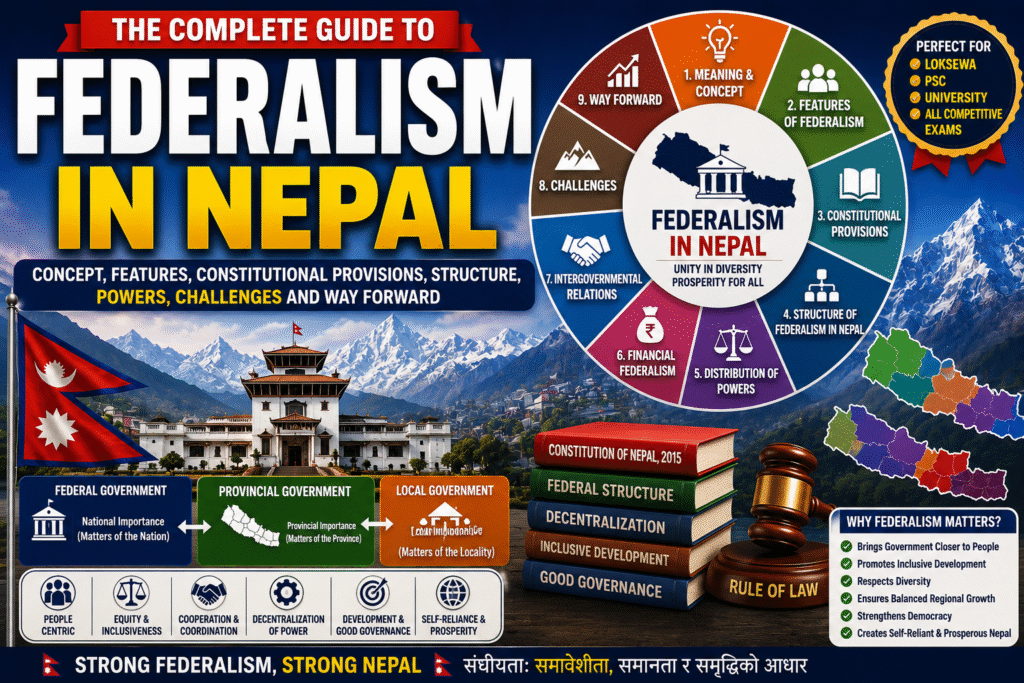
Federalism in Nepal: Meaning, Constitutional Framework, Structure, Powers, Challenges, and Importance
The Ultimate Guide for Loksewa, University Students, and Competitive Examinations
Introduction
Federalism is one of the most important constitutional and governance concepts in the modern world. It is a system of government designed to balance national unity with regional autonomy by distributing governmental powers among different levels of government. Rather than concentrating all authority in a single central institution, federalism creates multiple constitutionally recognized governments that exercise their own powers while cooperating to achieve common national objectives.
For countries with diverse geography, cultures, languages, ethnic communities, and economic conditions, federalism provides a practical framework for democratic governance. It enables governments to make decisions closer to the people while preserving the sovereignty and integrity of the nation.
Nepal’s transition to federalism marks one of the most significant political and constitutional transformations in its modern history. Following decades of centralized governance and years of political reform, Nepal adopted a federal system through the Constitution of Nepal, 2015 (2072 B.S.), replacing the unitary model with a three-tier structure consisting of the Federal Government, Provincial Governments, and Local Governments.
The purpose of this transformation extends beyond administrative restructuring. Federalism aims to decentralize power, strengthen democracy, promote inclusion, improve public service delivery, encourage citizen participation, and ensure balanced regional development throughout the country.
Today, federalism forms the constitutional foundation of Nepal’s governance system and influences virtually every aspect of public administration, constitutional law, development planning, local governance, and public policy. For this reason, it occupies a central place in the syllabus of the Loksewa Aayog, universities, and other competitive examinations.
This guide has been prepared to provide a clear, structured, and comprehensive understanding of federalism in Nepal. Instead of presenting isolated definitions or constitutional provisions, it explains the concept from theoretical, constitutional, administrative, and practical perspectives, enabling readers to build a strong conceptual foundation.
What is Federalism?
Federalism is a constitutional system in which governmental powers are divided and shared among different levels of government. Each level derives its authority directly from the Constitution and exercises its powers independently within its constitutional jurisdiction.
Unlike a unitary system, where the central government possesses most governmental authority, a federal system distributes legislative, executive, and financial powers among multiple governments. This distribution allows decisions to be taken at the level where they can be implemented most effectively while maintaining national unity under a single Constitution.
In simple words, federalism means sharing power without dividing the nation. Citizens remain under one sovereign state, one Constitution, and one citizenship, but governance responsibilities are constitutionally allocated among different levels of government.
The essence of federalism lies in cooperation rather than competition. Every level of government performs its assigned responsibilities while working together to achieve national development, democratic governance, and public welfare.
Origin of the Term “Federal”
The word Federal originates from the Latin word Foedus, which means agreement, covenant, treaty, or pact. The term reflects the historical practice of independent political communities entering into agreements to cooperate for common purposes while retaining a degree of self-government.
Over time, this idea evolved into the modern concept of federalism, where different governments coexist within a single sovereign state under a common Constitution. Although federal systems vary from country to country, they all share the same underlying principle: constitutional sharing of governmental authority.
Scholarly Definitions of Federalism
Political scientists have explained federalism from different perspectives, but they all emphasize constitutional division of powers and cooperation among governments.
K. C. Wheare defined federal government as “a method of dividing powers so that the general and regional governments are each, within a sphere, coordinate and independent.” This definition highlights constitutional independence and the coexistence of different governments.
Ronald L. Watts viewed federalism as a constitutional partnership that combines national unity with regional autonomy. According to him, federalism allows different levels of government to cooperate while respecting diversity and local self-government.
William H. Riker emphasized the political aspect of federalism, arguing that it emerges when political leaders agree to share governmental authority rather than concentrating all power in a central institution.
Despite differences in wording, these scholars agree on one central principle: federalism constitutionally distributes governmental powers while preserving the unity of the state.
Essential Characteristics of Federalism
A country can be described as federal only when several essential constitutional characteristics are present.
First, there must be a written Constitution that clearly establishes the structure of government and distributes powers among different levels. The Constitution serves as the supreme law and provides legal certainty for all governments.
Second, there must be a constitutional division of powers. Responsibilities are not delegated temporarily but permanently allocated by the Constitution.
Third, a federal state contains multiple constitutionally recognized governments. Each government exercises authority within its own jurisdiction and performs responsibilities assigned by the Constitution.
Fourth, constitutional supremacy ensures that no level of government acts beyond its constitutional authority. Every institution remains subject to the Constitution.
Fifth, an independent judiciary interprets the Constitution and resolves disputes among different levels of government, protecting the federal balance.
Finally, successful federalism requires cooperation, coordination, and mutual respect among governments. Constitutional provisions alone cannot guarantee effective federal governance unless all levels work together in the public interest.
Exam Insight: A high-scoring Loksewa answer should not stop at defining federalism. It should briefly mention its constitutional basis, key characteristics, and relevance to Nepal’s governance system.
Historical Evolution of Federalism
To understand federalism in Nepal, it is important to understand how the idea of federalism developed throughout history. Federalism did not emerge overnight. It is the result of centuries of political thought, constitutional evolution, and practical governance.
Since ancient times, societies have faced a common challenge: How can different communities live together under one nation while preserving their local identity and autonomy?
Initially, many kingdoms and political communities functioned independently. However, as trade expanded, security challenges increased, and societies became more interconnected, these communities realized that cooperation was essential. They needed a system that would allow them to work together on national matters while still managing their own local affairs.
This need gradually gave birth to the concept of federalism.
The term “Federal” originates from the Latin word Foedus, meaning agreement, covenant, or treaty. Historically, this referred to an agreement among independent political communities to cooperate under a common authority without surrendering all their individual powers.
Modern federalism took its strongest constitutional form with the adoption of the United States Constitution in 1787. The thirteen American states agreed to establish a stronger national government while preserving the constitutional powers of individual states. This became one of the world’s earliest and most influential examples of modern federalism.
Inspired by this model, several countries later adopted federal systems according to their own historical, geographical, and political circumstances.
Some of the major federal countries today include:
- United States
- Canada
- Switzerland
- Germany
- Australia
- India
- Brazil
- Nepal
Although the institutional arrangements differ from one country to another, every federal state shares one common principle:
Governmental powers are constitutionally divided among different levels of government while maintaining one sovereign nation.
Evolution of Federalism in Nepal
Nepal’s journey toward federalism followed a different path from countries such as the United States or Canada.
For many decades, Nepal operated under a highly centralized unitary system. Most political authority, financial resources, and administrative decisions were concentrated at the central level. While this system maintained centralized control, it also created several long-term challenges, including unequal development, limited local participation, and difficulties in delivering public services to geographically diverse regions.
Over time, demands for greater inclusion, decentralization, regional representation, and participatory democracy became stronger. Political reforms, democratic movements, and constitutional changes gradually shaped the national debate on restructuring the state.
A major turning point came after the People’s Movement of 2006 (Jana Andolan II). The movement emphasized democracy, inclusion, social justice, and state restructuring. These aspirations were further reflected in the Comprehensive Peace Accord (2006), which committed Nepal to restructuring the state in an inclusive and democratic manner.
Following extensive political dialogue and constitutional drafting, Nepal officially adopted federalism through the Constitution of Nepal, 2015 (2072 B.S.).
The Constitution transformed Nepal from a unitary state into a Federal Democratic Republic and established a three-tier system of government consisting of the Federal Government, Provincial Governments, and Local Governments.
This constitutional transformation marked one of the most significant milestones in Nepal’s modern political history.
💡 Remember This
Federalism in Nepal was not introduced merely to create provinces. Its broader purpose was to decentralize power, strengthen democracy, promote inclusion, improve governance, and ensure balanced national development.
Why Did Nepal Adopt Federalism?
The adoption of federalism was driven by multiple constitutional, political, administrative, economic, and social considerations. Rather than serving a single objective, federalism was intended to address several long-standing governance challenges simultaneously.
1. Decentralization of Power
One of the primary objectives of federalism is to distribute governmental authority among different levels of government.
Under the previous centralized system, major decisions regarding development, administration, and public services were made primarily by the central government. This often delayed decision-making and reduced the responsiveness of public institutions to local needs.
Federalism brings decision-making closer to citizens, enabling governments at different levels to respond more effectively to regional priorities.
2. Strengthening Democracy
Federalism expands democratic participation by creating elected governments at the federal, provincial, and local levels.
Citizens are now able to participate more directly in governance through their local representatives, making democracy more inclusive and accountable.
3. Promoting Inclusion
Nepal is home to diverse ethnic groups, languages, cultures, religions, and geographical regions.
Federalism seeks to ensure that this diversity is reflected in governance by creating greater opportunities for representation and participation in public decision-making.
This contributes to a more inclusive democratic system.
4. Balanced Regional Development
Development opportunities have historically been uneven across different regions of Nepal.
Federalism enables provincial and local governments to identify their own priorities and implement development programmes suited to local conditions.
This helps reduce regional disparities and promotes more balanced national development.
5. Improving Public Service Delivery
Governments located closer to the people are generally better positioned to understand local problems.
Federalism allows many public services—such as basic education, primary healthcare, local infrastructure, drinking water, agricultural extension, and civil registration—to be managed by local governments.
This improves accessibility, efficiency, and responsiveness.
6. Strengthening National Unity Through Diversity
A common misconception is that federalism divides a nation.
In reality, federalism aims to strengthen national unity by recognizing diversity while preserving one sovereign state under a single Constitution.
The Constitution of Nepal maintains one citizenship, one national sovereignty, one national flag, and one Constitution while distributing governmental powers among three levels of government.
Summary: Why Nepal Adopted Federalism
| Objective | Expected Outcome |
|---|---|
| Decentralization | Faster and more responsive governance |
| Democracy | Greater citizen participation |
| Inclusion | Representation of diverse communities |
| Balanced Development | Reduction of regional disparities |
| Service Delivery | Improved accessibility and efficiency |
| National Unity | Unity with diversity |
Principles of Federalism
Federalism is not simply a constitutional arrangement for dividing governmental powers. It is a comprehensive system of governance guided by several fundamental principles that ensure harmony, accountability, and effective administration. These principles form the backbone of every successful federal state and provide the framework within which different levels of government operate.
Understanding these principles is essential because they explain how federalism functions in practice, not merely how it is defined in theory.
Constitutional Supremacy
The Constitution is the highest law of a federal state. Every institution, every public authority, and every level of government derives its powers from the Constitution.
Neither the Federal Government nor the Provincial or Local Governments may exercise powers beyond those granted by the Constitution.
Whenever disputes arise regarding constitutional authority, the judiciary interprets the Constitution and ensures that all governments remain within their respective jurisdictions.
In Nepal, the Constitution of Nepal, 2015 serves as the legal foundation of the entire federal system.
Division of Powers
One of the defining principles of federalism is the constitutional division of governmental powers.
Instead of concentrating authority in a single government, the Constitution allocates legislative, executive, and financial responsibilities among different levels of government.
This division helps prevent excessive centralization while enabling governments to focus on responsibilities best suited to their respective levels.
National matters such as defence and foreign affairs remain with the Federal Government, whereas local public services are primarily managed by Local Governments.
Self-Rule and Shared Rule
Federalism combines two complementary ideas:
Self-rule refers to the constitutional authority of each level of government to manage its own affairs independently within its assigned jurisdiction.
Shared rule refers to cooperation among different levels of government in matters requiring collective action.
For example, environmental protection, disaster management, and sustainable development often require coordinated efforts among Federal, Provincial, and Local Governments.
This balance between independence and cooperation distinguishes federalism from other systems of governance.
Cooperative Governance
Modern federalism emphasizes cooperation rather than competition.
Although different governments possess separate constitutional responsibilities, they are expected to work together to achieve national objectives.
Cooperation includes:
- Policy coordination
- Information sharing
- Joint planning
- Financial cooperation
- Technical assistance
- Administrative coordination
Without cooperation, constitutional division of powers alone cannot ensure effective governance.
Democratic Participation
Federalism promotes democracy by expanding opportunities for citizen participation.
Instead of electing representatives only at the national level, citizens participate in elections for Federal, Provincial, and Local Governments.
This multi-level democratic structure strengthens public accountability and encourages greater citizen involvement in decision-making.
Accountability
Every government must remain accountable for performing its constitutional responsibilities effectively.
When responsibilities are clearly assigned, citizens can identify which level of government is responsible for delivering specific public services.
This clarity improves transparency and strengthens democratic governance.
Rule of Law
Federalism operates according to the principle of the Rule of Law.
Every government, regardless of its level, must act within constitutional and legal limits.
Public officials are accountable under the law, and governmental decisions must conform to constitutional provisions.
The Rule of Law protects citizens’ rights while maintaining constitutional balance among governments.
Respect for Diversity
Federalism recognizes that diversity is a national strength rather than a weakness.
Countries characterized by multiple languages, cultures, religions, ethnic communities, and geographical regions often adopt federalism because it accommodates diversity while preserving national unity.
Nepal’s federal system reflects this principle by promoting inclusive governance and recognizing the country’s multicultural character.
Exam Insight
When answering a descriptive question on the principles of federalism, explain each principle briefly rather than simply listing them. Examiners generally award higher marks for conceptual explanation than for isolated bullet points.
Major Characteristics of Federalism
Although federal systems vary across countries, they share several common characteristics that distinguish them from unitary systems.
1. Written Constitution
A written Constitution clearly defines the structure of government, distributes powers, protects citizens’ rights, and establishes constitutional institutions.
Since federalism depends upon constitutional clarity, almost every federal country operates under a written Constitution.
2. Constitutional Distribution of Powers
The Constitution clearly allocates powers among different levels of government.
This constitutional distribution reduces uncertainty and prevents arbitrary interference by one government in the affairs of another.
3. Multiple Levels of Government
Federal states contain more than one constitutionally recognized government.
In Nepal, governmental authority is exercised through:
- Federal Government
- Provincial Governments
- Local Governments
Each level possesses its own constitutional responsibilities.
4. Independent Judiciary
An independent judiciary safeguards constitutional supremacy and resolves disputes regarding the distribution of powers.
Whenever constitutional disagreements arise between governments, the judiciary acts as the final interpreter of the Constitution.
This maintains stability within the federal system.
5. Bicameral Legislature
Many federal countries establish two legislative chambers to ensure representation at both the national and regional levels.
In Nepal, the Federal Parliament consists of:
- House of Representatives
- National Assembly
The National Assembly provides representation to the provinces within the federal legislative process.
6. Financial Autonomy
Federalism requires that governments possess not only constitutional authority but also financial capacity.
Accordingly, different levels of government are assigned taxation powers, revenue sources, grants, and budgetary responsibilities.
Without adequate financial resources, constitutional powers cannot be exercised effectively.
7. Constitutional Amendment Procedure
Federal constitutions generally contain special procedures for constitutional amendment.
Since multiple governments are affected by constitutional changes, amendments often require broader political consensus than ordinary legislation.
This protects the stability of the federal system.
8. Coordination Among Governments
Successful federalism depends upon continuous dialogue and coordination.
Governments cooperate through formal institutions, intergovernmental meetings, administrative coordination, and financial arrangements to solve national challenges collectively.
Characteristics of Federalism at a Glance
| Characteristic | Importance |
|---|---|
| Written Constitution | Provides constitutional certainty |
| Division of Powers | Prevents excessive centralization |
| Multiple Governments | Brings governance closer to citizens |
| Independent Judiciary | Protects constitutional balance |
| Financial Autonomy | Enables effective implementation |
| Bicameral Legislature | Represents national and regional interests |
| Rule of Law | Ensures constitutional governance |
| Cooperation | Strengthens effective federal administration |
Remember This
A successful federal system rests upon five fundamental pillars:
Constitution + Division of Powers + Cooperation + Accountability + Rule of Law
Federalism vs Unitary System
Federalism and the unitary system are the two most widely practiced forms of state organization in the world. Both aim to maintain peace, provide public services, promote development, and protect national interests. However, they differ fundamentally in the way governmental powers are distributed and exercised.
In a unitary system, most governmental authority is concentrated in the central government. Regional or local authorities function under powers delegated by the central government, and these powers may be modified or withdrawn through ordinary legislation.
In contrast, a federal system constitutionally distributes governmental powers among different levels of government. Each level derives its authority directly from the Constitution and exercises its powers independently within its constitutional jurisdiction.
This constitutional division of powers is the defining feature that distinguishes federalism from a unitary system.
Comparison Between Federal and Unitary Systems
| Basis | Federal System | Unitary System |
|---|---|---|
| Constitutional Structure | Power is constitutionally divided | Power is concentrated at the centre |
| Levels of Government | Multiple constitutional governments | One dominant central government |
| Distribution of Powers | Clearly defined by the Constitution | Determined by the central government |
| Local Autonomy | Constitutionally guaranteed | Delegated by the central government |
| Constitutional Amendment | Usually more complex | Generally simpler |
| Decision-Making | Shared among different levels | Mainly centralized |
| Administrative Flexibility | Greater regional flexibility | Greater national uniformity |
| Examples | Nepal, India, USA, Canada, Australia | Japan, France (traditionally), Sri Lanka (largely unitary) |
Federalism vs Decentralization
Many students mistakenly believe that federalism and decentralization are identical concepts. Although both involve transferring authority away from the centre, they are fundamentally different.
Federalism is established by the Constitution. The powers of provincial and local governments are constitutionally protected and cannot be removed by ordinary legislation.
Decentralization, on the other hand, is an administrative policy through which the central government delegates certain responsibilities to lower administrative units. Since these powers are delegated rather than constitutionally guaranteed, they may be expanded, reduced, or withdrawn by the central government.
Thus, decentralization may exist even in a unitary state, whereas federalism requires constitutional recognition of multiple governments.
Common Examination Mistake
Do not write that decentralization automatically means federalism.
Federalism = Constitutional sharing of powers
Decentralization = Administrative delegation of powers
Constitutional Basis of Federalism in Nepal
Federalism in Nepal is firmly rooted in the Constitution of Nepal, 2015 (2072 B.S.), which serves as the supreme law of the land.
The Constitution formally transformed Nepal from a unitary state into a Federal Democratic Republic and established a governance system based on constitutional distribution of powers.
Article 4 of the Constitution declares Nepal to be an independent, indivisible, sovereign, secular, inclusive, democratic, socialism-oriented, federal democratic republican state.
This constitutional declaration provides the legal and institutional foundation for Nepal’s federal system.
Unlike ordinary legislation, constitutional provisions cannot be altered through simple legislative procedures. This ensures stability, predictability, and continuity in the federal governance system.
Constitutional Objectives of Federalism
The Constitution envisions federalism as a means to achieve several important national objectives.
These include:
- Decentralization of governmental authority.
- Promotion of inclusive democracy.
- Strengthening citizen participation.
- Balanced regional development.
- Effective public service delivery.
- Protection of diversity.
- Good governance.
- Social justice.
- Sustainable national development.
These objectives demonstrate that federalism is not merely an administrative arrangement but a comprehensive constitutional strategy for democratic state restructuring.
Constitutional Features Supporting Federalism
Several constitutional provisions strengthen Nepal’s federal system.
These include:
- Constitutional supremacy.
- Three levels of government.
- Distribution of legislative powers.
- Distribution of executive powers.
- Distribution of financial powers.
- Independent judiciary.
- Constitutional commissions.
- Fiscal federalism.
- Intergovernmental coordination mechanisms.
Together, these provisions ensure that Nepal’s federal structure functions within a stable constitutional framework.
Structure of Nepal’s Federal System
Nepal follows a three-tier federal governance structure.
Each level of government possesses constitutionally assigned responsibilities and functions independently within its own jurisdiction while cooperating with the other levels.
                Constitution of Nepal
                       │
      ┌────────────────┼────────────────┐
      │                │                │
Federal Government  Provincial Governments  Local Governments
This structure allows governance to be carried out at national, provincial, and local levels simultaneously.
The Constitution distributes legislative, executive, and financial responsibilities among these three levels to improve efficiency, accountability, and citizen participation.
Federal Government
The Federal Government is responsible for matters affecting the entire nation.
These subjects require national uniformity because they directly relate to Nepal’s sovereignty, security, economy, and international relations.
Its major responsibilities include:
- National defence
- Foreign affairs
- Citizenship
- Immigration
- Monetary policy
- Central banking
- International trade
- Customs administration
- National planning
- National highways
- Civil aviation
- Telecommunications
The Federal Government also formulates national policies and coordinates overall development across the country.
Provincial Governments
Nepal consists of seven Provinces, each having its own Provincial Government.
Provincial Governments function as an important bridge between the Federal Government and Local Governments.
Their major responsibilities include:
- Provincial transportation
- Provincial agriculture
- Provincial tourism
- Provincial irrigation
- Provincial public services
- Provincial infrastructure
- Provincial hospitals
- Regional economic development
- Provincial legislation on constitutionally assigned subjects
Provincial Governments play a vital role in addressing regional needs and reducing development disparities.
Local Governments
Local Governments represent the level of government closest to the people.
Nepal currently has 753 Local Governments, including Metropolitan Cities, Sub-Metropolitan Cities, Municipalities, and Rural Municipalities.
Their constitutional responsibilities include:
- Basic education
- Basic healthcare
- Drinking water
- Local roads
- Local markets
- Agricultural extension services
- Civil registration
- Local taxation
- Waste management
- Community development
- Local planning
Local Governments directly interact with citizens and therefore play the most visible role in public service delivery.
Nepal Context
One of the greatest strengths of Nepal’s federal system is that many essential public services are now delivered by Local Governments, allowing decisions to be made closer to the communities they serve.
Distribution of Constitutional Powers
One of the defining characteristics of Nepal’s federal system is the constitutional distribution of governmental powers through Schedules 5 to 9 of the Constitution.
Rather than assigning all responsibilities to one government, the Constitution clearly identifies which level of government is responsible for specific subjects.
This constitutional arrangement reduces administrative confusion, strengthens accountability, and promotes efficient governance.
Distribution of Constitutional Powers in Nepal
The effectiveness of any federal system depends largely on how clearly governmental powers are distributed among different levels of government. If responsibilities are unclear, conflicts may arise between governments, resulting in inefficient service delivery and administrative confusion.
To avoid such problems, the Constitution of Nepal, 2015 (2072 B.S.) has clearly divided powers among the Federal, Provincial, and Local Governments through Schedules 5, 6, 7, 8, and 9.
These schedules define:
- Exclusive powers of each level of government.
- Shared responsibilities among different levels.
- Areas requiring cooperation and coordination.
This constitutional arrangement forms the foundation of Nepal’s federal governance system.
Understanding Schedules 5–9 of the Constitution
Schedule 5: Exclusive Powers of the Federal Government
Schedule 5 contains subjects that fall exclusively under the authority of the Federal Government.
These matters require national-level decision-making because they directly affect sovereignty, national security, and international relations.
Major Subjects:
- Defence
- National security
- Foreign affairs
- Citizenship
- Immigration
- National monetary policy
- Central banking
- National standards
- International treaties
- Customs
- National taxation
- National highways
- Civil aviation
- Telecommunications
The Federal Government ensures national unity, security, and uniformity in these areas.
Schedule 6: Exclusive Powers of Provincial Governments
Schedule 6 defines the exclusive responsibilities of Provincial Governments.
Provinces are given authority over matters that have regional importance and require decisions based on local geographical and economic conditions.
Major Subjects:
- Provincial police administration
- Provincial public services
- Provincial transportation
- Provincial highways
- Provincial agriculture development
- Provincial tourism
- Provincial industries
- Provincial infrastructure
- Provincial universities
- Provincial development planning
Provincial Governments provide a regional perspective between national policies and local implementation.
Schedule 7: Concurrent Powers of Federal and Provincial Governments
Some subjects require cooperation between the Federal and Provincial Governments because they involve both national and regional interests.
Schedule 7 assigns such shared responsibilities.
Major Subjects:
- Education
- Health
- Forests
- Environment
- Water resources
- Electricity
- Disaster management
- Social security
- Economic planning
In these areas, effective coordination between Federal and Provincial Governments is necessary.
Schedule 8: Exclusive Powers of Local Governments
Schedule 8 provides exclusive powers to Local Governments.
These subjects directly affect citizens’ daily lives and therefore are assigned to the government closest to the people.
Major Subjects:
- Basic education
- Basic health services
- Local roads
- Drinking water
- Local markets
- Local taxation
- Agricultural extension
- Local development planning
- Waste management
- Birth, death, marriage registration
- Local statistics
Local Governments play a crucial role in grassroots democracy through these responsibilities.
Schedule 9: Concurrent Powers of Federal, Provincial and Local Governments
Some areas require involvement from all three levels of government.
Schedule 9 identifies subjects where Federal, Provincial, and Local Governments share responsibilities.
Major Subjects:
- Disaster management
- Environmental protection
- Tourism development
- Poverty reduction
- Natural resource management
- Social development
- Sustainable development programmes
These shared responsibilities require strong cooperation and coordination among all levels.
Constitutional Powers at a Glance
| Schedule | Level of Government | Type of Power |
|---|---|---|
| Schedule 5 | Federal Government | Exclusive |
| Schedule 6 | Provincial Government | Exclusive |
| Schedule 7 | Federal + Provincial | Concurrent |
| Schedule 8 | Local Government | Exclusive |
| Schedule 9 | Federal + Provincial + Local | Concurrent |
Memory Trick for Loksewa
5 → Federal
6 → Province
7 → Federal + Province
8 → Local
9 → All Three Levels
Remember: 5-6-7-8-9 = Federal → Province → Shared → Local → All
Fiscal Federalism in Nepal
Federalism is not successful only through political and administrative power sharing. Governments must also have adequate financial resources to perform their constitutional responsibilities.
This financial arrangement is known as Fiscal Federalism.
Fiscal federalism refers to the system through which financial powers, revenue sources, taxation authority, expenditure responsibilities, and fiscal transfers are distributed among different levels of government.
In simple terms:
Fiscal federalism answers three questions:
- Who collects revenue?
- Who spends public money?
- How are financial resources shared among governments?
Importance of Fiscal Federalism
Fiscal federalism is essential because constitutional responsibilities require financial capacity.
A Local Government may have authority over education or healthcare, but without sufficient resources, it cannot effectively provide these services.
Therefore, fiscal autonomy is a necessary foundation of effective federal governance.
Major Components of Fiscal Federalism
1. Revenue Assignment
The Constitution assigns taxation powers and revenue sources to different levels of government.
This determines which government can collect which types of taxes.
Examples:
- Federal Government manages major national revenues.
- Provincial Governments collect provincial-level revenues.
- Local Governments collect local taxes and service charges.
2. Revenue Sharing
Some revenues collected at the national level are distributed among Federal, Provincial, and Local Governments.
Revenue sharing helps ensure that all levels of government have access to necessary financial resources.
3. Intergovernmental Fiscal Transfers
Because all regions do not have equal revenue capacity, the Federal Government provides different types of grants to Provincial and Local Governments.
Major grants include:
Fiscal Equalization Grant
Provided to reduce financial inequality among governments.
Its purpose is to ensure that citizens receive reasonably similar levels of public services regardless of their geographical location.
Conditional Grant
Provided for specific programmes or sectors according to national priorities.
Examples:
- Education programmes
- Health programmes
- Infrastructure projects
Matching Grant
Provided when provincial or local governments contribute their own resources to a project.
Special Grant
Provided for specific needs such as disadvantaged regions, special communities, or priority development areas.
Challenges of Fiscal Federalism in Nepal
Although fiscal federalism has strengthened local autonomy, several challenges remain.
High Dependence on Federal Grants
Many Provincial and Local Governments still depend heavily on financial transfers from the Federal Government.
Limited Revenue Capacity
Some local governments have limited economic activities and therefore have difficulty generating sufficient internal revenue.
Unequal Development Capacity
Differences in geography, population, and economic opportunities create unequal financial capacity among governments.
Need for Better Financial Management
Effective budgeting, transparency, accountability, and financial discipline remain important requirements for successful fiscal federalism.
Exam Insight
When writing about fiscal federalism, do not only mention grants. Explain the relationship between financial resources and constitutional responsibilities.
Intergovernmental Relations in Nepal
The success of a federal system depends not only on the constitutional distribution of powers but also on the quality of cooperation among different levels of government. Even when responsibilities are clearly defined, many public issues cannot be solved by one level of government acting alone. Therefore, effective coordination and collaboration are essential for the smooth functioning of federalism.
The relationship among the Federal Government, Provincial Governments, and Local Governments is known as Intergovernmental Relations (IGR). It refers to the constitutional, administrative, financial, and political interactions through which different levels of government coordinate their activities, resolve disputes, share resources, and jointly implement development programmes.
In Nepal, intergovernmental relations are guided by the constitutional principles of cooperation, coexistence, and coordination. These principles encourage all levels of government to work together while respecting each other’s constitutional authority and ensuring the effective implementation of the federal system.
Effective intergovernmental relations involve:
- Cooperation
- Coordination
- Consultation
- Information sharing
- Joint decision-making
Strong intergovernmental relations help achieve several important national objectives. They ensure the smooth implementation of national policies, reduce duplication of governmental activities, prevent constitutional conflicts, improve public service delivery, promote balanced regional development, strengthen national unity, and encourage the efficient use of public resources.
Without effective coordination, even a well-designed federal constitution may face implementation difficulties.
Mechanisms of Intergovernmental Coordination
Nepal has established various constitutional and institutional mechanisms to strengthen coordination among different levels of government.
National Coordination Council
The National Coordination Council serves as an important forum for dialogue among the Federal Government, Provincial Governments, and Local Governments. Its primary objectives include strengthening cooperation, coordinating development activities, discussing policy issues, and resolving administrative challenges.
Intergovernmental Consultation
Governments regularly consult one another during policy formulation, budget preparation, development planning, disaster management, and infrastructure development. Such consultations improve policy coherence and reduce implementation problems.
Financial Coordination
Fiscal transfers, revenue sharing, and grant allocation require continuous financial coordination among governments. Proper financial coordination ensures equitable distribution of resources while maintaining fiscal discipline.
Administrative Coordination
Civil servants at different levels of government coordinate in implementing development projects, delivering public services, maintaining public records, and ensuring effective governance. Administrative cooperation plays a vital role in improving service delivery.
Advantages of Federalism
Federalism has become one of the most widely adopted systems of governance because it offers numerous political, administrative, economic, and social benefits.
For Nepal, these advantages are particularly significant due to the country’s geographical diversity, multicultural society, and democratic aspirations.
Decentralization of Power
Federalism distributes governmental authority among different levels instead of concentrating all power at the centre.
This reduces excessive centralization and brings decision-making closer to citizens.
Improved Public Service Delivery
Local Governments understand local needs better than distant central authorities.
As a result, services such as education, healthcare, drinking water, sanitation, agriculture, and local infrastructure can often be delivered more efficiently.
Greater Democratic Participation
Federalism expands opportunities for citizens to participate in governance.
People elect representatives at the Federal, Provincial, and Local levels, making democracy more participatory and accountable.
Promotion of Inclusion
Federalism creates opportunities for historically underrepresented communities to participate in governance.
It strengthens representation of different geographical regions, ethnic groups, languages, and cultures within democratic institutions.
Balanced Regional Development
Different regions have different development needs.
Provincial and Local Governments are better positioned to identify local priorities and implement region-specific development programmes.
This contributes to more balanced national development.
Better Accountability
Since responsibilities are constitutionally assigned, citizens can identify which level of government is responsible for specific public services.
This improves transparency and strengthens accountability.
Administrative Efficiency
Local decision-making often reduces administrative delays.
Projects can be planned and implemented more quickly because many decisions no longer require approval from the central government.
National Unity Through Diversity
Federalism recognizes regional diversity while preserving national sovereignty.
Citizens remain united under one Constitution, one citizenship, and one nation despite having multiple levels of government.
Challenges of Federalism in Nepal
Although federalism has created many opportunities, its successful implementation also faces several important challenges.
Recognizing these challenges is essential for strengthening Nepal’s federal system.
Institutional Capacity
Many Provincial and Local Governments continue to face shortages of skilled human resources, technical expertise, and administrative infrastructure.
Capacity development remains a major priority.
Financial Dependence
Many sub-national governments still rely heavily on federal grants due to limited local revenue generation.
Improving financial self-reliance remains an important challenge.
Overlapping Responsibilities
Some constitutional subjects involve shared responsibilities.
Without proper coordination, overlapping authority may create confusion regarding implementation.
Coordination Problems
Differences in political priorities, administrative procedures, and institutional capacity may affect coordination among governments.
Strengthening cooperative federalism is therefore essential.
Unequal Development
Significant differences exist among provinces and local governments in terms of geography, infrastructure, population, and economic opportunities.
These disparities affect development outcomes.
Political Instability
Frequent political changes can delay policy implementation and reduce continuity in development programmes.
Stable governance strengthens the effectiveness of federalism.
Public Awareness
Many citizens still have limited understanding of the constitutional responsibilities of different levels of government.
Greater civic education is necessary to improve democratic participation.
Corruption and Weak Governance
Like any governance system, federalism requires transparency, accountability, and ethical leadership.
Without good governance, constitutional reforms alone cannot achieve desired results.
Important Note
Federalism itself is not the challenge. The real challenge lies in its effective implementation. Strong institutions, capable leadership, financial discipline, and cooperation among governments are essential for making federalism successful.
Federalism and Good Governance
Federalism and good governance are closely interconnected.
Good governance refers to the effective, transparent, accountable, participatory, inclusive, and rule-based exercise of public authority.
Federalism supports good governance by bringing government closer to the people.
When local governments possess constitutional authority, they can better understand community needs and respond more quickly to local problems.
Federalism also strengthens:
- Transparency
- Accountability
- Public participation
- Responsiveness
- Inclusiveness
- Rule of Law
- Efficient service delivery
However, these benefits are realized only when governments function responsibly and cooperate effectively.
Good governance is therefore both an objective and a requirement of successful federalism.
अझै बाँकी छ। अहिलेसम्म करिब 75–80% मात्र पूरा भएको छ। अब बाँकी रहेका section हरू लेखेपछि मात्र यो Final Flagship Article पूरा हुन्छ।
Frequently Asked Questions (FAQs)
1. What is federalism?
Federalism is a constitutional system of government in which legislative, executive, and financial powers are divided among different levels of government. Each level exercises its constitutional authority independently while cooperating to achieve national development and maintain national unity.
2. When did Nepal adopt federalism?
Nepal officially adopted federalism with the promulgation of the Constitution of Nepal, 2015 (2072 B.S.) on 20 September 2015.
3. How many levels of government exist in Nepal?
Nepal has three constitutionally recognized levels of government:
- Federal Government
- Provincial Governments
- Local Governments
4. How many provinces are there in Nepal?
Nepal consists of seven provinces established under the Constitution of Nepal, 2015.
5. How many local governments are there in Nepal?
Nepal has 753 Local Governments, comprising:
- Metropolitan Cities
- Sub-Metropolitan Cities
- Municipalities
- Rural Municipalities
6. Why is federalism important?
Federalism promotes:
- Decentralization of power
- Democratic participation
- Inclusive governance
- Balanced regional development
- Efficient public service delivery
- Accountability
- National unity through diversity
7. Which constitutional schedules deal with the distribution of powers?
The Constitution distributes powers through:
- Schedule 5 – Federal Powers
- Schedule 6 – Provincial Powers
- Schedule 7 – Concurrent Federal and Provincial Powers
- Schedule 8 – Local Powers
- Schedule 9 – Concurrent Powers of Federal, Provincial, and Local Governments
8. What is fiscal federalism?
Fiscal federalism is the constitutional arrangement through which taxation powers, revenue sources, expenditure responsibilities, and financial transfers are distributed among different levels of government.
9. What is cooperative federalism?
Cooperative federalism refers to the practice of Federal, Provincial, and Local Governments working together through coordination, consultation, and mutual cooperation to achieve national development goals.
10. Is Nepal’s federalism based only on administrative restructuring?
No.
Nepal’s federalism aims to strengthen democracy, inclusion, decentralization, good governance, public participation, and balanced development—not merely to create new administrative units.
Quick Revision Notes
Before examinations, students often need concise revision material. The following points summarize the most important concepts discussed in this article.
Definition
Federalism is a constitutional system in which governmental powers are divided among multiple levels of government.
Origin
Federal comes from the Latin word Foedus, meaning agreement or covenant.
Nepal Adopted Federalism
- Constitution of Nepal, 2015 (2072 B.S.)
- Federal Democratic Republic
- Three-tier governance system
Three Levels of Government
- Federal
- Provincial
- Local
Constitutional Distribution of Powers
- Schedule 5 – Federal
- Schedule 6 – Province
- Schedule 7 – Federal + Province
- Schedule 8 – Local
- Schedule 9 – Federal + Province + Local
Major Principles
- Constitutional supremacy
- Division of powers
- Rule of Law
- Cooperation
- Accountability
- Democracy
- Inclusion
Advantages
- Decentralization
- Better governance
- Citizen participation
- Efficient service delivery
- Balanced development
- Inclusion
- Accountability
Challenges
- Capacity limitations
- Financial dependence
- Coordination issues
- Unequal development
- Political instability
- Public awareness
- Administrative challenges
Loksewa Practice Questions
Very Short Questions
- Define federalism.
- What is fiscal federalism?
- What is cooperative federalism?
- What is meant by constitutional supremacy?
- How many levels of government exist in Nepal?
Short Questions (5 Marks)
- Explain the meaning and characteristics of federalism.
- Why did Nepal adopt federalism?
- Explain the constitutional basis of federalism in Nepal.
- Describe the distribution of powers under the Constitution of Nepal.
- Explain fiscal federalism.
Long Questions (10–15 Marks)
- Critically evaluate the implementation of federalism in Nepal.
- Discuss the opportunities and challenges of Nepal’s federal system.
- Explain the relationship between federalism and good governance.
- Discuss the constitutional distribution of powers under the Constitution of Nepal, 2015.
- Evaluate the role of Local Governments in strengthening Nepal’s federal system.
Multiple Choice Questions (MCQs)
1. Nepal officially adopted federalism through:
A. Constitution of 1990
B. Interim Constitution 2007
✅ C. Constitution of Nepal, 2015
D. Local Government Act
2. The word “Federal” originates from:
A. Greek
B. Sanskrit
✅ C. Latin (Foedus)
D. French
3. Nepal has how many constitutionally recognized levels of government?
A. Two
✅ B. Three
C. Four
D. Five
4. Schedule 8 of the Constitution relates to:
A. Federal Powers
B. Provincial Powers
✅ C. Local Government Powers
D. Shared Powers
5. Fiscal federalism mainly concerns:
A. Elections
B. Judiciary
✅ C. Financial distribution among governments
D. Foreign affairs
Conclusion
Federalism represents one of the most significant constitutional reforms in Nepal’s democratic journey. Rather than concentrating governmental authority in a single institution, it creates a balanced governance system in which powers and responsibilities are constitutionally shared among the Federal, Provincial, and Local Governments.
The adoption of federalism through the Constitution of Nepal, 2015 was intended to strengthen democracy, promote inclusion, decentralize power, improve public service delivery, and ensure balanced regional development. By bringing decision-making closer to citizens, federalism seeks to make governance more responsive, transparent, and accountable.
At the same time, the successful implementation of federalism depends upon effective cooperation among all levels of government. Institutional capacity, financial sustainability, good governance, political commitment, and active citizen participation are essential for realizing the full potential of the federal system.
As Nepal continues to strengthen its federal institutions, the emphasis should remain on cooperative federalism, constitutional supremacy, the rule of law, and inclusive development. When implemented effectively, federalism has the capacity to enhance democratic governance, empower local communities, reduce regional disparities, and contribute to sustainable national progress.
Ultimately, federalism is not merely a constitutional arrangement—it is a long-term commitment to shared governance, democratic participation, national unity, and the collective development of Nepal.
References
- Constitution of Nepal, 2015 (2072 B.S.)
- K.C. Wheare, Federal Government
- Ronald L. Watts, Comparing Federal Systems
- William H. Riker, Federalism: Origin, Operation and Significance
- Government of Nepal, Ministry of Federal Affairs and General Administration (MoFAGA)
- National Natural Resources and Fiscal Commission (NNRFC)