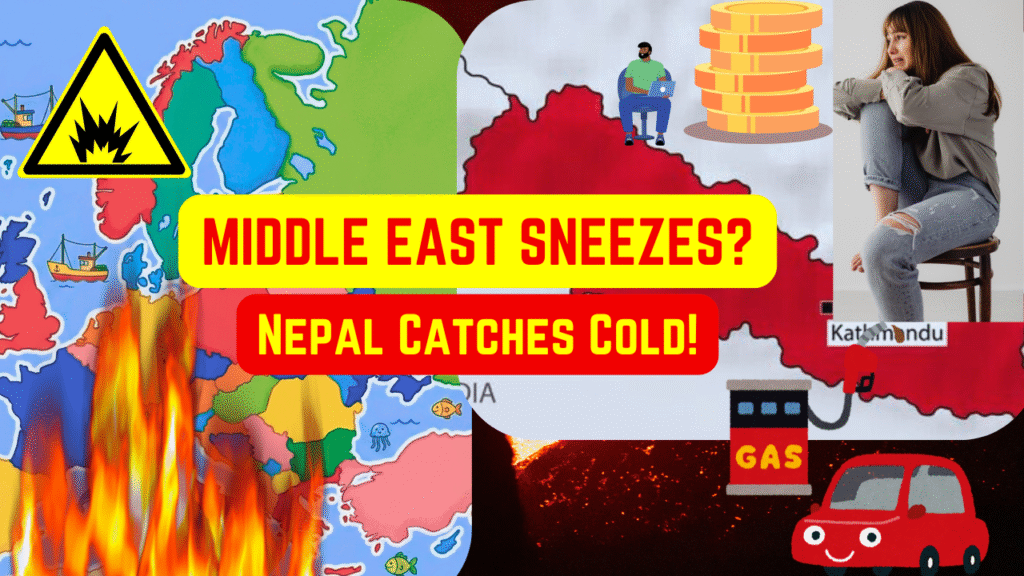
When the Middle East Sneezes, Does Nepal Catch a Cold?
We often focus on Nepal’s bilateral relations with big powers like USA, China and India when we study International Relations.
You might have been thinking a question like “ Conflicts and tensions in the Middle East have been affecting the global economy and international relations. In this context, analyze the impacts of such conflicts on developing countries like Nepal.”
Understanding Middle East Conflicts and Their Ripple Effects on Nepal
As of early March 2026, tensions between Iran, Israel, the US, and Gulf states were increasing, demonstrating that the Middle East’s ongoing conflicts are more than simply distant news headlines. They affect developing countries like ours in both direct and indirect ways.
A Brief Overview of the Current Middle East Crisis
As of March 2026, conflicts in the Middle East have drastically increased. Iran retaliated with missile and drone assaults on Israel and US-allied Gulf nations such the United Arab Emirates, Qatar, Saudi Arabia, Kuwait, Bahrain, and others after Israel and the US began operations against Iran on February 28. One of the primary chokepoints threatened by this battle is the Strait of Hormuz, which transports around 20% of the world’s oil. Additionally, it has blocked airspace and drawn civilian populations. The reaction has been intensified by the death of Iran’s Supreme Leader Ayatollah Khamenei’s wife from injuries, causing extensive damage, casualties, and anxiety in the world economy.
The Core Element: Why Should Nepal Care?
Generally, student might think, “Nepal is landlocked country and it is far away from war region. Why does a missile strike in Israel or in Iran matter to us?”
Your answer lies in 3 linkages:
- The Labor Corridor:- We send thousands of workers there.
- The Import Basket:- The buy our fuel from there.
- The Donor Circuit:- Some part of development budget comes from grants and loans from there.
1 The “Remittance Tsunami” Risk
This is the Socio-Economic Impact and we called it direct and tangible impact. The primary destination for Nepali migrant workers is Middle East i.e, Qatar, Saudi Arabia, UAE, Kuwait and Israel. Around 25 % of GDP is holded by Remittances.
Conflict Impact
- Job Loss and Deportation:- The construction stops when the conflicts start and oil production is disrupted, at last many businesses are shut down. Then the semi-skilled and unskilled labor like Nepali workers are the first to be laid off.
- Stop to New Migration:- New workers are banned for working in war region. Israel and other countries will not open the vacancy for working labor for many months or may be years.
- Safety and Welfare:- Our government must spend diplomatic capital and resources on rescue operations for maintaining the safety of Nepali.
2 The “Fuel and Goods” Inflation Punch
This is the Economic Impact on Nepal because Nepal is a fuel-importing nation.
Conflict Impact
- Rising Oil Prices:- We know that the Middle East is the world’s oil hub. If any one country involves in conflicts, it causes crude oil prices to skyrocket globally which is called Oil Price Shock.
- Imported Inflation:- If the oil prices increases then everything in Nepal becomes more expensive.
# Transportation
Truck freight cost and Bus fares increase.
# Manufacturing
Many Industries use generators or furnace oil. They will also suffer.
# Households
LPG gas costs becomes high. Dairy goods and vegetables price will increase due to increased in transportation costs.
- Supply Chain Disruption:- About 20% of world’s oil passes through the Strait of Hormuz (a narrow strait between Oman and Iran). If it gets blocked, Nepal will face shortage of oil.
3 The “Tourism and Transit” Paralysis
This is called Service Sector Impact. Being Nepal a beautiful country it is heavily reliant on tourism and transit trade.
Conflict Impact
- Tourism Slump:- Long-distance travelers to Nepal use the Middle East as a significant transit hub (via Qatar, Dubai, and Istanbul). Conflict frequently results in flight disruptions, increased insurance costs for airlines, and a general apprehension about visiting the area. Our hotel industry suffers as a result of a decline in visitor arrivals.
- Freight Costs:- During wars, airlines and shipping companies increase the cost of their war-risk insurance. The cost of moving goods across international borders increases as a result. For Nepal, a landlocked country, this exacerbates the situation. Exports like pashmina, apparel, and tea become more expensive and less competitive in the international market, while imports like technology and machinery become more expensive for Nepali consumers and businesses.
4 International Relations: The Diplomatic Tightroper
- Multilateral Forums:- Nepal needs to act morally in the UN. Nepal has historically acknowledged Israel’s right to exist while simultaneously supporting the Palestinian cause. It’s a diplomatic challenge to strike a balance without upsetting either side.
- Bilateral Relations
# With Israel
A labor agreement, technology, and agriculture are the foundation of our developing cooperation. We cannot afford to put this in danger.
# With Arab Nations
Saudi Arabia, the United Arab Emirates, and Qatar are our main labor partners. To avoid upsetting these hosts of our migrant labor, we must carefully coordinate our votes and remarks.
# With Iran
Should the conflict spread to Iran, it would interfere with a potential commerce route via the port of Chabahar, which is connected to India, as well as an alternate source of oil. This is a strategic issue.
5 The “Aid and Development” Slowdown
This is we called Long-term Impact. In case of Nepal World Bank, ADB, and bilateral partners like US, UK, EU are the major donors. Due to conflicts we may suffer from grants and loans.
Conflict Impacts
- Donar Fatigue:- Humanitarian crises and conflict zone reconstruction receive more attention and funding worldwide. Pledged grants and concessional loans to Nepal may be postponed or rerouted.
- Focus Shift:- Security and energy security take precedence over the global development agenda (SDGs), which has an impact on funding for health, education, and climate change in nations like Nepal.
Conclusion
Conflicts in the Middle East directly impact Nepal through rising fuel prices, higher transport costs, inflation, and risks to migrant workers and remittance flows. They also challenge Nepal’s diplomatic balance. To reduce vulnerability, Nepal must strengthen domestic jobs, diversify foreign employment, develop local energy, and expand trade partners, building resilience in an interconnected world.