
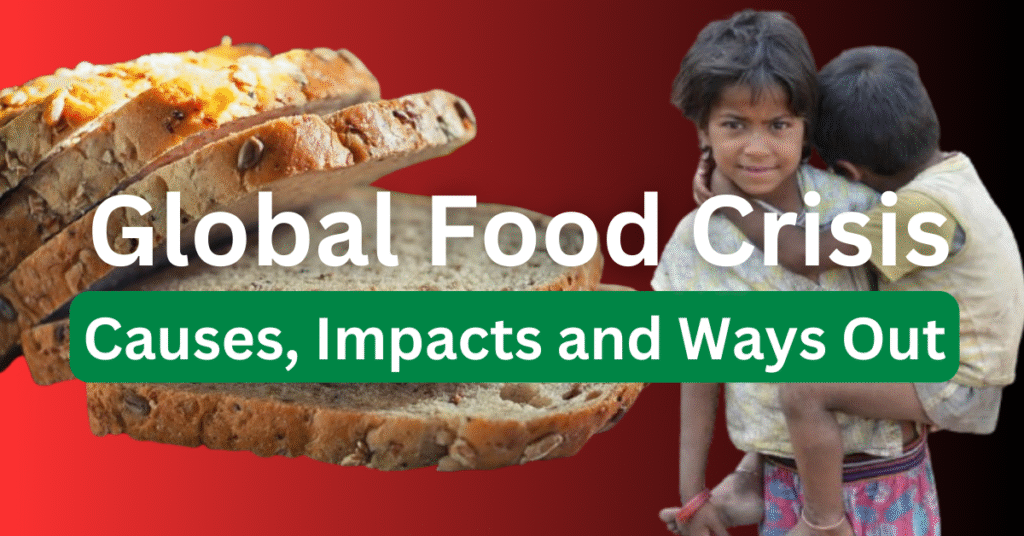
Before entering the topic, some latest facts related to the topic are presented here:
# According to the Global report and crisis (GRFC) 2025, 673 million people faced hunger in 2024, which is about 8.3% of the global population.
# In average, about 733 million people were undernourished in 2023 according to UN reports.
# Approximately, 2.3 billion (28%) people experienced moderate and severe food insecurity in 2024.
# In 2024, over 295 million people across 53 countries and territories experienced acute hunger. This is about 14 million more compared with the previous year 2023. The projection for 2026 suggests this number could rise to 318 million.
# If current trends continue, over 500 million people could still be facing hunger by 2030.
# More than one in five people in Africa faced hunger in 2024.
Background
Only a hungry person knows what hunger is. Hunger doesn’t come alone. It brings many other problems with it. The food crisis has been one of the serious global challenges among human beings. The world’s present population has reached more than 8 billion. Science and Technology has developed everything. People are trying to settle on another planet. On the other hand, millions of people across the earth are struggling for enough food. They, even in the modern era, have faced hunger and malnutrition. They have neither got a well paid job nor sufficient food. Contributing factors of the crisis are population growth, climate change, war and conflict, economic instability, and so on. Several adverse consequences have emerged on the earth: hunger and malnutrition, economic crisis, poverty and inequality, health hazards and vulnerable groups.
Great revolutions across the globe have changed the political systems of different countries. Nearly 10% of the world population is in acute hunger. Almost 30% of people are deprived of sufficient nutritional food. The problem is likely to increase in the upcoming years. Human civilization is getting to its optimum point. The luxurious lifestyle of them has created a vast gap between haves and haves not.
Root causes/Why Food Crisis?
The humans across the globe are unable to feed themselves equally. One of the important drivers of the food crisis is population growth. If the growth continues in this proportion, the gap between population and food stuff is sure to rise. Unlimited property has been invested in the luxurious lifestyle of some people. On the other hand, millions of people have been suffering from hunger, malnutrition and food insecurity. The critical population growth creates extreme pressure on the food system. Due to the rapid urbanization, a large amount of land is occupied. They can’t expand food production. That’s why the large population can’t meet its daily needs.
War or conflict is a pivotal cause of the food crisis. War causes a terrible destruction of infrastructure and property. It generates political instability, weakens governance and breaks the cycle of investment. Affected people are compelled to leave their homes and land. The people lose access to food and other resources. Demands for security or military force are highlighted in comparison of hunger and food security.
Climate change is a significant cause of starvation everywhere. Extreme weather destroys or reduces food production and increases hunger. Increased temperature, irregular rainfalls and melting glaciers cause frequent droughts and floods. That results not only in the decline of crops but also the destruction of farmland.
Deforestation is another serious cause of the food crisis. It begets environmental degradation, landslides, soil erosion, floods and diminishes biodiversity. As a result, useful insects and organisms are reduced slowly and agricultural products are reduced every year.
Poverty has a central role in the food crisis. Poverty is the condition in which people can’t fulfill their demands and are forced to stay hungry. They even don’t have any access to sufficient food and medicine.
Problem – poverty – low purchase power – low products – no personality progress – problem again. Life revolves around in such a vicious cycle. Due to the low and no storage facilities of peasants, large amounts of crops have been wasted in the harvesting place.
Unequal distribution of food and its wastage are other decisive agents of the food crisis. Some people have an oversupply of food stuff while others suffer from extreme food shortage. Millions of people are suffering from acute hunger. It is not only due to the lack of food but it’s due to the unequal distribution systems. Especially, developing countries can’t distribute food equally to needy people of every community. It is because of the lack of infrastructure, storage and other facilities of food supply. The distribution system also depends upon the socio-economic and political systems of the countries.
Food wastage is another determinant factor of food crisis. A large amount of crops is wasted in farmland while harvesting. Some amount is destroyed by pests and insects. Every year a great amount of crops have been swamped and destroyed by landslides, floods and other natural calamities. Similarly, a reasonable amount of food has been wasted in the kitchen and dining of hotels, social events and households as leftovers.
Impacts of food crisis
One of the most devastating impacts of the global food crisis is hunger and malnutrition. A large number of the world’s population is vulnerable to diseases, malnutrition and food insecurity. Fatal diseases like obesity, cardiovascular diseases etc emerge among the people who consume heavy and luxurious food. On the other hand, issues like poor immune system and malnutrition appear among the people who are deprived of enough nutritional food. Both extremes are the deeply rooted black stains of the human race.
The crisis may result in a severe economic pressure, especially in the low income countries. The people of those territories can hardly afford their food with their low income. As a result the needy people can’t have access to healthcare, education and other urgent needs. The governments have very limited budgets for development projects.
The food crisis pushes people into poverty and inequality. Throughout their lives, they continue to spend their total income to relieve their hunger only. This widens the gap between poor and rich society. As a result, poor people are becoming poorer while rich people are richer.
During starvation and food shortages, the price of food reaches the top. This can lead to social unrest and conflict. They struggle their whole lives only to feed their families. This may result in protests and violence. As a result, unrest, conflict, disorder and instability may occur in different societies.
Food shortages also affect education and personality development. It is said that hunger hinders investigation. Hungry children can’t concentrate on learning knowledge and skills. Children’s poor performance and dropout rate from school show the evidence of adverse effects of hunger among people. Therefore, hungry people always lag behind in their studies because they are forced to work. In this way, it is sure that they are likely to lose their future opportunities.
Lack of adequate food causes critical health problems which lead them to poor physical and mental development. This reduces the working capacity and lowers the productivity of the people.
Lack of food – low quality health – less learning skills – lowers productivity – results poor health – always stay poor. Such vicious circles repeat frequently.
Forced migration and displacements are evil effects of global food shortages. When people extremely suffer from hunger, they are compelled to leave their homes in search of better opportunities. The victims of hunger, who are separated just only for their survival, engage in works of low quality environment. Such displaced people face increased risk of poverty and exploitation.
Carelessly wasting food is a serious social crime. On the same mother earth, some people are struggling for a small amount of food whereas others are wasting food resources carelessly and foolishly. Wasting food is not only a matter of carelessness but a matter of morality too. So, the wasting behaviour of some people directly impacts on the vulnerable groups like children, elderly and disabled people, pregnant and breastfeeding women and homeless children.
Ways Out/ How to solve?
Despite the global spread of food shortages, they can be addressed with sustainable policies and international cooperation. Worldwide and selfless cooperation only can maintain food prices and formulate common policies to distribute food impartially in needy areas of the globe.
How much you earn doesn’t matter, how much you save actually matters. Therefore, controlling or reducing food waste is also like producing food. Possibilities of food waste in pre-harvest, during harvest and post-harvest are notable to be considered. Similarly, wastes in the kitchen and dining of households, hotels and social events should be stopped completely through different legal processes and awareness programmes. In urban regions, especially in elite class families and communities, excessive food is consumed and a lot of food is wasted. It is estimated that the wasted food can have fed millions of hungry people of the nearby or other regions. All people throughout the world have to be equal access to food.
A large amount of nourishing leftovers from different hotels, restaurants and social events can be collected and redistributed to elderly people, disabled, homeless children, poor communities and orphanages. Vulnerable groups are benefited through such distribution. Responsible governments and volunteer organizations can play vital roles in such benevolent social works. They can coordinate and collect such unused surplus food and can run orphanages and supply the food to the needy communities. Food substance, the main survival of humans, should be cared for, preserved and respected.
One of the effective ways of solving the food crisis is promoting sustainable agriculture. All the farmers should be equipped with modern farming tools and technologies. They should be provided quality seeds, fertilizers, irrigation and storage facilities. Every disadvantaged community and territories should have the access of experts and qualified manpower. Productive training and awareness programmes should be conducted up to the grassroots level.
One of the effective ways out of the food crisis is to reduce poverty and inequality globally. All the governments should ensure that all people can afford food stuff. For this purpose resources should be distributed equitably, not only equally. The governments should create job opportunities for all needy people. Food subsidies and cash should be provided to disadvantaged people.
Ending conflicts, ensuring political stability and keeping peace and order are the bases for sustainable development and food security. Only a stable government can provide people safety, security and a favourable environment. Such a government can be able to implement policy to support vulnerable people and manage resources. All the citizens can work fearlessly. In this way, a stable and peaceful society can break the cycle of hunger, poverty, and displacement.
Conclusion
In conclusion, the global food crisis is one of the critical issues of the present era. Population growth, war and conflicts, poverty, food waste, unequal food distribution and climate change are the determinant factors of the issue. Above mentioned challenges have created global hunger, malnutrition, fatal diseases, restlessness and disorder in the society, especially in the developing countries, war affected areas and extremely poor territories.
Hunger threatens human dignity and sustainable development. Appalling situations like overall setbacks, forced migration and social instability appear among human civilization. However, the situation is not beyond control. Global food security can be significantly ensured through reducing food waste and redistributing leftovers or food surplus equitably. Sustainable agriculture practices, international cooperation, positive attitudes of individuals and organizations and poverty elimination can play a decisive role against the food crisis. Finally, establishing a positive mindset in consuming food can solve the problem: We should eat to sustain life, not live only to satisfy our appetite.
Let’s shout the slogans!
# Stop wasting, start sharing.
# Don’t live for eating, but eat for living.
# Consume food for survival and health, not for pleasure and luxury.
# A full plate for all.
